
Does your current understanding of New Jersey law provide enough protection to keep you out of legal jeopardy following a self-defense encounter? The transition to the Civilian Carry Assessment and Range Evaluation (CCARE) protocol has introduced significant administrative and technical hurdles for those seeking NJ concealed carry permit training. Between the $200 total application fee and the complexities of the online Firearms Application and Registration System (FARS), it's easy to feel overwhelmed by the state's rigorous mandates. We understand that the shift from legacy qualification standards to the current 50-round live-fire requirement creates genuine anxiety for many applicants.
This guide provides a comprehensive roadmap to mastering the CCARE protocol and fulfilling all New Jersey State Police training requirements through professional, combined certification courses. You'll learn how to obtain the essential S.P. 182 form, achieve the mandatory 80 percent passing score at distances up to 15 yards, and develop a functional grasp of jurisdictional Use of Force laws. By examining the procedural steps of the NJSNRA101 curriculum, we'll prepare you to move beyond a simple certificate toward actual proficiency and total regulatory compliance.
Key Takeaways
- Identify the specific administrative and technical changes introduced by the CCARE protocol to ensure your Permit to Carry application adheres to the most recent state mandates.
- Master the 50-round shooting qualification standards, including the mandatory distances and scoring thresholds required to obtain the S.P. 182 certification form.
- Discern the long-term safety benefits of comprehensive NJ concealed carry permit training compared to expedited qualification-only courses.
- Review the essential gear and documentation checklist, from holster requirements to background check prerequisites, necessary for a successful training session.
- Gain clarity on how the NJSNRA101 course structure fulfills state requirements while building the foundational skills needed for responsible firearm carriage.
Navigating NJ Concealed Carry Permit Training Requirements in 2026
Obtaining a Permit to Carry (PTC) in New Jersey requires strict adherence to administrative procedures and technical proficiency standards. Since the transition to the Civilian Carry Assessment and Range Evaluation (CCARE) protocol, the state has formalized the NJ concealed carry permit training requirements to ensure a uniform level of competency among all permit holders. This protocol replaced previous qualification standards, mandating a specific 50-round live-fire course that tests accuracy at varying distances ranging from three to fifteen yards. For residents in Bergen County and neighboring Rockland County, understanding these shifts is essential to avoid application denials or legal complications arising from non-compliant certification.
The Legal Framework of the NJ PTC
The 2026 New Jersey State Police (NJSP) mandates require that every applicant demonstrates both safe handling and shooting proficiency through a certified instructor. Central to this process is the S.P. 182 form, which serves as the official certification of your training and must be uploaded to the online portal. Relying on "qualification-only" courses often leaves applicants legally vulnerable because these abbreviated sessions may skip critical instruction on New Jersey Gun Laws and the specific Use of Force statutes. Professional instructors act as a bridge between the range and the regulatory system, ensuring that your documentation is technically accurate and legally sound. This administrative precision is vital because even minor errors in the training certification can lead to a rejection of the $200 application fee.
Who Needs This Training?
Whether you're an initial seeker or a renewal applicant, the state's mandates apply with equal weight. Initial permit seekers must complete the full NJSNRA101 curriculum to establish a baseline of proficiency that meets both state and NRA standards. Renewal applicants, whose permits are valid for two years, must also ensure their training records remain current with the latest CCARE standards. This is particularly relevant for individuals living near the border of New Jersey and New York, as out-of-state residents must still meet identical NJSP training criteria to carry within the state. For a comprehensive breakdown of the application sequence, you should consult our guide on How to Get a Concealed Carry Permit in NJ: A 2026 Step-by-Step Guide. Failure to maintain these certifications can result in the immediate expiration of carry privileges, necessitating a complete restart of the application process.
The NJ CCARE Protocol: Understanding the Shooting Qualification Standards
The Civilian Carry Assessment and Range Evaluation (CCARE) protocol represents a rigorous shift in how NJ concealed carry permit training is conducted and assessed. Unlike previous standards that may have allowed for static shooting from a bench, the current protocol demands a dynamic demonstration of marksmanship and safety from a holster. This 50-round live-fire qualification is not merely a suggestion but a legal prerequisite for every applicant seeking to carry a handgun in the state. Understanding the specific strings of fire and scoring mechanisms is vital for anyone preparing for the range portion of their application.
Live-Fire Distances and String Requirements
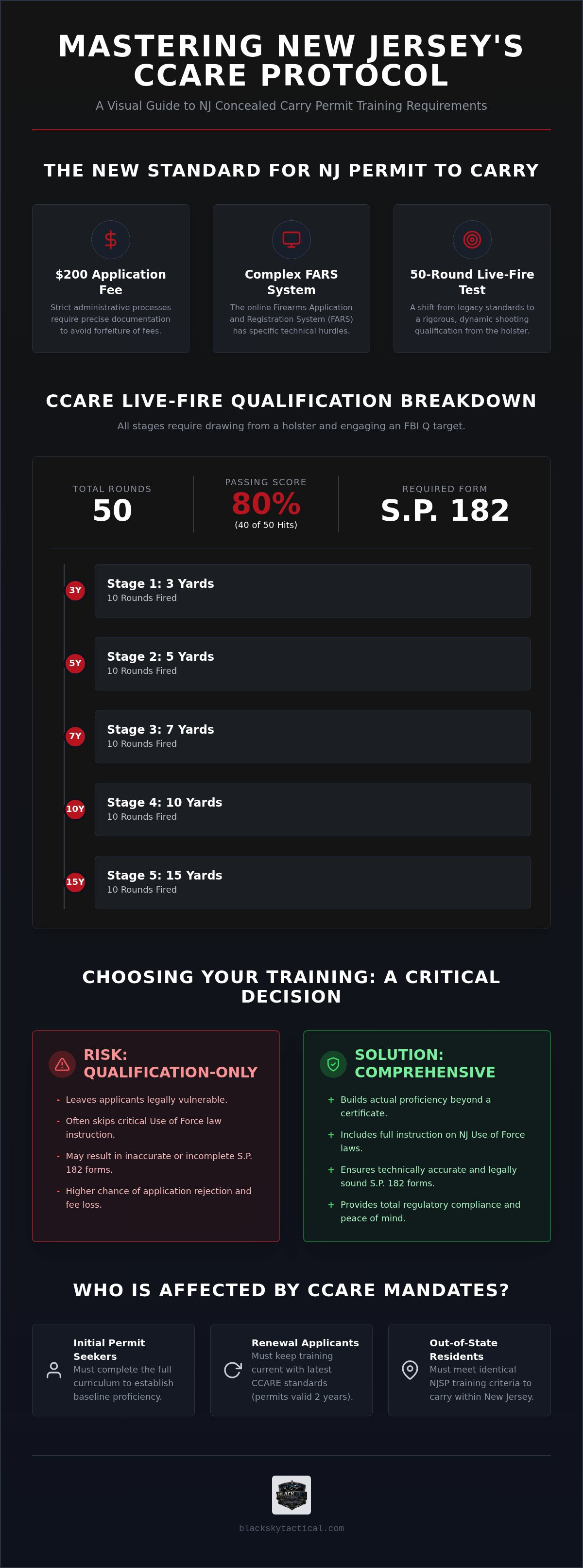
The qualification course is divided into five distinct strings of fire, each consisting of 10 rounds. Shooters must engage the target at distances of 3, 5, 7, 10, and 15 yards. Each string requires the participant to draw from a holster, engage the target within specified timeframes, and demonstrate proper recoil management and trigger control. To successfully complete the evaluation, an applicant must achieve a passing score of 80 percent, which equates to 40 out of 50 hits within the silhouette of a standard FBI Q target. This requirement ensures that permit holders possess the necessary accuracy to mitigate collateral risks in a high-stress environment. For a deeper dive into these technicalities, you may review our guide on the NJ Carry Permit Qualification Course: Mastering the CCARE Protocol.
Holster Proficiency and Safety
A significant portion of the evaluation focuses on the holster draw sequence, which is often where applicants encounter the most difficulty. New Jersey mandates that the holster used during qualification must be a safe, functional design that allows for a clean draw and secure re-holstering. Instructors look for a "safe draw" standard, which includes maintaining a proper grip, keeping the finger off the trigger until the sights are on target, and re-holstering without muzzle-flagging one's own body. Safety violations, such as a finger in the trigger guard during the draw, result in an immediate disqualification. This emphasis on procedural safety is a core component of the New Jersey Concealed Carry Law Overview, which outlines the state's commitment to public safety through strict training mandates. If you are concerned about meeting these standards, our NJSNRA101 combined course provides the structured coaching necessary to refine your draw stroke before the final evaluation.
Common reasons for failure often extend beyond poor marksmanship. Many applicants struggle with equipment malfunctions caused by poorly maintained firearms or using ammunition that is incompatible with their handgun. Others fail due to "anticipation" or "flinching" at the longer 10 and 15-yard distances, where minor technical errors are magnified. To avoid these pitfalls, we recommend a disciplined practice regimen that prioritizes dry-fire drills and holster work under professional supervision. Ensuring your equipment is in peak condition and your fundamentals are sound will provide the confidence needed to clear the 40-hit threshold on your first attempt.
Evaluating Training Options: Qualification vs. Comprehensive Proficiency
Choosing the right provider for NJ concealed carry permit training involves a critical distinction between a mere shooting test and a comprehensive educational experience. Many regional facilities offer "Quick Qual" sessions, which typically function as a three-hour evaluation window without formal instruction. While these may appeal to those seeking speed, they often fail to address the technical nuances of the CCARE protocol, particularly the holster draw sequence. For the responsible citizen, proficiency is not a binary state achieved by a certificate, but a continuous process of skill refinement that begins with a solid instructional foundation.
The Advantage of the NJSNRA101 Combined Class
The NJSNRA101 curriculum, offered by Black Sky Tactical, integrates the NRA Basic Pistol course with the mandatory New Jersey State Police (NJSP) requirements. This combined approach serves as a professional briefing that covers more than just marksmanship. By synthesizing foundational safety with jurisdictional mandates, students gain exposure to malfunction clearing, administrative handling, and a defensive mindset. This structure is particularly beneficial for residents in Bergen County who may also seek out-of-state permits, as the NRA certification is a widely recognized standard across multiple jurisdictions. Even experienced shooters find value in this methodical environment; it provides a necessary audit of their mechanics to ensure they meet the 80 percent accuracy threshold under the specific pressures of the CCARE strings. Many long-term owners have never been formally evaluated on a holster draw, and the structured feedback of a certified instructor is often the difference between a successful qualification and an administrative failure.
Legal and Use of Force Education
In New Jersey, the physical ability to hit a target is secondary to the legal judgment required to decide when to employ force. The classroom component of our combined course prioritizes a meticulous review of the state's statutes regarding self-defense. Understanding these regulations is essential to avoiding legal jeopardy, as the state maintains some of the most stringent restrictions on firearm carriage in the country. For a detailed analysis of these requirements, you may refer to our guide on NJ Concealed Carry Permit Laws: A Comprehensive 2026 Guide to Compliance. This theoretical knowledge ensures that permit holders are as proficient in their legal obligations as they are with their equipment. This synthesis of skill and law bridges the gap between technical shooting and the administrative responsibility of carrying a firearm in public spaces.
Preparation Checklist: Gear and Administrative Requirements
Success in NJ concealed carry permit training requires more than physical marksmanship; it demands meticulous preparation of both your equipment and your administrative credentials. Before you arrive at the range, you must confirm that your Firearms Purchaser Identification Card (FID) is active and that your background check status aligns with current New Jersey State Police (NJSP) standards. Residents of Bergen County, as well as those commuting from Westchester or Rockland, should verify their jurisdictional requirements, as out-of-state applicants follow a specific path through the non-resident application process. Meticulous preparation prevents the administrative delays that frequently plague incomplete applications.
Range Gear Essentials
Your choice of equipment directly impacts your ability to meet the CCARE protocol standards. While New Jersey permits both semi-automatic pistols and revolvers, you must ensure your firearm complies with the state's 10-round magazine capacity limit. For the qualification, you'll need a high-quality holster, either Inside the Waistband (IWB) or Outside the Waistband (OWB), that provides sufficient retention and covers the trigger guard completely. Safety is paramount during the draw sequence, so you should avoid "universal" or soft nylon holsters that may collapse or impede a secure re-holstering. We recommend bringing at least 150 rounds of ammunition; this provides 50 rounds for the official qualification and 100 rounds for warm-up strings and potential re-tests. Using the same ammunition for training that you intend to use for the qualification ensures consistent ballistic performance.
Post-Course Administrative Steps
Upon successful completion of the live-fire evaluation, your instructor will provide the S.P. 182 certification form. This document is the definitive proof of your proficiency and is the most critical component of your application. You must ensure that the form is the most current version approved for 2026 before uploading it to the Firearms Application and Registration System (FARS) portal. A common pitfall in the online application process is the submission of low-resolution scans or incorrect file formats, which can lead to administrative rejections. Accuracy in the digital submission phase is just as vital as accuracy on the firing line.
Once your documentation is uploaded, you'll be required to settle the application fees, which currently total $200. This is comprised of a $50 fee paid to the NJSP and a $150 fee paid to your local municipality. Approval timelines in the 2026 landscape vary by jurisdiction, but meticulous attention to detail during the portal submission phase can prevent unnecessary setbacks. If you have questions about the administrative sequence, register for our NJSNRA101 combined course to receive a full professional briefing on the FARS portal requirements alongside your tactical training.
Secure Your NJ Permit to Carry with Black Sky Tactical
Black Sky Tactical operates as a disciplined bridge between the private citizen and the complex regulatory requirements of the New Jersey State Police. Our approach to NJ concealed carry permit training is rooted in the belief that a Permit to Carry is a professional responsibility rather than a mere administrative achievement. Through the NJSNRA101: Combined NJS Conceal Carry + NRA Basic Pistol Class, we provide a structured environment where students can fulfill state mandates while developing the foundational marksmanship skills required for safe carriage. Our facility is strategically positioned to serve residents of Bergen, Rockland, and Orange counties, offering a centralized location for those navigating the jurisdictional overlap of the tri-state area.
Expert Instruction in Bergen County
Our instructors bring extensive backgrounds in tactical and safety training, ensuring that every session functions as a meticulous briefing on both technical mechanics and legal obligations. We prioritize transparency regarding the limits of civilian authority, helping students understand the high-stakes nature of the CCARE protocol. This commitment to meticulous compliance ensures that when you receive your S.P. 182 form, it represents genuine proficiency rather than a shortcut through the system. By maintaining a serious and grounded instructional environment, we prepare you for the administrative scrutiny of the NJSP portal and the physical demands of the range. You can view our current schedule and secure your placement through our professional registration portal to begin the process of state-mandated certification.
Beyond the Permit: Defensive Skill Building
Achieving the 80 percent passing score on the FBI Q target is a necessary legal milestone, yet it shouldn't be viewed as the conclusion of your tactical education. Responsible carriage requires a commitment to ongoing skill building that exceeds the minimum standards set by the state. For those seeking to advance their capabilities beyond the initial qualification, we offer Defensive Pistol Training NJ, which focuses on real-world applications and heightened situational awareness. This progression from basic qualification to defensive proficiency ensures that you remain prepared for the complexities of a self-defense encounter while maintaining strict adherence to the law. To take the first step toward fulfilling your legal requirements with a professional, combined curriculum, Register for the NJSNRA101 Combined Course and secure your path to lawful carry.
Advancing Your Path to Lawful Carry in New Jersey
Achieving a Permit to Carry in 2026 demands a disciplined approach to both technical marksmanship and administrative compliance. The transition to the CCARE protocol has established a rigorous standard that requires every applicant to demonstrate proficiency from a holster while maintaining a passing score of 80 percent. By prioritizing a combined curriculum, you ensure that your NJ concealed carry permit training provides the necessary depth of instruction to navigate the NJSP portal effectively and understand the state's stringent Use of Force laws.
Black Sky Tactical provides the NJSP-compliant S.P. 182 certification and integrated NRA Basic Pistol qualification required for a successful application. Our instructors specialize in serving residents across Bergen, Rockland, and Orange Counties with a focus on meticulous legal adherence and student safety. Register for your NJSNRA101 Combined Carry Course to secure your certification and establish a foundation of responsible, professional firearm carriage. We're prepared to assist you in meeting these critical state mandates with professional assurance.
Frequently Asked Questions
What is the current NJ carry permit qualification course in 2026?
The Civilian Carry Assessment and Range Evaluation (CCARE) protocol is the mandatory standard for all applicants in 2026. This protocol replaced previous interim standards to establish a uniform demonstration of proficiency across the state. Every applicant must complete this specific course of fire under the supervision of a certified instructor to obtain the necessary S.P. 182 certification form for their application.
How many rounds are required for the NJ CCARE shooting test?
The CCARE shooting test requires a total of 50 rounds fired at five different distances. These strings of fire consist of 10 rounds each at 3, 5, 7, 10, and 15 yards. To pass the evaluation, you must achieve a minimum score of 80 percent, which means at least 40 of your 50 shots must land within the silhouette of a standard FBI Q target.
Does the NJ carry permit training include the Use of Force classroom portion?
Yes, comprehensive NJ concealed carry permit training must include a classroom component focused on the state's Use of Force statutes. This briefing covers the legal justifications for using deadly force and the mandatory duty to retreat in New Jersey. Understanding these laws is essential for avoiding legal jeopardy, as the administrative requirements for carrying a firearm are strictly tied to your legal knowledge.
Can NY residents get a NJ concealed carry permit?
New York residents are eligible to obtain a New Jersey Permit to Carry by following the non-resident application process. The training requirements and shooting qualification standards remain identical to those for New Jersey residents. Non-residents must submit their applications through the New Jersey State Police portal and typically select the barracks closest to their residence or place of business for administrative processing.
Is the NRA Basic Pistol certificate required for the NJ PTC?
The NRA Basic Pistol certificate isn't explicitly mandated by state law, but it's a highly recommended prerequisite that many professional instructors include in their curriculum. Programs like the NJSNRA101 combine this foundational safety course with the mandatory CCARE protocol. This structure ensures that applicants possess a thorough understanding of firearm mechanics and safety before they attempt the high-stakes live-fire qualification required by the state.
What happens if I fail the NJ carry permit qualification?
If you fail to meet the 80 percent accuracy threshold, you won't receive the S.P. 182 certification and must attempt the qualification again. Most professional training providers will require you to complete remedial coaching to address specific technical deficiencies before a re-test. It's common for applicants to struggle with the 15-yard string, so additional practice at longer distances is often necessary to ensure a successful evaluation.
How long is the NJ concealed carry permit training valid for?
Training certifications are generally valid for two years, which aligns with the standard expiration cycle of the Permit to Carry. You're required to re-qualify and demonstrate continued proficiency with the latest CCARE standards during each renewal period. Staying current with these mandates is vital because the New Jersey State Police may update administrative forms or shooting protocols between your initial application and your renewal date.
Do I need to bring my own firearm and holster to the class?
You should bring the specific handgun you intend to carry, along with a safe, functional holster that complies with CCARE safety standards. Completing your NJ concealed carry permit training with your own equipment ensures that your proficiency is based on the actual gear you'll use daily. You must also bring at least 150 rounds of ammunition to cover the qualification strings and any necessary practice rounds during the session.


