
Obtaining a New Jersey Permit to Carry in 2026 is no longer just about basic firearm safety; it's a rigorous administrative and tactical process that leaves zero room for procedural error. You're likely aware that the transition to the mandatory Civilian Carry Assessment and Range Evaluation (CCARE) protocol, alongside the multi-step NJSP online portal, has added layers of complexity for those seeking an NJ permit to carry class Bergen County. This increased regulatory scrutiny requires a disciplined approach to both legal education and marksmanship.
This guide provides the clarity you need to manage these state mandates, focusing on how professional training can bridge the gap between initial confusion and full certification. We'll examine the specific requirements of the NJSNRA101 curriculum, which combines NRA fundamentals with state-specific protocols, and the linear path to securing your permit through current jurisdictional systems. By understanding the intersection of firearm safety and New Jersey's strict Use of Force standards, you'll approach your qualification with the calm assurance that comes from meticulous, compliant preparation.
Key Takeaways
- Understand the 2026 NJSP CCARE protocol and the specific shooting distances required to meet New Jersey’s standardized qualification mandates.
- Learn how the NJSNRA101 course integrates NRA Basic Pistol fundamentals with state-specific tactical requirements for a comprehensive training foundation.
- Prepare for the 50-round live-fire assessment, including the mandatory holster draw safety protocols and technical proficiency standards.
- Navigate the Bergen County application process by identifying the exact documentation and certification needed for the NJSP online portal.
- Discover why selecting a professional NJ permit to carry class Bergen County is essential for ensuring strict adherence to current Use of Force regulations.
Understanding the NJ Permit to Carry (PTC) Landscape in Bergen County
A New Jersey Permit to Carry (PTC) represents a formal authorization issued to individuals who demonstrate a high level of responsibility, legal knowledge, and marksmanship. Under current state mandates, obtaining this permit requires the successful completion of a comprehensive training program that includes both classroom instruction and a live-fire qualification. For residents seeking an NJ permit to carry class Bergen County, this certification is the foundational requirement for the official application. This process is governed by a strict regulatory framework, which you can explore in detail through a New Jersey Gun Laws Overview, ensuring that all applicants adhere to uniform safety standards across the state.
The Shift to CCARE Standards in 2026
The implementation of the Civilian Carry Assessment and Range Evaluation (CCARE) protocol in 2026 solidified a standardized approach to firearm training. This protocol replaced previous, less uniform standards to ensure that every permit holder possesses a documented understanding of the New Jersey Use of Force policy. The classroom portion of the training is not merely a suggestion; it's a legal obligation that covers the specific conditions under which force may be justified. Standardized training provides a level of legal protection for the permit holder, as it establishes that the individual has been formally educated by certified instructors on the boundaries of jurisdictional law.
Bergen County Jurisdictional Nuances
While the New Jersey State Police (NJSP) maintain the online application portal, local Bergen County law enforcement agencies play a critical role in the background investigation and approval process. Whether you reside in Hackensack, Paramus, or Ridgewood, your local police department is responsible for reviewing your submission and collecting the $150 local portion of the $200 total application fee. The transition from court-issued permits to police-issued permits has streamlined some aspects of the process, yet it places a greater emphasis on the accuracy of the training certificates provided by the applicant. Your specific municipality of residency dictates which department will handle your file, making it essential to coordinate with local officials once your training is complete.
Professional certification through a recognized program is the only viable starting point for this multi-step journey. Without a training certificate that explicitly meets the 2026 CCARE standards, an application will be rejected by local authorities, leading to administrative delays and potential forfeiture of fees. Maintaining a disciplined focus on these requirements ensures that your path to an NJ permit to carry class Bergen County is based on strict compliance and verified proficiency.
The NJSNRA101 Course: Integrating NRA Fundamentals with NJ Mandates
The NJSNRA101 program is designed for those who recognize that carrying a firearm involves more than just passing a shooting test. It integrates two distinct but complementary certifications to meet the state's 18-hour training mandate. By choosing this NJ permit to carry class Bergen County, applicants receive a dual-purpose education that satisfies both foundational safety needs and specific legal requirements. This combined curriculum ensures that every participant exits the course with the certificates necessary to satisfy local law enforcement and the state police.
NRA Basic Pistol: The Foundation of Handgun Safety
Before addressing the tactical complexities of concealed carry, a shooter must master the mechanical operation of their firearm. The NRA Basic Pistol Shooting Course provides this essential groundwork. Participants study pistol mechanics, various ammunition types, and the five core fundamentals of marksmanship: aiming, breath control, hold control, trigger control, and follow-through. This national standard ensures that residents have a recognized certification that remains valid beyond the state's borders, providing a level of proficiency that is required before advancing to the CCARE live-fire qualification.
NJ-Specific Carry Instruction
The second half of the curriculum shifts focus to the legal and administrative obligations unique to New Jersey. We provide a rigorous analysis of N.J.S.A. 2C:3-1, the statute governing the justifiable use of force. Understanding these legal boundaries is vital for anyone carrying in public spaces. The course also outlines the current list of "Sensitive Places" where carry is strictly prohibited, such as schools, government buildings, and parks. When you eventually log into the NJ FARS Application Portal to submit your documents, you'll do so with the confidence that your training certificate reflects a complete understanding of these regulations.
Classroom modules also cover situational awareness and the practicalities of safe storage. Instructors provide specific guidance on how to interact with law enforcement while carrying, which is a critical skill for maintaining professional decorum during traffic stops or other official encounters. This methodical approach ensures that you aren't just checking a box, but are developing the tactical proficiency necessary to carry responsibly. If you're ready to enroll in a comprehensive NJ permit to carry class Bergen County, you can view our upcoming course schedule to secure your seat and begin the certification process.
NJSP CCARE Shooting Standards and Qualification Requirements
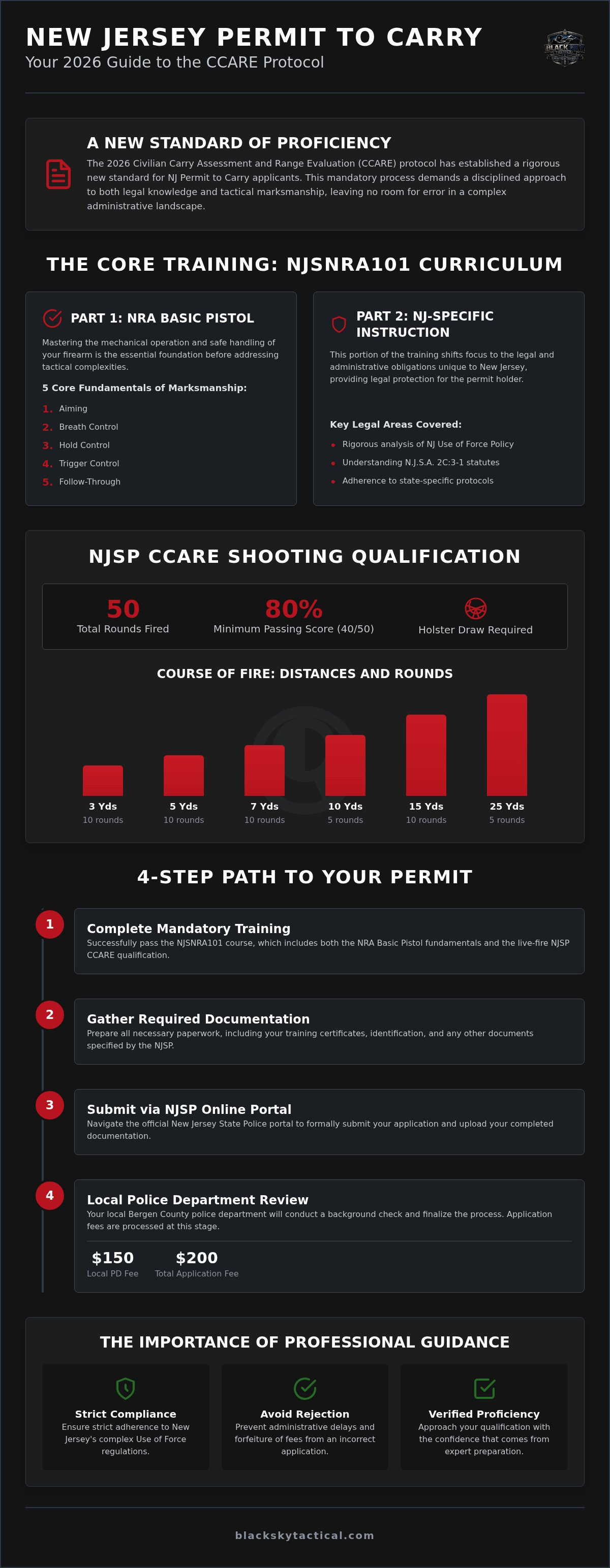
The range portion of the NJSNRA101 course is where theoretical safety is translated into measurable proficiency. This assessment follows the 2026 NJSP CCARE protocol, which is a standardized 50-round course of fire designed to evaluate a shooter's ability to engage targets accurately from various distances while maintaining strict safety standards. For those attending an NJ permit to carry class Bergen County, this live-fire qualification is the primary technical hurdle before submitting documentation through the Official NJSP Permit to Carry Application portal. It's a high-stakes evaluation that requires both mental discipline and mechanical consistency.
Technical Breakdown of the Course of Fire
The CCARE protocol consists of five distinct strings of fire, each requiring 10 rounds to be discharged. Shooters begin at the 3-yard line, followed by stages at 5, 7, 10, and 15 yards. Each distance presents unique challenges regarding sight picture and trigger control, especially as the distance increases to the 15-yard mark where fundamentals are most tested. The pass threshold for the CCARE protocol is 80% or 40 out of 50 rounds on target. Scores are recorded on a standardized silhouette target, typically the FBI Q-target or an equivalent approved by the NJSP, where only hits within the designated scoring area are counted toward the final grade.
Holster Proficiency and Safety
A critical component of the 2026 standards is the requirement for a holster draw. Applicants must demonstrate the ability to safely draw their firearm from a strong-side hip holster, which can be either an Inside the Waistband (IWB) or Outside the Waistband (OWB) configuration. Cross-draw, shoulder, or ankle holsters are strictly prohibited during the qualification due to the inherent safety risks associated with muzzle direction during the draw stroke. This tactical requirement ensures that permit holders can access their equipment under stress without endangering themselves or bystanders. You can find more details on achieving PTC compliance in our NJ Concealed Carry Permit Training resource.
Participants must bring a functional, clean firearm and a minimum of two magazines to the range. While the state doesn't mandate a specific caliber beyond what's legal for carry, the firearm used during the NJ permit to carry class Bergen County should be the primary handgun the applicant intends to carry. All equipment, including the holster and magazine pouches, will be inspected by instructors to ensure compliance with safety mandates before the course of fire begins. This meticulous attention to gear ensures that mechanical failure doesn't interfere with the qualification process, allowing the shooter to focus entirely on the strings of fire.
The Step-by-Step Application Process for Bergen County Residents
The administrative phase of securing a permit begins immediately following the successful completion of your NJ permit to carry class Bergen County. This transition from the range to the application portal requires meticulous attention to detail to avoid the technical rejections that often delay applicants. By following a linear, step-by-step approach, residents can ensure their submission meets the high standards of both the New Jersey State Police and local municipal departments. It's not just about passing the test; it's about providing a flawless record of your eligibility and training.
Documentation and Fingerprinting
Upon passing the NJSNRA101 course, you'll receive your training certification and the essential SP-182 form, which documents your proficiency with specific firearms. These documents are a prerequisite for the online portal. Simultaneously, you must schedule a fingerprinting session through IdentoGO, ensuring you use the specific service code for a Permit to Carry application. Failure to use the correct code will result in a background check that local departments cannot accept. You'll also need to identify four reputable references who are not related to you by blood or marriage. These individuals will receive an automated questionnaire via email, so it's vital to confirm their availability and willingness to respond promptly to avoid stalling your file.
Bergen County Submission Logistics
The online application requires your town's specific Originating Agency Identifier (ORI) number. Whether you're applying in Hackensack, Paramus, or Teaneck, using the correct ORI ensures your application is routed to the correct local police chief for review. During the submission, you'll be required to pay a total application fee of $200, which is split into a $50 payment to the New Jersey State Police and a $150 payment directly to your local police department. This dual-payment structure is a mandatory part of the digital filing process.
Once submitted, the processing window typically spans between 60 and 90 days, though this can vary based on the volume of applications within your specific municipality. During this time, the local department conducts a thorough background investigation and may contact you for an interview to clarify details of your submission. The final issuance will be a digital permit, though some departments may still provide a physical card. It's your responsibility to maintain a copy of this digital credential on your mobile device or as a printed document while carrying. To ensure your application is backed by the most rigorous training available, enroll in our NJSNRA101 course to secure your certified SP-182 and begin the process.
Why Black Sky Tactical is the Professional Choice for Bergen County
Choosing an NJ permit to carry class Bergen County is a decision with long-term legal and safety implications. Black Sky Tactical positions itself as a bridge between complex state mandates and the individual's need for tactical proficiency. Our instructors possess deep knowledge of both New Jersey and New York jurisdictional requirements, which is essential for residents in northern New Jersey who frequently cross state lines. This expertise ensures that your training is grounded in the specific legal realities of the tri-state area.
We maintain small class sizes to ensure that every participant receives meticulous attention during the range and classroom portions of the program. This isn't a high-volume certification mill. Instead, we focus on the professional responsibility inherent in carrying a firearm. Our support extends beyond the range, providing clarity on the administrative hurdles discussed in previous sections. We help you ensure your documentation is accurate before you engage with local law enforcement in your specific municipality.
A Disciplined Approach to Tactical Education
We prioritize tactical proficiency over simple range time. While many programs focus solely on meeting the minimum score for the CCARE qualification, we emphasize the mindset required for responsible carry in high-density areas like Bergen County. Local residents who've successfully obtained their PTC through the NJSNRA101 program frequently cite our focus on legal sobriety as the most valuable aspect of their training. This disciplined environment prepares you for real-world scenarios where split-second decisions must align with strict state laws. We don't just teach you how to shoot; we teach you when the law permits it.
Beyond the Initial Permit
A Permit to Carry is valid for two years, but tactical skills and legal knowledge require constant maintenance. We offer continued education opportunities, including Private Firearm Training and Violent Incident Command Training, to help permit holders advance their skills beyond the basic requirements. Regular requalification and skill maintenance are not just legal suggestions; they're professional obligations for any responsible carry advocate. Maintaining proficiency ensures that your response to a threat remains effective, controlled, and legally defensible over the long term.
If you're ready to commit to a program that prioritizes safety, compliance, and expert instruction, Register for your NJSNRA101 Combined Class today and secure your path to professional certification.
Secure Your Professional Certification for 2026
Successfully navigating the New Jersey carry requirements requires a disciplined approach to both technical proficiency and administrative accuracy. The transition to 2026 CCARE standards has established a uniform benchmark for marksmanship and legal understanding that every applicant must meet. By completing a comprehensive 18-hour curriculum, you ensure that your training certificate satisfies the rigorous review of local Bergen County law enforcement and the New Jersey State Police. This methodical preparation isn't just about passing a test; it's about establishing a foundation of legal sobriety and tactical skill.
Securing a seat in an NJ permit to carry class Bergen County is the essential first step toward obtaining your permit through the current state portal. Our instructors provide the expert guidance necessary to bridge the gap between basic safety and the complexities of jurisdictional carry laws. With your certification in hand, you can approach the application process with the calm assurance that your training meets every state mandate. We invite you to Enroll in the NJSNRA101 Combined Conceal Carry & NRA Class to begin your certification journey with professional oversight. Taking this disciplined path ensures you're prepared for the serious responsibilities of carrying in public spaces.
Frequently Asked Questions
What is the NJSP CCARE qualification and how is it different from the old standards?
The Civilian Carry Assessment and Range Evaluation (CCARE) protocol replaced the previous HQC2 standard to establish a uniform 50-round course of fire. It includes strings of fire at distances of 3, 5, 7, 10, and 15 yards. Unlike previous iterations, it mandates a holster draw from a strong-side hip holster to ensure tactical proficiency. This protocol ensures that every applicant meets a specific, documented level of competency before a permit is issued.
How many hours of training are required for a NJ Permit to Carry in 2026?
New Jersey law requires a total of 18 hours of instruction for initial permit applicants in 2026. This comprehensive requirement is fulfilled by our NJSNRA101 course, which integrates the NRA Basic Pistol curriculum with state-mandated legal and tactical modules. This duration ensures that participants have sufficient time to absorb the complex Use of Force statutes and demonstrate the necessary marksmanship proficiency on the range under the direct supervision of certified instructors.
Do I need to own my own firearm to take the NJ permit to carry class in Bergen County?
While owning a firearm is not a strict prerequisite for the classroom portion, the NJSP requires that you qualify with the specific handgun you intend to carry. For the NJ permit to carry class Bergen County, it's highly recommended that you use your own equipment to ensure familiarity with the firearm's mechanics and holster fit. If you don't yet own a firearm, we recommend consulting with our instructors regarding the purchase of a compliant model.
Does the NJSNRA101 course include the mandatory Use of Force training?
Yes, the NJSNRA101 curriculum explicitly includes the mandatory classroom instruction on the New Jersey Use of Force policy as outlined in N.J.S.A. 2C:3-1. This module is a critical component of the 18-hour training requirement and covers the legal parameters of self-defense, the duty to retreat, and the specific conditions under which force is justified. Understanding these legal boundaries is essential for maintaining full compliance with the current state mandates and administrative regulations.
Is the NJ Permit to Carry valid in other states like New York or Pennsylvania?
A New Jersey Permit to Carry a Handgun does not currently have formal reciprocity with New York or Pennsylvania. Each of these jurisdictions maintains its own strict permitting processes and doesn't recognize out-of-state permits for the purpose of carrying a concealed weapon. Residents who frequently travel across state lines should consider obtaining separate non-resident permits for those specific jurisdictions to ensure they remain in full compliance with all local and state firearm laws.
What happens if I fail the shooting qualification portion of the class?
If an applicant fails to achieve the required 80% passing score on the 50-round CCARE qualification, they are generally permitted to retake the shooting portion after additional practice. Our instructors provide specific feedback on technical errors, such as poor trigger control or improper sight alignment, to help the student improve. However, a training certificate can only be issued once the student demonstrates the mandatory proficiency standards required by the official NJSP protocol during a live-fire session.
How often do I need to renew my NJ Permit to Carry and my training certification?
A New Jersey Permit to Carry is valid for a period of two years from the date of approval. You must submit a renewal application through the NJSP online portal up to four months before your current permit expires. Renewal applicants are required to provide a current training certificate that demonstrates continued proficiency with the CCARE protocol. This ensures that their tactical skills and legal knowledge remain consistent with the most recent state standards and safety requirements.
Can residents of Bergen County apply for a non-resident New York concealed carry permit through your classes?
Yes, our NYSNRA101 course is specifically designed to meet the 18-hour training requirements for the New York concealed carry permit. Because Black Sky Tactical operates in Rockland County, we have extensive experience assisting residents with the multi-jurisdictional complexities of carrying in both states. Taking an NJ permit to carry class Bergen County alongside our NY-compliant modules is an efficient way for local residents to secure legal carry authorization across state lines.


