Under the strict regulatory frameworks of New York and New Jersey, the path to legal firearm possession is no longer a matter of simple application but a rigorous process of certified education. You likely recognize that meeting the 18-hour training mandate for a concealed carry permit feels like an overwhelming administrative hurdle, especially when managing the specific classroom and live-fire requirements of your local county. It's common to feel a sense of professional urgency to get this right, as any error in your certification can lead to significant delays or denials in the permitting process. The NRA basic pistol shooting course serves as the essential technical foundation for this journey, providing the standardized safety training that state authorities demand while establishing the proficiency necessary for responsible ownership.
This guide provides a comprehensive overview of the curriculum and the certification process, detailing exactly how these hours contribute to your legal eligibility. We'll examine the specific procedural steps required to fulfill the mandates for Rockland, Orange, Westchester, and Bergen counties, ensuring you move from a state of uncertainty to one of documented compliance and fundamental shooting proficiency.
Key Takeaways
- Understand how the NRA curriculum provides the essential technical grounding required for safe firearm handling and subsequent state-level certifications.
- Identify the five core instructional modules, ranging from safety protocols to maintenance, that form the basis of the NRA basic pistol shooting course.
- Learn how to efficiently satisfy the 18-hour training mandate for New York and New Jersey CCW permits by integrating NRA standards with state-specific legal requirements.
- Evaluate the procedural differences between traditional instructor-led training and blended learning formats to determine which logistical path best suits your professional schedule.
- Discover how the NYSNRA101 and NJSNRA101 combined programs streamline the permitting process by consolidating multiple certification requirements into a single, professional syllabus.
What is the NRA Basic Pistol Shooting Course?
The NRA basic pistol shooting course is the foundational framework for civilian firearm education in the United States. It provides a standardized instructional model that prioritizes safety, mechanical proficiency, and the development of a responsible mindset. Unlike informal training sessions, this course adheres to a strict syllabus that ensures every student receives identical, high-quality information regardless of where the training takes place. This consistency is why many licensing agencies and jurisdictional authorities recognize the program as the primary standard for safety certification.
Completion of the program is not merely a suggestion for many; it's a procedural necessity. In many states, including the complex regulatory environments of New York and New Jersey, this specific curriculum serves as a critical component for obtaining a concealed carry permit. The course structure is designed to be comprehensive, requiring participants to engage in both formal classroom instruction and a supervised live-fire range session. This dual-phase approach ensures that theoretical knowledge of firearm mechanics and safety rules is immediately reinforced through practical application under the guidance of a certified instructor. Safe handling is mandatory. The curriculum ensures that every participant adheres to a rigorous set of safety protocols before they ever discharge a round.
The History and Authority of NRA Training
The National Rifle Association (NRA) has established the benchmarks for civilian firearm training for over a century. This long-standing history provides a level of institutional authority that is widely respected by law enforcement agencies and state licensing boards. When a student presents an NRA certificate, it signifies that they've met a specific, rigorous standard of safety and proficiency. Certified instructors are the backbone of this system, undergoing their own intensive training and evaluation processes to maintain the high instructional quality that the organization demands. This oversight ensures that the NRA basic pistol shooting course remains relevant and compliant with evolving safety standards.
Who Should Enroll in This Course?
The program is intentionally inclusive, catering to various levels of experience while maintaining its rigorous standards. It's an ideal entry point for several types of individuals:
- First-time gun owners: Individuals who have never handled a firearm and require a sober, safe introduction to pistol operation and storage.
- Permit applicants: Residents of Rockland, Orange, Westchester, or Bergen counties who must satisfy mandatory training requirements for their CCW applications.
- Experienced shooters: Those who possess practical skills but lack formal certification for insurance purposes, administrative prerequisites, or legal documentation.
The course ensures that every participant, regardless of their starting point, leaves with a disciplined understanding of the responsibilities inherent in firearm ownership. It functions as a bridge between curiosity and competent, legal possession.
Core Curriculum: What You Will Learn
The instructional design of the NRA basic pistol shooting course utilizes a building-block approach to ensure that technical skills are developed on a foundation of absolute safety. This program is structured into five distinct modules that move the student from theoretical knowledge to practical range proficiency. By following this incremental path, the course ensures that participants don't merely memorize facts but internalize the habits necessary for responsible firearm ownership. Students can verify the curriculum standards by reviewing the NRA's official course catalog, which lists the authorized modules for this program.
Module 1: Gun Safety and Pistol Mechanisms
The 'Four Rules of Safe Gun Handling' dictate that one must always keep the firearm pointed in a safe direction, keep the finger off the trigger until ready to shoot, keep the gun unloaded until ready for use (the Baldwin Rule), and know your target and what’s beyond. Beyond these core rules, students receive a detailed breakdown of pistol components, including the frame, slide, barrel, and the intricate workings of the trigger assembly and magazines. Understanding the mechanical differences between semi-automatic pistols and revolvers is critical for safe operation. We examine how different action types function, specifically focusing on the procedural differences between Single Action systems, where the hammer must be cocked, and Double Action systems, where the trigger pull both cocks and releases the hammer.
Module 2: Fundamentals of Pistol Shooting
Precision shooting relies on a series of physical and mental disciplines that must be coordinated perfectly. Students learn to master the proper high-tang grip and a stable shooting stance, such as the Isosceles or Weaver positions, to manage recoil effectively. The curriculum covers the science of sight alignment, where the front and rear sights are positioned relative to each other, and the sight picture, which is the placement of those aligned sights on the target. To ensure accuracy, instructors provide guidance on trigger control and breath management techniques. These methods are designed to prevent 'flinching' or anticipation, which are common errors that pull a shot off-target at the moment of discharge.
Module 3: Range Protocols and Live Fire
The final phase of instruction transitions to the range, where administrative procedures and safety protocols are strictly enforced. Students must demonstrate their understanding of range commands like "cease fire" and "load and make ready" before handling live ammunition. This module provides a step-by-step guide to loading, firing, and unloading the pistol under direct supervision. A significant portion of this training involves clearing common malfunctions, such as 'stovepipes' or 'failure to fire' incidents, ensuring that the student can resolve mechanical stoppages safely. For residents in Rockland or Bergen counties, these fundamental modules are incorporated into the NYSNRA101 and NJSNRA101 combined courses to meet state requirements efficiently.
The program concludes with a practical shooting qualification. This isn't a high-pressure competition but a formal demonstration of mastery. Students must successfully hit targets at specified distances to prove they've absorbed the safety and technical lessons provided throughout the curriculum.
Regulatory Compliance: NRA Certification for NY and NJ Permits
In the current legal environment of the Northeast, obtaining a firearm permit requires more than a basic understanding of safety; it demands strict adherence to evolving state mandates. Following the implementation of the Concealed Carry Improvement Act (CCIA) in New York and similar legislative shifts in New Jersey, simple safety training is no longer sufficient for permit issuance. Jurisdictional authorities now require comprehensive, multi-day instructional programs that include specific classroom hours and documented live-fire performance. The NRA basic pistol shooting course serves as the technical core of these expanded requirements, providing the standardized curriculum that local licensing officers recognize as meeting the necessary safety benchmarks.
Administrative precision is a critical component of the application process. Instructors must provide specific, signed documentation that verifies a student's successful completion of every mandated module. Black Sky Tactical integrates this foundational curriculum into our specialized NYSNRA101 and NJSNRA101 classes, ensuring that the training you receive is not only technically sound but also administratively compliant with the specific demands of your county's licensing bureau. This integrated approach reduces the risk of application rejection due to insufficient or unrecognized training credentials.
Meeting the NYS 18-Hour Concealed Carry Mandate
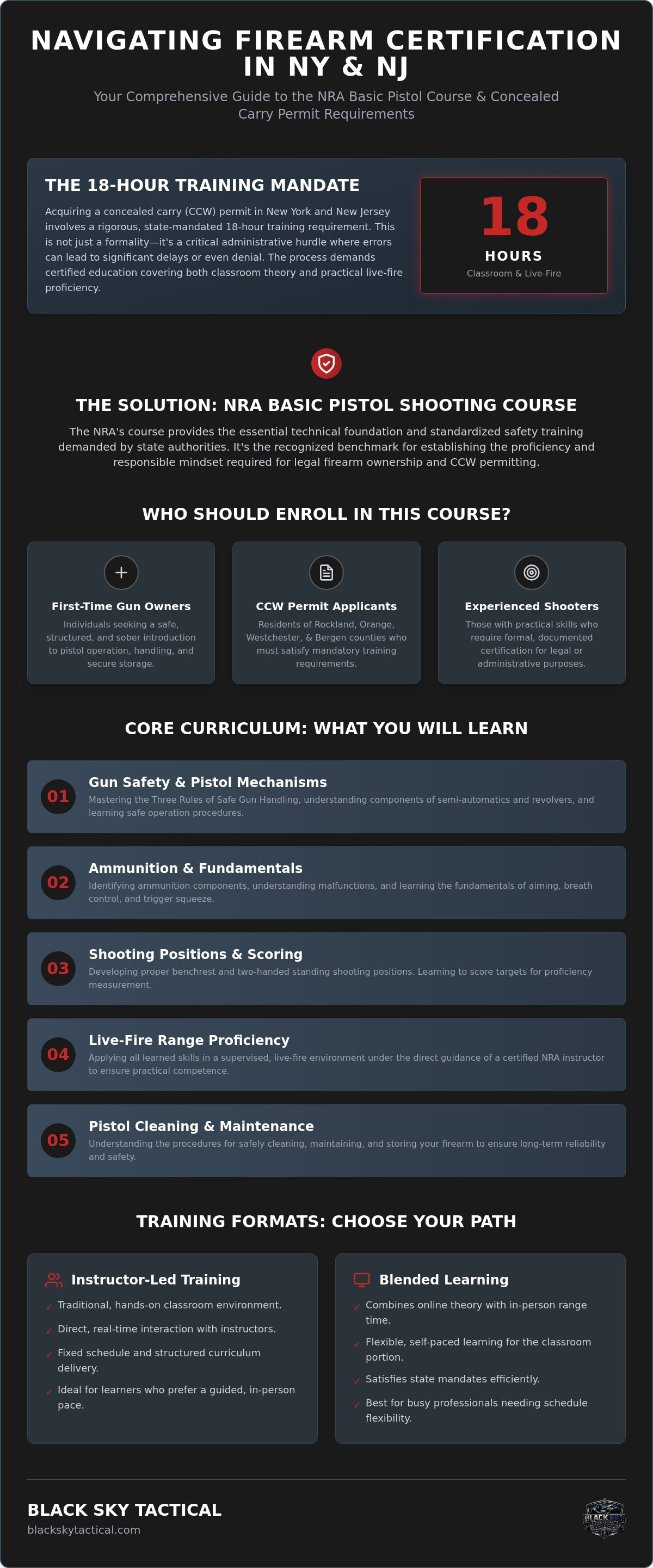
The state of New York currently mandates a minimum of 18 hours of training for all concealed carry permit applicants. This requirement is structured as 16 hours of classroom instruction followed by 2 hours of live-fire exercises. Within this framework, the NRA basic pistol shooting course provides the essential safety and mechanical modules that form the first half of the syllabus. For residents in Rockland, Orange, and Westchester counties, presenting a certificate from a recognized program is a vital part of the application packet. Our curriculum specifically addresses the CCIA training standards, ensuring that the legal and practical components are handled with the sobriety the law requires.
NJ Permit to Carry (PTC) Requirements in Bergen County
In New Jersey, the path to a Permit to Carry (PTC) involves navigating the 'substantial similarity' training requirements established by the State Police. The NRA curriculum is frequently utilized to satisfy these standards because of its rigorous and documented nature. For applicants in Bergen County, the process includes a specific live-fire qualification using targets and scoring methods prescribed by New Jersey's CCARE protocols. Successfully managing the administrative hurdles of NJ firearm training requires meticulous record-keeping. Our NJSNRA101 course is designed to provide the exact certification and performance data necessary to satisfy both the local police department and the presiding court's requirements for permit approval.
Blended Learning vs. Instructor-Led Training
Selecting the appropriate instructional format for the NRA basic pistol shooting course involves balancing personal scheduling needs with the rigid administrative expectations of local law enforcement. The National Rifle Association provides two distinct pathways to certification: a traditional, fully instructor-led experience and a modern blended learning option. While both formats cover the same core safety and mechanical modules, the method of delivery can significantly impact whether a specific licensing agency, such as those in New York or New Jersey, will accept the resulting certificate as part of a permit application. Your choice should be guided by the specific training mandates of the county where you intend to apply for your carry permit.
The Benefits of the Traditional Classroom Setting
The instructor-led format is conducted entirely in a physical classroom and range environment, providing direct, real-time access to an expert. This setting is particularly beneficial for first-time shooters who require immediate feedback on their grip, stance, and muzzle awareness. Instructors can facilitate interactive discussions on complex legal scenarios and safety protocols that are difficult to replicate in a digital environment. Many counties in New York and New Jersey specifically prefer or mandate 100% in-person instruction to satisfy the 18-hour training requirement. This ensures that the student is under professional supervision for the duration of the curriculum, leaving no ambiguity regarding the integrity of the training hours documented in the application packet.
How the Blended Online Phase Works
The blended learning option is structured into two phases to accommodate those with restrictive schedules. Phase 1 is a self-paced e-learning portion completed through the NRA's online portal, covering the theoretical aspects of pistol operation, ammunition, and safety rules. After successfully passing the online final exam, students receive a completion voucher. Phase 2 requires the student to meet with a certified instructor for the practical range portion of the curriculum. While this offers flexibility, participants must manage the logistical challenge of finding an instructor who is available to sign off on their range work. It's also vital to confirm that your local licensing officer accepts blended learning certificates, as some jurisdictions view the online phase as insufficient for meeting the classroom-hour mandates of the Concealed Carry Improvement Act.
To ensure your training meets the strict 18-hour requirement for Rockland, Orange, Westchester, or Bergen counties, consider the NYSNRA101 and NJSNRA101 courses provided by Black Sky Tactical. These programs are designed to consolidate all necessary instructional hours into a professional, in-person syllabus that satisfies both state laws and NRA standards without the administrative risks of self-paced learning.
Why Choose Black Sky Tactical for Your NRA Certification?
Black Sky Tactical functions as a disciplined institution for individuals who recognize that firearm training is a high-stakes endeavor requiring meticulous attention to detail. We provide a sober and professional environment that prioritizes legal compliance and technical proficiency over recreational excitement. Our integrated programs, specifically the NYSNRA101 and NJSNRA101 combined courses, ensure that you fulfill every state-mandated requirement within a single, streamlined curriculum. By incorporating the NRA basic pistol shooting course into these larger frameworks, we eliminate the administrative confusion often associated with piecemeal training certifications, providing a clear path toward permit eligibility.
The training environment we maintain is designed to reflect the gravity of the subject matter, ensuring that every participant absorbs the necessary safety protocols in a structured manner. Our instructors serve as a knowledgeable bridge between the student and the complex regulatory demands of the state, focusing on the procedural steps necessary to obtain and maintain a license. This commitment to professional standards ensures that our graduates are not only skilled with a handgun but also fully prepared for the administrative obligations of firearm ownership.
Expertise in NY and NJ Firearm Law
Our instructors possess deep expertise in the procedural nuances required by licensing officers in Rockland, Orange, Westchester, and Bergen counties. We understand that a successful permit application depends on more than shooting proficiency; it requires accurate documentation and a thorough understanding of the administrative steps involved in the process (including the specific requirements of the Concealed Carry Improvement Act). For detailed information on navigating these requirements, you may consult our NY 18-Hour Conceal Carry Course Guide. We also provide ongoing support for NRA membership enrollment and the periodic renewal training mandated by the state police to ensure your long-term compliance with jurisdictional authority.
Advanced Facilities and Personalized Instruction
We maintain strict limits on class sizes to ensure that every participant receives dedicated range time and personalized feedback from our certified staff. This instructional focus allows us to move beyond the basic syllabus, incorporating elements of situational awareness and tactical response that are essential for those seeking a concealed carry permit. The goal is to produce shooters who are not only technically proficient but also legally informed and mentally prepared for the responsibilities of possession. You can register for your NRA Basic Pistol and CCW Course today to begin the process of securing your recognized safety certificate in a professional, no-nonsense environment that respects the high-stakes nature of this training.
Securing Your Certification and Legal Compliance
The path to lawful handgun ownership in the Northeast requires a disciplined commitment to both technical proficiency and administrative diligence. By completing the NRA basic pistol shooting course, you establish the necessary foundation of safety and mechanical understanding that jurisdictional authorities demand. This certification serves as a vital component of the mandatory 18-hour training syllabus, ensuring your application meets the strict standards of the Concealed Carry Improvement Act. Black Sky Tactical provides the professional oversight required to navigate these procedural hurdles with absolute precision, ensuring that every instructional hour is documented accurately for licensing officers.
We serve residents across Rockland, Orange, Westchester, and Bergen counties, offering specialized training that is 100% compliant with current CCIA standards. You don't have to manage these complex legal requirements alone. Our instructors are prepared to guide you through every module and administrative step to ensure your documentation is recognized and your shooting skills are sound. Enroll in the Combined NYS 18-Hour and NRA Basic Pistol Course to begin your journey toward responsible, certified ownership. We look forward to assisting you as you take this significant step toward safety and professional proficiency.
Frequently Asked Questions
Does the NRA Basic Pistol course count toward the NY 18-hour mandate?
The NRA curriculum serves as a significant component of the required training, but it does not satisfy the full New York State mandate in isolation. Applicants for a concealed carry permit must complete a total of 18 hours, comprising 16 hours of classroom instruction and 2 hours of live-fire exercises. At Black Sky Tactical, we integrate the NRA basic pistol shooting course into our comprehensive NYSNRA101 syllabus to ensure that every administrative and technical requirement of the Concealed Carry Improvement Act is fully met.
How long is the NRA Basic Pistol Shooting Course?
A standard instructor-led course typically requires at least 8 to 9 hours to complete, depending on the pace of the classroom modules and the efficiency of the range session. This duration is standardized by the NRA to ensure that all safety protocols and mechanical instructions are thoroughly covered. When this curriculum is combined with the additional state-specific legal modules required for New York or New Jersey permits, the total instructional time extends to meet the respective 18-hour or CCARE mandates.
Do I need to own a gun to take the NRA Basic Pistol course?
Ownership of a firearm is not a prerequisite for enrollment in this foundational program. Many participants utilize the course to fulfill the mandatory training requirements necessary to apply for their initial purchase permit. Instructors typically provide the necessary firearms and safety equipment for the live-fire portion of the training, allowing students to gain practical experience before they legally possess their own handgun.
Is there a shooting test at the end of the NRA course?
Every student must successfully complete a practical shooting qualification to demonstrate their mastery of the curriculum. This is not a competitive exercise but a formal evaluation of your ability to apply shooting fundamentals and safety rules under supervised range conditions. Achieving the required scoring standard is a mandatory step for the issuance of your official course completion certificate.
Will I receive a certificate immediately after the course?
You will receive your official completion certificate once you have successfully finished all classroom modules and passed the practical range qualification. This document is a critical administrative asset, as it must be included in your application packet for review by county licensing officers. It's essential to maintain the original certificate, as it serves as the primary evidence of your compliance with recognized safety standards.
Can I take the NRA Basic Pistol course online?
The NRA offers a blended learning format that allows you to complete the theoretical Phase 1 through an online portal, but the practical Phase 2 must be conducted in person at a range. It's important to note that certain jurisdictional authorities in New York and New Jersey may not recognize online training hours for permit eligibility. For residents in Rockland or Bergen counties, 100% in-person instruction is often the most reliable path to ensuring your training is accepted by local law enforcement.
What is the minimum age to take the NRA Basic Pistol course?
While the NRA does not set a strict minimum age for training, legal possession of a handgun in New York and New Jersey generally requires an individual to be at least 21 years of age. Professional courses focusing on permit compliance are designed for adult applicants who meet the state's age requirements for licensing. Younger individuals may participate in safety-focused training only under specific conditions and with documented parental consent.
Is the NRA certificate valid in both New York and New Jersey?
The NRA basic pistol shooting course certificate is a nationally recognized credential, but its application toward permit requirements is subject to state-specific regulations. In New Jersey, the certificate may be used to demonstrate the 'substantial similarity' of your training, while in New York, it's a foundational element of the 18-hour CCW mandate. Because administrative requirements differ between Rockland and Bergen counties, we provide specialized combined courses to ensure your certification is valid in your specific jurisdiction.


