Responsible firearm ownership in New York extends beyond personal proficiency; it encompasses a stringent legal and moral obligation to ensure the safety of minors. For parents, this duty involves a dual-track approach: first, strict administrative compliance with New York's evolving safe storage laws, and second, proactive, age-appropriate education to demystify firearms and instill a profound respect for their potential danger. This guide provides a comprehensive framework for achieving both, addressing the core concerns of parents seeking to navigate the complexities of firearm safety for kids in NY.
From understanding the specific mandates of NYS Penal Law to implementing a practical family safety plan, we will detail the necessary steps to protect your family. We will cover the foundational safety rules for younger children, the transition to responsible handling for teens, and the critical conversations parents must have with their children and other households in their community.
Understanding NYS Safe Storage Laws and Legal Obligations (2026)
In New York State, the legal landscape governing firearm storage is precise and rigorously enforced, particularly when minors could potentially gain access to a weapon. The law is not merely a suggestion but a mandate designed to prevent accidental access, injury, and tragedy. Understanding these obligations is the foundational step for any firearm owner in a household with children or in a home that children may visit.
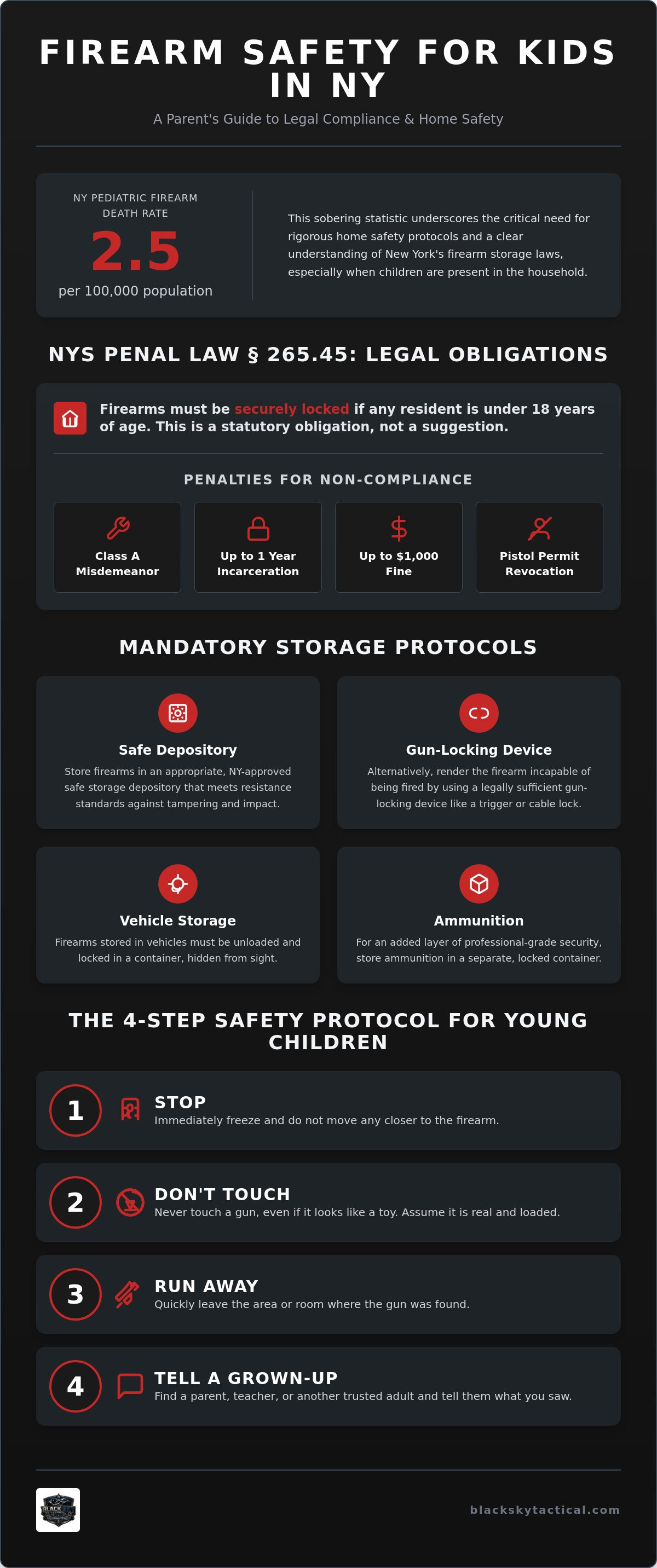
- NYS Penal Law Compliance: New York State Penal Law § 265.45, often referred to as the Child Access Prevention law, mandates that firearms be securely stored when residing with an individual under the age of 18 (previously 16, note the updated age threshold for 2026). This statute requires the firearm to be stored in an appropriate safe storage depository or rendered inoperable by a gun locking device.
- Defining "Securely Locked": According to 2026 NY standards, "securely locked" means the firearm is stored in a safe or other secure container that is locked and which is incapable of being opened without the key, combination, or other unlocking mechanism. Alternatively, a firearm may be secured with a trigger lock or similar gun locking device that renders it inoperable. The choice between a biometric safe and a trigger lock often depends on the need for quick access versus long-term storage, but both must meet state standards.
- Legal Consequences of Non-Compliance: Failure to adhere to these storage laws can result in severe legal penalties. If a child accesses an improperly stored firearm, the owner may face criminal charges, including endangering the welfare of a child and criminal possession of a weapon. A conviction can lead to imprisonment, substantial fines, and the permanent revocation of your firearm permit.
- The Role of Professional Training: Mandated courses, such as the comprehensive NY 18-hour concealed carry course, dedicate significant instructional time to these specific storage protocols. This formal training ensures that permit holders are not only proficient in firearm handling but are also fully educated on their legal responsibilities as owners.
Mandatory Equipment for NY Households
Compliance begins with acquiring the correct equipment. New York State maintains specific criteria for approved locking devices and safes, which are designed to prevent unauthorized access by children and other prohibited persons. It is incumbent upon the owner to ensure their storage solution is legally sufficient.
- Criteria for NY-Approved Devices: All new firearms sold in New York must be accompanied by a gun locking device. Approved devices are those that have been tested by a state-certified laboratory to meet established standards of quality and effectiveness. A list of approved devices is typically available through the New York State Police.
- Ammunition Storage: While the law focuses on securing the firearm itself, best practices and an abundance of caution dictate storing ammunition separately from the firearm. Storing ammunition in a separate, locked container adds a critical layer of security, further complicating any attempt at unauthorized access and use.
- Defining "Safe Storage": As per current NYS statutes, safe storage is a condition in which a firearm is secured in a locked container or rendered inoperable by a tamper-resistant mechanical lock or other safety device, making it inaccessible to any person other than the owner or another authorized user.
County-Specific Variations: Rockland, Westchester, and Orange
While state law provides a baseline for firearm safety, individual counties and municipalities may enact local ordinances that impose stricter requirements. Residents of the Hudson Valley, particularly in counties with dense suburban populations, should be aware of these potential variations.
- Local Ordinances: Some local jurisdictions may have specific rules regarding the type of safe required or the proximity of stored firearms to schools or parks. These local laws can exceed state-level mandates, and ignorance of them is not a valid legal defense.
- Confirming Local Requirements: It is of paramount importance for residents of Rockland, Westchester, and Orange counties to check with their local law enforcement agencies or county clerk's office. These authorities can provide the most current and accurate information on any local ordinances that supplement New York State's safe storage laws.
The "Stop, Don’t Touch" Foundation: Educating Younger Children
For younger children, the primary danger associated with firearms is natural, unsupervised curiosity. The "Forbidden Fruit" effect can make a hidden or forbidden object intensely interesting. Therefore, education must focus on removing the mystery and establishing an unbreakable, non-negotiable safety protocol. This approach is not about scaring a child but about empowering them with a clear, simple, and life-saving set of instructions.
- Curiosity as the Primary Danger: Children are naturally inquisitive. Simply hiding a firearm is insufficient because they may discover it accidentally. The core of youth firearm safety is to neutralize this curiosity with clear rules and open communication, transforming a potentially dangerous object into a known quantity with strict rules attached.
- The Four-Step Safety Protocol: The NRA's Eddie Eagle program provides a memorable mnemonic: Stop! Don’t Touch. Leave the Area. Tell an Adult. This protocol is effective because it is simple and absolute. It removes all ambiguity and decision-making from the child, providing a reflexive, conditioned response that is critical in a moment of discovery.
- Differentiating "Toy" vs. "Real": A critical part of this education is teaching children that they cannot reliably distinguish between a toy and a real firearm. Many toys are designed to look realistic, and some real firearms have colorful or toy-like features. The rule, therefore, is to treat every gun as if it is real and loaded, applying the four-step protocol without exception.
- Handling "Found" Firearms: This protocol must be practiced for various scenarios, including finding a firearm at a friend's house, in a park, or in any other location outside the home. The instruction remains the same: the child's only job is to stop, not touch, get away, and immediately find a trusted adult to report it to.
The Role of Demystification
A core tenet of effective NY youth firearm safety is demystification. When firearms are treated as a complete taboo, a child's curiosity may lead them to seek out information or access on their own. A controlled, supervised approach is far safer.
- Supervised Exposure: For parents who are firearm owners, allowing a child to see and (when age-appropriate and under strict, direct supervision) touch an unloaded firearm can remove the mystery. This controlled exposure reinforces that a firearm is a tool with specific rules, not a forbidden toy. It allows parents to control the narrative and set the boundaries.
- Establishing an "Open Door" Policy: Encourage your children to ask any questions they have about firearms. This prevents them from seeking answers from unreliable sources like friends or the internet. An open dialogue ensures that you remain the primary, trusted source of information and reinforces that firearms are not a secret to be explored covertly.
Communicating with Other Parents
Your child's safety extends to the homes they visit. It is a reasonable and responsible parenting practice to inquire about the presence and storage of firearms in the homes of your child's friends.
- How to Ask: This conversation can be approached as a routine part of your safety checklist, like asking about pets or swimming pool access. The goal is not to judge but to ensure your child's safety. A simple, non-confrontational question is most effective.
- Scripts for Rockland and Westchester Families:
- "My child is looking forward to coming over. As part of our family's safety rules, I always ask if there are any firearms in the home. If so, can you tell me how they are stored?"
- "We're teaching our kids about safety around things like pools and tools. We also talk about guns. Do you have any in your home, and if so, are they locked and secured?"
Transitioning to Responsibility: Training for Older Youth and Teens
As children mature, the safety conversation evolves from pure avoidance to the introduction of responsibility and safe handling principles. For older youth and teenagers, particularly those in households with firearms or who participate in shooting sports, supervised training is the logical next step. This transition should be based on individual maturity, not just age.
- Identifying Signs of Maturity: A youth ready for formal training demonstrates a high level of respect for rules, an ability to focus, and an understanding of consequences. Before considering a program like a Youth Safety Course, parents should be confident that their child can follow multi-step directions precisely and without deviation.
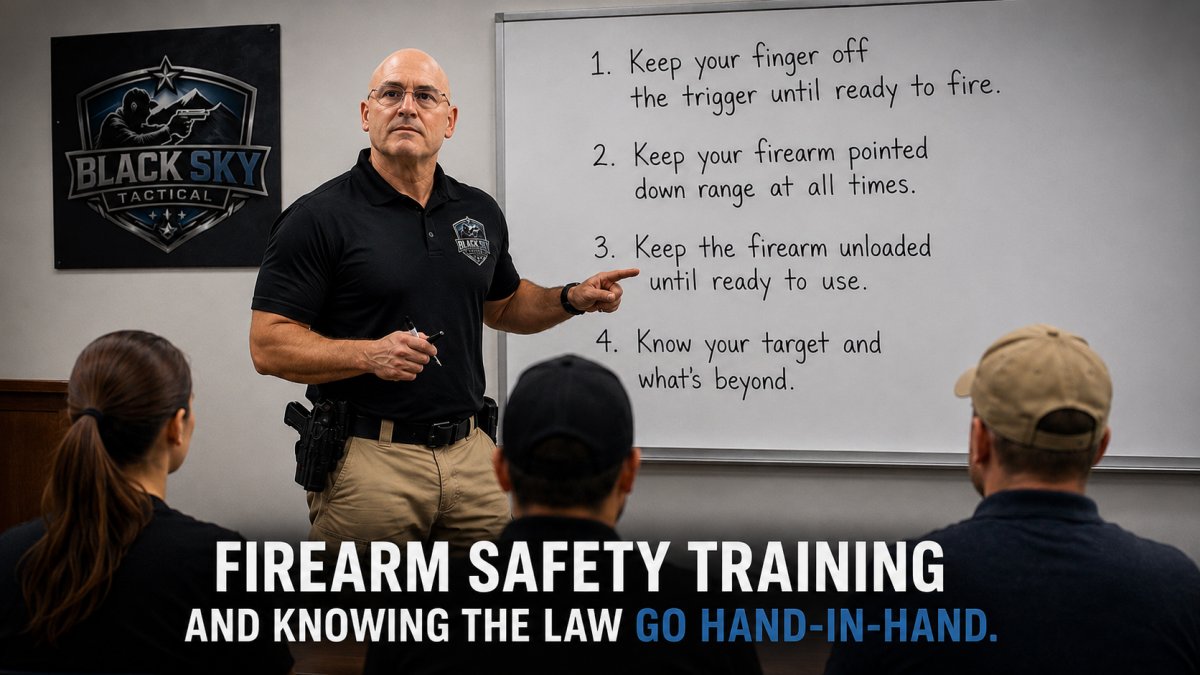
- From Avoidance to Safe Handling: The goal of this next phase is to replace the "don't touch" rule with a new set of principles for safe handling, always under professional supervision. This includes muzzle discipline, trigger discipline, and understanding how to safely operate a firearm.
- The NRA Basic Pistol Curriculum: For older teens who may be approaching the legal age for firearm ownership or permitting, the NRA Basic Pistol curriculum provides a standardized, nationally recognized foundation in handgun safety, operation, and marksmanship. It is a cornerstone of many state-mandated training programs.
- Addressing Situational Awareness: Training for teens should extend beyond the mechanics of firearm handling. It must include situational awareness: teaching them to recognize and avoid environments where illegal firearms may be present and to understand the legal and ethical ramifications of firearm use.
Professional Youth Safety Courses
Enrolling an adolescent in a professional training program offers significant advantages. An accredited instructor provides a formal, structured environment that reinforces the gravity of firearm safety.
- What to Expect: A professionally run youth program, such as those offered by Black Sky Tactical, will always prioritize safety and mindset over marksmanship. The curriculum focuses on the universal safety rules, the legal context of firearm ownership in New York, and developing the situational awareness necessary to avoid conflict.
- The Value of Third-Party Instruction: Children and teens often respond differently to a formal instructor than to a parent. A certified third-party instructor reinforces parental rules with professional authority, adding a layer of seriousness and legitimacy to the safety education process.
Building this level of maturity often involves varied forms of disciplined training. For parents looking for additional ways to foster respect and focus in their children, you can discover Renzo Gracie NH to see how Brazilian Jiu-Jitsu provides a structured environment that complements safety education by teaching situational awareness and self-control.
The 2026 NY Permit Roadmap for Young Adults
For young adults in New York, the path to legal firearm ownership is a multi-step process that begins long before they are eligible for a permit. Early safety training provides an essential foundation for this journey.
- Legal Age Requirements: In New York, the legal age to possess a handgun is 21. For long guns (rifles and shotguns), a person may possess them from the age of 18, and even younger for specific hunting and sporting purposes under supervision. Understanding these distinctions is critical.
- Preparation for Advanced Training: Early exposure to safety protocols and basic handling provides a significant advantage when a young adult eventually enrolls in the state-mandated NY 18-hour concealed carry course. They enter the course with a pre-existing respect for the fundamentals, allowing them to better absorb the complex legal and tactical information required for a concealed carry permit.
Creating a Family Safety Plan: Practical Steps for NY Households
A comprehensive approach to NY youth firearm safety requires a documented, practiced family plan. This plan transforms abstract rules into concrete actions and ensures every member of the household understands their role in maintaining a safe environment.
- Conducting a "Home Sweep": Regularly audit your home to identify and eliminate any potential for unauthorized access. This includes checking the integrity of your safe, ensuring keys or combinations are secure, and confirming that firearms are always returned to storage immediately after cleaning or use.
- Establishing a "Safe Handling Zone": If firearms are used for sport or maintenance, designate a specific area in your home where this occurs. This zone should be free of all ammunition and distractions, and access should be restricted when firearms are being handled.
- Regular "Safety Drills": Periodically quiz your children on the safety rules. Ask them, "What would you do if you saw a gun at your friend's house?" or "What are the four steps?" Regular, low-stress drills reinforce the protocols and keep them fresh in their minds.
- Documenting Your Safety Protocols: In the event of an incident, being able to provide law enforcement or insurance providers with a written copy of your family's safety plan and storage protocols can demonstrate a pattern of responsible ownership and due diligence.
Selecting the Right Storage Solutions
The type of storage you choose should align with your specific needs, balancing the requirement for secure storage with the potential need for quick access for personal defense.
- Quick-Access vs. Heavy-Duty Safes: Quick-access biometric safes offer rapid entry for authorized users while remaining secure from children. Heavy-duty, traditional safes offer a higher level of security against theft and fire but are slower to open. Many families use both: a smaller, quick-access safe for a primary defensive firearm and a larger safe for other firearms and valuables.
- Ammunition Storage Best Practice: The best practice for ammunition storage in NY homes is to secure it in a locked container separate from the firearms, thereby creating two distinct barriers an unauthorized person would need to breach.
Engaging Local Professional Resources
Local context is crucial for firearm training. An instructor who is intimately familiar with the laws and social environment of your specific region provides an invaluable resource.
- Why Local Instructors Matter: For residents in Rockland and Orange counties, a local, certified instructor understands the specific concerns of the community and the nuances of interacting with local law enforcement and licensing divisions.
- The Benefit of Private Instruction: For families, private firearm instruction allows for a personalized safety plan tailored to your home, your family's experience level, and your specific goals, ensuring that all protocols are relevant and practical.
- Comprehensive Legal Support: Beyond physical safety training, families should consider the legal aspects of firearm ownership; Mission Focus Legal Group offers expertise in criminal defense and family law to help navigate the complexities of liability and protection.
- Call to Action: Enroll your child in our next Youth Safety Course to provide them with expert-led, foundational safety training.
Frequently Asked Questions About NY Youth Firearm Safety
What is the legal age for a child to use a firearm in NY under supervision?
In New York, a person under 21 may handle a handgun only at a certified firing range under the direct supervision of a qualified instructor. For long guns (rifles and shotguns), individuals under 18 may use them for purposes such as hunting (with a hunting license, typically available from age 12) or at a range, again under appropriate adult supervision. Laws can be highly specific, so it is best to consult the exact regulations for the activity in question.
Does NY law require a gun safe, or is a trigger lock sufficient?
New York State Penal Law § 265.45 allows for either a "safe storage depository" (like a gun safe) or a "gun locking device" (like a trigger lock) to meet the legal requirement for securing a firearm from a minor. Both must be state-approved. A gun safe offers superior security against both unauthorized access and theft, while a trigger lock is a more portable and basic solution for rendering the firearm inoperable.
How do I talk to my child about gun safety without scaring them?
The key is to be calm, direct, and matter-of-fact. Frame the conversation around safety, just as you would with swimming pools or power tools. Focus on the rules (Stop, Don't Touch, Leave the Area, Tell an Adult) as a simple, empowering set of instructions. By treating the firearm as a tool with strict rules rather than a scary or taboo object, you can educate without inducing fear.
What should my child do if they find a gun at a friend's house in NY?
They should follow the four-step safety protocol immediately and without exception: 1) Stop and do not get any closer. 2) Do not touch the gun for any reason. 3) Immediately leave the area (e.g., leave the room). 4) Tell a trusted adult immediately—a parent, the friend's parent, or a teacher. This rule applies no matter the circumstances.
Are airsoft or BB guns considered firearms under NYS safety laws?
While airsoft and BB guns are generally not classified as "firearms" under the same section of the penal law as pistols and rifles, they are still heavily regulated. For example, New York City and other jurisdictions have strict laws prohibiting their possession and use. Regardless of their legal classification, they should be treated with the same fundamental safety principles: always assume they are loaded, never point them at anyone, and use them only with proper supervision and eye protection.


