In the state of New Jersey, owning a firearm isn't merely a personal choice; it's a significant legal and ethical commitment that requires strict adherence to evolving administrative mandates. If you are researching firearm safety for beginners NJ protocols, you likely feel the weight of this responsibility, perhaps coupled with a sense of confusion regarding the distinction between a Firearms Purchaser Identification Card (FPIC) and a Permit to Carry. It's common to feel a degree of anxiety when facing the technical and legal complexities of the state's regulatory environment, especially since New Jersey maintains some of the most rigorous firearm standards in the nation.
This guide provides a definitive briefing on the safety protocols and legal requirements you must master before you ever step onto a range. We'll clarify the essential path to obtaining NJ-compliant certification, including the foundational NRA Basic Pistol training that serves as a prerequisite for many state mandates. We'll also outline the four universal safety rules that govern every interaction with a weapon and detail the specific procedural steps required to secure your permits under current 2026 standards. By the end of this article, you'll have a clear, instructional roadmap to becoming a disciplined and law-abiding owner.
Key Takeaways
- Understand why a disciplined attitude is considered the most critical component of the NRA Triad when operating within New Jersey's high-stakes legal environment.
- Master the four universal rules of firearm safety and the specific storage mandates required to prevent unauthorized access and maintain legal compliance.
- Clarify the procedural distinctions between the Firearms Purchaser Identification Card and the Permit to Carry to ensure your ownership journey begins on firm legal ground.
- Identify the specific requirements for firearm safety for beginners NJ that only physical, instructor-led courses can satisfy under current state regulations.
- Evaluate how combined certification programs, like the NJSNRA101, efficiently bridge the gap between foundational NRA skills and mandatory state qualifications.
The Foundation of Firearm Safety: The NRA Triad for NJ Beginners
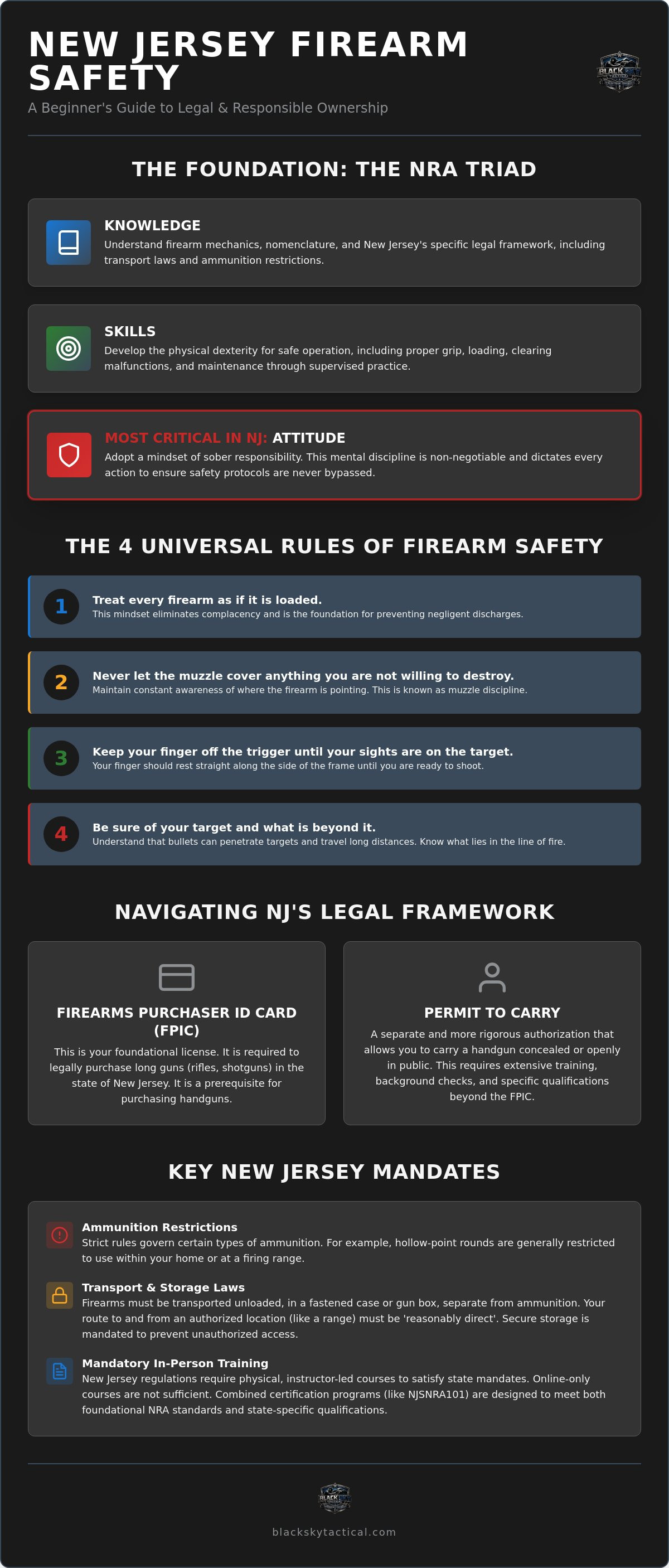
Establishing a disciplined approach to The Foundation of Firearm Safety begins with the NRA Triad. This framework consists of three essential pillars: Knowledge, Skills, and Attitude. For those investigating firearm safety for beginners NJ protocols, understanding these components is the first step in a lifelong commitment to responsible ownership. While technical proficiency is necessary, the state's strict legal environment means that your mental approach to handling a weapon is just as important as your ability to hit a target. You aren't just learning to shoot; you're learning to manage a high-stakes responsibility within a complex jurisdictional framework.
In New Jersey, the 'Attitude' component is often the most critical. The state's legal scrutiny is intense, and any lapse in judgment can have permanent legal consequences. Professional instruction helps you make the transition from mere curiosity to true competence. At Black Sky Tactical, our courses are structured to prioritize sober responsibility over the 'tactical flair' often found in popular media. We focus on creating a grounded, serious environment where the gravity of firearm ownership is always the primary focus.
Knowledge: Understanding the Mechanics and the Law
Knowledge begins with nomenclature. You must be able to identify the frame, slide, barrel, and trigger assembly of a pistol with absolute certainty. Understanding how these parts interact is vital for safe operation and maintenance. Beyond the physical tool, you need to understand the administrative requirements of New Jersey. This includes the legalities of transporting a firearm to a range in Bergen County, which requires the weapon to be unloaded and contained in a fastened case or gun box, separate from the ammunition. Beginners must also be aware of specific legal pitfalls, such as:
- NJ Ammunition Restrictions: Understanding the specific rules regarding hollow-point rounds, which are generally restricted to the home or the range.
- Transport Laws: Knowing that your route must be 'reasonably direct' between authorized locations.
- Administrative Awareness: Keeping your permits and identification current to avoid unintentional regulatory violations.
Skills and Attitude: The Practical and Mental Discipline
Skills involve the physical manipulation of the firearm. This includes developing the manual dexterity required to clear malfunctions, load magazines, and maintain a proper grip. These physical actions must become second nature through repetitive, supervised practice. However, these skills are dangerous without the 'Sober Responsibility' mindset. We don't treat firearms as gear, lifestyle accessories, or toys. They are precision tools that require constant respect. A positive safety attitude is the non-negotiable mental prerequisite that dictates every action a shooter takes, ensuring that safety protocols are never bypassed for convenience or speed. This mental discipline is what separates a casual hobbyist from a truly responsible owner in the eyes of the law and the community.
The 4 Universal Rules of Firearm Safety and NJ Storage Mandates
While the NRA Triad establishes the mental framework for ownership, the four universal rules of firearm safety provide the operational mandates that prevent accidents. These rules are not suggestions; they are absolute requirements that must be followed without exception, regardless of the environment or the type of firearm being handled. Adopting The fundamental NRA rules for safe gun handling is the most effective way to mitigate the risks associated with accidental discharge. Every beginner must internalize these four directives:
- Rule 1: Treat every firearm as if it is loaded. This mindset ensures that you never handle a weapon with complacency, even if you believe it to be cleared.
- Rule 2: Never let the muzzle cover anything you are not willing to destroy. Muzzle discipline is a constant administrative task that requires you to be aware of where the firearm is pointing at all times.
- Rule 3: Keep your finger off the trigger until your sights are on the target. The trigger guard is a physical boundary that your finger must never cross until you have made the conscious, legal decision to fire.
- Rule 4: Be sure of your target and what is beyond it. Projectiles can penetrate walls and travel long distances; you are legally responsible for every round that leaves your barrel.
Safe Storage Protocols in the NJ Home
In New Jersey, the responsibility of ownership extends to how the firearm is secured when not in use. Current state statutes place a heavy emphasis on preventing unauthorized access, particularly regarding minors. Under proposed legislation like the New Jersey Safe Storage of Firearms Act (S1433), there is an increasing push for firearms to be stored unloaded in a securely locked container, with ammunition kept in a separate, locked location. Given that nearly 360 children in the United States unintentionally shoot themselves or others annually, the use of biometric safes or high-quality trigger locks is a critical component of firearm safety for beginners NJ. These devices provide a necessary layer of security while ensuring the owner maintains administrative control over the weapon. For families seeking to establish these habits early, a Youth Safety Course provides a structured environment for younger household members to understand these boundaries.
Range Safety and Etiquette for First-Timers
The firing range is a highly regulated environment where safety is maintained through strict adherence to the authority of the Range Safety Officer (RSO). When you arrive at a range in Bergen County, you must keep your firearm cased until you are at your assigned booth on "The Line." Uncasing must always be done with the muzzle pointed downrange. Communication during a live-fire session should be brief and focused on safety instructions. If a "Cease Fire" is called, you must immediately stop shooting, place the firearm on the bench with the action open, and step back from the line. Understanding these protocols ensures that you can focus on building your skills without creating a hazard for yourself or other participants.
Navigating NJ Firearm Laws: FPID Cards and Permits to Carry
Understanding the administrative landscape is a prerequisite for any resident pursuing firearm safety for beginners NJ training. In New Jersey, the legal framework differentiates strictly between the right to possess and the right to carry. The Firearms Purchaser Identification Card (FPID) is the foundational document required to purchase long guns and serves as the gateway for obtaining specific permits to purchase handguns. While recent legal shifts have increased interest in the Permit to Carry (PTC), beginners should prioritize securing their FPID and handgun permits first. This sequential approach ensures that you possess the legal authority to own and transport a firearm to a range for the necessary training before seeking more advanced carry certifications.
In Bergen County, the administrative timeline for processing these applications typically ranges from 30 to 90 days, depending on the volume handled by local police departments and the State Police. Maintaining legal compliance throughout this period requires meticulous attention to detail. Any omission on your application can lead to delays or denials, which may complicate future attempts to exercise your ownership rights. Professional guidance during this phase focuses on administrative accuracy and a clear understanding of the state's jurisdictional authority.
The Step-by-Step NJ Application Process
The journey begins with the Firearms Application Reporting System (FARS), an online portal managed by the New Jersey State Police. Applicants must provide their local department's Originating Agency Identifier (ORI) code to ensure the application is routed correctly. The process involves several rigorous components:
- Fingerprinting: First-time applicants must schedule an appointment through the state's contracted vendor, Identogo, which carries a verified fee of $54.00.
- Background Checks: A comprehensive criminal history investigation is conducted, alongside a National Instant Criminal Background Check System (NICS) verification during the final purchase.
- Mental Health Records: Applicants must sign a waiver allowing the state to search institutional records for any history of disqualifying conditions.
- References: You must provide reputable references who can vouch for your character and fitness to possess a firearm.
Training Requirements for the NJ Permit to Carry (PTC)
To obtain a PTC, applicants must demonstrate "Safe Handling and Proficiency" through a state-approved course. This mandate requires more than a simple lecture; it necessitates a live-fire qualification conducted by a certified instructor. For those seeking firearm safety for beginners NJ, these training sessions are the only way to meet the state's rigorous proficiency standards. Most industry professionals recognize the NRA Basic Pistol course as the essential foundation for this process. It provides the technical skills and safety habits required to pass the mandatory qualification distances. Completing a comprehensive program, such as the NJSNRA101, streamlines this requirement by combining foundational pistol instruction with the specific live-fire standards mandated by the New Jersey State Police.
Choosing Your First Training Course in Bergen County
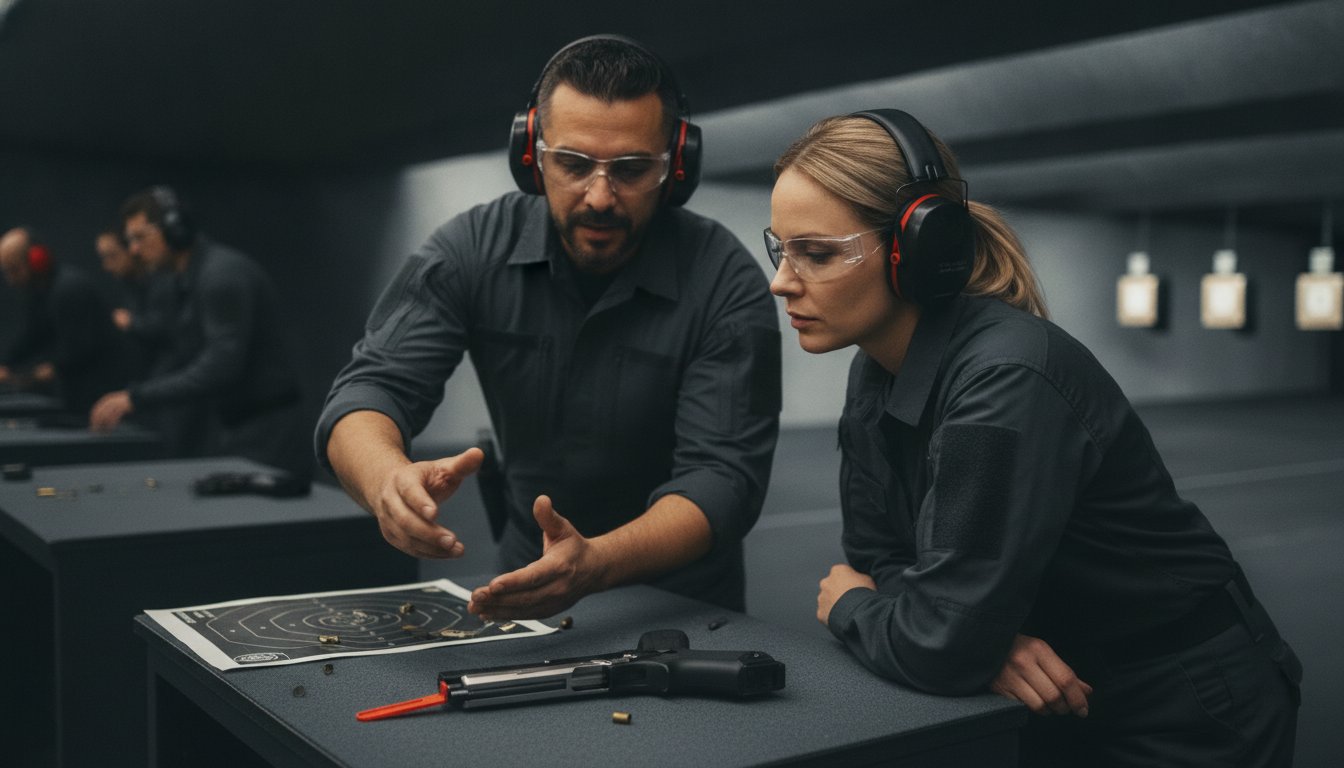
Selecting an appropriate curriculum is a critical decision for any resident pursuing firearm safety for beginners NJ certification. While some providers offer online-only modules for administrative convenience, these programs often fail to satisfy the 'live-fire' mandates required for actual New Jersey firearm permits. Physical handling under the supervision of a certified instructor is non-negotiable for true safety; it's the only method that ensures a student can manipulate the action, clear malfunctions, and maintain muzzle discipline in a real-world environment. When evaluating local facilities, prioritize those that maintain low instructor-to-student ratios, as this ensures that every manipulation of the firearm is monitored for strict compliance with safety protocols.
Preparation for your first session involves more than just registering. You must arrive with a focused, sober mindset and the necessary personal protective equipment, specifically eye protection and ear protection (over-the-ear muffs or high-decibel earplugs). Most professional ranges in Bergen County require these items before you're permitted to enter the firing line area. For those seeking personalized attention to overcome initial anxiety, our Private Firearm Training offers a structured, one-on-one environment that focuses entirely on your individual proficiency and comfort level.
The NRA Basic Pistol Course: The Beginner's Gold Standard
The NRA Basic Pistol course serves as the industry-standard foundation because its syllabus moves methodically from classroom theory to practical range qualification. Students begin by learning the mechanical operations of various pistol types before transitioning to the shooting assessment. This specific certification is highly valued because it's recognized across both New Jersey and New York jurisdictions, making it an essential credential for residents who may eventually seek multi-state permits. To succeed, you must prepare for a written exam that tests your knowledge of the NRA Triad and a shooting assessment that requires consistent accuracy at state-mandated distances.
Specialized Training: Youth and Private Instruction
Responsible ownership often involves the entire household, which is why specialized instruction is available for different age groups and needs. Introducing children to the concept of firearm safety requires a specific pedagogical approach, such as the 'Stop, Don't Touch, Run Away, Tell a Grown-up' protocol. This training isn't about teaching children to shoot, but rather about establishing clear boundaries and safety awareness within the home. Similarly, beginners should distinguish between 'Tactical' and 'Fundamental' training. While tactical courses may appear engaging in media, they are inappropriate for novices. A beginner's focus must remain exclusively on fundamental skills, such as grip, stance, and sight alignment. Our Youth Safety Course is specifically designed to provide this foundational awareness in a controlled, non-intimidating setting.
Black Sky Tactical: Professional Instruction for NJ Beginners
Black Sky Tactical functions as a disciplined educational institution for residents seeking firearm safety for beginners NJ certification. We maintain a professional environment in Bergen County that prioritizes legal compliance and sober responsibility, ensuring that every student understands the gravity of their obligations as a firearm owner. Because our instructors possess a thorough understanding of the specific mandates governing both New Jersey and New York, we are uniquely positioned to assist residents who must navigate the distinct regulatory environments of these neighboring jurisdictions. Our mission is to serve as a reliable bridge between the individual and the complex requirements of the state, providing the necessary certification through a methodical and instructional approach.
This focus on professional instruction and technical mastery is a principle that extends to many modern industries; for those interested in applying these skills to aerial technology, Caswell Aviation Ltd provides comprehensive drone services, including training and aerial imagery.
Why Our NJSNRA101 Course is the Efficient Choice
The NJSNRA101 course is specifically designed to streamline the path to legal ownership by integrating the NRA Basic Pistol curriculum with the requirements for the New Jersey Permit to Carry (PTC). This combined format ensures that you receive foundational technical instruction while simultaneously completing the live-fire qualification mandated by the New Jersey State Police. By consolidating these requirements, we ensure that all administrative documentation and training certificates are prepared to meet official standards, which helps to minimize the risk of application delays. Our training protocols are specifically tailored to address the unique jurisdictional requirements faced by residents of Rockland and Bergen Counties, ensuring they can navigate the distinct legal frameworks of both New Jersey and New York.
Beyond the Permit: A Lifetime of Proficiency
Securing a permit is only the initial step in what should be a lifelong commitment to safety and skill building. Once you have mastered the foundational requirements of firearm safety for beginners NJ, the next logical step is to move toward defensive proficiency. For those seeking a comprehensive approach to personal security, Performance Krav Maga offers specialized training that focuses on practical self-defense techniques. We provide advanced training opportunities, including courses focused on defensive pistol manipulation and situational awareness, which are designed to build upon the basics in a controlled and professional setting. We also encourage students to facilitate their NRA Membership through our programs to stay informed regarding legislative shifts and safety updates. True proficiency is an ongoing process that requires regular, supervised practice and a continuous dedication to the principles of responsible ownership.
View our upcoming NJ Beginner Safety Classes
Establishing Your Path to Responsible Ownership
Transitioning from a novice to a certified owner in New Jersey requires more than just mechanical skill; it demands a comprehensive understanding of the state's administrative and safety mandates. Mastering the mental discipline of the NRA Triad and the operational clarity of the four universal rules ensures that you operate with the sobriety required in this high-stakes environment. By prioritizing professional instruction that includes mandatory live-fire qualification, you satisfy the state's rigorous proficiency requirements while building the foundational confidence needed for safe range operations.
As you navigate the complexities of firearm safety for beginners NJ protocols, remember that accuracy in your administrative paperwork is as vital as your performance on the target. Our NRA Certified Instructors serve as combined NY and NJ compliance specialists, providing a clear roadmap through the certification process. Whether you require specialized youth safety programs for your household or are ready to fulfill state mandates, we offer the expert guidance necessary for your journey. Enroll in the NJSNRA101 Combined Safety and Permit Course today to begin your training with a team dedicated to professional excellence and legal integrity. Taking this first step demonstrates a serious commitment to the highest standards of responsible firearm ownership.
Frequently Asked Questions
Do I need to own a gun to take a firearm safety course in NJ?
You don't need to own a firearm to enroll in an introductory safety course. Most professional training facilities provide the necessary firearms and ammunition for the duration of the instruction. This arrangement allows beginners to receive foundational training and handle various pistol types before committing to a personal purchase or applying for specific handgun permits.
Is an online gun safety course enough to get a permit in New Jersey?
An online-only course isn't sufficient to satisfy the requirements for a New Jersey Permit to Carry. The state mandates a live-fire proficiency qualification conducted by a certified instructor to ensure safe handling under actual range conditions. While classroom theory is a vital component, physical manipulation and shooting assessments are non-negotiable for administrative compliance under current 2026 standards.
What is the minimum age for a firearm safety course in NJ?
The minimum age for a firearm safety course depends on the specific curriculum and the student's goals. While individuals must be 18 to apply for a Firearm Purchaser Identification Card, specialized safety awareness programs are available for younger students. Our Youth Safety Course focuses on establishing clear boundaries and safety protocols for minors within a household where firearms are present.
How long does it take to get a Firearm Purchaser ID in Bergen County?
Processing times for a Firearm Purchaser Identification Card in Bergen County typically range from 30 to 90 days. This timeline is subject to the administrative capacity of your local police department and the New Jersey State Police. Applicants should ensure all FARS registration details and reference information are accurate to avoid unnecessary delays during the background check phase.
Can I take a combined NY and NJ safety class?
You can enroll in combined courses that address the distinct mandates of both New York and New Jersey. The NJSNRA101 program is specifically designed to integrate NRA foundational skills with the proficiency requirements for a New Jersey permit. This approach is highly efficient for residents who navigate the jurisdictional borders of Rockland and Bergen Counties on a regular basis.
What happens if I fail the live-fire qualification portion of the course?
If a student fails to meet the proficiency standards during the live-fire qualification, instructors typically provide remedial training before a retest is scheduled. The goal of firearm safety for beginners NJ training is to ensure every participant achieves a high level of competence. Students are encouraged to practice fundamental skills through private instruction before attempting the official state-mandated shooting assessment.
Are there specific safety rules for storing firearms with children in the house?
New Jersey law emphasizes preventing unauthorized access to firearms by minors through strict storage protocols. Proposed legislation, such as the New Jersey Safe Storage of Firearms Act, would mandate that firearms be stored unloaded in a securely locked container with ammunition kept in a separate locked location. Utilizing biometric safes and trigger locks is considered a best practice for maintaining administrative control.
Do I need to renew my NJ firearm safety certification?
Certification for a New Jersey Permit to Carry must be renewed every two years. This renewal process involves a repeat of the live-fire qualification to demonstrate continued proficiency and an updated understanding of current state laws. It's the responsibility of the permit holder to track these expiration dates and schedule the necessary training sessions to maintain firearm safety for beginners NJ compliance.


