Crossing the state line between New York and New Jersey with a firearm is not a matter of reciprocity, but a matter of strict, dual-jurisdictional compliance. Many residents commuting between Rockland and Bergen counties mistakenly believe that a permit issued in one state offers some degree of legal leniency in the other, yet the reality is that both states maintain a zero-recognition policy. Failing to adhere to the specific NY and NJ concealed carry requirements can result in accidental felony possession charges, even for those who are otherwise law-abiding citizens. It's understandable to feel a sense of professional concern regarding these conflicting mandates and the administrative complexity they introduce to your daily commute.
This guide provides a meticulous overview of the current regulatory framework to help you secure the necessary certifications without procedural delays. You'll learn how to navigate the 18-hour New York State training mandate and the New Jersey CCARE protocol, ensuring that your training meets the exact standards of both jurisdictions. We will also examine the specific sensitive location restrictions that differ between the two states, providing you with a clear roadmap for maintaining legal peace of mind. This article outlines the precise administrative steps required to obtain and maintain dual-permit status in 2026.
Key Takeaways
- Understand that New York and New Jersey do not recognize each other’s permits, requiring residents to obtain separate, state-specific authorizations for legal carry.
- Identify the precise NY and NJ concealed carry requirements, including the mandatory 18-hour New York State course and the NJ CCARE qualification standards.
- Learn how to utilize combined training programs, such as the NYSNRA101, to efficiently satisfy both NRA standards and state-mandated classroom and live-fire requirements.
- Navigate the differing "sensitive location" definitions and private property "opt-in" regulations that govern lawful carry across the state border.
- Streamline your application process by understanding the county-level administrative procedures unique to residents of Rockland, Westchester, and Bergen counties.
Understanding the Absence of NY and NJ Concealed Carry Reciprocity
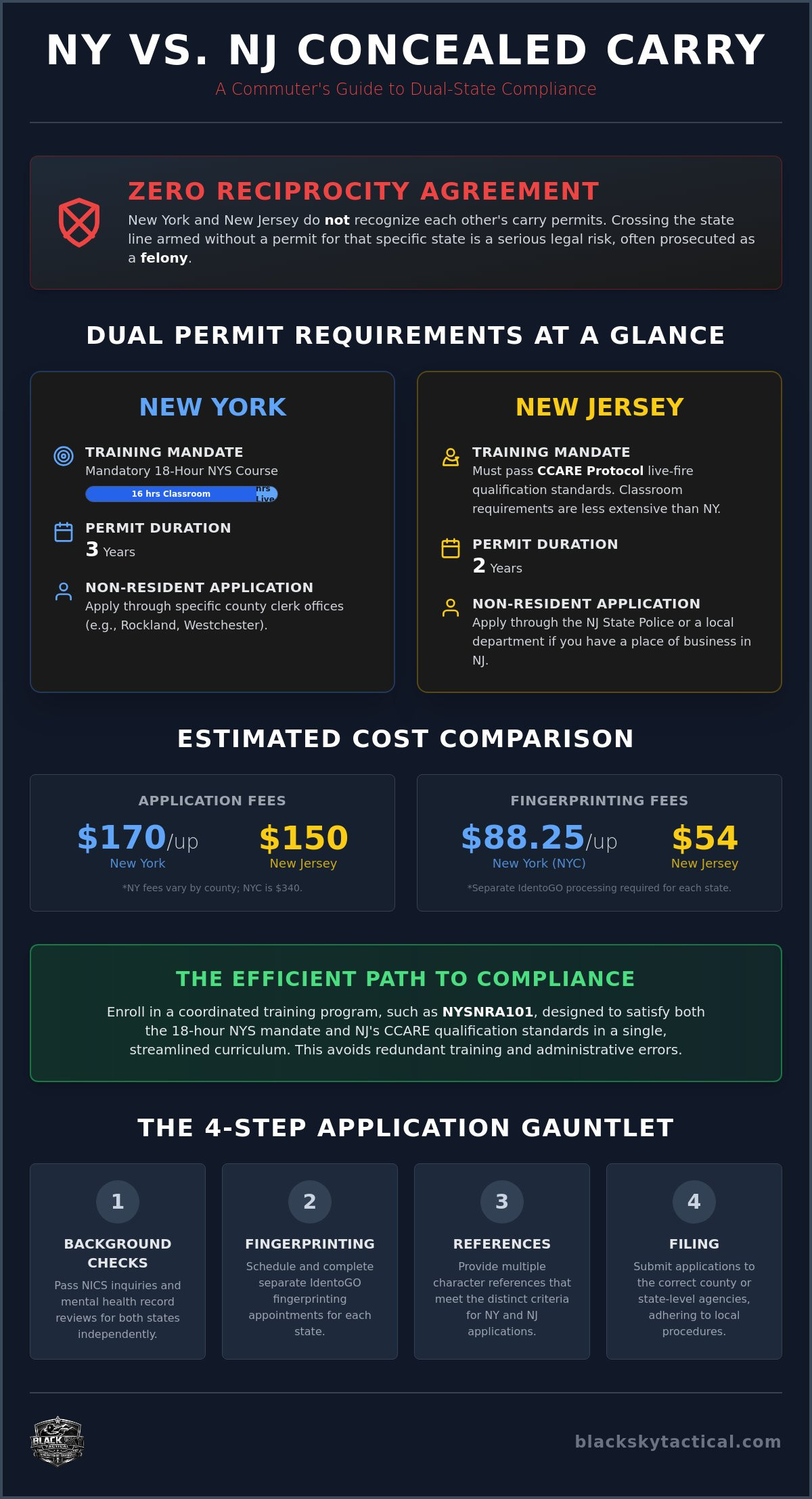
New York and New Jersey do not currently maintain a reciprocity agreement. A permit issued in one state remains entirely invalid in the other. This lack of recognition creates a complex environment for those attempting to meet NY and NJ concealed carry requirements. While the broader legal standards for Concealed carry in the United States transitioned to a "shall-issue" framework following the 2022 Supreme Court decision in Bruen, state-level jurisdictional autonomy remains absolute. You cannot legally carry a firearm across the border without holding a specific permit for both states.
For residents commuting between Rockland and Bergen counties, the absence of reciprocity isn't just a bureaucratic hurdle; it's a significant legal risk. Accidental possession in the neighboring state is often prosecuted as a felony. Because neither state grants leniency to out-of-state permit holders, a meticulous multi-permit strategy is the only viable solution. This approach requires understanding that each state views the other as a separate legal entity with no shared data or recognized certifications. You must treat every border crossing as a transition between two distinct legal systems.
The Status of Non-Resident Permits in NY and NJ
Eligibility for non-resident permits has expanded, yet the specific NY and NJ concealed carry requirements for training and background checks remain distinct. In New Jersey, non-residents apply through the New Jersey State Police or a local department if they maintain a place of business. New York utilizes a county-based system where residents from New Jersey must apply through specific county clerk offices, such as those in Rockland or Westchester. These administrative hurdles require careful coordination of background checks, mental health records, and character references.
Jurisdictional Overlap in the Tri-State Area
Navigating the specific quirks of Westchester and Orange County permit offices is essential for those seeking dual-state compliance. In 2026, processing times for non-resident applications have stabilized, but they still depend heavily on local administrative capacity. New state-level updates have introduced digital filing systems, yet the underlying requirement for thorough, manual verification of character references persists. You must track these local variations to avoid delays in your certification process, as each county office maintains its own procedural preferences for out-of-state applicants.
Requirements for Obtaining Dual NY and NJ Carry Permits
Securing a dual-state carry status requires a disciplined approach to two distinct regulatory frameworks. While both states now operate under a shall-issue mandate, the administrative path to meeting NY and NJ concealed carry requirements involves rigorous background checks and specific documentation. Applicants must undergo National Instant Criminal Background Check System (NICS) inquiries, mental health record reviews, and provide multiple character references. Additionally, documentation such as fingerprinting through IdentoGO and notarized affidavits are standard procedural steps for both jurisdictions. These requirements are non-negotiable and must be completed with meticulous attention to detail to avoid application denial.
- New Jersey Permit to Carry (PTC) application fee: $150.
- New York application fees: $340 in New York City or $170 in Westchester County.
- Fingerprinting fees: $88.25 in NYC and $54 in New Jersey.
Completing these steps in isolation often leads to administrative errors or missed deadlines. Enrolling in a structured program like the NYSNRA101 ensures all classroom and range mandates are satisfied through a singular, professional syllabus. This coordinated approach is particularly beneficial for residents who must manage the differing expiration cycles of a three-year New York license and a two-year New Jersey permit.
The NYS 18-Hour Training Mandate (16+2)
The NY 18 hour concealed carry course serves as the mandatory foundation for all New York applicants. This curriculum consists of 16 hours of classroom instruction covering firearm safety, conflict de-escalation, and state laws, followed by 2 hours of live-fire training. These New York State concealed carry license requirements ensure that every permit holder possesses a standardized level of proficiency and legal knowledge before carrying in public spaces. It's a rigorous process designed to prioritize public safety through comprehensive education.
NJ Permit to Carry (PTC) Standards
New Jersey requires non-residents to complete the Civilian Carry Assessment and Range Evaluation (CCARE) protocol. This standard includes a specific shooting qualification and mandatory use-of-force training under NJ Title 2C. Unlike the broader NYS requirements, the NJ PTC focuses heavily on specific qualification distances and target accuracy. It's essential to verify current 2026 live-fire qualification target distances to ensure your training remains compliant with the latest State Police administrative directives, as these standards are subject to periodic regulatory adjustment.
Mandatory Training Standards for Dual-State Certification
Achieving compliance with NY and NJ concealed carry requirements requires a methodical approach to training that accounts for the specific mandates of both jurisdictions. The most efficient path involves a tiered certification process. First, applicants should enroll in a combined program, such as the NYSNRA101, which is designed to satisfy the New York State 18-hour mandate while simultaneously providing the foundation for the NRA Basic Pistol certificate. This dual-purpose curriculum ensures that the classroom hours are utilized effectively, providing the necessary legal and safety education required by New York law while establishing a credential recognized across various shooting disciplines.
Following the classroom instruction, the second phase involves a mandatory two-hour live-fire qualification conducted by a certified instructor. Upon successful completion of both the academic and practical components, the third step is securing formal certificates of completion that specifically reference NYS CCW and NJ PTC standards. The NRA Basic Pistol certificate serves as a critical foundation here, as its standardized syllabus is often a prerequisite for advanced multi-state recognition and additional carry endorsements. For those seeking professional guidance, you can register for the NYSNRA101 class to begin this structured certification process.
Black Sky Tactical Combined Training Approach
The Combined NYS 18-Hour + NRA Basic Pistol Class streamlines the certification process by integrating two distinct syllabi into a single, cohesive training schedule. This approach prioritizes instructional focus on firearm safety, holster draws, and situational awareness, which are essential for responsible carry. By merging these requirements, students avoid redundant classroom time while gaining a more comprehensive understanding of both basic marksmanship and the specific legal obligations of carrying a concealed weapon in the tri-state area.
The Combined NYS 18-Hour + NRA Basic Pistol Class streamlines the certification process by integrating two distinct syllabi into a single, cohesive training schedule. This approach prioritizes instructional focus on firearm safety, holster draws, and situational awareness, which are essential for responsible carry. By merging these requirements, students avoid redundant classroom time while gaining a more comprehensive understanding of both basic marksmanship and the specific legal obligations of carrying a concealed weapon in the tri-state area. Many students in these courses come from military backgrounds and may be interested in custom squadron gear from Lucky Shot Tees, which features designs for NAS Whidbey Island and other naval installations.
The Live-Fire Qualification: NY vs NJ
Technical differences exist between the live-fire courses for Rockland and Bergen residents. New Jersey's CCARE protocol requires specific target distances and a higher volume of fire compared to the baseline New York 2-hour requirement. Common failure points often include improper holster technique or a lack of familiarity with the specific qualification strings. Avoiding these errors requires deliberate practice and a clear understanding of the scoring standards for each state's respective qualification target.
Practical Compliance for Rockland and Bergen County Commuters
Commuting between Rockland and Bergen counties requires an acute awareness of shifting legal boundaries. While you may have satisfied the NY and NJ concealed carry requirements for both states, your operational conduct must change the moment you cross the state line. In 2026, both jurisdictions maintain extensive lists of "sensitive locations" where carrying is strictly prohibited. These typically include:
- Schools, universities, and childcare providers
- Government buildings, courthouses, and polling places
- Public parks, beaches, and playgrounds
- Establishments serving alcohol, including bars and many restaurants
The "Vampire Rule" regarding private property is a critical point of divergence for local residents. New York law generally requires private property owners to "opt-in" by posting conspicuous signage that allows firearms. Conversely, New Jersey's default stance often presumes prohibition on private property unless explicit consent is granted by the owner. Navigating these differing "opt-in" versus "opt-out" laws is essential to avoid accidental trespassing charges while carrying.
Safe storage and transport laws also demand meticulous attention during your commute. While the federal Firearm Owners Protection Act (FOPA) provides some protection for interstate travel, it doesn't shield you if you stop for extended periods in a state where your permit isn't recognized. You must ensure your firearm is stored in a locked container, separate from ammunition, whenever you aren't in possession of a valid permit for your current location. Maintaining these permits also requires tracking disparate renewal cycles; specifically, three years for New York and two years for New Jersey.
Crossing the Border: Practical Scenarios
If law enforcement stops you in a non-reciprocal state, your conduct is governed by specific "duty to inform" statutes. New Jersey law mandates that you immediately disclose the presence of a firearm to the officer during any interaction. In New York, while state law is less uniform, many county-issued permits include administrative conditions that require similar disclosure. Failing to understand these procedural nuances can lead to immediate permit revocation or criminal prosecution.
Beyond the Permit: Proficiency and Safety
While mastering firearm mechanics is essential, true personal safety often requires a multi-faceted approach that includes hand-to-hand defensive tactics. For those looking to expand their skills beyond the range, Sin City Krav Maga & Fitness offers premier instruction in self-defense systems that emphasize real-world situational awareness and threat neutralization.
Obtaining a permit is merely the beginning of responsible ownership. We recommend Private Firearm Training NY for commuters who want to master the complexities of holster draws and situational awareness in high-stress environments. Additionally, households with dual-permit holders should prioritize youth firearm safety training to ensure that all family members understand the gravity of firearm storage and handling within the home environment. For those looking to supplement their training with high-quality tactical gear or maintenance equipment, you can visit Socom Tactical Airsoft to browse their extensive collection.
For those who manage commercial properties or corporate events and require professional security oversight, visit Broadway Security Services to find comprehensive safety solutions for your business.
For homeowners in the New Jersey and Pennsylvania area looking to integrate specialized security features or reinforced storage into their residence, learn more about Black Bear Construction to discover how a full-service general contractor can help secure your property.
Securing Your Dual-State Compliance
Navigating the absolute absence of reciprocity between New York and New Jersey requires a disciplined commitment to legal education and procedural accuracy. As established throughout this guide, the only lawful method for carrying across the state border is to maintain separate, valid permits that satisfy both NY and NJ concealed carry requirements. This process involves more than just passing a background check; it requires a comprehensive understanding of differing sensitive location mandates and the technical proficiency necessary for dual-state live-fire qualifications. It's essential to treat these requirements as a professional obligation rather than a mere administrative hurdle.
Efficiency in this process is achieved by selecting training that addresses multiple jurisdictional standards simultaneously. Our professional instructors, who possess extensive tactical and law enforcement backgrounds, provide the local expertise necessary for residents in Rockland, Orange, and Bergen counties to navigate these complex hurdles. You can Register for the Combined NYS/NJS 18-Hour Concealed Carry & NRA Course to ensure your certification meets the highest standards of compliance and safety. Taking this step provides the legal peace of mind required for your daily commute while ensuring you're fully prepared for the responsibilities of dual-state carry.
Frequently Asked Questions
Does New Jersey recognize a New York concealed carry permit in 2026?
No, New Jersey does not recognize concealed carry permits from any other state, including New York. To carry a firearm legally within New Jersey, you must obtain a specific New Jersey Permit to Carry (PTC). There's no reciprocity between these jurisdictions, meaning a valid New York license offers no legal protection or recognition once you cross the state line into New Jersey.
How long is the NYS 18-hour concealed carry course valid for application?
The certificate of completion for the NYS 18-hour course is generally intended for use within the current application cycle. While state law defines the training curriculum, individual licensing officers at the county level often determine the acceptable age of a training certificate. It's best to submit your application immediately after completing the course to ensure your 16 hours of classroom work and 2 hours of live-fire remain administratively valid.
Can a New Jersey resident get a New York non-resident pistol permit?
Yes, New Jersey residents are eligible to apply for a New York concealed carry license, provided they meet all NY and NJ concealed carry requirements. This process is managed at the county level, typically requiring applicants to apply in a jurisdiction where they're employed or maintain a place of business. You'll need to complete the full 18-hour New York training mandate and pass a comprehensive background investigation conducted by the local licensing authority.
What are the sensitive locations where I cannot carry in NJ vs NY?
Both states prohibit carrying in schools, government buildings, public parks, and establishments that serve alcohol. New York further restricts carry in public transportation hubs and houses of worship. New Jersey's list of prohibited areas includes casinos, beaches, and hospitals. It's your responsibility to monitor local legislative updates, as the list of "sensitive locations" in both states is subject to change based on ongoing legal challenges and state-level policy shifts.
Do I need a separate qualification for each handgun I intend to carry in NJ?
Under the current Civilian Carry Assessment and Range Evaluation (CCARE) protocol, the focus is on your individual proficiency rather than qualifying with every specific serial number. While you don't necessarily need a separate qualification for each handgun, you must ensure that any firearm you carry is legally owned and compliant with state safety standards. You should always confirm with your local police department or the State Police for any specific administrative variations regarding your equipment list.


