
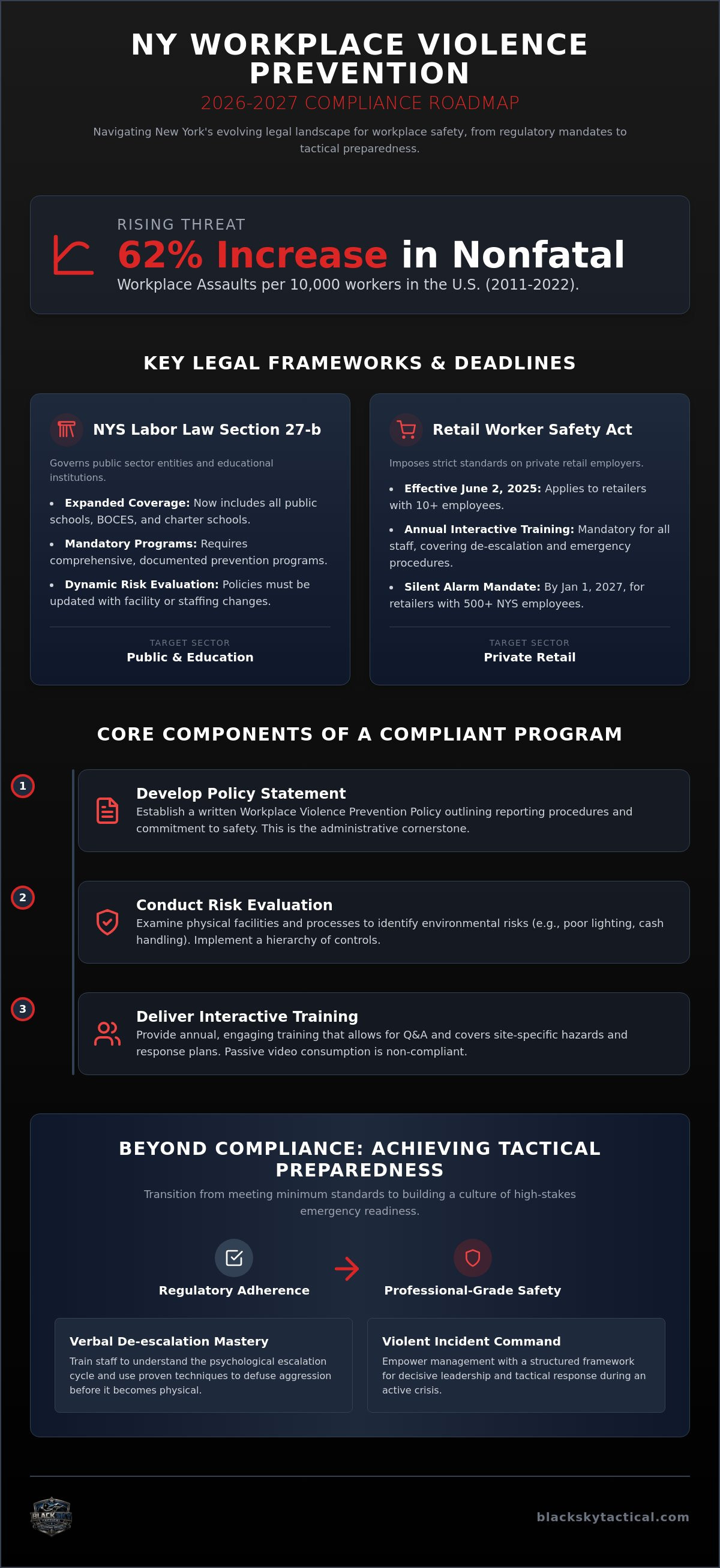
Nonfatal workplace assaults in the United States increased by 62 percent per 10,000 full-time workers between 2011 and 2022; this data reflects a concerning trend that New York employers cannot afford to ignore. You likely understand that fulfilling your duty of care involves more than just a cursory review of safety posters, especially as state mandates become increasingly granular and punitive. Securing professional workplace violence prevention training NY is now a critical component of institutional risk management, ensuring that your organization remains compliant with the Retail Worker Safety Act and upcoming 2026 healthcare facility requirements.
This article provides an authoritative roadmap to help you navigate these shifting legal obligations while establishing a robust tactical defense for your staff. You'll gain a clear understanding of the specific administrative procedures required by the New York State Department of Labor, including the January 2027 deadline for silent alarm installations and the mandatory inclusion of opioid antagonists in workplace first aid kits. We will also outline how to implement the Violent Incident Command framework to bridge the gap between simple regulatory compliance and actual, high-stakes emergency preparedness.
Key Takeaways
- Identify the specific legal frameworks, including NYS Labor Law Section 27-b and the Retail Worker Safety Act, that dictate your organization's mandatory compliance obligations for 2026.
- Establish a formal Workplace Violence Prevention Policy Statement and conduct a comprehensive risk evaluation as the foundational administrative requirements for any state-approved program.
- Master the psychological escalation cycle and verbal de-escalation techniques to effectively defuse aggressive behavior before it reaches a physical threshold.
- Implement professional workplace violence prevention training NY through the Violent Incident Command framework to empower management with decisive leadership during active emergencies.
- Transition from mere regulatory adherence to professional-grade safety by integrating situational awareness and tactical response protocols into your corporate culture.
NY Workplace Violence Prevention Laws: 2026 Compliance Standards
The New York Department of Labor defines workplace violence as any physical assault or threatening behavior that occurs at or is in work sites. This definition encompasses a broad spectrum of Workplace aggression, ranging from verbal threats and harassment to physical attacks and homicides. Under current administrative standards, employers are obligated to identify and mitigate specific environmental factors that increase the likelihood of such incidents. Failure to establish a formal prevention program can lead to significant legal liability and regulatory penalties, particularly as state oversight intensifies.
Section 27-b and Public Education Coverage
Public sector entities and educational institutions are governed by NYS Labor Law Section 27-b. A significant 2023 legislative amendment removed the previous exemption for public schools, meaning all districts, BOCES, and charter schools must now maintain comprehensive prevention programs. For the 2026 compliance cycle, administrators must verify that their written policy statements are accessible and that their risk evaluations, which identify potential hazards specific to their facilities, are documented and reviewed with employee representatives. It's essential that these evaluations are not static; they must be updated whenever physical changes to the facility or staffing levels occur.
The Retail Worker Safety Act Mandates
The Retail Worker Safety Act, which became effective on June 2, 2025, imposes strict standards on private retail employers. Organizations with 10 or more employees are required to implement a formal prevention program and provide annual interactive training to all staff. This training must include de-escalation tactics, emergency procedures, and a review of site-specific hazards. By January 1, 2027, retailers with 500 or more employees across New York State must also provide access to silent alarms or panic buttons at checkout areas or via mobile devices. Utilizing professional workplace violence prevention training NY ensures these mandates are met through structured, compliant curricula rather than generic, non-interactive materials. These mandates emphasize the state's move toward proactive, technology-driven safety measures in high-traffic environments.
Core Components of a Compliant Prevention Program
Establishing a legally defensible safety framework requires more than a generic handbook entry. Every organization must develop a written Workplace Violence Prevention Policy Statement that clearly outlines the procedures for reporting incidents and the employer's commitment to maintaining a secure environment. This document serves as the administrative cornerstone for all subsequent safety actions under the NY Workplace Violence Prevention Law. It's essential that this policy is not only written but also disseminated to all employees to ensure total transparency regarding organizational expectations and safety protocols.
Risk Evaluation and Site-Specific Procedures
A thorough risk evaluation is a mandatory second step. Employers must examine their physical facilities and operational processes to identify environmental risk factors. These often include poor lighting in parking areas, the handling of cash, or situations where staff members work in isolation. Once these hazards are identified, a hierarchy of controls should be implemented. Engineering controls, such as installing physical barriers or enhanced security systems, are prioritized over administrative changes. To ensure these evaluations lead to actionable safety, organizations often find that professional Violent Incident Command Training provides management with the necessary leadership skills to oversee these site-specific protocols effectively.
Interactive Training Requirements
Compliance with New York mandates hinges on the delivery of interactive training. The state explicitly requires that workplace violence prevention training NY goes beyond passive video consumption. To meet this standard, training sessions must allow for real-time questions and answers or provide other interactive elements that engage the staff. Programs must incorporate feedback loops where employees can discuss site-specific hazards and review the organization's unique emergency response plans. Documentation remains a non-negotiable aspect of compliance. Employers are required to maintain meticulous records of all violent incidents, including the location and circumstances of each event. Additionally, training attendance logs must be preserved to prove that every employee has received the mandated annual instruction. These records provide the necessary evidence to protect an organization's legal standing during a Department of Labor audit.
Tactical Response: De-escalation and Active Shooter Preparedness
Compliance serves as the legal floor; however, tactical proficiency is the ceiling that actually preserves life. Understanding the psychology of conflict requires a disciplined study of the escalation cycle. Most violent incidents don't occur in a vacuum. They follow a predictable progression from initial agitation to verbal aggression and, ultimately, physical violence. Recognizing these stages allows staff to apply intervention strategies before a situation becomes unmanageable. Professional workplace violence prevention training NY must equip employees with the ability to identify pre-attack indicators, such as target glancing or repetitive movements, which often precede a physical breach.
Verbal De-escalation and Conflict Resolution
Effective de-escalation hinges on maintaining professional distance and non-threatening body language. In public-facing or high-stress retail environments, staff should adopt an open, "interview" stance that protects their personal space without appearing confrontational. Communication strategies must focus on active listening and the use of calm, declarative statements to redirect the individual's focus. By minimizing emotional reactivity, employees can often defuse aggressive behavior before it necessitates an emergency response. This approach prioritizes safety while maintaining the professional integrity of the organization.
Active Shooter and Emergency Procedures
When de-escalation fails and a violent act occurs, the "Run, Hide, Fight" protocol provides a structured response framework. Every facility must have clearly defined exit routes and secure hide locations that are reinforced against entry. It's critical that staff understand how to interact with law enforcement during a tactical response. Officers arriving on the scene will prioritize neutralizing the threat; therefore, employees must keep their hands visible, empty, and away from their bodies at all times. To ensure your leadership team can manage these high-stakes scenarios with precision, consider enrolling in Violent Incident Command Training to build the necessary tactical muscle memory. Developing these skills ensures that your emergency response plan isn't just a document, but a practiced capability.
Black Sky Tactical: Violent Incident Command for NY Professionals
Adhering to state mandates is a necessary administrative function, but true organizational resilience requires moving beyond the minimum thresholds of compliance. The Violent Incident Command Training philosophy is built on the principle that management must be prepared to exercise decisive leadership during the chaotic initial moments of an emergency. While basic workplace violence prevention training NY provides the required legal foundation, specialized command training empowers supervisors to coordinate responses, manage communications, and oversee the safety of their personnel until emergency services arrive. This level of preparation transforms a reactive policy into a proactive safety culture that prioritizes the physical well-being of the workforce over mere paperwork.
Professional Instruction vs. Model Training
Utilizing expert-led instruction significantly reduces institutional liability and increases employee confidence in a way that generic, pre-recorded model training cannot achieve. Professional instructors bring actual tactical experience to the classroom, providing context that helps staff internalize safety protocols rather than simply memorizing them for a certification test. For professionals seeking to enhance their personal safety proficiency alongside corporate requirements, the Comprehensive Guide to the NY 18-Hour Concealed Carry Course (2026) offers a detailed look at the rigorous standards required for individual firearm licensing in New York. Integrating this level of high-stakes expertise into workplace safety programs ensures that the instruction is both grounded in reality and compliant with current jurisdictional standards.
Implementing a Culture of Safety
A robust prevention program is only effective if it's supported by clear communication channels that allow for the reporting of hazards without fear of retaliation. Businesses in Rockland, Orange, and Westchester County face unique operational challenges that require customized safety programs tailored to their specific environments. Establishing a culture of safety involves conducting regular drills and procedural reviews to ensure that every team member maintains a high state of readiness. To begin the process of upgrading your organization's safety standards, you may contact Black Sky Tactical to schedule a professional consultation. We provide the administrative oversight and tactical training necessary to secure your facility and protect your legal standing in an increasingly complex regulatory environment.
Securing Your Organization Against Evolving Threats
The landscape of workplace safety in New York is undergoing a significant transformation, necessitating a move from static policy manuals to active, tactical readiness. By the 2026 and 2027 deadlines, organizations must have fully integrated the administrative requirements of the Retail Worker Safety Act and Section 27-b. Implementing professional workplace violence prevention training NY is no longer a discretionary choice; it's a fundamental requirement for maintaining your legal standing and ensuring the physical security of your staff. Compliance is the first step toward resilience. This process involves a meticulous risk evaluation followed by the delivery of interactive, site-specific instruction that addresses the practical realities of conflict de-escalation.
Black Sky Tactical provides the specialized expertise required to navigate these complex NY and NJ regulatory frameworks. Our experienced tactical instructors deliver Violent Incident Command Training, which equips your management team with the command-and-control skills necessary for high-stakes emergency response. We invite you to schedule your professional Violent Incident Command Training today to ensure your organization is prepared for the challenges of the upcoming compliance cycle. Establishing a disciplined culture of safety today provides the calm assurance your employees deserve for tomorrow.
Frequently Asked Questions
Is workplace violence prevention training mandatory for all NY employers?
While no single statute mandates training for every private business, specific sectors face rigorous requirements under state law. Public sector entities, educational institutions, and retail employers with 10 or more staff members are legally obligated to provide instruction. Additionally, healthcare facilities must begin implementing new programs in late 2026, making sector-specific compliance a critical administrative priority for most organizations across the state.
What qualifies as interactive training under the Retail Worker Safety Act?
Interactive training is defined as instruction that enables active participant engagement rather than passive observation of a pre-recorded video. To meet this standard, the program must provide opportunities for employees to ask questions, receive real-time feedback, and discuss hazards unique to their specific worksite. Utilizing a professional workplace violence prevention training NY curriculum ensures that these interactive requirements are satisfied through structured dialogue and expert-led Q&A sessions.
How often must NY public school employees receive violence prevention training?
Employees within the public education sector are required to receive violence prevention instruction on an annual basis. Following the 2023 legislative amendment to Section 27-b, which extended coverage to all public school districts and charter schools, administrators must ensure that training is conducted every year. This regular interval is designed to maintain staff familiarity with emergency response protocols and site-specific risk evaluations.
Does the 2026 law require businesses to install panic buttons?
The requirement for panic buttons specifically applies to large retail employers under the Retail Worker Safety Act. By January 1, 2027, retail organizations with 500 or more employees in New York State must provide access to silent alarms or panic buttons at checkout areas or via mobile devices. These systems are intended to provide an immediate, discreet signal to law enforcement during a violent incident or emergency situation.
What are the penalties for non-compliance with NYS Labor Law Section 27-b?
Failure to comply with Section 27-b can result in formal citations and monetary fines issued by the New York State Department of Labor. Beyond administrative penalties, a non-compliant organization faces substantial legal liability if a violent event occurs in the absence of a mandated prevention program. Regulatory bodies often interpret the lack of a documented safety plan as a breach of the employer's professional duty of care.


