
Possessing a Permit to Carry in New Jersey is no longer a matter of simple paperwork; it's a rigorous test of administrative precision and documented technical proficiency. You likely recognize that the regulatory environment for firearm owners in the Garden State remains complex, often leaving even the most diligent citizens feeling uncertain about current mandates. If you're seeking clarity on how to get a concealed carry permit in nj, you must first accept that the state's stringent requirements demand a methodical approach to both training and application.
This guide provides a definitive roadmap to help you navigate the Civilian Carry Assessment and Range Evaluation (CCARE) protocol and the specific jurisdictional filing steps required for 2026. We'll outline the exact path from selecting the correct police department for your filing to successfully completing the mandatory live-fire qualifications. By following this structured professional briefing, you'll gain the necessary insight to meet every legal obligation with total compliance and confidence.
Key Takeaways
- Confirm your foundational eligibility by ensuring you are at least 21 years of age and already possess a valid New Jersey Firearms Purchaser Identification (FPID) card.
- Master the specific requirements of the Civilian Carry Assessment and Range Evaluation (CCARE) protocol, which serves as the mandatory 2026 live-fire qualification standard.
- Learn the administrative precision required for how to get a concealed carry permit in nj by correctly utilizing the FARS online portal and identifying your local jurisdiction's ORI Number.
- Recognize the legal boundaries of your permit, including the "Sensitive Places" doctrine and the mandatory duty to disclose your status during any interaction with law enforcement.
- Maintain compliance by tracking the two-year validity period of your permit and preparing for the renewal process well in advance of the expiration date.
Understanding Eligibility and Prerequisites for the NJ Permit to Carry (PTC)
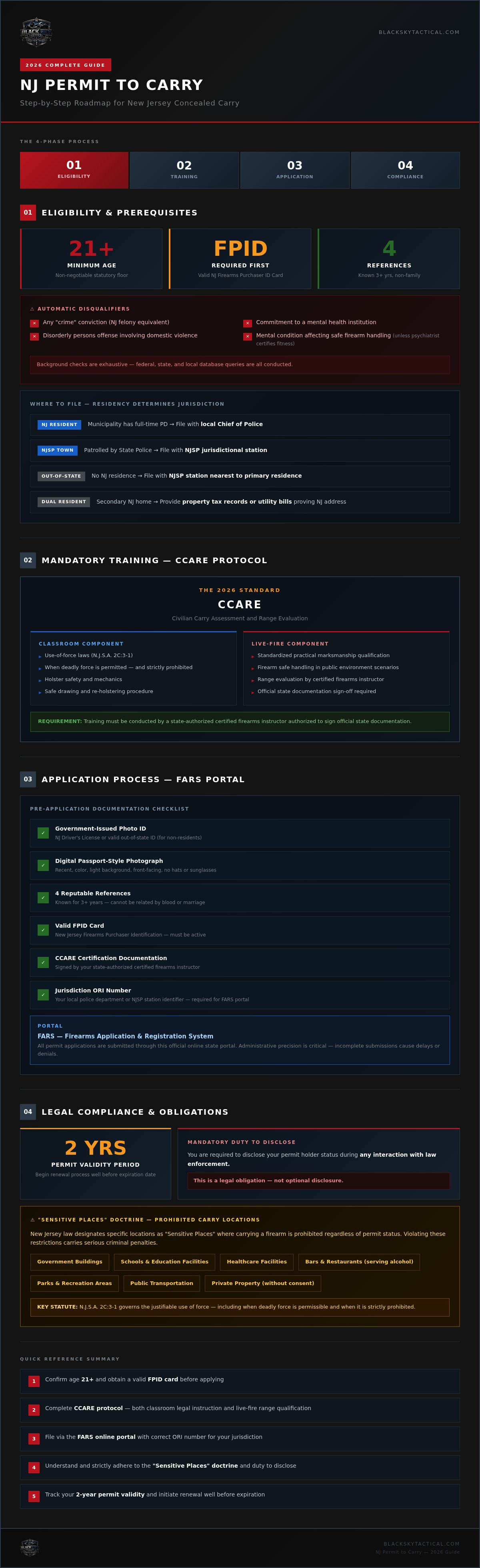
The process of determining how to get a concealed carry permit in nj begins with a rigorous assessment of your legal and administrative eligibility. New Jersey law establishes a high threshold for applicants, requiring a baseline of personal history that satisfies both public safety mandates and statutory requirements. Before you initiate the formal application through the state's digital portal, you must ensure you meet the fundamental age requirement of 21 years. This is a non-negotiable statutory floor. Additionally, you must already possess a valid New Jersey Firearms Purchaser Identification (FPID) card. The FPID serves as your primary vetting document; without it, the state will not process a Permit to Carry (PTC) application.
Statutory disqualifiers are strictly enforced during the background investigation phase. Your record must be free of convictions for any "crime" (the New Jersey equivalent of a felony) or a disorderly persons offense involving domestic violence. Mental health history is also scrutinized. If you've been committed to a mental health institution or suffer from a condition that would interfere with the safe handling of a firearm, you'll face immediate disqualification unless you provide a medical certification of fitness from a licensed psychiatrist. These background checks are exhaustive and involve federal, state, and local database queries.
Residency Requirements and Jurisdictional Authority
Determining where to file your application depends entirely on your legal residency status. Residents of a municipality with a full-time police department must file with their local Chief of Police. If your town is patrolled by the New Jersey State Police (NJSP), you'll file with the station that has jurisdiction over your area. A common point of confusion arises for dual-residents. If you maintain a secondary home in New Jersey but reside primarily in another state, you must provide clear evidence of your dual-residency. This typically requires documentation such as property tax records or government-issued utility bills that link your name to the New Jersey address. Out-of-state applicants with no New Jersey residence must apply through the NJSP station geographically closest to their primary residence.
Pre-Application Documentation Checklist
Administrative precision is vital to avoid application delays or denials. Before logging into the portal, organize the following essential items:
- Government Identification: A clear digital copy of your NJ Driver's License or a valid out-of-state ID if you're a non-resident.
- Digital Photograph: You'll need a recent passport-style color photograph with a light background. It must be a clear, front-facing headshot without hats or sunglasses.
- Reputable References: You must provide the names and contact information for four reputable persons who've known you for at least three years. These individuals cannot be related to you by blood or marriage.
Securing these documents early ensures that your submission to the Firearms Application & Registration System (FARS) is handled with the professional clarity the state expects from permit seekers.
Fulfilling the Mandatory NJ Firearms Training and Qualification Requirements
Securing the necessary certification is the most technically demanding phase of learning how to get a concealed carry permit in nj. The state mandates a dual-pronged approach to training that encompasses both theoretical legal knowledge and practical marksmanship. This requirement ensures that every permit holder possesses a standardized understanding of New Jersey's stringent use-of-force laws and the mechanical skills required to operate a firearm safely in a public environment. The training must be conducted by a certified firearms instructor who is authorized to sign off on the state's official documentation.
The classroom component is heavily focused on the legal ramifications of carrying a handgun. Instructors must cover the statutes regarding the justifiable use of force, specifically N.J.S.A. 2C:3-1, which outlines when the use of deadly force is permitted and, more importantly, when it is strictly prohibited. Additionally, the curriculum includes mandatory instruction on holster safety and the mechanics of safe drawing and re-holstering. This instruction is vital because the state requires all permit holders to demonstrate that they can carry their specific firearm in a safe and secure manner at all times. It isn't just a formality; it's a legal briefing designed to ensure applicants understand the grave responsibility of carrying a firearm in public.
The CCARE Protocol and Shooting Standards
The technical execution of the CCARE protocol is the primary hurdle when determining how to get a concealed carry permit in nj, as it requires consistent performance under structured conditions. As of late 2023 and continuing through 2026, the Civilian Carry Assessment and Range Evaluation (CCARE) protocol serves as the uniform shooting standard for all New Jersey applicants. This 50-round qualification course is designed to test accuracy at various distances, ranging from close-quarters to intermediate engagements. Shooting is typically performed on an FBI Q-style silhouette target. To achieve a passing grade, you must place at least 40 out of 50 rounds (80%) within the scoring area of the silhouette. The course of fire is broken down into specific stages:
- 3 Yards: 10 rounds fired in two stages of five rounds each.
- 5 Yards: 10 rounds fired in two stages of five rounds each.
- 7 Yards: 10 rounds fired in two stages of five rounds each.
- 10 Yards: 10 rounds fired in two stages of five rounds each.
- 15 Yards: 10 rounds fired in two stages of five rounds each.
Upon successful completion, the instructor will execute the SP 182 form. This document is a critical administrative requirement for your application. It acts as the official certification that you have met the state's proficiency standards. Without a properly executed SP 182, your application will be rejected by the licensing authority.
Integrating NRA Certification for Enhanced Proficiency
While the CCARE protocol focuses on the qualification itself, the NRA basic pistol shooting course remains the premier method for establishing the foundational skills necessary to pass the state test. The NRA curriculum offers a comprehensive deep dive into firearm mechanics, ammunition types, and the fundamentals of marksmanship that the condensed state-mandated briefing might not fully explore. Integrating these two programs ensures that you aren't just "teaching to the test" but are building a lasting base of competence.
Black Sky Tactical offers the NJSNRA101 course, which combines the mandatory New Jersey training with the NRA Basic Pistol curriculum. This integrated approach streamlines the certification process, providing you with both the state-required SP 182 form and a nationally recognized NRA certificate in a single, professional session. It's a structured path designed for those who prioritize safety and full legal compliance.
Navigating the Online NJSP Permit to Carry Application Process
The administrative core of how to get a concealed carry permit in nj is the Firearms Application & Registration System (FARS). This digital portal, managed by the New Jersey State Police, has replaced traditional paper applications to increase data accuracy and procedural efficiency. However, the system is strictly structured; a single error in the initial setup can lead to an immediate rejection of your application and the forfeiture of non-refundable state fees. You must approach the digital submission with the same level of precision required during your live-fire qualification.
The most critical piece of data you'll need before starting is the Originating Agency Identifier, commonly known as the ORI Number. This specific code directs your application to the correct police department for investigation. If you reside in a municipality with its own police force, you must use their unique ORI. Applying under the wrong code, such as using a State Police ORI when your local department has jurisdiction, will result in a denied application. Most departments list this number on their official municipal websites, but it's often safer to contact their firearms licensing division directly to confirm the current code before you begin the online session.
Step-by-Step Portal Navigation
Once you've entered the correct ORI, you'll initiate the process by selecting the "Initial" application status. The portal will prompt you to enter your personal history and upload your training documentation. You must have a digital copy of your signed SP 182 form ready for upload to prove you've met the CCARE standards discussed previously. Additionally, you'll need to provide accurate email addresses for your four reputable references. The FARS system automatically sends these individuals an electronic questionnaire. It's your responsibility to ensure your references monitor their inboxes, including spam folders, and respond promptly. Any delay in reference responses will directly stall the progression of your background investigation.
The Background Check and Fingerprinting Phase
After finalizing your online submission and paying the state-mandated application fee, you'll receive a confirmation email containing a contributor's case number. You must use this information to schedule an appointment with IdentoGO for digital fingerprinting. This step is mandatory for all initial applicants, regardless of whether you've been fingerprinted for an FPID card in the past. These prints are routed to the State Bureau of Identification (SBI) to facilitate a comprehensive criminal history check.
The background investigation also includes a mandatory review of mental health records, which requires your digital consent during the application. While New Jersey statutes aim for a 90-day processing window, the actual duration depends heavily on the administrative resources of your local jurisdiction. Some municipal departments may complete the investigation within 60 days, while others with higher volumes may require the full statutory period to finalize their findings.
Administrative Timelines, Fees, and Permit Renewal Protocols
The process of maintaining a Permit to Carry (PTC) is as administratively demanding as the initial application. Every permit issued in the state of New Jersey is valid for exactly two years from the date of approval. Unlike a Firearms Purchaser Identification (FPID) card, which remains valid indefinitely unless revoked for cause, the PTC requires periodic re-certification of both your background and your technical proficiency. Understanding the financial and chronological commitments is essential for anyone researching how to get a concealed carry permit in nj without encountering unexpected lapses in legal authorization.
A lapse in your permit's validity can have severe legal consequences. If you're found carrying a handgun with an expired permit, you may face charges for unlawful possession of a weapon, regardless of whether you were previously licensed. There's no "grace period" provided under New Jersey law; the moment your permit reaches its two-year expiration date, your legal authority to carry in public ceases. This reality places a significant burden of responsibility on the permit holder to track their own renewal dates and initiate the process well in advance.
Financial Obligations and Administrative Fees
The total cost of obtaining a permit is comprised of several distinct fees that you must budget for accordingly. The state application fee is currently $200, although you should verify the exact amount through the FARS portal at the time of your submission as state fee structures are subject to legislative adjustments. This $200 fee is typically split between the New Jersey State Police and your local municipality. However, this isn't the only expense you'll encounter. You must also account for the following:
- Fingerprinting Fees: Digital fingerprinting through IdentoGO involves a separate service fee, usually ranging between $60 and $70.
- Training Costs: Professional instruction for the CCARE qualification and the classroom legal briefing is a private expense.
- Administrative Extras: Costs for passport-style digital photographs and potential municipal processing surcharges.
To ensure you meet these standards efficiently, the NJSNRA101 course at Black Sky Tactical provides a comprehensive training solution that fulfills all state mandates in a single professional session.
Managing the Renewal Cycle
To prevent a lapse in coverage, you should adhere to the "120-day rule." It's highly recommended that you initiate your renewal application at least four months before your current permit expires. High-volume jurisdictions often experience significant processing backlogs that can extend beyond the statutory 90-day window. Starting early ensures that the local police department has sufficient time to conduct an updated background investigation and review your references.
The renewal process mirrors the initial application in many ways. You'll need to submit a new application via FARS and complete a new CCARE live-fire qualification. The training certification is not a one-time requirement; it must reflect your current proficiency levels as defined by the most recent state standards. If you change your home address or lose your permit, you must file a duplicate application through the online portal immediately to ensure your records with the State Bureau of Identification remain accurate and compliant.
Legal Obligations and Prohibited Carry Locations in New Jersey
Securing the physical permit card is merely the administrative conclusion of learning how to get a concealed carry permit in nj. Once you possess the permit, you enter a phase of continuous legal and ethical responsibility that requires an acute understanding of New Jersey's restrictive carry environment. The state imposes a strict duty to disclose mandate. If you're stopped by law enforcement for any reason while carrying a handgun, you must immediately inform the officer of your status and the location of your firearm. Failure to do so can result in the immediate revocation of your permit and potential criminal charges. You're expected to maintain a professional and compliant demeanor during these high-stakes interactions, as the burden of transparency rests entirely on the permit holder.
You must also recognize that New Jersey does not practice reciprocity with other states. Your NJ Permit to Carry is valid only within the borders of the Garden State; conversely, New Jersey does not recognize permits issued by any other jurisdiction. Carrying a firearm across state lines into New York or Pennsylvania requires separate, specific legal authorizations. Assuming your permit provides protection in neighboring states can lead to severe felony prosecutions and the permanent loss of your second amendment rights.
Navigating Prohibited Carry Zones
New Jersey utilizes the "Sensitive Places" doctrine to define areas where carry is strictly forbidden, even for legitimate permit holders. These locations include, but are not limited to, the following:
- Schools, colleges, and university campuses.
- Government buildings, courthouses, and polling places.
- Public gatherings, demonstrations, and establishments that serve alcohol for on-site consumption.
- Health care facilities and social service centers.
A critical distinction in New Jersey law involves private property. Unless a property owner has explicitly posted signage or granted verbal permission, many private establishments are treated with a default prohibited status under current regulatory interpretations. Violating these restrictions isn't just an administrative error; it's a serious breach of the law that can lead to criminal firearm offenses. You're responsible for surveying every location before entry to ensure you aren't inadvertently violating a statutory ban.
Beyond the Permit: Tactical Proficiency
While the administrative steps of how to get a concealed carry permit in nj focus on meeting a minimum standard, true defensive readiness requires ongoing education. The NJ carry permit qualification course and the CCARE protocol establish a baseline of safety and accuracy, but they don't simulate the stress or complexity of a real-world defensive encounter. The state's qualification is a floor, not a ceiling, for your personal skill development.
For Bergen County residents, the transition from a licensed citizen to a prepared one involves advanced defensive pistol training and situational awareness drills. Maintaining proficiency means visiting the range more than once every two years. It involves practicing draws from your specific holster, understanding the mechanical limits of your equipment, and staying updated on the frequent legislative shifts that characterize New Jersey's firearm statutes. Compliance is your legal shield, but consistent, disciplined training is your practical one.
Securing Your Legal Authority and Tactical Proficiency
Navigating the complex administrative landscape of New Jersey firearm laws requires a commitment to both procedural accuracy and documented skill. The path to understanding how to get a concealed carry permit in nj involves more than just submitting an application; it demands a thorough mastery of the CCARE protocol and a strict adherence to the state's evolving "Sensitive Places" doctrine. By organizing your documentation early and selecting the correct police jurisdiction, you've established the foundation for a successful application process.
Administrative compliance is only the first step toward responsible carry. To meet the state's rigorous training requirements while building a baseline of foundational safety, you should choose a program that prioritizes legal clarity and technical excellence. Our NJSNRA101 course is specifically designed to bridge the gap between state mandates and practical proficiency. This class fulfills all New Jersey training requirements, includes the NRA Basic Pistol Certification, and features expert instruction from certified range safety officers.
Enroll in the NJSNRA101 Combined Conceal Carry Class Today to ensure your application is backed by the highest standard of professional certification. We're prepared to help you meet these requirements with confidence and integrity.
Frequently Asked Questions
How long does it take to get a concealed carry permit in NJ in 2026?
The statutory processing window for a New Jersey Permit to Carry is 90 days from the date your application is considered complete. While some municipal departments may finalize the background investigation in a shorter timeframe, high-volume jurisdictions often utilize the full 90-day period. You're encouraged to monitor the FARS portal for updates regarding your reference responses and fingerprinting status to ensure there are no administrative delays.
Can a non-resident apply for a New Jersey Permit to Carry?
Yes, non-residents are eligible to apply provided they meet the same training and background requirements as residents. When determining how to get a concealed carry permit in nj as an out-of-state applicant, you must file your submission through the New Jersey State Police station that is geographically closest to your home. You'll still need to travel to an authorized location for your live-fire qualification and digital fingerprinting appointment.
What is the CCARE protocol and is it different from the old qualification?
The CCARE protocol, or Civilian Carry Assessment and Range Evaluation, is the current standardized shooting qualification that replaced previous individual instructor standards in late 2023. It's a uniform 50-round course of fire that must be completed at distances ranging from 3 to 15 yards. Unlike older standards, CCARE includes a mandatory classroom component focused specifically on New Jersey's justifiable use of force statutes and safe holster techniques.
Do I need a separate permit for every handgun I intend to carry?
No, a single New Jersey Permit to Carry authorizes you to carry any handgun that you legally own and possess. While you must demonstrate proficiency with a handgun during your qualification, the permit itself is not limited to a specific serial number. You must, however, ensure that any firearm you carry remains fully compliant with state laws regarding magazine capacity and safety features.
What happens if my NJ concealed carry permit application is denied?
If your application is denied, the issuing authority must provide you with a written statement outlining the specific grounds for the rejection. You have the right to appeal this decision by filing a request for a hearing in the Superior Court of the county where the application was filed. This appeal must be initiated within 30 days of the denial notice, and it's highly recommended that you seek specialized legal counsel for this process.
Is there a live-fire requirement for permit renewals in New Jersey?
Yes, you're required to complete a new live-fire qualification under the CCARE protocol during every two-year renewal cycle. The state requires this re-certification to ensure that all permit holders maintain their technical marksmanship skills and stay informed about any changes to use-of-force laws. Your training certification must be current and uploaded to the FARS portal at the time of your renewal submission.
Can I carry my handgun in other states with an NJ PTC?
New Jersey does not currently have reciprocity agreements with other states, meaning your NJ Permit to Carry is only recognized within New Jersey borders. You're responsible for researching the specific laws of any state you plan to visit, as carrying a firearm in a non-reciprocal jurisdiction can lead to felony charges. Many states have their own permit requirements that you must meet independently of your New Jersey status.
What documents prove residency for a dual-resident applicant?
Dual-resident applicants must provide documentation that establishes a legitimate residential nexus to a New Jersey address. This typically includes property tax records, government-issued utility bills, or a New Jersey voter registration card. These records are necessary to determine the correct jurisdictional authority for your application and to verify that you meet the residency standards required for filing with a specific municipal police department.


