
A single administrative error on your S.P. 182 form or a momentary hesitation during the mandatory holster draw is often the primary factor between securing your permit and receiving a formal rejection from the state. Since the transition from the legacy HQC2 standards to the current Civilian Carry Assessment and Range Evaluation (CCARE) protocol, the requirements for a NJ carry permit qualification course have become significantly more stringent. It's understandable that the 2026 mandates, which emphasize both technical marksmanship and rigorous administrative compliance, create a sense of anxiety for even the most experienced firearm owners.
This guide serves as a comprehensive resource to ensure your compliance with the current New Jersey State Police mandates. We provide a definitive breakdown of the 2026 shooting requirements, the specific scoring thresholds for the FBI Q target, and the essential Use of Force training that is now a prerequisite for certification. We'll analyze the 50-round course of fire across all five mandatory distances and provide the procedural clarity required to complete the S.P. 182 certification form with absolute precision. By examining these standards in detail, you can prepare for your qualification with the calm assurance that stems from professional instruction and a thorough understanding of the law.
Key Takeaways
- Analyze the specific requirements of the Civilian Carry Assessment and Range Evaluation (CCARE) protocol, which mandates a 50-round course of fire at distances ranging from 3 to 15 yards.
- Identify the critical proficiency standards required to pass an NJ carry permit qualification course, including the necessity of achieving a minimum 80% accuracy rate on an FBI Q target.
- Navigate the administrative complexities of the application process, ensuring that the S.P. 182 Safe Handling and Proficiency Certification is executed in strict accordance with current NJSP Rev. 9/23 standards.
- Establish a foundational understanding of the legal "Use of Force" mandates and the procedural requirements for holster-draw safety that are now central to the 2026 certification process.
Understanding the NJ Permit to Carry (PTC) and CCARE Mandates
The Civilian Carry Assessment and Range Evaluation, commonly referred to as the CCARE protocol, represents the current proficiency standard established by the New Jersey State Police (NJSP) on September 15, 2023. This protocol effectively replaced the previous HQC2-Modified standard, introducing a more rigorous assessment of a participant's ability to safely handle and discharge a firearm from a concealed holster. Under the evolving framework of New Jersey gun laws, which transitioned to a shall-issue system following the Bruen decision, the CCARE protocol serves as the mandatory benchmark for all individuals seeking a Permit to Carry (PTC).
Completing an NJ carry permit qualification course isn't merely about marksmanship; it's a multi-faceted certification process that includes a legal "Use of Force" briefing and a demonstration of safe handling. The state requires that every applicant demonstrates mastery over their specific firearm through a live-fire evaluation and administrative documentation via the S.P. 182 form (Rev. 9/23). For residents in border regions like Bergen County, New Jersey, or Rockland and Orange Counties in New York, selecting a comprehensive NJ carry permit qualification course like the NJSNRA101: Combined NJS Conceal Carry + NRA Basic Pistol Class ensures an integrated path to meeting these mandates while maintaining compliance with both jurisdictional authorities.
Who Must Qualify Under the CCARE Protocol?
The mandate for CCARE certification applies to several categories of applicants, ensuring that all individuals carrying in public maintain a uniform standard of safety. These include:
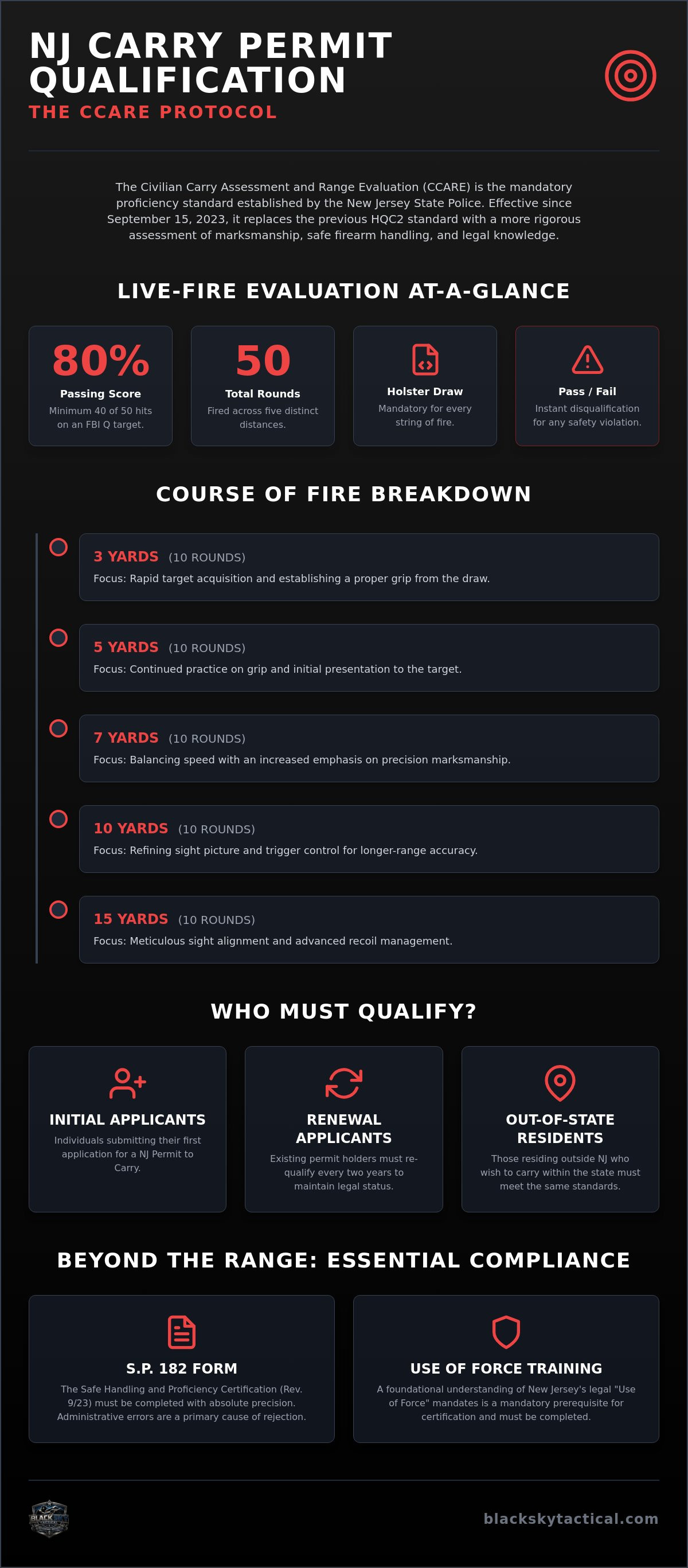
- Initial Applicants: Any individual submitting their first application for a New Jersey Permit to Carry must successfully complete the full CCARE protocol and the associated Use of Force training.
- Renewal Applicants: Since the PTC is valid for a period of two years, existing permit holders must re-qualify under current standards to maintain their legal status.
- Out-of-State Residents: Individuals who reside outside of New Jersey but wish to carry within the state must meet the same proficiency standards as residents, regardless of any prior certifications held in their home jurisdiction.
NJ Carry Permit Shooting Standards: The CCARE Live-Fire Test
The technical core of the NJ carry permit qualification course is the live-fire evaluation, which utilizes a standardized 50-round course of fire conducted on an FBI Q target, or a functionally equivalent silhouette. To achieve a passing result, a participant must demonstrate an 80% accuracy threshold, which equates to a minimum of 40 hits within the scoring area. This assessment is strictly pass/fail; any safety violation, such as a breach of muzzle direction rules or improper trigger finger discipline, results in immediate disqualification and the termination of the evaluation process.
Distances and Strings of Fire
The protocol is structured into five distinct stages, each requiring 10 rounds of fire at varying distances to test the applicant's versatility. At the 3 and 5-yard lines, the evaluation focuses on rapid target acquisition and the ability to establish a proper grip immediately after the draw. As the distance increases to the 7 and 10-yard marks, the emphasis shifts toward a balance of speed and precision marksmanship. The final stage at 15 yards demands meticulous sight alignment and advanced recoil management, as the increased distance significantly amplifies any fundamental shooting errors.
The Holster Draw Requirement
Unlike previous standards that allowed for starting from a ready position, the CCARE protocol mandates that every string of fire must begin with the firearm secured in a holster, which should ideally be the concealed holster the applicant intends to use for daily carry. Participants must demonstrate the ability to safely draw, engage the target, and re-holster under the direct supervision of a certified instructor. Because the holster draw introduces the highest risk of accidental discharge or safety infractions, it remains the most common reason for failure during the qualification. For those seeking to refine these technical skills before their evaluation, enrolling in a comprehensive NJSNRA101 course provides the supervised range time necessary to master these specific holster transitions and ensure administrative compliance.
Essential Gear and Proficiency for a Successful Qualification
Successful completion of an NJ carry permit qualification course requires more than shooting ability; it demands logistical preparation and equipment that meets specific administrative standards. Participants may utilize either semi-automatic pistols or revolvers, provided the firearm is in safe working order and compliant with current state regulations. It's recommended to bring between 50 and 100 rounds of factory-manufactured ammunition to account for the 50-round qualification and any potential administrative re-shoots. Safety equipment must include wrap-around eye protection and electronic hearing protection, which allows the participant to clearly hear range commands while suppressing the sound of gunfire.
NJSP Compliant Holster Standards
The CCARE protocol places heavy emphasis on holster safety, making your choice of carry gear a critical factor in your certification. To maintain a safe range environment, certain holster designs are strictly prohibited during the evaluation. These include small-of-back, cross-draw, and shoulder holsters, as they often require the muzzle to "sweep" bystanders or the shooter's own body during the draw stroke. A compliant holster must possess sufficient structural integrity to remain open when the firearm is removed, allowing for one-handed re-holstering. Whether you choose an Inside-the-Waistband (IWB) or Outside-the-Waistband (OWB) configuration, the holster must provide adequate retention to ensure the firearm remains secure during movement.
Prerequisite Skills: Are You Ready?
Before attempting the live-fire test, shooters should perform a candid self-assessment of their current abilities. If you can't consistently place shots within the scoring area of a silhouette at 15 yards, additional training is necessary. Establishing foundational habits through the NRA Basic Pistol Shooting Course provides the technical base required for more advanced certifications, ensuring that the participant understands the mechanical operation of their firearm before introducing the complexities of a holster draw. Mastery of clearing common malfunctions is also essential, as these must be addressed safely under the supervision of the instructor. To ensure your gear and skills are fully prepared for the CCARE protocol, you should schedule private firearm training before your qualification date.
Administrative Compliance: S.P. 182 and the Filing Process
The successful completion of the live-fire evaluation is only the first phase of the certification process. Your instructor must execute the S.P. 182 form (Rev. 9/23), which serves as the official Permit to Carry Safe Handling and Proficiency Certificate. This document is a legal attestation that you've met the CCARE standards and completed the mandatory Use of Force training. Once you possess this signed form, you'll need to access the New Jersey State Police online portal to begin your formal application. The digital transition has centralized the process, but it requires meticulous attention to detail during the upload of your credentials.
The administrative burden includes integrating your Use of Force certification into the final submission. This isn't a mere formality; it's a legal requirement that ensures every permit holder understands the jurisdictional authority and limitations regarding lethal force. After your digital application is submitted, you must schedule fingerprinting through the state-approved vendor. Depending on your municipality, you may also be required to participate in an interview with your local police department. These steps verify your background and personal history, ensuring that the high standards of an NJ carry permit qualification course are matched by the applicant's personal record.
The Black Sky Tactical Advantage
Black Sky Tactical provides a streamlined approach for residents in the tri-state area. Our NJSNRA101 course is specifically designed to bridge the gap between technical proficiency and administrative success. For those who also navigate the requirements of the NY 18-Hour Concealed Carry Course, we offer expert guidance on the crossover between New York and New Jersey mandates. We ensure your S.P. 182 is executed with professional sobriety and accuracy, minimizing the risk of rejection due to clerical errors. By choosing an NJ carry permit qualification course that prioritizes both the classroom and the range, you're investing in a certification that stands up to the scrutiny of both state and local authorities.
Achieving Certification and Maintaining Legal Compliance
Navigating the transition to the CCARE protocol requires a disciplined approach to both technical skill and administrative precision. We've examined the 50-round live-fire course of fire and the necessity of mastering the holster draw to meet the mandatory 80% accuracy threshold. It's clear that the New Jersey Permit to Carry process is as much about understanding the legal Use of Force mandates as it is about marksmanship at the 15-yard line. Establishing a foundation of safety and proficiency ensures that you remain compliant with the evolving regulatory landscape of 2026.
Selecting a professional NJ carry permit qualification course ensures that you don't merely practice, but prepare for the specific regulatory scrutiny of the New Jersey State Police. You may Register for the NJSNRA101 Combined Qualification Course to benefit from a program that is fully NJSP CCARE compliant and led by NRA-certified instructors. This training provides the clarity required for successful S.P. 182 filing and ensures your proficiency meets the professional standards expected by jurisdictional authorities. With the right instruction and meticulous attention to detail, you can meet these rigorous requirements and uphold your responsibilities as a permit holder.
Frequently Asked Questions
What is the passing score for the NJ carry permit qualification?
The passing score for the qualification is 80%, which requires the participant to achieve a minimum of 40 hits within the scoring area of an FBI Q target. This standard is strictly enforced during the 50-round CCARE course of fire across all five prescribed distances. Failing to meet this threshold necessitates a re-evaluation after the applicant has completed additional training to address marksmanship deficiencies.
Can I use a red dot sight during the NJ PTC qualification course?
You may utilize a red dot sight during the NJ PTC qualification course provided the optic is securely mounted to the firearm you intend to carry. The New Jersey State Police mandates that the equipment used during the qualification, including optics and holsters, must reflect the actual configuration of the firearm the applicant will carry in public. Participants should ensure their batteries are fresh and the zero is confirmed prior to the live-fire assessment to avoid equipment failure during the evaluation.
How often do I need to requalify for my NJ Permit to Carry?
Permit holders must requalify every two years in conjunction with their Permit to Carry renewal application. Because a New Jersey Permit to Carry is only valid for a 24-month period, the state requires a fresh certification of safe handling and proficiency to ensure the applicant still meets the CCARE standards. It's advisable to schedule your NJ carry permit qualification course at least four months prior to your permit's expiration to account for administrative processing delays at the municipal level.
What happens if I fail the NJ CCARE shooting test?
If an applicant fails the NJ CCARE shooting test due to a scoring deficiency, they must typically undergo remedial training before attempting the qualification again. However, if the failure is the result of a safety violation, such as a muzzle sweep or improper trigger finger discipline, the evaluation is terminated immediately. In such instances, the instructor cannot execute the S.P. 182 form, and the applicant must demonstrate a significant improvement in safe handling protocols before a subsequent attempt is authorized.
Is the NJ carry permit qualification valid for New York residents?
The NJ carry permit qualification is valid for New York residents who are seeking a non-resident New Jersey Permit to Carry. While New Jersey doesn't currently recognize New York permits through reciprocity, out-of-state applicants from Rockland or Orange counties can qualify under the same CCARE protocol as New Jersey residents. It's important to understand that this certification doesn't grant the authority to carry within New York State, as that requires a separate NYS-specific 18-hour course and permit issuance.


