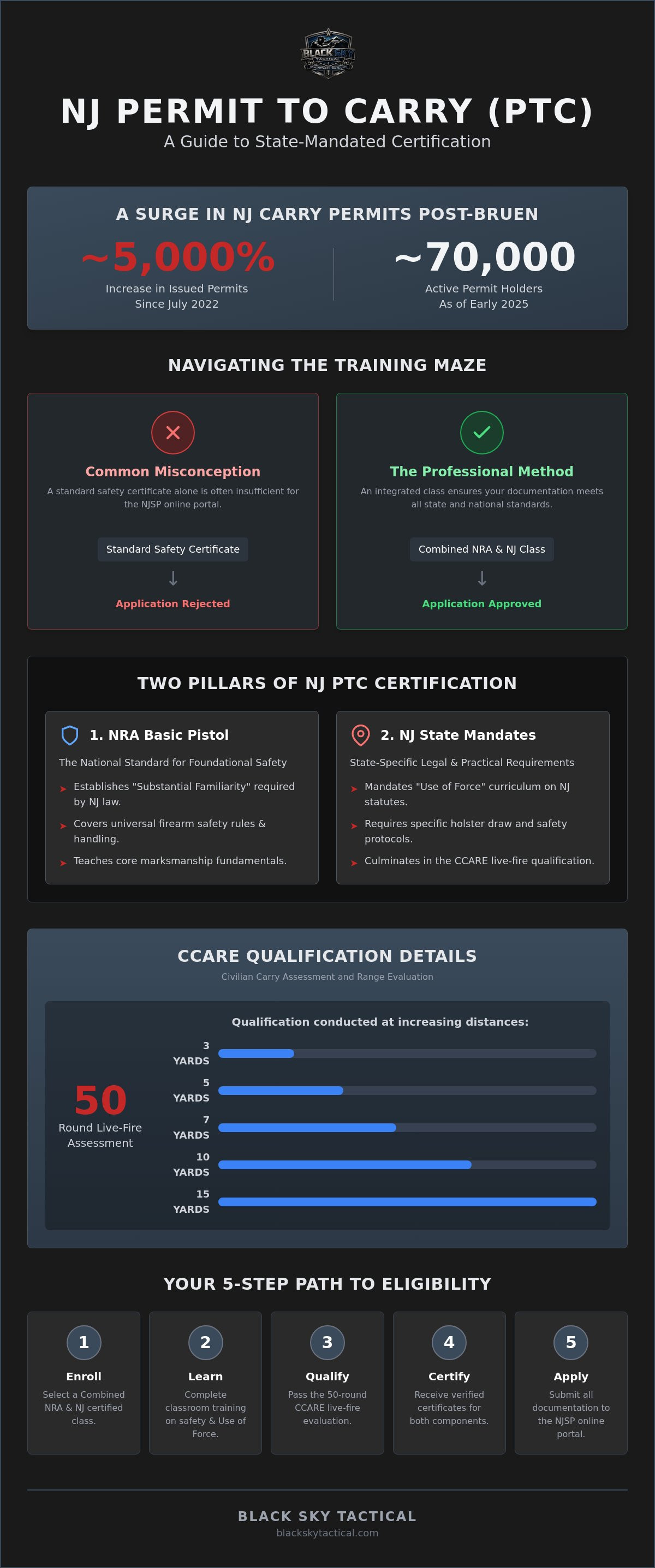
Since the July 2022 Bruen decision, New Jersey has seen a nearly 5,000% increase in issued carry permits, resulting in nearly 70,000 active permit holders as of early 2025. This rapid expansion has led to frequent administrative confusion regarding which specific certifications satisfy the New Jersey State Police mandates for public carry. While many applicants assume a standard safety certificate is sufficient, the regulatory environment requires a more integrated educational approach. Enrolling in a Combined NRA and NJ concealed carry class is the professional method for ensuring your training documentation adheres to both national safety standards and the mandatory state-specific protocols.
It's natural to experience some apprehension when navigating the transition from the previous HQC2 standard to the current Civilian Carry Assessment and Range Evaluation (CCARE) protocol, particularly regarding the 50-round live-fire qualification. This article provides a structured roadmap to PTC eligibility by detailing how NRA foundational instruction serves as the basis for New Jersey's specific holster draw and use of force requirements. We'll outline the procedural steps necessary to build your proficiency and confirm that your certification will be recognized by jurisdictional authorities during the online application process.
Key Takeaways
- Understand how the NRA Basic Pistol syllabus establishes the legal standard of "substantial familiarity" required by New Jersey statutes for permit applicants.
- Identify the core differences between national marksmanship standards and the specific New Jersey mandates for "Use of Force" and holster proficiency.
- Learn the technical specifications of the CCARE protocol, including the 50-round live-fire assessment conducted at distances ranging from 3 to 15 yards.
- Discover the logistical advantages of enrolling in a Combined NRA and NJ concealed carry class to fulfill both foundational safety and state-specific certification requirements in a single program.
- Verify the administrative steps necessary for Bergen County residents to ensure their training documentation is accepted by the New Jersey State Police online application portal.
Understanding the NRA Pistol Safety Course in the NJ Permit to Carry (PTC) Landscape
The NRA Basic Pistol Shooting Course serves as the definitive national standard for foundational firearm safety, marksmanship, and responsible ownership. In the context of New Jersey gun laws, this curriculum provides the essential framework for demonstrating "substantial familiarity" with firearms, a specific legal requirement for any individual seeking a Permit to Carry (PTC). While the New Jersey State Police (NJSP) mandates the Civilian Carry Assessment and Range Evaluation (CCARE) protocol for the live-fire qualification, the NRA syllabus ensures that an applicant possesses the technical knowledge and safety habits necessary to pass that evaluation safely. Selecting a Combined NRA and NJ concealed carry class ensures that the instructional phase and the state-mandated assessment are integrated into a single, cohesive training record.
The Legal Significance of Certified Training in 2026
Administrative precision is paramount in 2026, as the NJSP online application portal requires the submission of specific, verifiable training certificates. An NRA certificate is a recognized instrument of proof across multiple jurisdictions; however, it must be paired with a certification that explicitly mentions the CCARE protocol to satisfy New Jersey's unique mandates. Choosing an instructor who maintains both NRA certification and NJSP recognition is the only way to guarantee that your training documentation will withstand the scrutiny of local law enforcement reviewers during the background check process.
Who Should Prioritize an NRA Pistol Safety Course?
While first-time applicants must complete this training to establish their initial eligibility, seasoned shooters often find that formal safety protocols mitigate the risk of unsafe habits developed over years of informal practice. For those seeking permit renewal, a Combined NRA and NJ concealed carry class provides a necessary refresher on use-of-force statutes while verifying that their skills remain compliant with current shooting standards. Safety is a perishable skill, and the NRA curriculum provides the structured environment required to maintain professional-grade proficiency, regardless of a shooter's prior experience level. This commitment to rigorous standards is essential in any safety discipline; for example, you can learn more about Guardian Safety to see how professional training and consultancy are delivered in other high-responsibility sectors.
Syllabus Breakdown: NRA Basic Pistol Standards vs. NJ State Mandates
The NRA Basic Pistol syllabus focuses on technical fundamentals, including the universal safety rules, identification of pistol parts, and ammunition characteristics. While these form the bedrock of safe handling, the New Jersey State Police require additional, jurisdiction-specific instruction. A Combined NRA and NJ concealed carry class bridges this gap by merging national marksmanship standards with the mandatory "Use of Force" curriculum. This integration is essential because the NJ Permit to Carry application requires a signed letter of training from a certified instructor that explicitly confirms the applicant's familiarity with both safe handling and state statutes. Without this administrative documentation, an application will be rejected regardless of the applicant's shooting proficiency.
Classroom Instruction: Laws and Liability
New Jersey law mandates that all carry permit holders receive comprehensive instruction on the justifiable use of force. This module covers the legal thresholds for self-defense, the duty to retreat, and the potential liabilities associated with discharging a firearm in public. By linking the NRA’s emphasis on responsible ownership to these strict legal obligations, students develop a disciplined understanding of their role as permit holders. It's a critical component that transforms a safe shooter into a legally compliant carrier.
Range Training: Precision and Safety Protocols
Range sessions utilize the NRA’s "Methods of Shooting" to instill consistent marksmanship under controlled conditions, which prepares students for the administrative stressors of the CCARE qualification. The NRA certificate serves as the foundational document for handgun safety certification in the US. Beyond marksmanship, these combined courses integrate holster safety protocols, teaching students the mechanics of a safe draw and re-holstering process to prevent negligent discharges. For residents in Bergen County, the NJSNRA101: Combined NJS Conceal Carry + NRA Basic Pistol Class provides this dual-certification in a streamlined format.
Preparing for the NJ Carry Permit Qualification: From Classroom to Range
Transitioning from classroom instruction to the live-fire range requires a methodical approach to equipment and technique. The New Jersey State Police mandate the CCARE protocol, which evaluates an applicant's ability to engage targets accurately while demonstrating safe holster operations. Enrolling in a Combined NRA and NJ concealed carry class provides the structured environment necessary to bridge the gap between basic marksmanship and the dynamic requirements of the state qualification. Before arriving at the range, applicants should ensure they possess the following equipment:
- A functional, clean, and lubricated handgun suitable for concealed carry.
- A high-quality holster specifically designed for the firearm, capable of securing it during movement.
- At least two or three spare magazines or speed loaders to facilitate efficient reloading.
- A minimum of 100 rounds of factory ammunition to allow for practice and the official 50-round qualification.
Step-by-Step Guide to the CCARE Qualification
The CCARE protocol consists of 50 rounds fired at an FBI Q target from five specific distances. Applicants begin at 3 yards and progress to 5, 7, 10, and finally 15 yards. To achieve a passing grade, the shooter must secure a minimum score of 80 percent, which equates to 40 hits within the silhouette of the target. Beyond simple accuracy, the evaluation includes a practical demonstration of drawing from a holster, reloading, and safely re-holstering under the supervision of a certified instructor. This ensures the applicant is not only a capable marksman but also a safe practitioner of concealed carry techniques. Precision is mandatory.
Overcoming Common Obstacles to Certification
The primary concern for many applicants is the transition from static shooting to the dynamic holster draw required by New Jersey. Fear of failing the live-fire qualification often stems from a lack of formal holster experience, as most recreational shooting is conducted from a bench. By utilizing the fundamentals taught in the NRA Basic Pistol Shooting Course: The Foundation of Handgun Safety and Compliance, students build the muscle memory needed to manage these stressors effectively. For those seeking a comprehensive training solution, a Combined NRA and NJ concealed carry class offers the most efficient path to proficiency. If you're ready to secure your certification, you can register for our professional qualification course to ensure you meet all state requirements with confidence.
Selecting a Combined NRA and NJ Concealed Carry Class in Bergen County
Choosing a training provider requires more than a simple review of course availability; it demands a selection based on the provider's ability to navigate the complex intersection of national standards and local mandates. For residents in Bergen County and the surrounding municipalities, the NJSNRA101: Combined NJS Conceal Carry + NRA Basic Pistol Class offers a distinct advantage by consolidating two separate training requirements into a single, professional program. This streamlined approach minimizes the logistical burden of booking multiple sessions and ensures that all training records remain consistent and compliant with the latest New Jersey State Police standards.
Black Sky Tactical positions itself as a disciplined bridge between the applicant and the state's rigorous requirements. By focusing on a high-stakes training environment, we prioritize legal compliance and technical proficiency over general familiarization. This specialized instruction is particularly valuable for those who require verification that their training will be accepted by local law enforcement agencies during the administrative review process.
Why Local Expertise Matters for NJ Residents
Instructors with deep jurisdictional knowledge provide more than just range supervision; they act as advisors through the administrative hurdles of the NJ Firearms Identification (FID) and Permit to Carry (PTC) application systems. Understanding the nuances of local police department requirements in Bergen County can prevent unnecessary delays in permit issuance. For those with interests across the border, see our Comprehensive Guide to the NY 18-Hour Concealed Carry Course (2026) to understand how different jurisdictions manage their training mandates.
Finalizing Your Application Packet
Upon the successful completion of the NJSNRA101 program, students receive a comprehensive documentation packet required for their digital application. This packet includes:
- A formal NRA Basic Pistol certificate confirming foundational safety training.
- The official CCARE qualification form detailing the 50-round live-fire results.
- The certified instructor’s endorsement, which is a mandatory component for the NJSP online portal.
Securing these documents through a Combined NRA and NJ concealed carry class ensures that your submission is complete and accurate. We encourage serious applicants to view our upcoming schedule and register to begin the formal certification process today.
Securing Your Certification Through Professional Training Standards
Mastering the technical and legal requirements for a New Jersey Permit to Carry requires a commitment to structured education and administrative accuracy. As established throughout this guide, the integration of NRA safety fundamentals with the specific mandates of the CCARE protocol is the most reliable method for ensuring full compliance with state law. By choosing a Combined NRA and NJ concealed carry class, applicants eliminate the risk of documentation discrepancies that frequently result in application rejections during the background review process.
Black Sky Tactical provides a specialized Bergen County training facility where NRA Certified Instructors guide students through the current 2026 NJ State Police standards. This professional environment ensures that every participant develops the holster proficiency and use-of-force knowledge required for a successful permit application. You are encouraged to Enroll in the NJSNRA101: Combined NJS Conceal Carry + NRA Basic Pistol Class to finalize your training with a team dedicated to legal precision and operational excellence. Taking this step ensures you approach your permit application with the necessary documentation and the confidence of professional-grade instruction.
Frequently Asked Questions
Is the NRA Basic Pistol course mandatory for the NJ Carry Permit?
The NRA Basic Pistol course isn't strictly mandatory by name under New Jersey statutes; however, applicants must demonstrate "substantial familiarity" with firearms to qualify for a permit. Most professional instructors utilize the NRA curriculum to satisfy this legal requirement because it provides a standardized, verifiable record of safety training. Enrolling in a Combined NRA and NJ concealed carry class ensures that this foundational familiarity is documented alongside the mandatory state-specific live-fire qualification.
How long is the NRA pistol safety course valid for in New Jersey?
NRA safety certificates don't have a built-in expiration date, but the New Jersey State Police typically require training to be current within the last two years for permit applications or renewals. If your training was completed several years ago, administrative reviewers may require a refresher or a new qualification under the current CCARE standards. It's vital to maintain a record of recent training to avoid delays in the application process.
Can I use an NRA certificate from another state for my NJ PTC application?
An NRA certificate from another state only satisfies the "familiarity" portion of the requirement and isn't sufficient on its own for a New Jersey Permit to Carry. New Jersey mandates specific instruction on state Use of Force laws and the completion of the CCARE live-fire protocol, which are rarely covered in out-of-state courses. You'll likely need to complete a supplementary module or a full New Jersey-specific course to meet these jurisdictional obligations.
What is the difference between NRA CCW and the NJ CCARE qualification?
The NRA CCW course is a comprehensive national curriculum focused on the fundamentals of concealed carry, safety, and marksmanship. In contrast, the NJ CCARE (Civilian Carry Assessment and Range Evaluation) is a specific 50-round shooting protocol mandated by the New Jersey State Police as of September 15, 2023. While the NRA course builds the necessary skills, the CCARE is the administrative evaluation you must pass to satisfy state law.
Do I need to own a firearm before taking the NRA pistol safety course in NJ?
You aren't required to own a firearm to participate in the classroom portion of the NRA pistol safety course, but you'll need a suitable handgun to complete the live-fire qualification. For the NJ Permit to Carry, it's highly recommended to train and qualify with the specific firearm you intend to carry for personal protection. This ensures that your proficiency is verified with the exact equipment listed on your application.


