
In the eyes of the New York legal system, your ability to perceive a threat accurately is the essential foundation upon which any justifiable use of force is built. For those pursuing situational awareness training NY professionals provide, the objective extends beyond simple observation; it involves the rigorous application of mental frameworks to ensure every action remains within the strict mandates of state law. Many residents in Rockland, Orange, and Westchester counties feel a justifiable anxiety regarding increasing crime rates and the dense complexity of local self-defense statutes. You likely recognize that reacting to a violent incident requires more than just instinct; it demands a disciplined understanding of procedural requirements and jurisdictional authority.
This article outlines the specific methodologies required to develop a proactive mindset for threat avoidance while maintaining absolute legal compliance. We will analyze the mechanics of the OODA loop and Cooper’s Color Codes, providing you with a methodical syllabus for identifying escalating dangers and adhering to the standards of NYS Penal Law Article 35. By mastering these tactical observations, you can transform uncertainty into a structured approach to personal safety and regulatory adherence.
Key Takeaways
- Understand the critical cognitive distinction between generalized paranoia and the systematic process of perceiving environmental elements to maintain preparedness in high-density urban areas.
- Learn how maintaining advanced awareness facilitates compliance with the "Duty to Retreat" mandate under NYS Penal Law Article 35, ensuring your actions are legally defensible.
- Identify high-risk "transitional spaces," including parking structures and ATM vestibules, to recognize pre-attack indicators before a physical confrontation occurs.
- Develop specialized observation techniques for the Metro-North and NJ Transit systems through professional situational awareness training NY residents require for secure daily commuting.
- Discover the administrative necessity of integrating mental preparedness with tactical instruction to meet the rigorous standards of the NYS 18-Hour Concealed Carry curriculum.
What is Situational Awareness and Why is it Essential in NY?
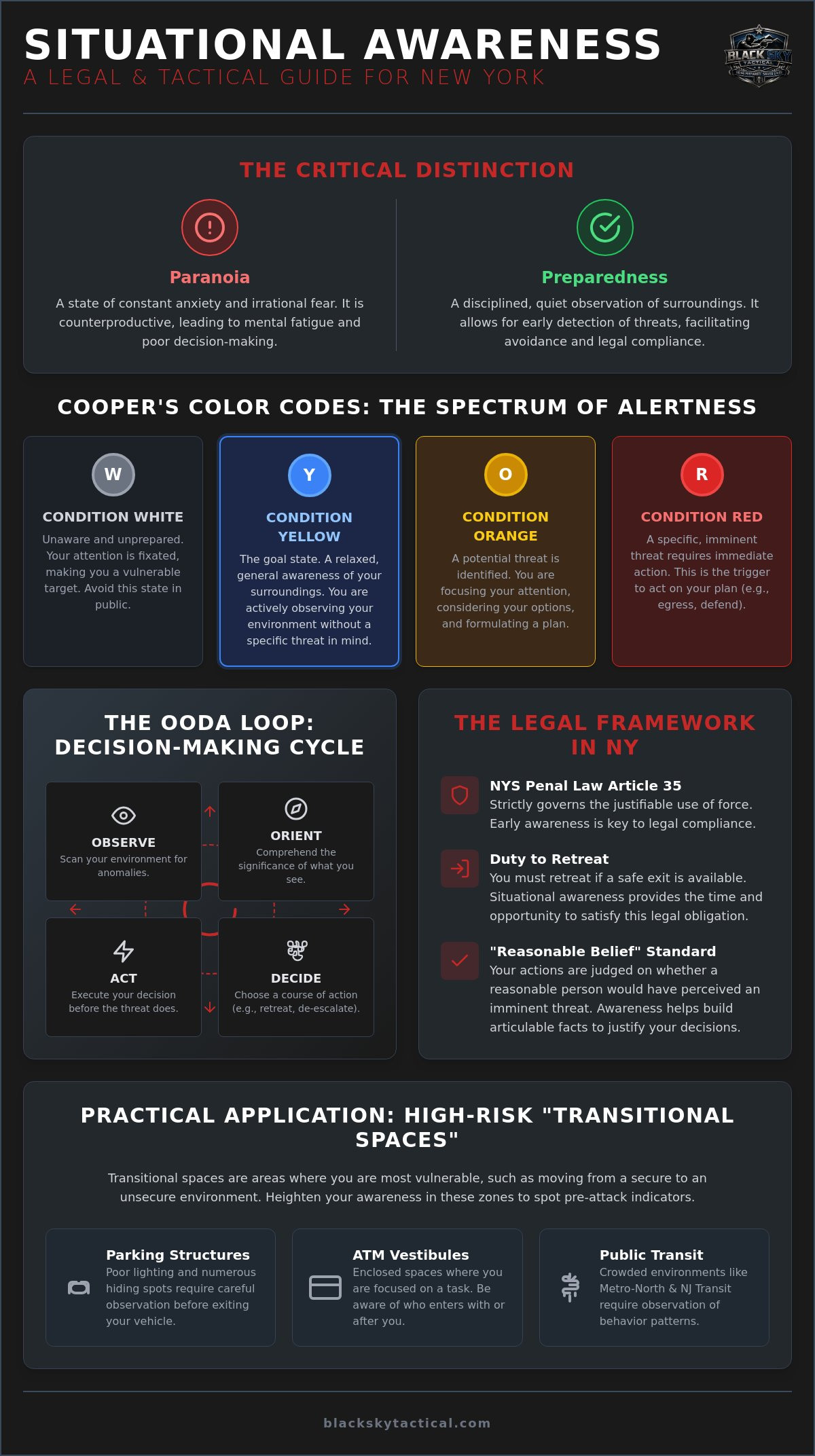
What is Situational Awareness? is defined as the cognitive process of perceiving environmental elements, comprehending their significance, and predicting potential threats before they manifest into physical confrontations. For those pursuing situational awareness training NY professionals provide, the objective isn't to cultivate a state of constant anxiety or paranoia. In high-density areas like Westchester County and New York City, there's a vital distinction between being paranoid and being prepared. Preparedness involves a disciplined, quiet observation of one's surroundings that allows for the early detection of anomalies without drawing unnecessary attention to oneself.
This mental discipline serves as the primary layer of defense, often facilitating the avoidance of a conflict entirely. Under New York law, an individual's actions during a self-defense encounter are frequently evaluated against the "reasonable person" standard. This legal benchmark examines whether a person with similar training and in a similar situation would have perceived a threat as imminent. By maintaining a high level of awareness, you create a documented mental history of observations that can help justify your actions as reasonable and necessary. It's the first step in ensuring that any subsequent response remains within the boundaries of legal compliance.
The OODA Loop: Observe, Orient, Decide, Act
The Boyd Cycle, commonly known as the OODA loop, offers a structured framework for civilian threat assessment. By continuously observing the environment and orienting yourself to specific anomalies, you can decide on a course of action and act before an adversary can complete their own cycle. Shortening this reaction time is critical when identifying pre-attack indicators in public spaces. These indicators often include unnatural posturing, target glancing, or "grooming" behaviors that suggest an individual is preparing for a violent act.
Cooper's Color Codes of Readiness
Navigating the spectrum of mental alertness requires an understanding of Cooper's Color Codes. Many individuals spend their daily lives in Condition White, a state of total unawareness that makes them vulnerable targets in suburban hubs like Rockland and Orange counties. Professional instruction emphasizes maintaining Condition Yellow, a state of relaxed alert where you're aware of your surroundings but not focused on a specific threat. This state allows you to transition rapidly to Condition Orange when a potential danger is detected, or Condition Red when a specific threat requires immediate action or egress.
The Legal Framework: Awareness and NYS Penal Law Article 35
In New York, the legal right to use defensive force is strictly governed by NYS Penal Law Article 35. This statute outlines the specific conditions under which force is considered justifiable, placing a heavy emphasis on the "duty to retreat." Situational awareness training NY residents undergo must address how early detection provides the necessary window for safe egress. If you identify a threat while it's still at a distance, you satisfy the legal obligation to avoid physical conflict whenever a safe exit is available. This proactive observation prevents the escalation to a justifiable use of force event, which is always the preferred outcome for both legal and personal safety reasons.
Justification and the 'Reasonable Belief' Standard
The legal defense of one's actions depends on the ability to provide articulable facts that support a reasonable belief of imminent danger. Situational awareness isn't just a tactical advantage; it's an administrative necessity. By noting specific pre-attack indicators, such as aggressive closure of distance or a hand reaching for a concealed waistband, you build a factual foundation for your decision-making process. Since the implementation of the Concealed Carry Improvement Act (CCIA), the state has prioritized situational awareness training NY permit holders need within the mandatory 18-hour curriculum. This ensures that individuals don't just know how to operate a firearm, but also understand when the law strictly prohibits its use.
De-escalation as a Legal Strategy
Effective de-escalation begins with spatial management and professional verbal commands. By maintaining a reactionary gap, you afford yourself the time to use voice as a tool rather than physical force. This composure is often rooted in foundational skills; for instance, the NRA basic pistol shooting course provides the technical confidence necessary to remain calm under pressure. When you aren't fumbling with equipment, you can focus on de-escalating the situation. Engaging in professional firearms instruction helps bridge the gap between theoretical law and practical threat management in high-stakes environments.
Practical Application: Awareness in Rockland, Westchester, and Bergen Counties
In the tri-state area, practical application requires a meticulous understanding of specific geographic vulnerabilities. Transitional spaces, such as parking structures in Westchester or gas stations in Bergen County, represent environments where individuals are most susceptible to criminal targeting. These locations are defined by a temporary shift in focus, typically involving the retrieval of keys or the processing of financial transactions at an ATM. Establishing a "baseline" for your local neighborhood in Rockland or Orange County is essential; you must recognize the normal patterns of life to identify the anomalies that signify a potential threat.
Maintaining 360-degree awareness on the Metro-North or NJ Transit is a critical component of situational awareness training NY residents utilize to mitigate risks during daily travel. Commuters often fall into a state of "Condition White" by focusing on mobile devices, which effectively eliminates their peripheral vision and increases their reaction time. Professional instruction emphasizes the importance of scanning the environment and identifying potential egress points before a train or bus arrives at a station.
Environmental Assessment Techniques
Developing an "Exit Strategy" mindset is a non-negotiable requirement for public safety. This involves identifying at least two paths of egress upon entering any public building or transit hub. In more rural or suburban areas like Orange County, managing "Visual Lead Time" while driving or walking ensures that you perceive obstacles or suspicious vehicles well before they enter your immediate sphere of influence. This foresight is a primary objective of Professional Incident Command Training, which provides the structural framework for managing complex safety scenarios.
Digital and Social Awareness
Mobile devices are the most significant impediment to maintaining a secure perimeter. By reducing digital distractions in public "hot zones," you avoid the dangers of "target fixation," where the brain focuses exclusively on one object while ignoring surrounding threats. Maintaining a broad peripheral view allows for the early detection of individuals who may be "grooming" or conducting pre-operational surveillance. For those seeking to elevate their preparedness, enrolling in Violent Incident Command Training provides the advanced skills necessary to manage residential security and respond effectively to escalating threats.
Professional Training: From Awareness to Incident Command
While theoretical knowledge provides a necessary foundation, situational awareness training NY residents undertake must include professional, hands-on instruction to bridge the gap between classroom concepts and real-world application. Static learning cannot replicate the physiological stress or the rapid decision-making requirements of a critical incident. Consequently, the integration of these mental frameworks into the NY 18-Hour Concealed Carry Course is essential for meeting current state-mandated standards. This curriculum ensures that mental preparedness is treated as the "pre-shot" phase of any defensive encounter, prioritizing threat avoidance and legal justification before any physical intervention occurs.
Adhering to a regimen of recurring training is required to prevent "skill fade," a documented phenomenon where mental alertness and procedural knowledge diminish without regular reinforcement. Maintaining the sharp observational skills needed to navigate high-density environments in Westchester and Rockland counties demands a commitment to ongoing education. This disciplined approach ensures that your response to a potential threat remains a calculated, professional action rather than a reactive impulse.
Violent Incident Command Training
Advancing from individual survival to scene management requires specialized Violent Incident Command Training. This instruction focuses on the critical period between the conclusion of a threat and the arrival of emergency services. Participants develop the proficiency needed to manage the immediate aftermath, including established communication protocols for reporting activity accurately to jurisdictional authorities. Understanding how to function within a command structure is vital for those who may be responsible for the safety of others in private or public spaces.
Private Instruction and Specialized Courses
For individuals with specific requirements, such as corporate teams or families in Bergen County, private instruction allows for the customization of awareness protocols to suit unique environmental factors. This tailored approach ensures that the training is relevant to the specific transitional spaces and residential baselines of the client. Transitioning from basic safety to advanced tactical proficiency with Black Sky Tactical ensures that all actions remain grounded in legal compliance and professional responsibility, providing a clear path from initial awareness to comprehensive incident management.
Advancing Your Mental and Tactical Preparedness
Mastering the principles of situational awareness training NY provides is more than a tactical advantage; it's a fundamental requirement for maintaining legal compliance under NYS Penal Law Article 35. By internalizing these mental frameworks, residents of Rockland, Westchester, Orange, and Bergen counties can effectively identify threats before they escalate, ensuring that any subsequent actions are justified by articulable facts and a reasonable belief of danger. This disciplined approach to threat detection facilitates the mandatory duty to retreat and provides a structured path for safe egress in high-density environments.
Black Sky Tactical functions as a professional institution dedicated to your safety and regulatory adherence. Our NYS Certified Firearm Instructors deliver comprehensive instruction, including the combined 18-hour NYS/NJS and NRA Basic Pistol classes, to ensure you meet all jurisdictional mandates with precision. We invite you to enroll in our next NYS/NJS Concealed Carry or Violent Incident Command course to refine your tactical observations and secure your professional certification. Developing a proactive mindset is a continuous responsibility, and we're prepared to provide the expert guidance necessary for your ongoing preparedness.
Frequently Asked Questions
Is situational awareness training mandatory for a NYS Concealed Carry permit?
Yes, situational awareness is a mandatory component of the 18-hour training required for a New York State Concealed Carry permit under the Concealed Carry Improvement Act. This instruction is integrated into the curriculum to ensure that permit holders can identify threats and satisfy the legal duty to retreat before utilizing force. It serves as the foundational pre-shot phase that dictates whether the use of a firearm is legally justifiable.
What is the difference between situational awareness and self-defense?
Situational awareness is the cognitive process of threat identification and avoidance, while self-defense is the physical application of force to stop an imminent threat. Effective situational awareness training NY residents utilize aims to prevent the need for self-defense entirely by facilitating early egress or de-escalation. While self-defense is a reactive measure, situational awareness is a proactive mental state designed to keep an individual out of a physical confrontation.
Can situational awareness prevent an active shooter incident?
Situational awareness is the most effective tool for the early detection of an active shooter incident through the identification of pre-attack indicators. By recognizing anomalies in a public environment, such as unnatural posturing or target glancing, an individual can initiate an exit strategy or report suspicious activity before an incident escalates. This early recognition is critical for scene management and personal survival in high-density areas.
How often should I refresh my situational awareness training?
Mental preparedness skills should be refreshed at least once a year to prevent skill fade and ensure cognitive habits remain effective. Because situational awareness relies on disciplined observation and rapid decision-making, these skills can diminish without consistent reinforcement. Participating in recurring situational awareness training NY programs ensures that your ability to scan environments and apply legal frameworks remains sharp and effective against evolving threats.
Does situational awareness apply to home defense in Rockland County?
Situational awareness is a vital component of residential security and home defense strategies for homeowners in Rockland County. It involves establishing a baseline for your neighborhood to recognize suspicious vehicles or individuals and implementing protocols for Violent Incident Command within the home. This mental preparedness allows a homeowner to identify a breach or a threat early, providing the necessary time to secure family members and contact law enforcement.


