
If you believe that basic marksmanship is the only hurdle to legal firearm carry in New Jersey, you're overlooking the administrative and technical rigors that define the state's 2026 regulatory environment. It's understandable if you feel overwhelmed by the shifting requirements for a Permit to Carry (PTC) or the specific nuances of the Civilian Carry Assessment and Range Evaluation (CCARE) protocol. Finding a comprehensive gun ownership safety course NJ residents can trust requires a focus on both NRA fundamentals and the precise mandates issued by the New Jersey State Police.
This guide provides a clear path through the current legal landscape, ensuring you understand the difference between basic safety training and the rigorous live-fire qualifications now required for civilian carry. You'll learn the exact standards of the 50-round CCARE assessment, including the 80 percent passing threshold and mandatory holster proficiency demands. By outlining the procedural steps for certification and the latest administrative fee structures, we help you transition from uncertainty to full, responsible compliance. We will preview the specific training modules necessary to meet the 2026 standards for legal firearm possession and concealed carry in the Garden State.
Key Takeaways
- Distinguish between the legal frameworks governing home-based firearm possession and the more stringent administrative mandates required for public carry in New Jersey.
- Determine which gun ownership safety course NJ curriculum aligns with your needs, ranging from fundamental marksmanship to the specific live-fire standards necessary for a Permit to Carry.
- Gain clarity on essential safety protocols, including the four cardinal rules of handling and the state's specific legal interpretations of transportation, storage, and the "Duty to Retreat."
- Navigate the two-phase certification process involving comprehensive classroom instruction on theoretical safety and a formal written examination of your procedural knowledge.
- Discover the administrative efficiency of a combined training model that fulfills New Jersey’s rigorous carry requirements while awarding nationally recognized NRA certification.
Navigating the Legal and Ethical Standards of NJ Gun Ownership
The regulatory environment for firearm possession in New Jersey remains one of the most stringent in the United States, requiring a meticulous approach to administrative compliance and personal responsibility. For those entering this landscape in 2026, the transition from a prospective owner to a legally authorized citizen involves a series of mandatory procedural steps. Enrolling in a comprehensive gun ownership safety course NJ residents can rely on is not merely a recommendation; it's a foundational requirement for establishing the legal and ethical framework necessary for safe possession. This training serves as the primary bridge between acquiring a tool for protection and understanding the grave legal consequences that accompany its use.
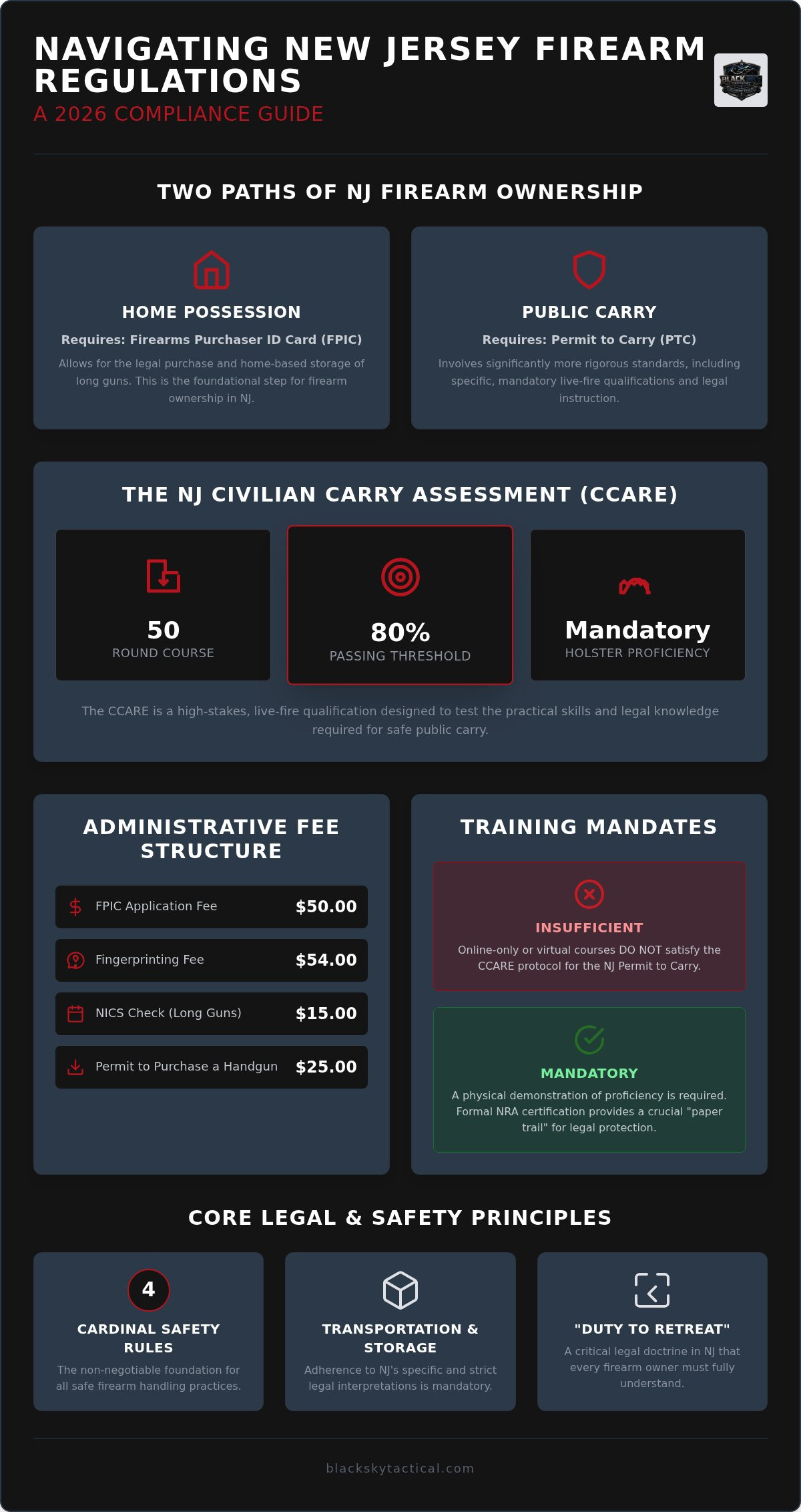
A critical distinction exists between owning a firearm for home defense and obtaining the authorization for public carry. While a Firearms Purchaser Identification Card (FPIC) allows for the purchase and home-based storage of long guns, the standards for a Permit to Carry (PTC) are significantly more rigorous, involving specific live-fire qualifications. Beyond state mandates, many private shooting clubs and insurance providers now require an "Introduction to Handgun Safety" certificate as a prerequisite for membership or coverage. This reflects a broader industry trend where documented, hands-on instruction is viewed as the only acceptable method for mitigating the inherent risks of firearm handling. Every owner carries a moral obligation to move beyond static manuals and seek professional guidance to ensure they don't become a liability to themselves or their community.
NJ’s Jurisdictional Requirements for 2026
The administrative process for obtaining an FPIC currently requires an initial fee of $50.00, supplemented by a $54.00 fingerprinting fee and a $15.00 NICS background check for long guns. Bergen County residents must navigate these requirements through the New Jersey State Police online portal, ensuring all local background check protocols are satisfied before a permit is issued. Local ordinances and the efficiency of your municipal police department often influence the total training timeline, making it vital to begin your certification early. Each Permit to Purchase a Handgun carries an additional $25.00 fee, and applicants must demonstrate a clear understanding of New Jersey gun laws to ensure they remain compliant during the transport of newly acquired firearms.
The Role of Professional Certification
Online-only courses are insufficient for meeting the state's rigorous standards, particularly regarding the Permit to Carry (PTC). New Jersey mandates a physical demonstration of proficiency, meaning virtual training cannot satisfy the Civilian Carry Assessment and Range Evaluation (CCARE) protocol. Obtaining a certificate from a recognized authority, such as the NRA, provides a standardized "paper trail" that is invaluable for legal liability protection. In the event of a legal dispute, having documented proof of professional instruction demonstrates a commitment to safety and adherence to the law. This formal certification acts as a professional syllabus, confirming that the owner has been briefed on the specific obligations and procedural steps required by the state's jurisdictional authorities.
Comparing NJ Gun Safety Course Options: Which One Do You Need?
Identifying the appropriate gun ownership safety course NJ involves a tiered evaluation of your specific legal and practical needs. The training landscape is divided into distinct categories, each serving a specific jurisdictional or educational purpose. The NRA Basic Pistol Course serves as the industry standard for fundamental marksmanship, providing the theoretical and practical groundwork for all subsequent training. Conversely, the NJ Permit to Carry (PTC) Qualification is a mandatory, high-stakes assessment that focuses on the legalities and mechanics of public carry. For those seeking to address specific administrative obligations, court-mandated safety courses provide a targeted curriculum for legal compliance. Beyond these entry-level mandates, tactical and home defense programs allow owners to move from passive safety awareness to proactive protection strategies tailored for high-stress environments.
Basic Safety vs. Carry Permit Training
The curriculum depth varies significantly between foundational safety instruction and defensive carry training. Basic courses prioritize the mechanics of the firearm, including grip, stance, and sight alignment, while carry permit training introduces complex defensive tactics and holster proficiency. The time commitment for NJ carry permit training is extensive, reflecting the state's rigorous CCARE standards established in late 2023. It's a natural progression to move from firearm safety for beginners NJ to these more advanced certifications. For applicants who prioritize administrative efficiency, selecting a program like the NJSNRA101 combined course allows for the fulfillment of both NRA fundamental standards and state-specific carry requirements within a structured, dual-purpose framework.
Specialty Programs for Families and Professionals
Specialty programs provide essential education for specific demographics, such as the Youth Safety Course, which focuses on removing curiosity and instilling the "Stop, Don’t Touch" protocol for household safety. Professionals and community leaders may find value in Violent Incident Command training, which prepares individuals for the logistical and psychological demands of emergency management during high-stakes events. For those requiring rapid skill acquisition or specialized remedial work, private firearm training offers a focused environment where instruction is tailored to the individual's pace and technical needs. These programs ensure that safety education isn't limited to the owner but extends to the entire family or organizational unit, creating a comprehensive culture of responsibility.
Essential Components of a Valid NJ Firearm Safety Curriculum
A valid gun ownership safety course NJ must integrate the four cardinal rules of firearm safety into every phase of instruction to ensure a standardized baseline of competence. These rules include treating every firearm as if it's loaded, keeping the finger off the trigger until the sights are on target, never pointing the muzzle at anything you aren't willing to destroy, and being certain of your target and what lies beyond it. These aren't merely suggestions; they're the non-negotiable pillars of responsible ownership. Beyond these rules, a comprehensive curriculum must cover the mechanical operation of various handgun actions, such as striker-fired, single-action, and double-action systems, alongside their respective mechanical safeties. Understanding ammunition types and the fundamentals of stable shooting positions provides the technical foundation necessary for both accuracy and safety on the range.
NJ Legal Standards and Use of Force
Instruction on the lawful use of deadly force in New Jersey is a critical component of any state-compliant program. Owners must understand the "Duty to Retreat" and the specific circumstances where the use of force is legally justifiable. Safe storage mandates are equally vital, requiring firearms to be kept unloaded and secured in a locked container, with ammunition stored separately to remain compliant with state law. For residents who navigate the jurisdictional boundaries of the tri-state area, reviewing the NY 18 hour concealed carry course is often necessary to ensure multi-state compliance and understanding of differing regional mandates.
Practical Skills and Range Safety
The practical application of safety protocols culminates in range-based evaluations where students must demonstrate holster proficiency and malfunction clearing. For those seeking a Permit to Carry (PTC), the ability to safely draw from a concealed holster is a mandatory requirement under the current CCARE protocol. This involves meticulous muzzle discipline and situational awareness to prevent accidents during high-stress manipulations. Students are also trained to identify and clear various firearm stoppages, such as failure to feed or failure to eject, without compromising the safety of others on the line. NJ Safe Handling Standards are defined as the proficient demonstration of muzzle control, trigger finger discipline, and mechanical safety operation during all administrative and live-fire evolutions as mandated by 2026 state protocols.
From Classroom to Range: The NJ Firearm Qualification Process
The transition from theoretical knowledge to practical proficiency is a structured, multi-phase progression designed to ensure total compliance with state mandates. This process begins in the classroom, where the administrative and legal nuances of a gun ownership safety course NJ are thoroughly dissected. Applicants engage in dry-fire exercises, allowing for the refinement of draw strokes and trigger control in a controlled environment without the use of live ammunition. Following this, a formal written examination serves as a mandatory gatekeeper, verifying that the student has retained the essential safety protocols and jurisdictional laws discussed during the instructional period.
The live-fire qualification represents the third and most critical phase of the certification process. Conducted under the direct supervision of a certified instructor, this evaluation utilizes the Civilian Carry Assessment and Range Evaluation (CCARE) protocol, which was established as the mandatory standard in late 2023. Applicants must fire a total of 50 rounds at an FBI Q target from distances of 3, 5, 7, 10, and 15 yards. Achieving a minimum passing score of 80 percent, or 40 hits within the scoring area, is required for certification. Upon successful completion, the instructor executes the necessary documentation, including the NJSP S.P. 182 form, which is the official record required for submission through the New Jersey State Police online portal.
NJ Carry Permit Shooting Standards
The CCARE protocol is an objective standard that focuses on demonstrable skill and safe handling under pressure. As part of a comprehensive gun ownership safety course NJ, the protocol requires firing from varying distances to simulate different defensive scenarios. It's imperative that you qualify with the specific firearm you intend to carry, as mechanical familiarity is essential for safety and accuracy. Many applicants experience anxiety during this high-stakes evaluation, but this can be mitigated through thorough preparation in an NRA basic pistol shooting course. This foundational training builds the muscle memory and confidence needed to meet the accuracy threshold during the timed qualification.
Equipment and Mental Preparation
Success on the range requires meticulous logistical and mental preparation. Applicants must arrive with required safety gear, including wrap-around eye protection and electronic ear protection that allows for clear communication with the instructor. Your holster must be a high-quality design that maintains its shape for safe re-holstering, as a demonstration of safe drawing and holstering is a mandatory part of the evaluation. Beyond gear, the NRA emphasizes a "Positive Attitude," which is a disciplined mental state focused on safety and precision. Once you achieve your certification, remember that a New Jersey Permit to Carry is valid for two years. To ensure you meet these rigorous 2026 standards, you can register for a professional qualification session to secure your legal certification.
Advancing Your Proficiency with Black Sky Tactical’s NJ Training
Achieving a passing score on the mandatory CCARE protocol is a significant milestone, but it represents only the beginning of a lifelong commitment to tactical and legal proficiency. For residents of Bergen County and Rockland County, identifying a gun ownership safety course NJ that balances administrative efficiency with instructional depth is paramount. Black Sky Tactical addresses this need through the NJSNRA101 program, which functions as a dual-purpose curriculum. This combined model ensures that students satisfy the rigorous New Jersey Conceal Carry mandates while simultaneously earning their NRA Basic Pistol certification, establishing a robust foundation for both legal compliance and technical skill. It's a structured approach that prioritizes professional responsibility over mere procedural completion.
The instructional staff at Black Sky Tactical provides expert guidance tailored to the specific needs of the local community, recognizing that many students navigate the jurisdictional complexities of the tri-state area. Beyond the basic requirements for a Permit to Carry (PTC), we offer advanced defensive pistol training and situational awareness programs designed for high-stakes environments. These courses move beyond the static range environment to address real-world variables, ensuring that your training remains relevant to your personal protection strategy. Joining the broader community through NRA membership enrollment also provides access to ongoing education and resources that help maintain your proficiency long after your initial certification is issued.
Why Choose a Combined NJ/NRA Course?
The primary advantage of the NJSNRA101 combined training model is the elimination of approximately 18 hours of redundant instruction that often occurs when state and national programs are pursued separately. By integrating the NRA’s fundamental marksmanship syllabus with the specific legal requirements of New Jersey, students receive a more cohesive and comprehensive educational experience. This is especially vital for individuals who reside in New Jersey but work in New York, as it provides a thorough understanding of the differing regulatory landscapes. For those who require personalized skill refinement, private firearm training sessions are available to address specific technical gaps before attempting the formal state qualification.
Next Steps: Securing Your Training Date
Finalizing your certification requires careful attention to the upcoming schedule for Bergen County sessions, as classes fill quickly due to the high demand for state-compliant training. Once you have selected a date, you should begin preparing your application materials for the NJ Permit to Carry, ensuring all administrative steps are aligned with your training timeline. Taking this step ensures you are prepared for the 2026 regulatory environment and any potential fee increases currently under legislative review. To secure your position in our next session and fulfill your state mandates, you may Register for the NJSNRA101 Combined Class. This commitment to professional instruction is the most effective way to ensure your status as a responsible, legally authorized firearm owner.
Securing Your Legal Compliance and Proficiency in 2026
Achieving a Permit to Carry in New Jersey requires a disciplined commitment to both administrative accuracy and technical skill. The transition from classroom theory to the 50 round CCARE live fire evaluation represents a rigorous standard designed to ensure only proficient individuals carry in public spaces. Selecting a comprehensive gun ownership safety course NJ residents can trust is the most critical step in establishing a documented history of responsible training. This professional certification serves as an essential component of your legal defense and demonstrates your strict adherence to the state's jurisdictional mandates.
Black Sky Tactical functions as a reliable bridge between your current skill level and the stringent requirements of the law. Our NJSP-compliant training is led by Certified NRA Instructors who specialize in guiding residents through the complexities of state-specific protocols. Whether you are located in Bergen, Rockland, or Orange County, we provide the meticulous instruction needed to navigate the 2026 regulatory landscape with confidence. You can Enroll in the NJSNRA101 Combined Conceal Carry & NRA Course today to fulfill your state obligations and build a foundation of safety that protects both you and your community. We look forward to assisting you in achieving your certification goals.
Frequently Asked Questions
Is a safety course required to buy a gun in NJ?
New Jersey law now requires all first-time applicants for a Firearms Purchaser Identification Card (FPIC) to complete a state-approved firearm safety course. This mandate ensures that every new owner has received formal instruction on safe handling, storage, and the specific legal obligations of gun ownership in the state. Applicants must provide proof of course completion during the online application process through the New Jersey State Police portal.
How long does a NJ gun safety certificate last?
The validity of a safety certificate depends on the specific permit being sought. While the training for an initial Firearms Purchaser Identification Card is generally a one-time requirement, the certification for a Permit to Carry (PTC) is tied to the permit's two-year expiration cycle. Applicants must undergo a new shooting qualification every two years to maintain their legal authorization for public carry, reflecting the state's emphasis on continuous proficiency.
Can I take a NJ gun safety course online?
You cannot satisfy the legal requirements for a Permit to Carry or an initial purchase permit through online-only training. New Jersey mandates a physical demonstration of proficiency, including safe handling and live-fire qualification, which must be conducted under the direct supervision of a certified instructor. While some theoretical components may be reviewed digitally, the final certification requires in-person attendance at a recognized gun ownership safety course NJ facility.
What is the difference between NRA Basic Pistol and the NJ PTC course?
The NRA Basic Pistol course focuses on the universal fundamentals of marksmanship, including grip, stance, and sight alignment, serving as an educational baseline for all shooters. In contrast, the NJ Permit to Carry (PTC) course is a specialized program centered on the Civilian Carry Assessment and Range Evaluation (CCARE) protocol. This qualification involves timed defensive shooting and holster proficiency specifically designed to meet the state's legal standards for public carry.
Do I need to bring my own gun to a NJ safety course?
For a Permit to Carry qualification, you are required to use the specific firearm you intend to carry, as the certification is linked to your ability to safely operate that specific mechanical system. For introductory safety courses, some instructors may provide rental firearms; however, it's highly recommended to train with your personal equipment to build necessary muscle memory. Always verify the specific equipment requirements with your instructor before the scheduled training date.
What happens if I fail the NJ carry permit shooting qualification?
If an applicant fails to achieve the mandatory 80 percent passing score on the CCARE protocol, they are not granted a certification for that session. Most professional instructors will require the individual to undergo remedial training or private instruction to address technical deficiencies before attempting the qualification again. There is no statutory limit on the number of attempts, but each session typically requires a separate registration and administrative fee for the range time.
Is the NJ hunter education course valid for a carry permit?
The New Jersey hunter education course is designed for wildlife conservation and hunting ethics and does not satisfy the requirements for a Permit to Carry. The state-mandated CCARE protocol involves specific defensive shooting standards, holster draws, and handgun-specific safety evaluations that are not covered in the hunting curriculum. To obtain a carry permit, you must complete a dedicated gun ownership safety course NJ that specifically addresses the civilian carry assessment and range evaluation.
How much time does the NJSNRA101 combined course take?
The NJSNRA101 combined course is a comprehensive program that typically spans 18 hours of instruction, often conducted over a two-day period. This duration allows for the full integration of the NRA Basic Pistol syllabus with the New Jersey-specific legal briefings and the mandatory CCARE live-fire qualification. This integrated approach is designed to provide maximum educational depth while satisfying all administrative requirements for a Permit to Carry in a single, efficient timeframe.


