
The traditional 'Run, Hide, Fight' protocol remains foundational; however, it's no longer sufficient for organizational leaders tasked with the legal and ethical responsibility of managing a high-stakes emergency before law enforcement arrives. You likely feel the weight of recent legislative shifts, such as the New York Retail Worker Safety Act that went into effect on June 2, 2025, which now mandates specific interactive training for many employers. This regulatory environment often creates more anxiety than clarity, leaving many to wonder how to bridge the gap between simple survival and professional incident management. This guide provides the clarity you need to navigate these complex mandates and implement professional Active shooter response training NY protocols that prioritize both compliance and the preservation of life.
We'll examine the specific requirements of current New York safety standards, resolve the confusion surrounding conflicting response acronyms, and outline the administrative steps necessary for effective violent incident command. By the end of this briefing, you'll possess a structured understanding of how to move from passive reaction to disciplined, proactive leadership during a crisis. Our focus remains on providing a methodical approach to safety that aligns with the highest professional and legal standards in the state.
Key Takeaways
- Evaluate the 2026 threat landscape and ensure organizational compliance with the New York Retail Worker Safety Act's specific interactive training requirements.
- Transition from passive survival techniques to the ALICE framework through specialized Active shooter response training NY designed for high-stakes environments.
- Master the Violent Incident Command (VIC) protocols required to maintain organizational leadership and facilitate seamless integration with the Incident Command System (ICS).
- Implement rigorous site assessment strategies and realistic drill schedules to identify and mitigate physical and procedural vulnerabilities in New York facilities.
- Leverage localized expertise in Rockland, Orange, and Westchester counties to secure professional certification that meets rigorous state safety standards.
Understanding the Active Shooter Threat Landscape in New York (2026)
The operational environment for New York organizations has undergone a significant transformation. In high-density jurisdictions such as Westchester and Rockland counties, the logistical complexity of an emergency response increases exponentially due to the concentration of personnel and the intricate physical layout of modern commercial facilities. While the New York State Gun Involved Violence Elimination (GIVE) initiative reported a 19% decrease in shooting incidents involving injury through June 2026, the potential for high-impact workplace violence remains a critical concern for administrative leaders. The data is clear. Although overall numbers may decline, the severity of individual incidents demands a level of preparedness that exceeds basic survival instincts. New York employers are bound by a rigorous legal and moral framework to maintain an environment free from recognized hazards, making professional Active shooter response training NY a procedural necessity rather than a discretionary luxury.
The Evolution of Workplace Violence Prevention
Legislative mandates have shifted the primary burden of preparedness from public law enforcement onto private organizations. The New York Retail Worker Safety Act, which became fully effective on June 2, 2025, requires employers to implement specific workplace violence prevention policies and provide interactive training to staff. This shift emphasizes the identification of pre-incident indicators, including significant behavioral changes, erratic communication patterns, or expressed grievances. Administrative controls, such as access management and the implementation of silent panic buttons, serve as the first layer of defense. These controls are designed to mitigate potential threats before they escalate into active violence, ensuring that the organization meets its statutory obligations under NYS law.
Defining the Professional Response Standard
There's a fundamental distinction between individual survival and organizational incident management. While an individual's priority is personal safety, an organization's priority must be the systematic management of the entire facility and its occupants. This requires the development of a formal, written Emergency Action Plan (EAP) that is tailored to the specific tactical vulnerabilities of the site. Engaging in Active shooter training allows leadership to move beyond the limitations of basic "Run, Hide, Fight" models toward a more comprehensive Violent Incident Command framework. Active shooter response is a multi-layered administrative and tactical discipline requiring the integration of policy, physical security controls, and incident management protocols. Investing in specialized Active shooter response training NY ensures that leadership remains capable of managing the immediate aftermath of an event before first responders assume control of the scene.
Core Response Protocols: Moving Beyond "Run, Hide, Fight"
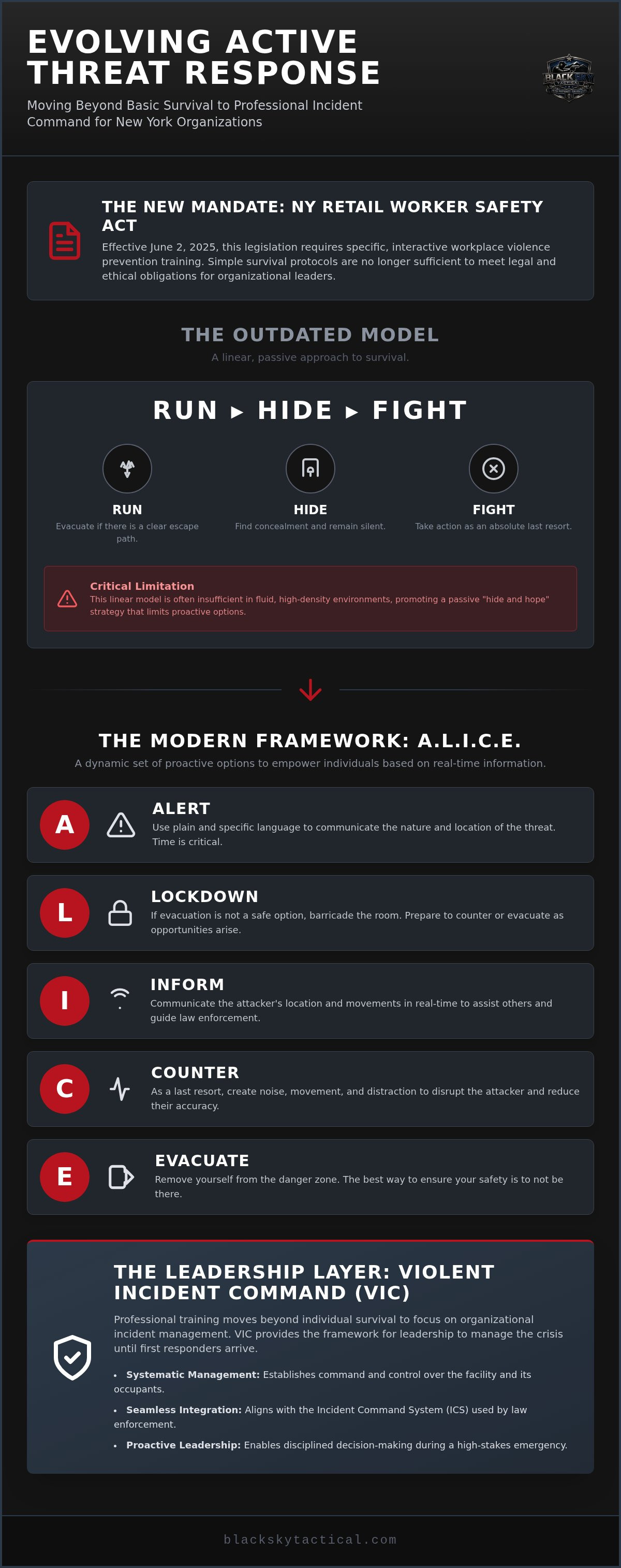
While the "Run, Hide, Fight" framework provided a necessary starting point for civilian safety, its linear nature often proves insufficient in the fluid and high-density environments found throughout New York. Professional Active shooter response training NY has largely transitioned toward the ALICE methodology, which stands for Alert, Lockdown, Inform, Counter, and Evacuate. Unlike traditional models, ALICE is not a chronological list of actions but a set of proactive options designed to empower individuals based on real-time information. The "Counter" component remains the most frequently misunderstood element of this protocol. It don't advocate for untrained individuals to engage in hand-to-hand combat; rather, it focuses on using noise, movement, and distraction to disrupt an attacker's accuracy and decision-making cycle. Mastering these techniques requires professional instruction to ensure they're applied only as a last resort and with maximum efficacy. Implementing these strategies requires a high degree of situational awareness, which must be integrated into daily professional routines to reduce response times during the critical first minutes of an incident.
The Limitations of Passive Lockdown
The traditional "hide and hope" strategy, where occupants remain silent and stationary in an unlocked room, has been largely discredited by modern safety analysis. Organizations are now shifting toward "enhanced lockdown" procedures. This involves the physical fortification of spaces using existing furniture, door-blocking devices, and administrative controls to create a significant barrier between occupants and a threat. The New York State Preparedness Training Center emphasizes that active participation in one's own safety significantly improves psychological resilience during a crisis. By moving from a passive state to an active one, survivors reduce the physiological effects of "freeze" responses, allowing for clearer decision-making under extreme stress.
Evacuation Strategies in Complex Environments
Evacuating a high-rise office building in Westchester or an NYC-adjacent facility presents unique logistical challenges, particularly regarding "bottleneck" traps in stairwells and lobbies. A professional evacuation plan must establish secondary and tertiary rally points that are located a safe distance from the facility and away from potential glass-fall zones. Real-time communication is essential during this phase. Utilizing internal notification systems to provide specific, actionable intelligence allows occupants to choose the safest egress route based on the threat's last known location. For those seeking to formalize these procedures within their own organizations, exploring Violent Incident Command Training can provide the necessary management framework to oversee such complex operations effectively.
The Role of Violent Incident Command in Emergency Management
The management of a violent critical incident requires a specialized administrative framework that goes beyond the tactical actions of individuals. Violent Incident Command (VIC) is the professional standard for organizational leaders in New York, providing a structured methodology to oversee facility safety during the chaotic interval before law enforcement arrives. This framework is designed to integrate seamlessly with the standard Incident Command System (ICS) utilized by New York first responders, ensuring that the transition from private management to public authority is orderly and efficient. Comprehensive Active shooter response training NY must include this command-level instruction to be considered truly effective, as it establishes a clear chain of responsibility and prevents the administrative paralysis that often occurs during a crisis. By assuming the role of Incident Commander during the critical first ten minutes, a designated leader can direct evacuations, manage internal communications, and provide essential data to emergency dispatchers.
Bridging the Gap to First Responders
Clear communication depends on the use of standardized terminology that is recognized by both internal staff and external agencies such as the New York State Police and local EMS units. Professional Active shooter response training NY focuses on teaching leaders how to provide concise, tactical updates regarding the location of the threat, the number of injured parties, and the status of facility lockdowns. This alignment is often informed by the training standards established at the NYS Preparedness Training Center, which emphasizes interoperability between various response tiers. For organizations operating across state lines, it's also useful to review regional variations in preparedness, such as those outlined in our guide on Tactical Response Training in NJ: A Comprehensive Reference Guide (2026). Managing the "Transition of Command" is a formal process where the internal Incident Commander briefs the arriving law enforcement lead, transferring all oversight responsibilities while remaining available as a subject matter expert on the facility's layout and occupants.
Post-Incident Command and Management
The responsibilities of the command staff don't conclude once the immediate threat is neutralized. Incident management shifts toward accounting for all personnel and overseeing the reunification process, which is often a complex logistical undertaking involving family members, media, and mental health professionals. Command leaders must coordinate with legal and administrative bodies to ensure that all regulatory reporting requirements, including those mandated by OSHA and New York State labor laws, are meticulously documented. This stage of management requires a disciplined approach to record-keeping and a thorough understanding of the organization's liability and duty of care obligations. Ultimately, incident command is a skill set that must be practiced through realistic simulations, as theoretical knowledge alone is insufficient for managing the intense physiological and cognitive demands of a real-world emergency.
Implementing a Proactive Safety Culture in NY Workplaces
Establishing a proactive safety culture requires more than the distribution of a handbook; it demands the systematic integration of vigilance into the daily operations of the organization. Professional Active shooter response training NY is most effective when supported by a workforce that understands the nuance of situational awareness. This involves training staff to recognize "clusters" of suspicious behavior, such as unusual surveillance of facility exits or erratic, out-of-character communication, rather than focusing on isolated incidents. A preparedness mindset replaces reflexive panic with calculated, decisive action. It ensures that every individual understands their specific role within the larger safety framework. This cultural shift is essential for reducing the critical seconds of hesitation that often occur during the onset of a violent event.
Site Assessments and Physical Security
Organizations operating in Orange and Rockland counties must conduct formal site assessments to evaluate the viability of safe rooms and the efficacy of current access control systems. These audits should be measured against 2026 security standards, which prioritize physical barriers that can withstand forced entry attempts and provide immediate sanctuary. During the "Counter" phase of an incident, environmental awareness becomes a primary survival tool. Staff should be trained to identify improvised weapons within their immediate vicinity and utilize the physical layout of their workspace to disrupt an intruder's decision-making cycle. Regular, realistic drills provide the necessary data to refine these protocols. They move beyond the predictable nature of standard fire safety evacuations to address the dynamic and unpredictable variables of a violent encounter. To secure a professional audit of your facility's readiness, consider enrolling in Violent Incident Command Training.
The Human Element: Training and Mental Readiness
The physiological response to extreme stress often results in a "freeze" response, which can be significantly mitigated through repetitive, professional training. Addressing employee concerns and potential trauma is a necessary component of implementing these drills effectively. Transparency regarding the purpose and procedures of the training helps build organizational trust and reduces the anxiety often associated with workplace safety mandates. It's vital to acknowledge that mental readiness is as important as physical preparedness. For individuals seeking a deeper understanding of personal protection within the legal framework of the state, reviewing the Comprehensive Guide to the NY 18-Hour Concealed Carry Course (2026) provides essential context on current NYS requirements. By incorporating Active shooter response training NY into the annual professional development cycle, organizations can ensure that their personnel are equipped to respond with clarity and purpose when faced with a critical incident.
Professional Training Solutions with Black Sky Tactical
Black Sky Tactical provides a specialized suite of programs designed to address the specific tactical and administrative requirements of New York professionals. Our local expertise in Rockland, Orange, and Westchester counties allows us to offer instruction that is grounded in the jurisdictional realities of the region. This localized focus is essential, as first responder protocols and legal mandates can vary significantly across the Hudson Valley and Bergen County. Unlike national providers who may rely on generic, blended learning modules, our approach prioritizes the legal and tactical reality of the NY/NJ area. By integrating Violent Incident Command Training with advanced situational awareness and, where applicable, CCW proficiency, we equip leaders with a comprehensive skill set. This integrated approach ensures that Active shooter response training NY is not merely a lecture but a rigorous preparation for real-world scenarios.
Tailored Programs for NY Organizations
We recognize that a retail environment in a high-traffic urban center requires a different response strategy than a corporate office in a suburban county. Our programs are customized to fit specific industry needs, including K-12 education, corporate management, and retail operations. We move beyond simple "check-the-box" compliance by conducting in-person instruction that accounts for your specific facility layout and personnel requirements. This no-nonsense instruction focuses on genuine operational readiness, ensuring that every administrative control and tactical protocol is viable within your unique environment. Our instructors emphasize the practical application of the ALICE methodology and the VIC framework, ensuring that your staff don't just understand the theory but can execute the necessary actions under extreme stress.
Next Steps for Safety Leadership
Maintaining a secure environment requires a commitment to continuous education and the regular renewal of safety certifications. Leadership must ensure that their Emergency Action Plans are not static documents but evolving strategies that reflect current 2026 standards. Scheduling a professional site assessment or a private training session for your team is the first step toward achieving this standard of professional excellence. Black Sky Tactical serves as a disciplined bridge between complex state requirements and practical, high-stakes preparedness. To begin the process of formalizing your organization's readiness, you can Contact Black Sky Tactical for Professional Violent Incident Command Training and secure the expertise necessary to lead during a critical incident. Incorporating Active shooter response training NY into your annual professional development cycle ensures that your personnel remain equipped to respond with clarity and purpose when faced with a violent threat.
Advancing Organizational Resilience and Incident Preparedness
Transitioning from a passive survival mindset to a proactive command framework is the definitive standard for modern organizational safety. By integrating the ALICE methodology with a structured chain of responsibility, leaders can effectively bridge the critical gap between the onset of an incident and the arrival of law enforcement. This disciplined approach not only fulfills your moral duty of care but also ensures compliance with the evolving legislative mandates in New York. Professional Active shooter response training NY provides the necessary skills to manage these complex variables with calm assurance and procedural clarity.
Black Sky Tactical offers specialized Violent Incident Command programs that are meticulously tailored for the unique facility layouts and personnel needs of Rockland, Orange, and Westchester county organizations. Our local expertise ensures that your training remains grounded in the administrative and tactical realities of the NY/NJ region, moving beyond simple compliance toward genuine operational readiness. Secure your organization with professional Violent Incident Command training from Black Sky Tactical. You have the capacity to transform your workplace into a resilient environment through expert guidance and rigorous, ongoing preparation.
Frequently Asked Questions
Is active shooter training mandatory for NY businesses in 2026?
Active shooter training is mandatory for specific New York employers under the New York Retail Worker Safety Act, which became effective on June 2, 2025. Retail employers with 10 or more employees must implement a workplace violence prevention policy and provide interactive training. For organizations with 50 or more employees, this training is required annually; whereas those with 10 to 49 employees must provide it upon hiring and every two years thereafter.
What is the difference between ALICE and Run, Hide, Fight protocols?
The primary distinction lies in the transition from a linear, passive model to a multi-option, proactive framework. While "Run, Hide, Fight" provides a basic sequence of actions, the ALICE methodology (Alert, Lockdown, Inform, Counter, Evacuate) empowers individuals to use real-time information to choose the safest response. This approach prioritizes active participation and situational awareness, which are central themes in professional Active shooter response training NY programs designed for modern facilities.
How often should active shooter drills be conducted in a workplace?
Under current New York law, the frequency is determined by the size of the workforce, with larger retail employers required to conduct training at least annually. Beyond legal mandates, safety professionals recommend conducting realistic drills quarterly or bi-annually to ensure that protocols remain fresh in the minds of personnel. Regular practice reduces the physiological "freeze" response and allows the organization to identify and rectify tactical vulnerabilities in their specific facility layout.
Does Black Sky Tactical provide on-site training in Westchester and Rockland counties?
Yes, Black Sky Tactical provides specialized on-site instruction throughout Rockland, Orange, and Westchester counties, as well as Bergen County in New Jersey. Our mobile training teams conduct thorough site assessments and facilitate scenario-based drills tailored to the unique physical security challenges of your specific location. This localized approach ensures that your organization receives instruction that is relevant to regional law enforcement response times and local Active shooter response training NY requirements.
What is Violent Incident Command and who should be trained in it?
Violent Incident Command (VIC) is a professional administrative framework designed for organizational leaders to manage a critical incident before law enforcement assumes control. It's intended for department heads, security managers, and executive leadership who are responsible for facility oversight. VIC focuses on establishing a chain of responsibility, managing internal communications, and ensuring a seamless transition of command to arriving first responders, preventing administrative paralysis during high-stakes emergencies.
Can active shooter training help with general workplace violence prevention?
Comprehensive training significantly enhances general workplace violence prevention by teaching staff to recognize pre-incident behavioral indicators and de-escalation techniques. By establishing a proactive safety culture, organizations can identify potential threats, such as erratic communication or expressed grievances, before they escalate into physical violence. These programs integrate administrative controls and situational awareness, providing a robust defense against various forms of workplace aggression and unauthorized facility access.
What are the first steps an individual should take when an incident begins?
An individual's first priority is to assess the immediate threat and determine the safest course of action based on the location of the intruder. If a safe egress route is available, evacuation should be the immediate choice; otherwise, occupants must move to a secure location and implement enhanced lockdown procedures. Once personal safety is stabilized, alerting others and providing concise, tactical information to emergency dispatchers becomes the secondary objective to facilitate a rapid response.
How does NYS law enforcement typically respond to an active shooter call?
NYS law enforcement personnel are trained to bypass the injured and move directly toward the sound of gunfire to neutralize the threat as quickly as possible. Arriving officers prioritize the cessation of violence over all other tactical objectives. It's critical for occupants to keep their hands visible and follow all verbal commands without hesitation. Secondary teams, often including tactical medics, will enter the facility only after the "hot zone" has been sufficiently cleared by initial entry teams.


