
Tactical proficiency is not defined by the equipment one owns but by the cognitive ability to execute precise protocols under extreme stress. For residents seeking tactical response training NJ offers a complex landscape where legal compliance is as critical as physical skill. The recent July 2026 judicial rulings regarding firearm specifications have added new layers of responsibility for every permit holder. It's common to feel uncertain about how these administrative changes impact your training requirements or your legal standing during a critical incident.
We understand that the distinction between tactical gear and tactical training is often blurred, leaving many professionals and citizens unsure of their actual readiness. This guide serves as a comprehensive reference for New Jersey residents, providing a disciplined breakdown of tactical response protocols and the legal requirements governing the use of force. You'll learn the specific progression from foundational skills to advanced disciplines like Violent Incident Command. By outlining the clear training pathways available in Bergen County, this article ensures you have the knowledge to handle violent incidents with both tactical precision and strict adherence to the law.
Key Takeaways
- Understand why tactical response training NJ is defined as a cognitive discipline that prioritizes situational awareness and coordinated incident management over basic marksmanship.
- Explore the procedural framework of Violent Incident Command, which is a specialized protocol designed to manage active threats within public or private jurisdictions.
- Review the 2026 administrative mandates for the New Jersey Permit to Carry (PTC) to ensure your training meets current state standards and legal obligations.
- Learn to identify specific pre-attack indicators in various environments, providing the necessary foundation for maintaining situational awareness during a high-stakes encounter.
- Identify streamlined training pathways in Bergen County, including the NJSNRA101 course that combines state-specific carry requirements with foundational pistol instruction.
Defining Tactical Response Training for NJ Residents
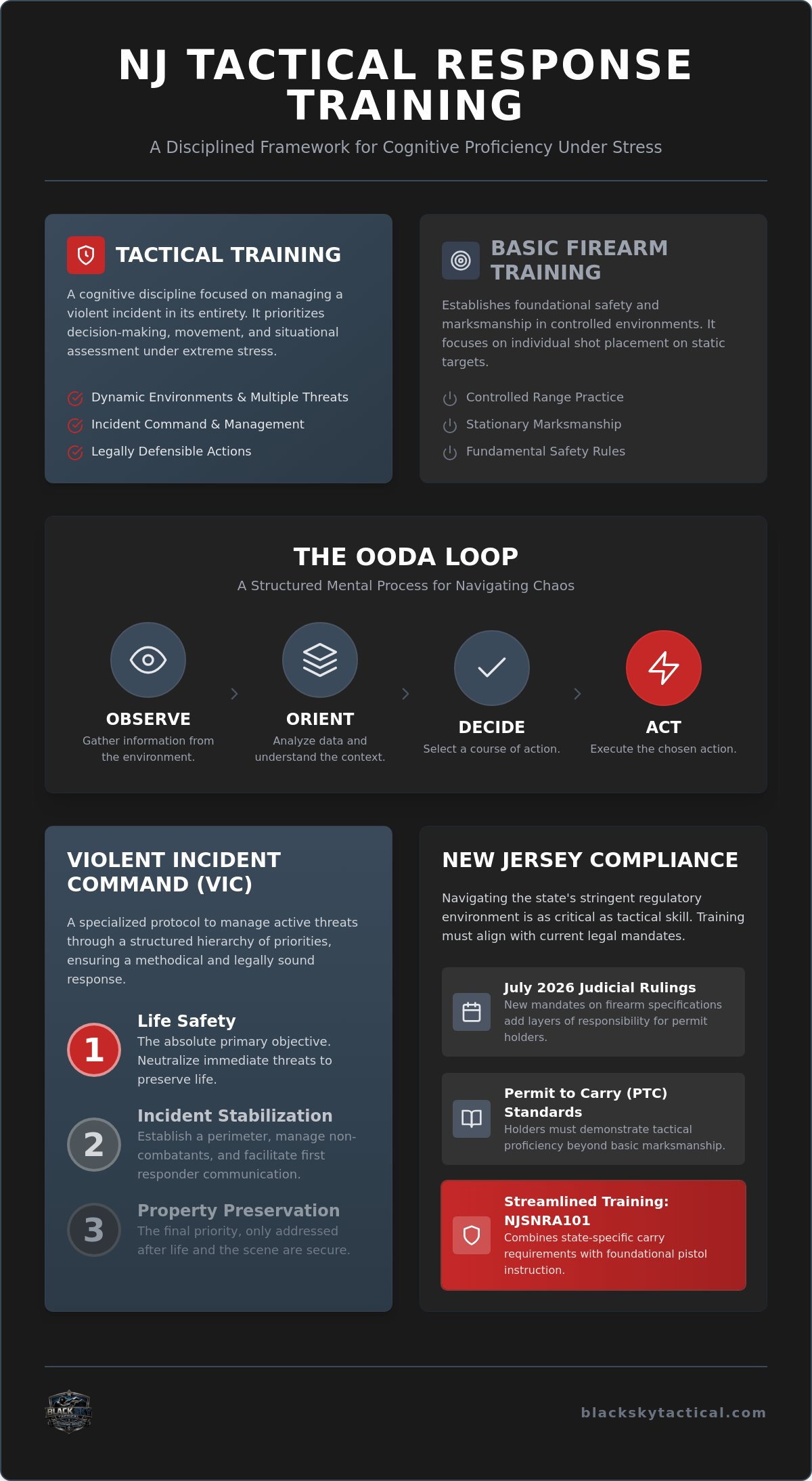
Tactical response training NJ is defined as a structured educational framework that prioritizes the neutralization of threats through disciplined movement, environmental assessment, and rapid decision-making. Unlike traditional range practice, which often emphasizes static marksmanship and individual shot placement, tactical training focuses on the management of a violent incident in its entirety. This discipline is modeled after the rigorous standards utilized by a Police tactical unit, adapted for the legal and situational realities faced by civilians and private security professionals in New Jersey. The primary objective is to move beyond mere firearm manipulation and develop a command mindset that remains functional under the physiological effects of extreme stress.
In the context of New Jersey's stringent regulatory environment, this training serves as a critical bridge between basic firearm safety and the practical application of defensive skills. It integrates state-mandated safety requirements with advanced protocols, ensuring that every action taken is both tactically sound and legally defensible. Participants are taught to treat a violent encounter as a series of evolving problems that require specific procedural solutions, including:
- Coordinated movement and use of cover to minimize exposure.
- Situational assessment to distinguish between immediate threats and non-combatants.
- Incident management protocols that facilitate clear communication with first responders.
- Rapid resolution of equipment malfunctions while maintaining environmental awareness.
Tactical vs. Basic Firearm Training
The distinction between these two levels of instruction is significant. Basic training is designed to establish foundational safety and marksmanship, frequently through the NRA basic pistol shooting course, which focuses on stationary targets and controlled environments. Tactical response training NJ introduces variables that mirror real-world complications, such as multiple threats, low-light conditions, and the necessity of movement. For New Jersey Permit to Carry (PTC) holders, achieving tactical proficiency is a logical and necessary progression to ensure they can meet their professional and legal obligations during a high-stakes encounter.
The Role of Mental Preparedness
A central component of this training is the management of cognitive load. When a violent incident occurs, the brain's ability to process information is often compromised by a surge in adrenaline. Tactical training utilizes the OODA Loop, which stands for Observe, Orient, Decide, and Act, to provide a structured mental process for navigating chaos. By practicing these cycles in a controlled, professional environment, students develop the sobriety and professional responsibility required for NJ compliance. This mental discipline ensures that every decision made is deliberate, grounded in reality, and focused on the preservation of life within the boundaries of the law.
The Pillars of Tactical Incident Management and Command
Effective tactical response training NJ requires more than individual technical proficiency; it necessitates a comprehensive understanding of incident management and command structures. While basic shooting skills are mechanical, the ability to manage a violent encounter involves a cognitive transition from a reactive state to a command state. This command discipline ensures that actions are coordinated, legally defensible, and focused on the immediate stabilization of a life-threatening situation. It's this transition that distinguishes a disciplined responder from a person who merely possesses equipment without the requisite procedural knowledge.
Violent Incident Command Training
Violent Incident Command (VIC) is a specialized protocol designed to manage active threats within public or private environments through a structured hierarchy of priorities. This training framework establishes that the primary objective is life safety, followed by incident stabilization and the preservation of property, in that exact order. Whether applied within a corporate security setting or by a private citizen, the command structure provides a methodical approach to identifying the threat, establishing a perimeter, and facilitating the arrival of law enforcement. This systematic approach is increasingly relevant as the state updates its NJ Firearm Laws and Training Mandates to reflect modern readiness standards. Engaging in Violent Incident Command Training allows individuals to function as a disciplined bridge between the initial incident and the professional response.
Tactical Communication Protocols
Communication is a primary tactical tool that serves to either de-escalate a potential conflict or coordinate a defensive response. In the context of tactical response training NJ, students learn to utilize verbal commands that are clear, authoritative, and designed to minimize ambiguity for both the aggressor and potential bystanders. When an incident escalates, the focus shifts to reporting protocols where the individual must provide concise, objective data to 911 dispatchers. This data should include the nature of the threat, the presence of firearms, and their own physical description to prevent identification errors by responding officers. Hand signals and non-verbal coordination methods are also taught to maintain team cohesion in high-decibel environments where verbal communication may fail.
Environmental assessment remains a constant requirement throughout this process. Practitioners must distinguish between cover, which stops projectiles, and concealment, which merely obscures vision, while simultaneously identifying primary and secondary egress routes. Post-incident procedures are equally critical, requiring meticulous scene management and the preservation of evidence to assist in legal documentation. This comprehensive approach ensures that every phase of an encounter, from the initial observation to the final administrative report, is handled with the highest degree of professional responsibility and sobriety.
Navigating NJ Firearm Laws and Training Mandates
New Jersey maintains a regulatory framework for firearm ownership and carry that is among the most demanding in the United States. For individuals pursuing tactical response training NJ, understanding these statutory requirements is as essential as the physical application of defensive skills. The legal landscape in 2026 continues to evolve, particularly following the removal of the "justifiable need" standard and the subsequent expansion of "sensitive place" restrictions. These complexities create a high-stakes environment where a single administrative oversight or a lack of documented proficiency can lead to severe legal consequences. Professional training functions as a necessary bridge, ensuring that permit holders don't just meet the letter of the law but possess the disciplined judgment required to navigate its nuances.
NJ Carry Permit Training Requirements
The standards for obtaining and maintaining a Permit to Carry (PTC) in New Jersey involve mandatory live-fire qualification and a thorough understanding of the state's use-of-force statutes. These requirements are designed to ensure that any individual carrying a firearm in public spaces possesses a verified level of competency. For residents who commute between jurisdictions, particularly those traveling into Rockland or other New York counties, the training requirements become even more intricate. Many professionals find it necessary to complete the NYS 18-hour concealed carry course to maintain multi-state compliance. This cross-jurisdictional proficiency is a hallmark of a responsible owner who recognizes that legal boundaries don't diminish the need for professional standards.
Legal Compliance and Documentation
Documenting your training history is a critical component of a responsible defensive strategy. In the event of a critical incident, the ability to produce a comprehensive training log that details your participation in tactical response training NJ can serve as vital evidence of your commitment to safety and proficiency. This documentation should include certifications from NRA-certified instructors, as these credentials carry significant weight in demonstrating that your instruction met recognized national and state standards. Relying on uncertified or "informal" training can create significant liability during legal discovery.
It's also vital to avoid 'tactical' pitfalls that project an aggressive or vigilante persona rather than one of professional responsibility. New Jersey courts often scrutinize the intent and mindset of individuals involved in self-defense scenarios. By focusing on training that emphasizes de-escalation, incident command, and strict adherence to the law, you establish a record of sobriety and restraint. This disciplined approach ensures that your training is viewed as a tool for public safety rather than a source of legal vulnerability. Black Sky Tactical prioritizes this administrative and legal clarity, providing a structured pathway that aligns your physical skills with New Jersey's rigorous legal expectations.
Developing Situational Awareness and Defensive Proficiency
Situational awareness serves as the primary defensive layer in any tactical response training NJ framework. It's the active process of perceiving environmental elements, comprehending their meaning, and projecting their future status. In high-density environments like Bergen County retail centers or NJ Transit hubs, identifying pre-attack indicators allows for proactive avoidance rather than reactive engagement. These indicators may include target glancing, unnatural gait, or conspicuous loitering. This cognitive preparation ensures that a responder isn't surprised by an escalating threat, which is crucial for maintaining both tactical and legal control during a violent encounter.
For those beginning their defensive journey, integrating private firearm training for beginners in NY provides the essential technical foundation required before advancing to complex tactical scenarios. Developing these skills in a personalized, one-on-one environment ensures that safety protocols become subconscious. This allows the student to eventually focus on environmental variables and command decisions rather than basic equipment manipulation, which is a prerequisite for advanced tactical response training NJ.
The Color Code of Awareness
We utilize Cooper’s Color Code to categorize the mental state of a responder and manage the cognitive load of public carry. Condition White represents a state of total unawareness, which is an unacceptable condition for a permit holder in any public jurisdiction. We train students to maintain Condition Yellow, a state of relaxed alertness where one is aware of their surroundings without being paranoid. If a specific threat is identified, the responder moves to Condition Orange for evaluation and, if necessary, Condition Red for action. Managing physiological responses, such as tunnel vision and auditory exclusion, is a core component of this mental discipline. These phenomena can severely limit the ability to perceive secondary threats or hear commands from law enforcement, making deliberate, stress-inoculated practice essential.
Advanced Defensive Shooting Skills
Physical proficiency must strictly match mental readiness to ensure a successful outcome. This involves the ability to draw from concealment under significant time pressure while maintaining a safe and efficient draw stroke that complies with NJ holster standards. Training also addresses shooting from non-traditional positions, such as kneeling or from behind cover, to minimize exposure to return fire. Clearing malfunctions while maintaining focus on the threat environment is another critical skill that must be mastered. These techniques are practiced with a focus on professional responsibility and sobriety, ensuring that the use of force remains a disciplined last resort. To begin your progression toward professional proficiency, explore our Private Firearm Training options today.
Professional Tactical Training Solutions in Bergen County
Black Sky Tactical functions as a professional institution focused on safety, education, and strict adherence to the law. For those seeking tactical response training NJ, we provide a disciplined and no-nonsense environment where the gravity of firearm ownership is always respected. Our instructors are knowledgeable experts who serve as a bridge between the user and the complex administrative requirements of the state. Because we operate within the specific jurisdictional needs of Bergen and Rockland counties, our training protocols are tailored to the legal realities of this region, ensuring that your skills remain relevant to your daily environment.
One of our core offerings is the NJSNRA101, which is a combined NJS Conceal Carry and NRA Basic Pistol Class. This course provides a streamlined path to both legal compliance and practical proficiency, ensuring that participants meet the high-level standards required for a New Jersey Permit to Carry in 2026. Beyond individual carry, we provide customized programs for families, including the Youth Safety Course and comprehensive home defense training. These programs are designed to instill a sense of professional responsibility within the household, ensuring every family member understands their role in maintaining a secure environment and follows official safety procedures.
The Black Sky Tactical Advantage
Our training philosophy is rooted in integrity and realism, avoiding the superficial marketing fragments often found in the industry. We maintain small class sizes to facilitate personalized instruction and complex explanatory dialogue, which is necessary to ensure that no detail of a state mandate is misunderstood. This approach reflects the procedural and certification-heavy nature of modern firearm ownership, where accuracy in both physical skill and administrative documentation is paramount. We don't just teach you how to shoot; we prepare you to manage the logistical and legal obligations that follow a critical safety event with calm assurance and meticulous attention to detail.
Getting Started with Tactical Response
For new NJ permit applicants, we recommend a methodical course progression that begins with foundational safety before moving into specialized disciplines like Violent Incident Command. Scheduling Private Firearm Training allows for tailored skill development that addresses your specific requirements in a controlled, one-on-one setting. This deliberate pace ensures that you absorb the gravity of the information provided without the distractions of a larger group. The rhythm of our instruction is designed to move you logically from general safety concepts to the administrative details of carry compliance. When you're ready to commit to a higher standard of readiness, you can Register for Tactical Response Training at Black Sky Tactical to begin your professional syllabus.
Establishing Your Path to Tactical Readiness
Developing a professional command mindset requires a commitment to both physical proficiency and administrative precision. We've outlined how tactical response training NJ functions as a cognitive discipline where situational awareness and incident management are prioritized over static shooting. By adhering to the rigorous 2026 standards for carry permits and maintaining a disciplined training history, you ensure that your defensive strategy remains legally defensible and professionally responsible.
Black Sky Tactical serves as your bridge to these complex state mandates through our Bergen County local training facility. Our expert NJ/NY certified instructors deliver comprehensive 18-hour compliance courses that focus on the procedural and certification-heavy nature of modern safety. This methodical approach ensures that every student absorbs the gravity of their responsibilities while building a functional skill set for high-stress environments.
Secure Your Spot in Our Next NJ Tactical Response Session to begin your progression toward a higher standard of readiness. We're dedicated to providing the expert guidance necessary for you to navigate New Jersey's regulatory landscape with confidence and sobriety.
Frequently Asked Questions
What is the difference between tactical training and standard target practice?
Standard target practice focuses primarily on the mechanical fundamentals of marksmanship, such as sight alignment and trigger control, within a controlled range environment. Tactical response training NJ expands this foundation by introducing variables like environmental assessment, movement, and cognitive decision-making under stress. While target practice is about the individual shot, tactical training is about the management of a violent incident from its initial observation to its legal resolution.
Does New Jersey require specific tactical training for a concealed carry permit?
New Jersey mandates a specific training qualification course that includes a classroom component on the state’s Use of Force policy and a live-fire proficiency test. While the state doesn't explicitly label this "advanced tactical" training, the 2026 standards require a high level of verified competency. Many permit holders find that standard qualification is only a baseline, necessitating further tactical instruction to handle real-world complexities safely and legally.
Can civilians enroll in Violent Incident Command training in NJ?
Civilians and private security professionals are encouraged to enroll in Violent Incident Command training to develop a structured hierarchy for managing active threats. This protocol establishes clear priorities, starting with life safety and incident stabilization, which are applicable in corporate offices, retail spaces, or transit hubs. It provides the necessary procedural framework to coordinate effectively with responding law enforcement agencies during a critical safety event.
How often should I undergo tactical response training to remain proficient?
Professional standards suggest that tactical skills should be refreshed at least once per year to manage the perishable nature of high-stress decision-making. For context, an October 2025 directive now requires all New Jersey law enforcement officers to complete approved tactical training every five years. Private citizens often require more frequent sessions to maintain the OODA loop efficiency and subconscious safety habits required in a public carry environment.
What equipment is required for a tactical response course in Bergen County?
Participants typically need a reliable firearm, a high-quality holster that complies with NJ safety standards, at least three magazines, and appropriate eye and ear protection. Because tactical response training NJ often simulates daily carry conditions, instructors may require specific concealment garments or belt systems. It's essential to review the specific equipment list provided in your course syllabus to ensure all gear meets the facility's safety requirements.
Is tactical training suitable for beginners, or should I start with basic pistol classes?
Beginners must start with foundational instruction, such as the NJSNRA101 course, before attempting tactical disciplines. Tactical training assumes that the student has already mastered safe firearm manipulation and basic marksmanship. Attempting to manage the high cognitive load of tactical scenarios without these subconscious skills can lead to safety risks and an inability to absorb the complex instructional material provided during advanced sessions.
How does tactical response training address the legal use of force in NJ?
Tactical instruction integrates New Jersey’s Use of Force statutes directly into every practical exercise to ensure legal compliance. Students are taught to apply the OODA loop—Observe, Orient, Decide, Act—within the strict boundaries of state law, emphasizing de-escalation as the primary tactical tool. This approach ensures that force is only used as a disciplined last resort, with every action supported by the sobriety and professional responsibility required by the jurisdiction.


