
In New York State, the most critical component of firearm ownership isn't the hardware you choose, but your disciplined adherence to the administrative landscape that governs it. For those seeking to understand NY firearm laws for new gun owners, the process often feels like a series of moving targets due to the rigorous standards established by the Concealed Carry Improvement Act. It's natural to feel a sense of anxiety regarding accidental non-compliance, especially when a single procedural error can lead to the denial of your application or significant legal complications.
You deserve a reliable, no-nonsense resource that bridges the gap between complex state mandates and your goal of lawful possession. This article provides a comprehensive roadmap for navigating the permitting process with professional precision. We'll detail the specific requirements for the mandatory 18-hour training course, which includes 16 hours of classroom instruction and two hours of live-fire qualification. By following this structured guide, you'll gain the clarity needed to identify your specific license type, complete the necessary safety certifications, and submit a compliant application to your local licensing authority.
Key Takeaways
- Distinguish between the "Possess on Premises" and "Concealed Carry" licenses to ensure your application aligns with your specific legal requirements and intended use.
- Understand the comprehensive mandates of NY firearm laws for new gun owners, including the 18-hour training requirement that combines classroom instruction with live-fire proficiency standards.
- Navigate the administrative application process with precision, from the submission of the PPB-3 form to the completion of mandatory fingerprinting and background checks.
- Identify the strict legal boundaries regarding "Sensitive Locations" and safe storage obligations to maintain permanent compliance and professional responsibility.
Navigating the New York State Firearm Licensing Framework
The legal framework governing NY firearm laws for new gun owners is characterized by a multi-tiered licensing structure that prioritizes administrative vetting over immediate access. It's essential to distinguish between the "Possess on Premises" license, which restricts the firearm to a specific dwelling or business location, and the "Concealed Carry" license, which permits the carrying of a handgun in public spaces subject to strict limitations. Since the implementation of the Concealed Carry Improvement Act (CCIA), the standards for issuance have become more rigorous, requiring applicants to provide extensive character references and historical data for review. A New York Gun Laws Overview reveals that these regulations extend to long guns as well; as of September 2022, individuals must also obtain a specific license to purchase or take ownership of semi-automatic rifles.
The final authority in the issuance of these permits rests with the local licensing officer, who is typically a County Court Judge or a Police Commissioner. This official evaluates the application to ensure the candidate meets all statutory requirements and maintains the necessary qualifications for safe ownership. While the state sets the baseline, the procedural rhythm is often dictated by the specific administrative preferences and staffing levels of the jurisdictional office overseeing the background investigation.
Eligibility and Prohibited Possessors
Applicants must be at least 21 years of age to apply for a handgun or semi-automatic rifle license. New York utilizes a "good moral character" standard, which functions as a primary vetting mechanism during the investigation phase. Common disqualifiers include felony convictions, "serious offenses" as defined by state law, or a history of involuntary mental health commitments. Administrative accuracy is vital. Any omission regarding past legal encounters can be interpreted as a lack of candor, leading to an immediate denial of the permit application.
County-Specific Jurisdiction
Jurisdictional authority is tied strictly to your primary residence or principal place of business. In Rockland, Orange, and Westchester counties, the application procedures involve specific local forms and fingerprinting schedules that may vary slightly. It's necessary to coordinate with your specific county clerk's office to ensure you're utilizing the most current version of the local supplemental materials. This local oversight ensures that the licensing officer has a direct connection to the community where the firearm will be kept.
The Procedural Steps to Obtaining a NY Pistol License
The administrative process begins with the completion of the State of New York Pistol/Revolver License Application, known as the PPB-3. Accuracy is paramount. While this form is standardized at the state level, applicants in Rockland, Orange, or Westchester counties must also complete specific supplemental packets provided by their respective county clerk's office. Following the submission of these documents, you'll be required to undergo a comprehensive fingerprinting process that facilitates a background check through the National Instant Criminal Background Check System (NICS). For the most current regulatory updates and access to necessary state forms, refer to the Official NYS Gun Safety Information portal.
Under the current framework of NY firearm laws for new gun owners, the vetting process has expanded to include a review of your social media history and the provision of four character references. These references must be non-family members who can attest to your "good moral character." In counties like Westchester and Rockland, these individuals often must reside within the same jurisdiction for a specified period, typically six months to a year. Ensuring your administrative file is complete is a prerequisite for success, much like the preparation found in professional private firearm training.
The Interview Process
Investigators from the local Sheriff’s Office or Police Department will conduct an interview to verify the information provided in your application. They may inquire about your history, residence, and specific need for a license, particularly for those seeking business-related carry permits. You should have all supporting documentation, such as business licenses or proof of employment, organized and ready for inspection. Preparation prevents delays.
Application Timelines and Recertification
Once issued, concealed carry permits are no longer "lifetime" documents in New York. You're required to recertify your license every three years through the New York State Police online portal. This is a mandatory obligation. If you move between counties, you must initiate a formal transfer of records through your current county clerk to maintain the legal standing of your permit under NY firearm laws for new gun owners.
Mandatory Training: The 18-Hour Concealed Carry Requirement
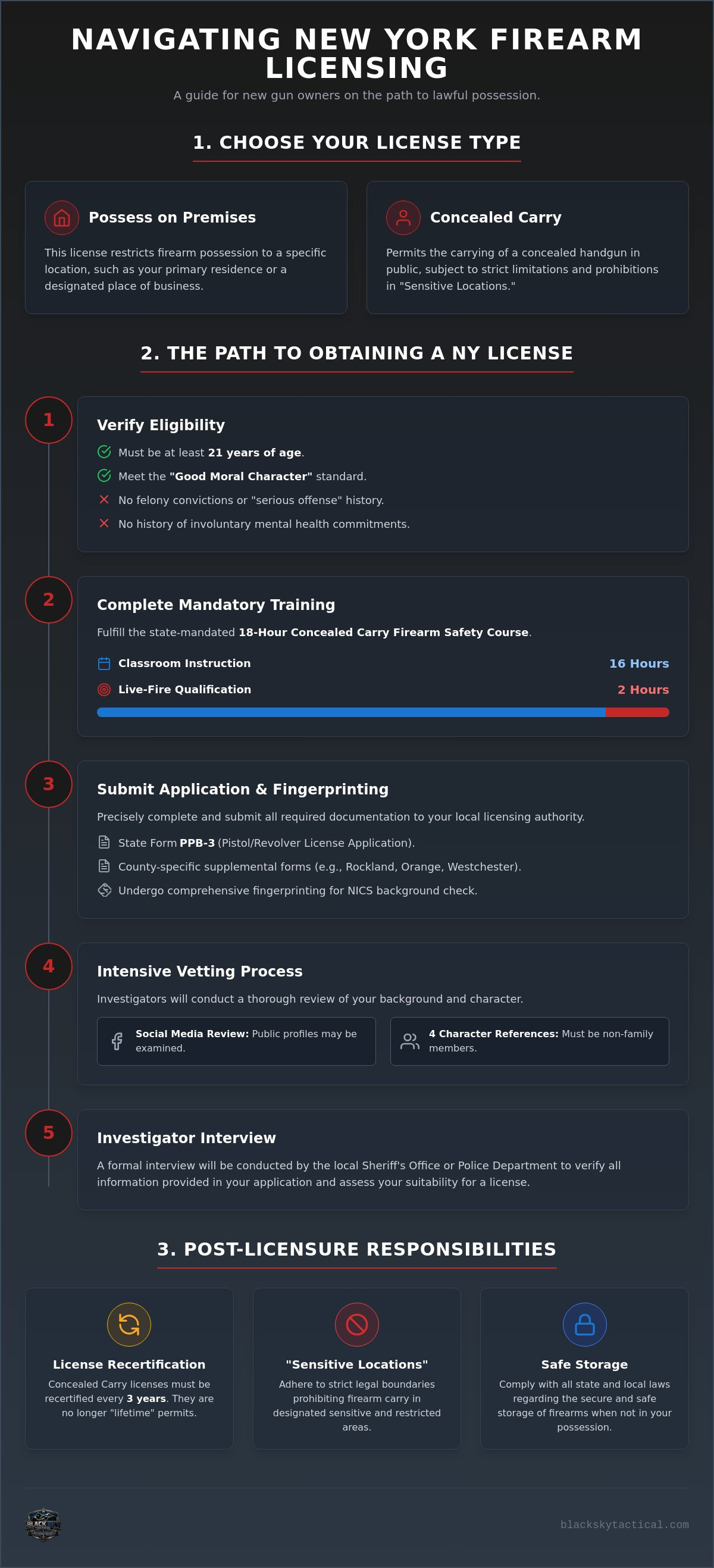
Fulfilling the mandates of NY firearm laws for new gun owners requires the completion of a standardized 18-hour training curriculum. This educational requirement is divided into 16 hours of classroom instruction and a 2-hour live-fire proficiency assessment. The NYSNRA101: Combined NYS 18-Hour Conceal Carry + NRA Basic Pistol Class has become the industry standard for meeting these obligations, as it integrates the rigorous state curriculum with the technical fundamentals of the NRA. Applicants should verify their instructor's credentials through the NYS Pistol License Application resources to ensure the resulting certificate of completion will be accepted by their local licensing officer.
The 16-hour classroom portion is a methodical briefing on the legal and practical responsibilities of carry. It includes:
- A comprehensive review of NYS Penal Law and the legal standards for the justification of force.
- Instruction on conflict de-escalation and situational awareness techniques.
- Mandatory safe storage protocols and child access prevention requirements.
- Administrative procedures for interacting with law enforcement while carrying.
Curriculum Focus: NYS Penal Law and Article 35
A primary objective of the training is a thorough understanding of NYS Penal Law Article 35. This section of the law dictates the specific conditions under which the use of force is considered "justified." New owners must also learn to navigate the distinction between "Sensitive Locations," such as parks and government buildings, and "Restricted Locations," which include private properties that haven't explicitly posted authorization for concealed carry. Proficiency in these legal nuances is essential for permanent compliance.
Live Fire Qualification Standards
The 2-hour live-fire component serves as a formal evaluation of your ability to handle a firearm safely and effectively. You'll be required to pass a mandatory shooting drill that assesses accuracy and safety under the supervision of a certified instructor. Technical mastery of the NRA basic pistol shooting course provides the necessary skill set to meet these proficiency standards with confidence. To ensure you meet these rigorous training mandates, you should register for a professional 18-hour certification course.
Post-Licensure Responsibilities: Storage and Public Conduct
Securing a permit is the beginning of a long-term administrative commitment rather than the conclusion of a process. Under current NY firearm laws for new gun owners, you're legally mandated to utilize safe storage depositories or locking devices if a minor under the age of 18 or a prohibited person resides in your household. These requirements extend to your vehicle; firearms left in an unattended car must be stored in a locked fireproof container and hidden from view. Failure to comply with these storage standards can result in criminal charges and the immediate revocation of your licensing privileges.
Navigating the public landscape requires a constant awareness of jurisdictional boundaries and transport protocols. Within New York State, firearms should be transported unloaded and in a locked container separate from ammunition. If your travel takes you across state lines into New Jersey or Connecticut, you must recognize that your New York permit holds no legal reciprocity. In these instances, you're subject to federal transport laws which require the firearm to be locked in a trunk or a container inaccessible to the driver. During any encounter with law enforcement, such as a routine traffic stop, it's a professional and safety-conscious standard to immediately notify the officer of your permit status and the location of your firearm.
Sensitive vs. Restricted Locations
The Concealed Carry Improvement Act created two distinct categories of prohibited areas. Sensitive locations include schools, government buildings, healthcare facilities, and public parks. Restricted locations encompass all private property, including businesses and private residences, where carrying is prohibited by default. You're only permitted to carry on private property if the owner has clearly posted a sign authorizing it or has given express consent. Ignorance of these boundaries isn't a valid legal defense.
Maintaining Proficiency and Legal Standing
Legal compliance is a perishable skill that requires regular updates and physical practice. Engaging in Private Firearm Instruction NY ensures that your marksmanship and situational decision-making remain sharp. To stay informed about shifting mandates, such as the pending "Francesco’s Law" regarding universal storage, you should regularly consult official state bulletins and professional training institutions. Consistent education is the only way to ensure you remain a responsible and lawful participant in the licensing system.
Establishing a Foundation for Legal Compliance
Achieving lawful firearm ownership in New York requires a disciplined commitment to administrative detail and a thorough understanding of the state's regulatory framework. As established, navigating NY firearm laws for new gun owners is a multi-step process that begins with precise application filing and extends through a lifetime of responsible storage and professional conduct. The transition from an applicant to a permit holder is contingent upon your ability to meet the rigorous standards set by the Concealed Carry Improvement Act. This includes the successful completion of the mandated 18-hour training curriculum, which serves as the essential bridge between your initial submission and final approval from your licensing officer.
To ensure your application meets all legal standards, you should train with experts who understand the specific procedural nuances of Rockland, Orange, and Westchester county mandates. Our certified NYS and NRA instructors provide a curriculum that is fully compliant with current state requirements. You can Register for the NYS-Mandated 18-Hour Concealed Carry Course to secure the necessary certification and proficiency required for your permit. Taking this methodical step ensures you are fully prepared for the grave responsibilities of legal ownership.
Frequently Asked Questions
Do I need a permit to buy a handgun in New York in 2026?
Yes, you must obtain a valid New York State Pistol License before you can legally purchase or take possession of a handgun. The license serves as the primary authorization for both the purchase transaction and the ongoing possession of the firearm. It's also necessary to note that a separate license is now required for the purchase of semi-automatic rifles, a mandate that took effect in September 2022.
What is the 18-hour concealed carry course required by New York State?
The 18-hour course is a mandatory training program for concealed carry applicants that consists of 16 hours of classroom instruction and a 2-hour live-fire proficiency assessment. This curriculum is designed to ensure that those navigating NY firearm laws for new gun owners understand conflict de-escalation, safe storage, and the legalities of the use of force. You must receive a certificate of completion from a state-authorized instructor to proceed with your application.
How often do I need to renew or recertify my NYS pistol permit?
You're required to recertify your concealed carry license every three years through the New York State Police online portal. This three-year administrative cycle is a specific requirement of the Concealed Carry Improvement Act and is shorter than the five-year cycle applied to certain other permit types. Maintaining this schedule is vital, as a failure to recertify will result in the automatic expiration of your legal authority to possess the firearm.
Can I carry my firearm in public parks or on public transportation in NY?
No, public parks and public transportation systems are classified as "Sensitive Locations" where carrying a firearm is strictly prohibited by state law. These restrictions apply even to individuals who hold a valid concealed carry permit. Carrying a firearm into these zones, or into "Restricted Locations" like private businesses that haven't explicitly posted authorization, can lead to felony charges and the permanent revocation of your license.
Are there different rules for firearm ownership in Rockland, Orange, and Westchester counties?
While the baseline standards for NY firearm laws for new gun owners are established by state statute, the administrative procedures and supplemental forms vary significantly between Rockland, Orange, and Westchester counties. Each county clerk's office manages its own fingerprinting schedules, character reference requirements, and application fees. You must follow the specific procedural roadmap provided by the licensing authority in the county where you maintain your primary residence.
Does New York recognize concealed carry permits from other states?
No, New York State does not maintain reciprocity agreements with any other state and does not recognize out-of-state concealed carry permits. To legally carry a handgun within New York, you must possess a license issued by a New York licensing officer. Visitors or new residents must complete the full application process, including the mandatory 18-hour training course, to ensure they're in compliance with local jurisdictional mandates.


