
Achieving a passing score on the Civilian Carry Assessment and Range Evaluation (CCARE) protocol is a legal mandate, but it doesn't inherently equate to the ability to manage a high-stress defensive encounter. Many permit applicants in New Jersey feel the weight of these complex regulatory requirements, often struggling to find instruction that bridges the gap between basic marksmanship and the legal sobriety required for lawful carry. This guide provides the technical insights and administrative clarity necessary to master defensive pistol training NJ standards, ensuring you meet the 80% qualification threshold while developing the disciplined decision-making skills required for real-world scenarios.
You'll find that maintaining proficiency is a continuous obligation that extends beyond the initial application. We will examine the specific New Jersey State Police shooting standards for 2026, the procedural steps for a 100% compliant Permit to Carry (PTC) application, and the practical drills that transform range practice into life-saving proficiency. By focusing on the intersection of technical accuracy and strict adherence to current statutes, you can build the confidence necessary to carry responsibly within the state's rigorous legal framework.
Key Takeaways
- Understand the critical distinction between static marksmanship and defensive pistol training NJ, which emphasizes threat neutralization through movement and high-stress decision-making.
- Master the specific requirements of the Civilian Carry Assessment and Range Evaluation (CCARE) protocol, including the mandatory 50-round qualification and holster proficiency standards.
- Explore how specialized training modules, such as drawing from concealment and stress drills, bridge the gap between basic range safety and actual defensive readiness.
- Learn to evaluate training providers in Northern New Jersey by prioritizing courses like the NJSNRA101 that combine NRA foundational skills with state-mandated certification.
- Gain clarity on the administrative procedures for 2026, including digital Permit to Carry (PTC) renewals and the legal implications of carrying in restricted "sensitive places."
Defining Defensive Pistol Training: Beyond the Basics of Marksmanship
Defensive pistol training NJ is often misunderstood as merely an extension of traditional target practice. While basic marksmanship remains a necessary prerequisite, defensive training represents a distinct discipline focused on the immediate neutralization of a threat rather than the pursuit of a perfect bullseye. This transition requires a fundamental shift in mindset from recreational shooting to a state of professional responsibility. For individuals carrying under New Jersey Permit to Carry (PTC) regulations, it's essential to acknowledge that the firearm is a tool of last resort, utilized only when all other defensive measures have been exhausted.
Effective training doesn't just teach you how to shoot; it teaches you how to fight with a handgun. This involves integrating movement, the utilization of cover, and the management of physiological stress. When you're on a static range, you're practicing a skill in a vacuum. In a defensive scenario, you're solving a complex, life-threatening problem under extreme time constraints. The objective is to stop the threat as quickly and safely as possible, which requires a blend of technical skill and legal sobriety.
Marksmanship vs. Defensive Proficiency
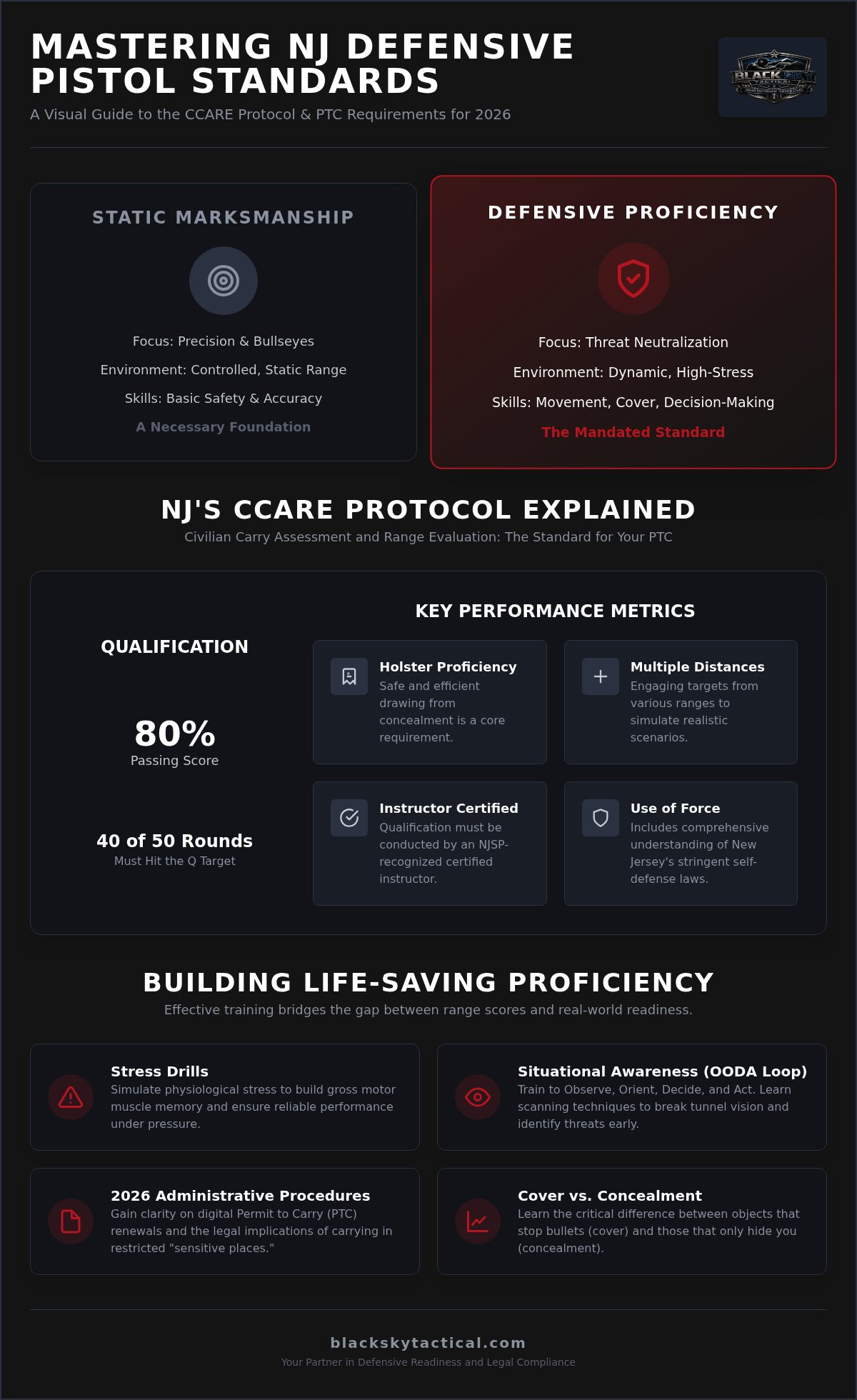
Static range shooting provides the foundation for firearm safety and accuracy, but it fails to account for environmental variables. Defensive training adds these layers by introducing dynamic elements that simulate real-world encounters. While competitive shooters might prioritize "minute of angle" accuracy, defensive proficiency emphasizes "center of mass" consistency. Understanding the basics of defensive marksmanship involves recognizing that under extreme stress, fine motor skills often degrade. Consequently, your training must focus on building gross motor muscle memory to ensure reliable performance when decision-making time is measured in fractions of a second. You aren't just aiming at a target; you're managing recoil, clearing potential malfunctions, and maintaining awareness of your surroundings simultaneously.
The Role of Situational Awareness
High-quality defensive pistol training NJ also emphasizes the periods before a shot is ever fired. Situational awareness acts as your primary layer of defense, allowing you to identify potential threats through the OODA loop (Observe, Orient, Decide, Act) process. In the specific legal landscape of New Jersey, the ability to de-escalate or avoid a confrontation entirely is the most critical skill a permit holder can possess. Training should include specific modules such as:
- Scanning techniques: Methods to break "tunnel vision" and identify secondary threats or exits.
- Cover vs. Concealment: Learning to distinguish between objects that stop bullets and those that merely hide your position.
- Verbal commands: Utilizing authoritative language to deter an aggressor while establishing a legal record of your intent to avoid conflict.
By integrating these tactical elements with a disciplined approach to safety, you move beyond the limitations of a recreational mentality. This comprehensive preparation ensures that if a life-saving moment occurs, your response is calculated, compliant, and effective.
New Jersey Legal Standards: PTC Requirements and the CCARE Protocol
The legal landscape for firearm carry in New Jersey is governed by strict administrative mandates, primarily the Civilian Carry Assessment and Range Evaluation (CCARE) protocol. This protocol, issued on September 15, 2023, serves as the standardized benchmark for all Permit to Carry (PTC) applicants. Unlike basic safety courses, the CCARE protocol requires a demonstrable level of proficiency that includes both a comprehensive understanding of the use of force and a rigorous live-fire qualification. It's imperative that this training is conducted by certified instructors recognized by the New Jersey State Police (NJSP) to ensure the validity of your certification. At Black Sky Tactical, we integrate these specific state standards into our NJSNRA101 curriculum, providing a streamlined path toward legal compliance and technical readiness.
Effective defensive pistol training NJ must align with these evolving regulatory requirements to prevent administrative denials during the application process. The state's transition to a "shall-issue" framework has not lessened the burden of proof regarding an applicant's competence. Instead, it has codified the expectation of safe handling, particularly concerning holstering and unholstering procedures during live-fire exercises. Applicants who fail to demonstrate these procedural steps with precision will not meet the state's criteria for permit issuance.
Understanding the CCARE Protocol
The core of the CCARE requirement is a 50-round course of fire performed on an FBI Q target. Applicants must achieve a minimum passing score of 80%, meaning at least 40 rounds must strike within the target silhouette. The evaluation is conducted at varying distances: 3, 5, 7, 10, and 15 yards. Beyond mere accuracy, the protocol mandates a demonstration of safe holstering, unholstering, and reloading techniques. Common failure points often involve safety violations during the draw or failing to maintain a consistent cadence under the instructor's observation. Mastery of these fundamentals is a prerequisite for any serious practitioner.
Recertification and Legal Maintenance
Once issued, a New Jersey Permit to Carry remains valid for two years. The renewal process is now entirely digital, requiring applicants to submit updated documentation and re-qualify if their previous certification has lapsed. It's also critical to stay informed about "sensitive places" restrictions, which prohibit carrying in locations such as public parks, bars, and government buildings. For a detailed breakdown of the application journey, you can review our How to Get a Concealed Carry Permit in NJ: A 2026 Step-by-Step Guide. Maintaining your permit requires constant vigilance regarding these legislative shifts. If you are preparing for an initial application or an upcoming renewal, our instructors can provide the necessary certification through our NJSNRA101 course.
Examples of Defensive Training Modules: From Holster Draws to Stress Drills
Comprehensive defensive pistol training NJ is structured around specific, repeatable modules that transition a shooter from basic competency to tactical readiness. While target shooting focuses on the mechanics of the trigger press, defensive modules prioritize the context in which that press occurs. These exercises are designed to simulate the physiological stressors of a real-world encounter, ensuring that your response is both instinctive and legally justifiable. By training in environments that replicate high-stakes decision-making, you build the discipline required to manage a firearm when your heart rate is elevated and your fine motor skills are compromised.
One critical aspect of this training is the management of malfunctions under time pressure. In a controlled environment, a failure to fire is a minor inconvenience. In a defensive situation, it's a catastrophic failure. Training modules teach students to identify and clear common malfunctions without diverting their focus from the environment. Common drills include:
- Type 1 Malfunctions: Immediate action for failures to fire, often addressed with the "tap, rack, reassess" sequence.
- Type 2 Malfunctions: Clearing "stovepipes" where a casing is caught in the ejection port, obstructing the slide.
- Type 3 Malfunctions: Complex clearing procedures for "double feeds" which require stripping the magazine to clear the chamber.
Additionally, "Shoot/Don't Shoot" scenarios are utilized to build the rapid judgment necessary to distinguish between a lethal threat and a non-combatant. This skill is paramount for maintaining compliance with NJ use-of-force statutes, where the legal justification for discharging a firearm is scrutinized with extreme precision.
Concealed Draw and Presentation
For NJ Permit to Carry holders, the ability to draw from concealment is a non-negotiable skill. A professional benchmark often utilized in defensive pistol training NJ is the 1.5-second draw-to-first-shot standard. This module focuses on the economy of motion required to clear a cover garment, such as a jacket or untucked shirt, and establish a firm grip before the firearm ever leaves the holster. Students practice with various NJ-compliant holsters, ensuring that their equipment choice doesn't impede their speed or safety during a high-stress presentation. Maintaining strict muzzle discipline while clearing garments is a primary focus of these exercises.
Movement and Use of Cover
Survival often depends more on where you stand than how well you shoot. Training modules include "slicing the pie" drills, which teach shooters how to clear corners by moving in small increments, exposing the minimum amount of their body to a potential threat. A vital distinction taught in these drills is the difference between cover and concealment. Cover, such as a brick wall or an engine block, provides physical protection from incoming rounds. Concealment, like a bush or a standard interior door, only hides your position. Mastery of these concepts is essential for anyone seeking to exceed the basic requirements found in the NJ Carry Permit Qualification Course: Mastering the CCARE Protocol. By integrating movement with accuracy, you develop a more robust defensive capability.
Evaluating Training Providers in Bergen County and Northern NJ
Selecting a provider for defensive pistol training NJ in the Northern New Jersey region requires a discerning approach that prioritizes instructional quality over mere convenience. While many facilities offer basic qualification, a reputable institution must demonstrate a commitment to administrative accuracy and professional responsibility. This is particularly vital given the high stakes of New Jersey's regulatory environment, where a single clerical error on certification paperwork can result in the rejection of a Permit to Carry (PTC) application. Prospective students should verify that instructors possess recognized NRA certifications and ideally bring backgrounds in law enforcement or military service, ensuring the training is grounded in real-world application rather than theoretical range exercises.
You should avoid so-called "permit mills" that prioritize high-volume throughput over student proficiency. These operations often rush the shooting qualification, providing minimal feedback on holster safety or situational decision-making. In contrast, a disciplined training program views the qualification as the conclusion of a rigorous educational process, not just a procedural hurdle. Ensuring that your instructor provides a thorough briefing on current New Jersey State Police (NJSP) standards is a hallmark of a professional institution.
The Value of Combined NRA and NJS Courses
The NJSNRA101 model represents a highly efficient path for residents of Bergen County, as it combines the NRA Basic Pistol course with the specific requirements of the New Jersey Conceal Carry curriculum. This 18-hour instructional block ensures that students receive a comprehensive foundation in firearm safety before advancing to the live-fire standards mandated by the state. By integrating these national and state certifications, the student benefits from a unified syllabus that reduces the likelihood of conflicting instruction. This consolidated approach also addresses logistical challenges, allowing for the completion of all necessary prerequisites within a single, structured timeframe, which ultimately reduces overall costs and scheduling conflicts.
Private Instruction vs. Group Classes
Choosing between group dynamics and private firearm instruction depends largely on your current proficiency level and specific learning objectives. Private sessions allow for rapid skill correction, where an instructor can focus exclusively on your grip, stance, and draw stroke to eliminate bad habits. Group classes, however, provide a unique benefit by simulating the environmental noise and social pressure inherent in high-stress situations. Black Sky Tactical utilizes a balanced approach, delivering personalized feedback within a group setting to ensure that every participant meets the rigorous standards of defensive pistol training NJ while benefiting from a collaborative learning environment. If you require a tailored approach to your qualification, you can book a private training session to ensure your skills meet the highest professional standards.
Advancing Your Proficiency with Black Sky Tactical
Black Sky Tactical functions as a professional institution dedicated to bridging the gap between basic firearm safety and advanced defensive proficiency. Our instructional philosophy is rooted in the belief that a Permit to Carry is not the end of a journey, but the beginning of a sustained commitment to professional responsibility. For residents of Bergen County and the surrounding Northern NJ and NY regions, we provide specialized expertise regarding the differing jurisdictional requirements of each state. This cross-border knowledge is essential for those who live and work in the tri-state area, where legal nuances regarding firearm transport and carry vary significantly between jurisdictions.
We maintain strictly limited class sizes to ensure that every student receives meticulous attention regarding their form, safety protocols, and draw stroke. This disciplined environment allows our instructors to identify and correct technical deficiencies that might otherwise go unnoticed in larger, less structured settings. Our commitment to your proficiency extends beyond the initial certification; we provide ongoing support for permit renewals and offer pathways to more advanced tactical modules as your skills evolve. Maintaining a high standard of defensive pistol training NJ requires this type of continuous, expert-led oversight.
The NJSNRA101 Advantage
The NJSNRA101 course is our flagship offering for those seeking a comprehensive path to certification. This 18-hour curriculum is specifically designed to navigate the administrative hurdles of the New Jersey permit process while building a robust technical foundation. The syllabus includes an exhaustive review of legal compliance, intensive holster work, and the mastery of the CCARE live-fire standard. By the conclusion of the course, students possess not only the required NJSP documentation but also the technical confidence that comes from rigorous evaluation. We ensure that every participant is prepared for the procedural and practical demands of the 2026 application cycle.
Next Steps for Serious NJ Gun Owners
For individuals who recognize that defensive readiness involves more than just marksmanship, we offer Violent Incident Command training. This program provides a holistic approach to safety, focusing on leadership and command decisions during high-stress encounters. Additionally, we provide Private Firearm Training for those who require specialized instruction tailored to their unique defensive needs or specific equipment configurations. These advanced offerings ensure that your training remains relevant and your skills remain sharp in an ever-changing legal environment. You can take the first step toward achieving professional-grade proficiency and 100% compliance with current state standards by choosing a syllabus that prioritizes accuracy and integrity.
Securing your certification is a multi-step process that requires professional guidance. Register for your NJSNRA101 Combined Class today to ensure your defensive pistol training NJ meets the highest standards of safety and legal sobriety.
Securing Your Future as a Responsible Permit Holder
Navigating the complexities of New Jersey's firearm statutes requires more than a basic understanding of handgun operation. True proficiency is found at the intersection of technical skill, situational awareness, and strict adherence to the CCARE protocol. By prioritizing defensive pistol training NJ that emphasizes real-world application over static range practice, you ensure that your response to a threat is both effective and legally sound. It's critical to remember that the responsibility of carrying a firearm in the tri-state area necessitates a commitment to ongoing education and administrative precision.
Black Sky Tactical provides the disciplined environment necessary to achieve these standards through our NRA Certified Instructors and an NJSP CCARE compliant curriculum. Our deep expertise in NJ and NY regional firearm laws ensures that you remain compliant across jurisdictional lines. You'll find that choosing a training path that values accuracy, integrity, and safety is the most reliable way to prepare for the high-stakes nature of defensive carry.
We invite you to Enroll in the NJSNRA101 Combined Conceal Carry & NRA Course to master the essential skills required for lawful carry in 2026. Your journey toward becoming a knowledgeable and proficient firearm owner begins with the right foundation.
Frequently Asked Questions
What is the NJ CCARE protocol and why is it required for training?
The Civilian Carry Assessment and Range Evaluation, commonly known as the CCARE protocol, is the mandatory proficiency standard issued by the New Jersey State Police on September 15, 2023. It's required because it establishes a uniform benchmark for firearm safety and marksmanship that all Permit to Carry applicants must meet. The evaluation consists of a 50-round live-fire course on an FBI Q target, requiring an 80% passing score to ensure the applicant can safely manage a firearm in a public setting.
How many hours of training are needed for a NJ Permit to Carry?
New Jersey statutes do not prescribe a specific minimum number of hours for the carry permit qualification itself, but the instruction must be sufficient to cover the state-mandated use-of-force curriculum and the CCARE shooting standards. Many applicants find that a comprehensive approach, such as an 18-hour combined course, is necessary to absorb the legal nuances and technical skills required for defensive pistol training NJ. This duration allows for a thorough review of administrative procedures and safe handling drills.
Can I use the same training for both NJ and NY concealed carry permits?
No, you cannot use a single training certification to satisfy the requirements for both New York and New Jersey, as each state maintains distinct legal mandates and shooting protocols. While the mechanical skills of shooting are universal, the administrative certifications and state-specific use-of-force lectures are not reciprocal between these jurisdictions. You must complete the specific curriculum required by each state's regulatory body to obtain the respective permits.
What should I bring to a defensive pistol training course in NJ?
You should bring a reliable, cleaned handgun and a minimum of 50 to 100 rounds of factory-fresh ammunition that is appropriate for your specific firearm. Additionally, you'll need a high-quality, NJ-compliant holster, a sturdy belt, and personal protective equipment including eye and ear protection. It's also mandatory to have a valid form of identification and any preliminary paperwork required by the certified instructor to document your qualification results.
Do I need to own a firearm before taking a defensive pistol class?
It's strongly recommended that you own the handgun you intend to carry, as the state requires you to demonstrate proficiency with a specific firearm during the qualification process. While some introductory courses may offer rentals, defensive pistol training NJ focused on permit issuance is most effective when performed with your own equipment. This ensures that the muscle memory and holster techniques you develop are directly applicable to the firearm you will rely on for protection.
Is holster training mandatory for the NJ carry permit?
Yes, the CCARE protocol specifically mandates that applicants demonstrate safe holstering and unholstering techniques during the live-fire evaluation. This requirement is designed to ensure that permit holders can safely present their firearm from concealment without violating safety protocols or risking accidental discharge. Instructors must observe your ability to clear cover garments and maintain muzzle discipline throughout the entire draw stroke to certify your proficiency.
How often do I need to re-qualify for my NJ Permit to Carry?
You must re-qualify and submit a new training certification every two years to coincide with the expiration of your New Jersey Permit to Carry. Because the permit is only valid for a 24-month period, the renewal process requires you to demonstrate that your shooting skills and knowledge of the law remain current. It's advisable to schedule your re-qualification at least several months before your permit expires to account for digital processing times.
What is the difference between NRA Basic Pistol and NJ state-mandated training?
The NRA Basic Pistol course is a national standard focused on the foundational mechanics of marksmanship and general firearm safety, while NJ state-mandated training is a jurisdictional requirement focused on specific use-of-force statutes. While the NRA curriculum provides an excellent educational base, it doesn't satisfy the administrative requirements of the NJSP on its own. Most professional training providers integrate both programs to ensure students are both technically skilled and legally compliant.


