
Possessing a New York State concealed carry permit signifies that an individual has met the minimum administrative requirements, but it's important to realize it doesn't guarantee they're prepared for the physiological and legal realities of a high-stress defensive encounter. You likely recognize that completing the mandated 18-hour course is a necessary procedural hurdle, yet you may still experience a lingering sense of uncertainty regarding your actual ability to deploy a firearm safely and effectively under pressure. This gap is precisely why specialized firearm proficiency training NY experts offer is essential for those who view self-defense as a serious professional responsibility rather than a mere regulatory checkbox.
In the following sections, we'll demonstrate how to transition from basic legal qualification to true firearm proficiency through structured, expert-led training. You'll gain a clearer understanding of the legal standards outlined in NYS Article 35 concerning the justification of force, learn to distinguish between technical qualification and real-world skill, and discover a practical roadmap for long-term skill maintenance. Our goal is to ensure that your confidence is rooted in disciplined practice and a thorough grasp of the law, providing you with the clarity needed to act decisively if the situation demands it.
Key Takeaways
- Recognize that New York State concealed carry training standards represent an administrative baseline rather than a benchmark for functional performance during a crisis.
- Identify the essential role of the NRA Basic Pistol Shooting Course as a fundamental building block for those pursuing a disciplined path toward long-term skill retention.
- Evaluate the benefits of private instruction for correcting specific technical deficiencies and ensuring a curriculum tailored to your unique defensive requirements.
- Explore how the Violent Incident Command framework provides a necessary structure for situational awareness and emergency management both before and after a shot is fired.
- Learn how to select a professional instructor who offers comprehensive firearm proficiency training NY residents need to bridge the gap between state mandates and real-world readiness.
Defining Firearm Proficiency vs. NYS Legal Compliance
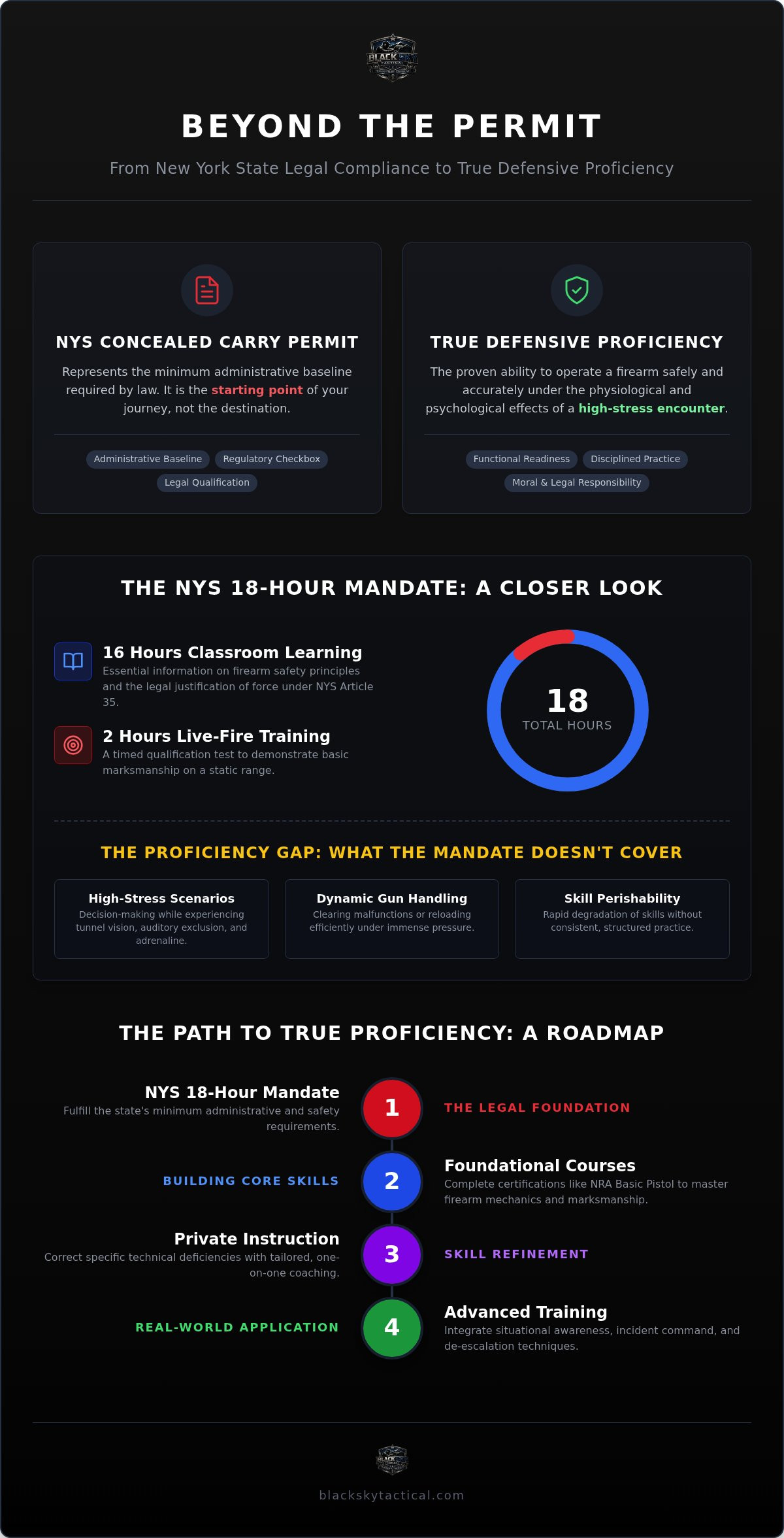
Achieving a license to carry a concealed firearm in New York is a significant administrative accomplishment, yet you must distinguish between possessing a permit and possessing the requisite skill set to use a firearm effectively. Firearm proficiency training NY programs emphasize that while the state mandates specific hours of instruction, these requirements are designed to establish a baseline of safety rather than a high level of tactical mastery. Proficiency is defined as the ability to operate a firearm safely and accurately while experiencing the physiological effects of acute stress, such as tunnel vision, auditory exclusion, and diminished fine motor skills. Marksmanship, often characterized as the ability to produce tight groups on a static paper target, is merely one component of defensive proficiency, which prioritizes the preservation of life in dynamic, unpredictable environments.
Skills acquired during initial training are notoriously perishable. Without consistent and structured practice, the muscle memory required for safe handling and accurate delivery of fire degrades rapidly. For the responsible New York firearm owner, the state-issued permit is not the conclusion of their education but the entry point into a disciplined, ongoing process of skill maintenance and legal study.
The 18-Hour Mandate: What It Covers and What It Doesn't
As of July 2026, New York State requires applicants to complete a total of 18 hours of instruction, which includes 16 hours of classroom learning and 2 hours of live-fire qualification. While this curriculum provides essential information on Handgun Safety Certification NY requirements, the classroom-heavy structure often limits the time available for practical, hands-on firearm manipulation. Students may find that the two-hour range session is sufficient to pass a basic qualification test but insufficient to develop the subconscious competence needed to clear a malfunction or reload under pressure. This gap in practical handling is where many permit holders remain vulnerable, as they have met the legal standard without achieving functional readiness.
Why Proficiency is a Moral and Legal Responsibility
The legal consequences of a negligent discharge or the unintended injury of a bystander are severe, making the adherence to fundamental firearm safety principles a non-negotiable duty for every owner. In New York, the use of deadly physical force is governed by the stringent requirements of NYS Article 35, which demands that an individual makes sound, split-second decisions under extreme duress. Advanced firearm proficiency training NY residents seek helps bridge the gap between knowing the law and applying it correctly when every second counts. Defensive proficiency is the intersection of technical skill and legal judgment. By elevating your skills beyond the administrative minimums, you reduce the risk of collateral damage and ensure that your actions remain within the bounds of legal justification.
The Path to Mastery: Types of Firearm Training in NY
Achieving long-term competence requires a methodical approach that moves beyond the initial 18-hour mandate. While New York State's firearm training requirements provide a necessary legal baseline, they're merely the first step in a broader educational syllabus. True firearm proficiency training NY residents rely on involves a tiered progression, beginning with mechanical fundamentals and advancing toward high-stress tactical applications. This roadmap ensures that an individual's skills are built on a stable foundation of safety before introducing the complexities of defensive movement or split-second decision-making. Without this structured advancement, a shooter may develop habits that are sufficient for the range but fail under the physiological demands of a real-world encounter.
Foundational Certifications: NRA Basic Pistol
The NRA curriculum remains the industry standard for establishing a disciplined understanding of firearm mechanics and marksmanship. By completing the NRA Basic Pistol Shooting Course pillar, students gain a formal certification that often serves as a prerequisite for more advanced tactical programs. This course prioritizes the knowledge and technical skills necessary for safe firearm ownership, providing a structured environment where students master grip, stance, and sight alignment. It's the most reliable way to ensure that your initial habits are technically sound and that you possess the confidence required for more rigorous training phases. Mastering these basics is essential before attempting to integrate movement or speed into your practice sessions.
Defensive and Tactical Skill Building
Once an individual has mastered static marksmanship, the focus must shift toward Personal Protection Training NY protocols. Defensive shooting differs significantly from recreational target practice. It requires the ability to draw safely from a holster, perform emergency reloads, and utilize cover effectively. Dynamic drills introduce the element of movement, forcing the shooter to maintain accuracy while navigating a physical environment. This transition is critical because real-world incidents rarely occur while standing perfectly still at a fixed distance. Training must evolve to include shooting from various positions and managing malfunctions while under time constraints.
Family-wide preparedness is another vital component of a comprehensive training plan. Programs like a Youth Safety Course ensure that every member of a household understands the gravity of firearm presence and the protocols for safe interaction. This holistic approach prevents accidents and builds a culture of responsibility within the home. For those seeking to begin this progression, enrolling in a structured program like the NYSNRA101: Combined NYS 18-Hour Conceal Carry + NRA Basic Pistol Class provides a streamlined entry into both legal compliance and foundational skill-building. By treating training as a continuous journey, you ensure that your capabilities remain sharp and your responses remain legally justifiable.
Private Firearm Instruction: When to Choose One-on-One Training
While group classes provide the necessary administrative foundation for legal compliance, they often lack the granularity required to address individual technical deficiencies in a high-stakes environment. Private instruction offers a disciplined, professional setting where an instructor's attention is focused exclusively on the student's performance, allowing for a thorough analysis of mechanics that group settings cannot provide. This personalized approach is particularly beneficial for individuals in Rockland or Westchester Counties who may have specific privacy concerns or high-profile professional roles that make traditional group settings less desirable. One-on-one sessions ensure that the curriculum is tailored to the specific firearms the user intends to carry, while adhering strictly to the New York State Police firearm information regarding the legal possession and transport of firearms within the state.
Accelerating the Learning Curve
The efficiency of a private session is significantly higher than that of a traditional classroom or range environment. It's often observed that two hours of focused, one-on-one instruction can yield technical progress equivalent to eight hours of group-based training, primarily because the pace is dictated by the student's actual progress rather than a fixed syllabus. This acceleration is due to the immediate, expert feedback provided on critical mechanical fundamentals such as grip pressure, stance stability, and sight alignment. In this setting, the private instructor serves a diagnostic role, identifying and correcting ingrained bad habits or subtle mechanical errors before they become permanent impediments to safe performance. This level of scrutiny is essential for Private Firearm Training for Beginners in NY, as it establishes a technically sound baseline from the very first shot.
Customized Drills for NY Compliance
Preparing for the mandatory two-hour live-fire qualification requires more than just general shooting ability; it requires a precise understanding of the standards set by the state. Private sessions allow for intensive focus on the specific holster work and draw sequences that are often required for advanced certifications or specific county mandates. Whether you're addressing recoil management on a compact carry pistol or refining your trigger control for the NYS qualification, these drills are conducted using the actual equipment you intend to use for defensive purposes. Specialized firearm proficiency training NY residents utilize ensures that you're not just meeting the minimum requirements, but exceeding them in a way that reflects the environmental and legal constraints of your specific jurisdiction. By focusing on the firearm you actually own, you build a level of familiarity and confidence that general range rentals cannot provide, ensuring your training is as realistic and applicable as possible.
Beyond the Range: Situational Awareness and Incident Command
True firearm proficiency training NY residents pursue is fundamentally incomplete if it ignores the cognitive processes that precede and follow a kinetic engagement. Technical marksmanship is a single component of a much larger security posture, which must be supported by a sophisticated level of situational awareness. By the time a firearm is deployed, several opportunities to avoid or de-escalate the encounter have likely already passed. The OODA Loop, which stands for Observe, Orient, Decide, and Act, serves as a critical mental framework for the civilian defender. This process allows an individual to process information more rapidly than an adversary, providing the necessary time to make a legally justifiable decision under extreme pressure. In the high-density environments of New York, the ability to orient oneself to potential threats before they materialize is as vital as the ability to deliver accurate fire.
Situational Awareness Training
Developing a proactive mindset involves learning to identify specific pre-attack indicators in public spaces, such as abnormal gait, scanning behavior, or "grooming" gestures that often precede a violent act. This training moves the individual from a reactive state, where they're surprised by an event, to a proactive state, where they're prepared to move or intervene. For residents and professionals in Orange and Bergen Counties, integrating this level of awareness into daily life ensures that personal safety is maintained without constant, paralyzing anxiety. It's a disciplined approach to observing the environment, identifying exits, and recognizing when a situation no longer feels normal. This cognitive layer of protection is often the most effective tool in preventing an incident from reaching a point where a firearm is required.
Violent Incident Command (VIC)
The conclusion of a defensive encounter marks the beginning of a complex administrative and tactical aftermath. Managing the scene effectively and communicating clearly with emergency services is essential for ensuring that the responder's actions are correctly interpreted by law enforcement. Violent Incident Command is a framework designed to guide individuals through these critical moments, addressing everything from immediate medical needs to the specific language used during a 911 call. For business owners and high-profile professionals, tactical incident management is a necessary skill set that protects both physical safety and legal standing. Black Sky Tactical emphasizes this discipline as the pinnacle of proficiency because it addresses the total lifecycle of a violent event. Understanding how to secure a scene and provide a concise, factual report to arriving officers is just as important as the split-second decision to act. To ensure you are prepared for the complexities of a post-incident environment, consider enrolling in Violent Incident Command Training to master these essential management protocols.
Choosing a Training Provider in the NY/NJ Area
Selecting a professional institution for your firearm education is a decision that carries significant legal and personal consequences. In a regulatory environment as complex as New York's, you must ensure that your chosen provider does not merely facilitate the completion of administrative paperwork but offers a rigorous, syllabus-driven experience. High-quality firearm proficiency training NY residents require should be delivered by instructors who possess a deep understanding of current statutes and a proven ability to communicate complex technical skills. For those residing near the state border, the efficiency of combined certifications is a primary consideration. Accessing a program like the NJSNRA101: Combined NJS Conceal Carry + NRA Basic Pistol Class provides a level of procedural streamlinedness that is essential for maintaining multi-jurisdictional compliance without sacrificing the quality of instruction.
Vetting Your Instructor's Credentials
When evaluating potential instructors, the primary benchmark remains the possession of valid NRA Certified Instructor credentials alongside specific authorizations required by the state. You should prioritize professionals who demonstrate a meticulous understanding of the legal climate in 2026, particularly regarding the nuances of New York's evolving carry laws and justification statutes. While "tactical" experience from military or law enforcement backgrounds is certainly valuable, it must be paired with pedagogical competence. An effective instructor is one who can diagnose subtle mechanical errors in a student's performance and provide clear, actionable corrections that align with established safety protocols. This ability to teach, rather than just demonstrate, is what allows a student to transition from a novice to a proficient permit holder.
The Black Sky Tactical Difference
Black Sky Tactical serves as a bridge between administrative mandates and functional readiness for residents of Rockland, Orange, Westchester, and Bergen Counties. Our philosophy is defined by a commitment to sobriety and professional responsibility, ensuring that every student understands the gravity of firearm ownership. We distinguish our curriculum by integrating the NRA Basic Pistol certificate directly into our NYSNRA101: Combined NYS 18-Hour Conceal Carry + NRA Basic Pistol Class. This integration ensures that you receive a nationally recognized foundation in marksmanship and safety while simultaneously fulfilling the 18-hour state requirement. We do not view the state's minimums as the final goal, but rather as the starting point for a comprehensive education in personal protection.
Our commitment to providing a professional syllabus means that our students leave with more than just a certificate; they leave with a roadmap for continued development. We invite you to review our upcoming course dates for the Combined NYS 18-Hour Conceal Carry class to ensure your training meets the highest standards of safety and legal meticulousness. By choosing a provider that prioritizes disciplined practice and accurate legal guidance, you take the most important step in becoming a responsible and proficient firearm owner in the Lower Hudson Valley.
Advancing Your Commitment to Responsible Ownership
Transitioning from administrative compliance to functional proficiency is a process that requires a disciplined mindset and a structured educational roadmap. You now understand that the 18-hour state mandate is merely a procedural entry point; true readiness involves the integration of mechanical skill, situational awareness, and a thorough grasp of the legal standards governing the use of force. By prioritizing firearm proficiency training NY experts provide, you ensure that your capabilities are rooted in professional standards rather than the minimum requirements of a license application. This commitment to ongoing education is what distinguishes a permit holder from a prepared and responsible civilian defender.
Black Sky Tactical functions as a bridge between these state mandates and real-world competence. Our NRA Certified Instructors provide authorized training for both New York and New Jersey, serving the specific needs of Rockland, Orange, and Westchester Counties with meticulous attention to detail and legal accuracy. We invite you to Enroll in the Combined NYS 18-Hour Conceal Carry + NRA Basic Pistol Class to begin a training progression that prioritizes your safety and your legal standing. Taking this step demonstrates a serious commitment to the high-stakes responsibilities of firearm ownership and ensures you're prepared to act with clarity and precision if the situation demands it.
Frequently Asked Questions
What is the difference between a pistol permit class and proficiency training?
A pistol permit class is an administrative prerequisite designed to satisfy New York State mandates for licensing, whereas firearm proficiency training NY residents pursue focuses on the mechanical and tactical mastery required for defensive scenarios. While the permit class covers essential safety and legal frameworks, proficiency training involves intensive drills to ensure you can operate a firearm accurately under the physiological stress of a real-world encounter. One satisfies a legal obligation, while the other builds the functional capability to protect life.
Does the NYS 18-hour CCW course make me a proficient shooter?
The 18-hour course establishes a necessary baseline for safety and legal knowledge but does not typically provide enough range time to achieve true proficiency. Achieving a level of mastery where firearm manipulation becomes subconscious requires consistent practice beyond the mandated two hours of live-fire qualification. Most students find that additional structured training is required to build the muscle memory necessary for effective self-defense and malfunction clearance under pressure.
How often should I seek professional firearm training in NY to maintain proficiency?
Industry professionals generally recommend seeking structured instruction at least once or twice a year to prevent the degradation of perishable skills. Because shooting is a diminishing skill set, regular diagnostic sessions with a certified instructor help identify and correct technical errors that often develop during solo practice. This ensures that your handling remains safe and your marksmanship remains precise while staying updated on the specific legal constraints of New York.
Can I take private firearm instruction before I have my NY pistol permit?
You may participate in private firearm training before obtaining a permit, provided the instruction takes place at an authorized range under the direct supervision of a certified instructor. This is an excellent way to build foundational safety habits and mechanical skills before beginning the formal application process. Starting your education early ensures that you're better prepared for the mandatory live-fire qualification required for the concealed carry permit later on.
What are the live-fire qualification standards for the NYS concealed carry permit in 2026?
As of July 2026, applicants must achieve a minimum score of 80% on a written examination and demonstrate proficiency during a two-hour live-fire assessment. This assessment typically requires the student to successfully land a specific number of shots on a target at varying distances, such as landing 4 out of 5 hits at a distance of 4 yards. These standards are designed to ensure basic competency rather than advanced tactical performance.
Is NRA Basic Pistol required for the NYS 18-hour concealed carry course?
New York State law does not strictly mandate the NRA Basic Pistol course as part of the 18-hour requirement, but many professional providers integrate it to ensure a higher standard of instruction. By completing a combined course like the NYSNRA101, you receive a nationally recognized safety certification alongside the state-mandated training. This approach provides a more comprehensive educational foundation than a course focused solely on meeting the state's minimum administrative requirements.
Where can I find advanced firearm proficiency training in Rockland County?
Advanced firearm proficiency training NY residents seek in Rockland County is available through professional institutions like Black Sky Tactical. Our programs focus on elevating skills beyond the administrative baseline, offering specialized instruction in areas such as recoil management, holster work, and situational awareness. We provide a disciplined environment for residents of Rockland, Orange, and Westchester Counties to refine their defensive capabilities under expert, certified guidance.
Does Black Sky Tactical offer training that covers both NY and NJ requirements?
Black Sky Tactical offers specialized combined courses designed to satisfy the specific training requirements for both New York and New Jersey. The NJSNRA101 program is specifically structured for residents near the border who require multi-jurisdictional compliance for their concealed carry privileges. This syllabus ensures that you meet the mandatory standards for both states while receiving the foundational benefits of the NRA Basic Pistol curriculum in a single, professional process.


