
If you believe that completing the mandatory 18-hour certification course makes you fully prepared for a lethal force encounter in New York, you are likely overlooking the most critical aspects of modern self-defense. While the 2022 Concealed Carry Improvement Act established a baseline for permit eligibility, many citizens discover that meeting the minimum state requirements leaves them feeling undertrained and legally vulnerable. The reality of 2026 is that defensive pistol training NY must now encompass far more than basic marksmanship; it requires a deep, functional mastery of complex jurisdictional mandates and the psychological readiness to act under extreme stress.
It's common to feel a sense of unease regarding the potential legal repercussions of self-defense or the practical limitations of a one-time safety class. This article demonstrates how personal protection training has evolved into a comprehensive discipline that prioritizes legal literacy alongside tactical proficiency. We will examine the current defensive landscape, focusing on the practical application of NYS Penal Law Article 35 and outlining a clear roadmap for your continuing education and long-term skill retention.
Key Takeaways
- Understand how the Concealed Carry Improvement Act (CCIA) has shifted the focus from simple permit acquisition to a rigorous requirement for ongoing legal and tactical education.
- Gain essential clarity on the provisions of NYS Penal Law Article 35 to ensure that any defensive action remains within the strict parameters of legal justification.
- Identify why comprehensive defensive pistol training NY must bridge the significant proficiency gap that exists between initial state-mandated certification and real-world readiness.
- Explore the integration of modern equipment trends, such as Red Dot Sights, and life-saving skills like trauma care into a holistic personal protection strategy.
- Learn the methodical steps required to transition from a basic permit holder to a proficient defender through structured private instruction and a sustainable training regimen.
The Evolution of Personal Protection Training in New York (2026)
In 2026, the concept of personal protection training in New York has transitioned from a niche pursuit into a formalized, multi-disciplinary requirement for responsible firearm ownership. It's no longer sufficient to view defensive pistol training NY as a mere extension of recreational target shooting; the two disciplines serve entirely different purposes. While recreational shooting typically focuses on the mechanics of accuracy against static targets in a controlled environment, professional defensive training emphasizes the fundamental principles of gun safety within the context of high-stress, real-world environments. This evolution reflects a growing recognition among New York residents that technical marksmanship is only one component of a broader safety framework. The current trend shows a significant shift toward professional-grade instruction for civilians, as individuals seek to mirror the standards once reserved for law enforcement and security professionals.
Why the Standard Has Shifted
The catalyst for this shift was the passage of the Concealed Carry Improvement Act (CCIA), which responded to the Supreme Court's Bruen decision by establishing rigorous new mandates for permit applicants. Since the implementation of these regulations, New York has seen increased legal scrutiny applied to every defensive encounter, making the margin for error virtually nonexistent. Personal protection training in NY is now defined as the integration of legal knowledge, situational awareness, and firearm proficiency under stress. This professionalization of training standards ensures that civilians are better prepared for the administrative and procedural complexities of the state's legal system. By moving from a "may-issue" to a "shall-issue" framework, the state has replaced arbitrary discretion with objective, high-level training requirements that demand a serious commitment from the permit holder. Legal literacy is now as vital as marksmanship.
The Role of Professional Certification
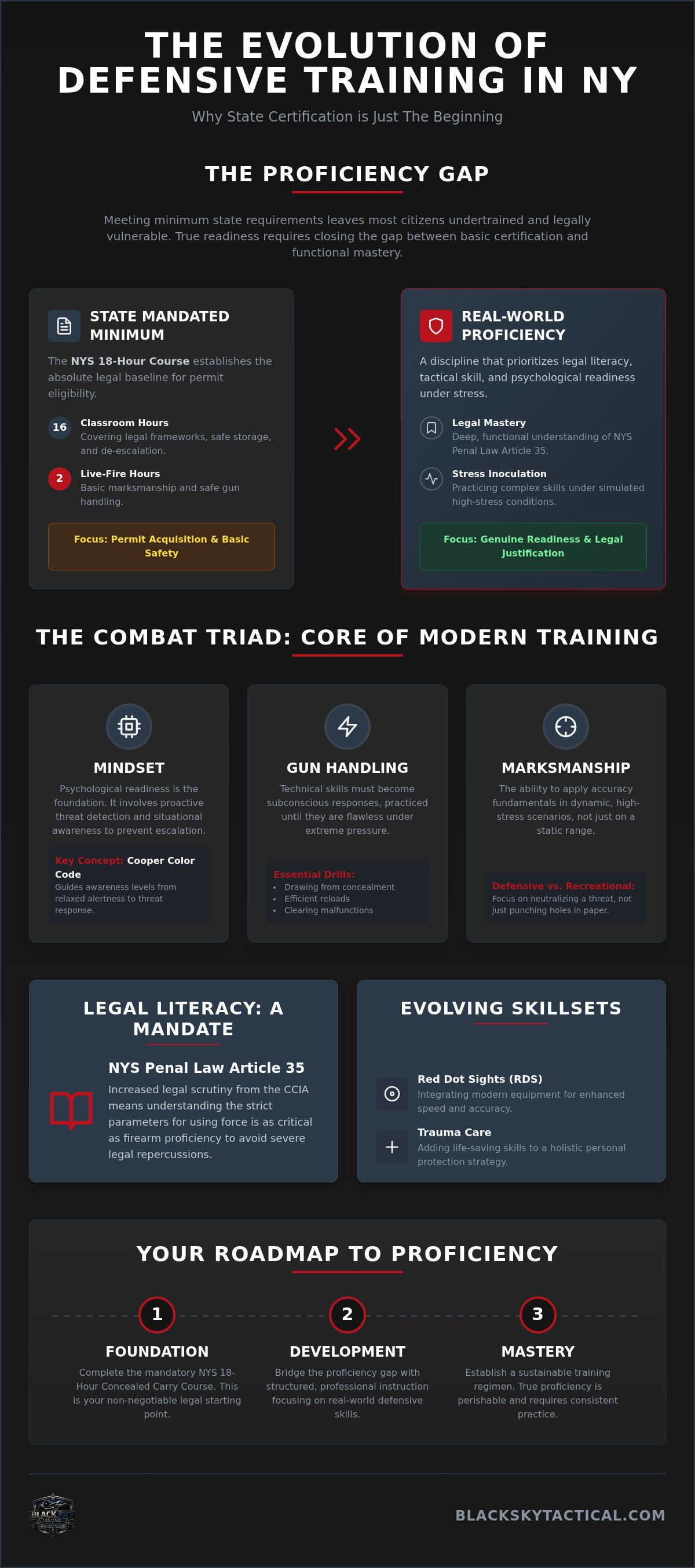
State-mandated certifications, such as the 16-hour classroom and 2-hour live-fire requirement, serve as the essential legal baseline for all permit holders. It's vital to seek instruction from professionals who understand the specific jurisdictional nuances of New York's various counties, as local enforcement priorities and administrative procedures can vary significantly. The NYS 18-Hour Concealed Carry Course provides the foundational knowledge required to navigate these complexities, offering a structured curriculum that covers everything from safe storage to conflict de-escalation. However, obtaining a certification is merely the starting point for a disciplined training regimen. True proficiency requires a commitment to ongoing education that exceeds the minimum standards set by the state. Certification is just the start. This ensures that the individual is prepared for the technical and legal realities of a self-defense situation, moving beyond compliance toward genuine readiness.
Core Components of Modern Defensive Training
A comprehensive approach to personal protection requires more than just mechanical skill; it demands a sophisticated understanding of the regulatory environment and the psychological factors involved in a conflict. Defensive pistol training NY is built upon the "Combat Triad," a concept that balances mindset, gun handling, and marksmanship. Without the psychological readiness to identify a threat, even the most precise marksman remains vulnerable. This readiness is often categorized by the Cooper Color Code, which guides individuals through varying levels of awareness, from "Condition Yellow," representing a state of relaxed alertness, to "Condition Red," where a specific threat has been identified and a response is required. Proactive threat detection and situational awareness are the primary layers of defense that often prevent an encounter from escalating into a physical confrontation.
Technical proficiency also includes skills that go beyond the basic requirements of a standard safety course. Technical skills, which are fundamental to defensive pistol training NY, include drawing from concealment, performing efficient reloads, and clearing various types of firearm malfunctions under pressure. These actions must be practiced until they become subconscious responses, as the cognitive load during a defensive encounter is often too high to permit deliberate thought regarding equipment operation.
Mastering NYS Penal Law Article 35
Understanding the nuances of New York State firearm laws is perhaps the most critical component of a defender's education. NYS Penal Law Article 35 governs the justification of the use of force and serves as the legal framework for self-defense. It explicitly outlines the "duty to retreat" in public spaces, while also defining the limited "Castle Doctrine" protections within one's own dwelling. A defender must be able to articulate a "reasonable belief" that deadly physical force is necessary to prevent the imminent use of similar force by an aggressor. Failure to grasp these legal thresholds can lead to severe criminal and civil consequences, regardless of the tactical outcome of an encounter. Legal training is not an adjunct to firearm instruction; it's the foundation upon which all defensive decisions must be built.
The Psychology of a Defensive Encounter
The physiological response to high-stress situations often results in tachypsychia, which is the perceived distortion of time, and tunnel vision. Modern training methodologies address these effects by pushing students to "train to failure" in controlled environments, which builds the necessary muscle memory to function when fine motor skills degrade. Prioritizing de-escalation remains the most effective defensive tool, as avoiding an encounter entirely is the only way to ensure a zero-risk outcome. For those seeking to refine these advanced competencies, private firearm training offers a focused environment to address specific skill gaps and ensure full compliance with state mandates.
Beyond the 18-Hour Requirement: The Proficiency Gap
A common misconception among new permit applicants is the belief that completing the state-mandated 18-hour course represents the conclusion of their defensive education. In reality, there is a substantial distinction between being legally compliant and being tactically proficient. While the mandatory curriculum fulfills the procedural requirements for a license, it's designed as a safety orientation rather than a comprehensive program for tactical mastery. Academic research on firearm training effectiveness suggests that skill retention is heavily dependent on frequency and the quality of ongoing practice. Without a commitment to continued defensive pistol training NY, individuals often experience "skill fade," where the ability to perform complex motor tasks under pressure diminishes rapidly after the initial instruction concludes.
The baseline 18-hour syllabus focuses primarily on administrative rules and basic handling, which are necessary for public safety but insufficient for high-stakes defensive encounters. Advanced training involves a level of technical complexity that isn't possible to master in a single weekend. This includes the ability to process information while moving, utilizing cover effectively, and making split-second decisions regarding the use of force. For many, the transition from an entry-level student to a prepared defender requires a structured approach that moves beyond the minimum standards set by the state.
Why the Baseline Isn't Enough
The current state requirements provide a vital foundation in safety, but the two hours of live-fire training mandated by law are rarely enough to build consistent proficiency. Real-world threats are dynamic and unpredictable, often requiring movements and responses that aren't covered in a static range environment. This is why many students seek private firearm training for beginners in NY to refine their individual mechanics. Personalized instruction allows for the correction of deep-seated habits that might otherwise go unnoticed in a larger group setting, ensuring that the student's foundation is technically sound before they attempt more advanced defensive pistol training NY.
Bridging the Gap with NRA Standards
To address the limitations of basic safety courses, integrating nationally recognized curriculum standards is essential for building foundational accuracy. The NRA Basic Pistol Shooting Course adds significant technical depth by focusing on the fundamental mechanics of pistol operation and marksmanship. At Black Sky Tactical, these standards are integrated into the mandatory NYS training to ensure that students don't just leave with a certificate, but with a measurable improvement in their shooting ability. This dual-track approach bridges the gap between administrative compliance and the technical proficiency required for actual personal protection.
Emerging Trends in Civilian Personal Protection
Modern personal protection has expanded beyond the firearm itself to include a broader spectrum of life-saving interventions and management skills. Defensive pistol training NY now frequently incorporates "Stop the Bleed" protocols and basic trauma care, recognizing that the ability to manage a medical emergency is statistically as significant as the ability to deploy a firearm in a defensive encounter. There is also a growing demand for specialized disciplines like Violent Incident Command, which focuses on situational management and the coordination of safety efforts during high-stress events. These competencies represent a shift from purely reactive measures toward a proactive, command-oriented mindset that prioritizes the preservation of life through multiple modalities. By integrating medical proficiency with tactical skill, the modern defender adopts a more professional and responsible approach to public safety.
Technological Advancements in Training
The integration of technology has redefined how individuals maintain their proficiency outside of traditional range environments. Dry-fire systems and laser trainers allow for consistent, home-based practice of fundamental mechanics without the logistical constraints or costs associated with live-fire facilities. There is also a distinct movement toward optics-ready handguns, which facilitate faster target acquisition and allow the shooter to maintain a focus on the threat rather than the front sight post. Industry trends indicate that a significant majority of modern defensive shooters in NY are transitioning to red dot optics for improved accuracy under stress. This shift toward electronic sighting systems reflects the broader professionalization of civilian equipment standards, as these tools provide a clear technical advantage in low-light or high-pressure situations where traditional iron sights may be difficult to align.
Holistic Family Safety
Personal protection is increasingly viewed as a family-wide responsibility rather than an individual pursuit, necessitating a structured approach to household security. This holistic strategy emphasizes the necessity of secure home storage solutions and the formal education of all household members, including children and young adults. Understanding the specific firearm laws for young adults in NY is a critical component of family safety planning, as it ensures that every member of the household operates within the legal framework provided by the state. Moving from an individual defense mindset to a comprehensive family safety plan ensures that responses to emergencies are coordinated, disciplined, and legally sound. To begin implementing these advanced safety protocols and situational management strategies, you can explore the specialized Violent Incident Command Training designed for those who require a higher level of tactical and administrative preparedness.
Developing a Sustainable Training Regimen with Black Sky Tactical
Achieving a state of genuine readiness requires a transition from the administrative milestone of permit acquisition to the disciplined pursuit of tactical mastery. Defensive pistol training NY is not a singular event but a continuous process of refinement that necessitates a structured and sustainable regimen. While the initial certification provides the legal authority to carry, the transition to becoming a proficient defender involves the consistent application of skills in varied environments. Skill atrophy is a documented phenomenon in firearm proficiency; without regular engagement, the neuromuscular pathways required for effective response under stress begin to degrade. Scheduling quarterly "tune-ups" serves as a vital safeguard against this decline, ensuring that your mechanics remain sharp and your legal knowledge stays current with evolving state mandates.
Engaging with the local Rockland and Orange County training community offers a professional environment where these standards are maintained through collective discipline. Private instruction remains the most effective method for correcting deep-seated habits that generalized courses may fail to address. By working with a knowledgeable instructor, you can identify specific technical deficiencies and develop a targeted plan for improvement. This methodical approach ensures that your training is not just frequent, but purposeful and aligned with the highest standards of professional responsibility.
Tailored Instruction Paths
Effective training must mirror the reality of your daily operational environment. This involves customizing drills to reflect your specific carry gear and holster setup, as the transition from a range holster to a concealment system can significantly impact draw times and retention techniques. Mentorship through Black Sky Tactical focuses on these individual nuances, providing one-on-one guidance that addresses the complexities of your personal safety plan. Advanced sessions often incorporate low-light shooting and alternative force options, providing a comprehensive defensive capability that extends beyond basic marksmanship. This specialized focus ensures that your defensive pistol training NY is relevant to the high-stakes encounters you are preparing to manage.
Your Next Steps for NY Compliance and Safety
For those beginning the certification process, the NYSNRA101 course serves as the foundational bridge between state mandates and technical proficiency. This combined curriculum ensures that you meet all legal requirements while building a solid mechanical base. For permit holders who have already cleared the initial hurdles, exploring Violent Incident Command training offers a professional-level understanding of situational management and crisis coordination. The final step in establishing your regimen is to contact Black Sky Tactical to audit your current proficiency level. This assessment provides a clear, objective baseline of your skills, allowing you to move forward with a training plan that is both realistic and legally sound.
Establishing Your Path to Tactical Proficiency
Navigating the 2026 defensive landscape in New York requires a disciplined commitment to both legal literacy and technical proficiency. It's clear that the transition from a mere permit holder to a prepared defender involves recognizing that state mandates are only the foundational baseline for personal safety. True readiness is achieved through the integration of modern equipment, situational management, and a sustainable training regimen that accounts for the physiological realities of high-stress encounters. By prioritizing continuous education, you move beyond simple compliance toward a state of genuine preparedness.
Black Sky Tactical serves as the expert bridge between these complex jurisdictional requirements and the practical skills needed for real-world protection. When you choose a curriculum that combines NRA standards with New York mandates, you ensure that your defensive pistol training NY is both comprehensive and compliant. Our expert instructors specialize in the nuances of NY and NJ law, providing professional local training throughout Rockland, Orange, and Westchester Counties.
Enroll in the NYSNRA101 Combined 18-Hour CCW & NRA Course today to secure your certification and establish a professional foundation for your long-term safety. Taking this proactive step ensures you're not just legally authorized, but genuinely prepared to protect yourself and your family with confidence.
Frequently Asked Questions
What is the difference between basic gun safety and personal protection training?
Basic gun safety focuses on the administrative handling and mechanical operation of firearms to prevent accidental discharge and maintain a safe environment. Personal protection training involves the application of these foundational skills within a defensive context, incorporating situational awareness, proactive threat detection, and the legalities of using force. It's the transition from preventing accidents to managing a specific, high-stress conflict effectively.
Is the NY 18-hour CCW course enough to be considered 'trained'?
The mandatory 18-hour course provides the administrative baseline required for permit eligibility but does not equate to tactical proficiency. Comprehensive defensive pistol training NY requires ongoing education and frequent practice beyond the classroom to bridge the proficiency gap. Without a commitment to continued skill building, the ability to perform complex motor tasks under pressure will diminish rapidly over time.
Does personal protection training cover the legal use of force in New York?
Professional training programs specifically address NYS Penal Law Article 35, which outlines the justification for the use of physical and deadly physical force. Understanding these statutes is vital for any defender to ensure their actions remain within the strict legal parameters established by the state. Training clarifies complex concepts like the duty to retreat and the specific thresholds for reasonable belief in a defensive encounter.
Can I take advanced defensive training before I have my NY pistol permit?
In New York, you cannot legally handle or practice with a pistol until you possess a valid permit issued by your licensing officer. You can, however, complete the required 18-hour safety course and other classroom-based instruction while your application is pending. This includes legal seminars, situational awareness training, and medical courses like "Stop the Bleed," which don't require the possession of a firearm.
What gear do I need for a defensive pistol training course in NY?
Standard requirements typically include a reliable handgun, a quality holster designed for that specific model, a sturdy belt, and multiple magazines with pouches. Students must also provide wrap-around eye protection and electronic ear protection for all live-fire sessions. It's essential that your gear reflects your actual carry setup to ensure that the muscle memory you develop is relevant to your daily life.
How often should I refresh my personal protection training?
Practical skills require consistent attention to prevent atrophy, even if state recertification intervals are several years apart. Professional instructors recommend scheduling quarterly "tune-up" sessions and engaging in dry-fire or live-fire practice at least once every two weeks. This frequency ensures that your equipment operation remains subconscious, allowing you to focus your cognitive resources on threat assessment and legal decision-making during an incident.
Does Black Sky Tactical offer training for New Jersey residents as well?
Black Sky Tactical provides the NJSNRA101 course, which is a combined NJS Conceal Carry and NRA Basic Pistol class specifically for New Jersey residents. This curriculum is tailored to meet the unique jurisdictional requirements of New Jersey while providing the same high-level technical instruction found in their New York offerings. It's an ideal path for those seeking a multi-state approach to their personal safety strategy.
What is 'Violent Incident Command' training?
Violent Incident Command training focuses on the management and coordination of safety efforts during high-stress events. It moves beyond individual marksmanship to teach situational leadership, effective communication with law enforcement, and the holistic management of a defensive encounter. This training is designed for individuals who require a professional-level understanding of how to command a scene and minimize risk during and after a violent incident.


