
The legal landscape for firearm ownership in New York has shifted into a strictly regulated framework where a single administrative oversight can result in the summary denial of your permit application. Since the implementation of the Concealed Carry Improvement Act (CCIA), obtaining a concealed carry license requires a disciplined commitment to the 18-hour mandatory gun safety training NY residents must now complete to satisfy state licensing officers. It's understandable if you feel overwhelmed by the transition from brief safety orientations to a comprehensive 16-hour classroom and 2-hour live-fire curriculum, as these evolving mandates leave little room for procedural error.
This guide serves as an authoritative reference to help you navigate the complex landscape of New York's firearm training mandates, providing clarity on the current legal requirements and certification standards. By following this methodical briefing, you'll gain a thorough understanding of the state-mandated curriculum, which includes essential topics such as situational awareness and conflict de-escalation. We'll also provide the necessary procedural steps for locating a duly authorized instructor and preparing for the rigorous live-fire proficiency assessment, ensuring you meet the 80 percent passing threshold required for your official certification of completion.
Key Takeaways
- Identify the specific legal mandates established by the Concealed Carry Improvement Act (CCIA) to ensure your permit application adheres to the current regulatory framework for both premises and concealed carry licenses.
- Clarify the logistical breakdown of the 18-hour mandatory gun safety training NY applicants must complete, including the 16-hour classroom component and the subsequent 2-hour live-fire proficiency assessment.
- Prepare for the comprehensive state-mandated curriculum by reviewing essential safety topics such as situational awareness, safe storage requirements, and suicide prevention protocols.
- Learn the administrative procedures for verifying a "Duly Authorized Instructor" through the DCJS or State Police to ensure your certificate of completion is valid for jurisdictional filing.
- Understand the procedural advantages of the NYSNRA101 course, which synthesizes the state’s 18-hour requirement with the NRA Basic Pistol syllabus for a superior standard of safety and education.
The Landscape of Mandatory Gun Safety Training in NY
The implementation of the Concealed Carry Improvement Act (CCIA) in September 2022 fundamentally restructured the legal requirements for firearm possession within the state. This legislative shift moved New York away from a discretionary licensing model toward a standardized, objective framework that demands rigorous educational compliance. For residents seeking a permit in 2026, understanding the scope of mandatory gun safety training NY is the first step in a complex administrative process. This training is no longer an optional recommendation for responsible ownership; it's a statutory prerequisite that applies to new applicants and those seeking to renew their concealed carry licenses under the current three-year renewal cycle.
The New York State Division of Criminal Justice Services (DCJS), in conjunction with the State Police, established the minimum standards for this instruction to ensure uniform safety protocols across all sixty-two counties. These standards define "mandatory training" as a multi-day commitment that encompasses both theoretical knowledge and practical proficiency. Unlike previous years where a brief safety talk might satisfy a local judge, the current legal threshold requires a specific curriculum that cannot be bypassed through self-study or informal instruction. Applicants must present a formal certificate of completion from a "Duly Authorized Instructor" to prove they have finished the required 16 hours of in-person classroom work and 2 hours of live-fire exercises. Failure to provide this specific documentation results in the immediate administrative denial of the permit application.
Historical Context: From Optional to Mandatory
The transition toward these stringent requirements began following the 2022 Supreme Court decision in New York State Rifle & Pistol Association, Inc. v. Bruen, which invalidated the state's previous "proper cause" requirement. In response, the state legislature enacted the CCIA to preserve public safety through enhanced vetting and standardized education. This legislation significantly altered the Gun laws in New York by replacing subjective criteria with a mandatory 18-hour educational standard. By 2026, these regulations have become the established baseline for all permit holders, including those who previously held restricted licenses and are now transitioning to full carry status.
Jurisdictional Authority in New York State
While the State Police provide the regulatory framework, the actual administration of permit applications remains under the purview of County Licensing Officers. In Rockland, Orange, and Westchester counties, these officers, often superior court judges or police commissioners, strictly enforce the training mandates. Each county maintains its own administrative procedures for how mandatory gun safety training NY certificates are submitted and verified during the background check process. It's also critical to recognize that New York's standards are designed specifically for its unique legal environment; they do not offer automatic reciprocity with neighboring states like New Jersey or Connecticut, which maintain their own distinct certification procedures.
The 18-Hour Requirement: NY's Gold Standard for CCW
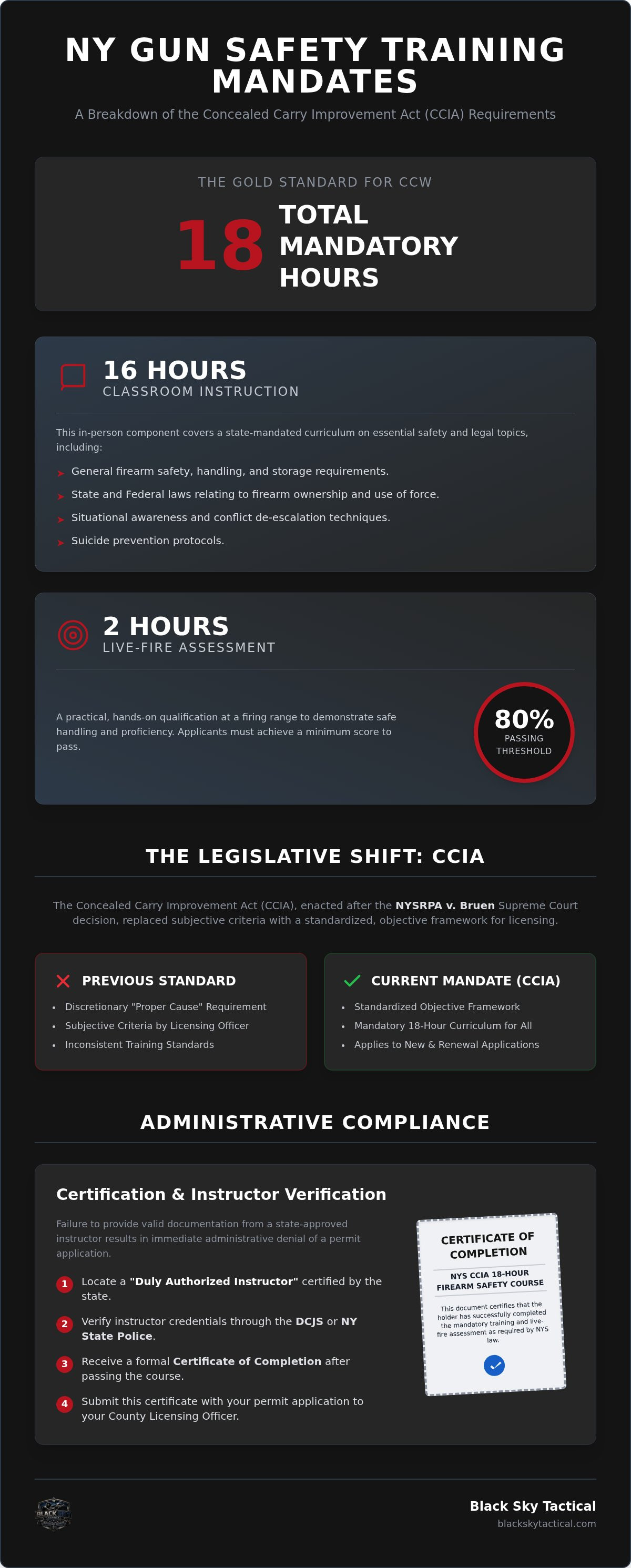
The 18-hour curriculum represents a significant administrative and educational hurdle for civilian applicants, established to ensure a uniform baseline of proficiency across the state. This requirement, codified under New York's Concealed Carry Improvement Act, splits the instruction into two distinct phases: 16 hours of classroom-based legal and safety education followed by 2 hours of live-fire range qualification. While the 18-hour mandate is comprehensive, certain individuals, such as active or retired law enforcement officers who've previously met specific state training standards, may be exempt from these requirements depending on their specific jurisdictional credentials. For the majority of citizens, the mandatory gun safety training NY requires must be completed as a prerequisite for the permit application, as the certificate of completion serves as an essential document in the background investigation packet.
Timing is a critical factor in the application process. Most licensing jurisdictions require the training to be completed within a specific window prior to the application date, though you should verify specific county timelines to avoid the expiration of your credentials. It's a structured process that leaves no room for shortcuts or informal substitutions. If you're looking for a disciplined environment to complete these hours, the NYSNRA101 course offers a professional framework that aligns with all state requirements while providing a superior educational foundation.
The 16-Hour Classroom Syllabus
The classroom portion focuses heavily on the legalities of firearm possession and the high-stakes responsibility of carrying in public spaces. Instructors must cover both state and federal laws regarding the transport of firearms, ensuring students understand the boundaries of jurisdictional authority. A critical segment of this instruction involves conflict de-escalation and New York's specific "Duty to Retreat" laws, which dictate the legal parameters for the use of deadly force. Additionally, the syllabus mandates a thorough review of the adverse effects that alcohol and controlled substances have on firearm safety, reinforcing the sober responsibility required of every permit holder.
The 2-Hour Live-Fire Qualification
The live-fire portion transitions from theory to practical application, requiring students to demonstrate physical competence under professional supervision. This phase isn't merely a practice session; it's a formal assessment where applicants must successfully perform safe drawing from a holster and re-holstering techniques without violation of safety protocols. Standardized shooting drills are utilized to measure accuracy, muzzle control, and safe handling. To receive a passing grade, an applicant must achieve a minimum score of 80 percent on the written examination and demonstrate proficiency during the range drills. If an individual fails to meet these standards, they won't receive the certification and must usually repeat the training.
Mandatory Curriculum: Essential Safety and Legal Topics
The 16-hour classroom segment of the mandatory gun safety training NY requires is not merely a lecture on mechanics; it is a rigorous exploration of the legal and ethical burdens placed upon the permit holder. State regulators have designed this curriculum to address the most common points of legal failure, starting with the physical security of the firearm. Beyond the technical aspects of marksmanship, the state demands that every applicant understands their role in broader community safety, which includes a mandatory focus on suicide prevention and mental health awareness. This proactive approach aims to reduce firearm-related tragedies by teaching owners how to recognize warning signs within their own households and social circles. It's a sobering requirement that reflects the high-stakes nature of carrying a concealed weapon in public spaces.
Applicants must also prepare for the psychological and legal realities that follow a defensive encounter. The training outlines the immediate steps one must take after a discharge, including the specific protocols for interacting with law enforcement and the administrative investigations that inevitably follow. By addressing situational awareness and the necessity of avoiding violent encounters through proactive de-escalation, the curriculum emphasizes that the best defensive shooting is the one that never occurs. This comprehensive approach ensures that those who finish the mandatory gun safety training NY mandates are prepared for the administrative, physical, and psychological aspects of firearm ownership.
Safe Storage and Child Access Prevention
New York state law imposes strict mandates on how firearms are secured within a residence, particularly when individuals under the age of 18 are present. Compliance requires the use of a secure, locked container or a safety locking device that renders the firearm inoperable by unauthorized users. Under the Concealed Carry Improvement Act (CCIA), these storage requirements extend to vehicle transport; firearms must be stored in a fire-resistant, impact-resistant, and tamper-resistant container that is hidden from plain view when the vehicle is left unattended. Failure to adhere to these storage protocols can result in criminal charges and the immediate revocation of your handgun permit.
Conflict De-escalation and Use of Force
The curriculum places heavy emphasis on the legal parameters for the use of deadly physical force as defined in NY Penal Law Article 35. Understanding the psychological effects of high-stress encounters, such as auditory exclusion and tunnel vision, is vital for maintaining the clarity required to make lawful decisions under pressure. Justification under New York law is an affirmative defense providing that conduct which would otherwise constitute an offense is permitted when it is necessary to prevent an imminent public or private injury. By mastering these legal distinctions, permit holders ensure they operate within the strict confines of state authority during a crisis.
Administrative Compliance: Certificates and Instructors
The integrity of your permit application depends entirely on the credentials of your chosen instructor. Under current regulations, mandatory gun safety training NY must be conducted by a "Duly Authorized Instructor" as recognized by the Division of Criminal Justice Services (DCJS) or the State Police. If an instructor lacks this specific jurisdictional authority, the certificate they issue will be rejected by your County Licensing Officer, necessitating a complete repetition of the 18-hour course at your expense. A valid NYS Training Certificate must contain specific data points, including the instructor's unique certification number, your full legal name, the date of completion, and a clear attestation that you passed both the 80 percent written exam and the 2-hour live-fire qualification.
Maintaining these records is a long-term responsibility for the permit holder. Since concealed carry licenses must now be renewed every three years, you should retain the original certificate or a high-resolution digital copy for your personal records. Common administrative errors, such as a misspelling of your legal name or the omission of the 16+2 hour curriculum breakdown, are frequent causes of application delays. Ensuring that your documentation is precise from the outset prevents the administrative friction that often stalls the background investigation process during the vetting stage.
Finding a Certified Training Provider
When selecting a school, be wary of providers who offer "expedited" courses or fail to provide a dedicated range for the live-fire portion. These are significant red flags that suggest the training may not meet the rigorous standards required for state certification. For residents in Rockland and Orange counties, local instruction is particularly beneficial as instructors are often familiar with the specific administrative preferences of local licensing judges. If you're just starting your journey and prefer individual attention before committing to the full certification, you might consider private firearm training for beginners NY to build your confidence and technical skill.
The Certificate Submission Process
The method of submitting your training credentials varies by county. Some offices, like those in Westchester, may prefer physical copies delivered during an in-person interview; others utilize digital portals for document uploads. If you lose your original certificate, you must contact your training provider immediately for a duplicate, though many instructors only maintain these records for a limited period. Regarding out-of-state training, New York rarely grants reciprocity unless the course curriculum is an exact match for the NYS 18-hour standard, which is why most residents choose to complete their requirements within the state to ensure compliance.
To ensure your paperwork is beyond reproach and meets all jurisdictional standards, you can register for the NYSNRA101 course to receive the precise administrative documentation required by New York licensing officers.
Meeting NY Mandates with Black Sky Tactical
Black Sky Tactical provides a structured, professional environment where the administrative complexities of state compliance are managed with meticulous care. Our flagship NYSNRA101 course is the primary vehicle for residents to complete the 18-hour mandatory gun safety training NY currently demands for concealed carry applicants. By integrating the state-mandated curriculum with the NRA Basic Pistol syllabus, we provide a dual-certification path that satisfies local licensing officers while establishing a nationally recognized baseline of proficiency. This intensive program is delivered with the sobriety and technical precision required for such a high-stakes responsibility, ensuring every student leaves with the confidence to handle their firearm safely and lawfully.
For those in Rockland, Orange, and Westchester counties, our facility serves as a regional hub for regulatory education. We understand that the transition from application to permit is often stalled by insufficient training credentials, which is why our syllabus is reviewed constantly to align with the latest DCJS standards. Scheduling an 18-hour intensive requires logistical planning, and our instructors guide you through the transition from the classroom to the live-fire range with a focus on procedural perfection rather than mere participation. This methodical approach ensures that your mandatory gun safety training NY requirements are met without the risk of administrative rejection.
The Value of the NRA Basic Pistol Integration
While the state of New York mandates a specific 16+2 hour format, the integration of the NRA basic pistol shooting course provides an added layer of instructional heritage. NRA standards are widely accepted as the foundational safety framework in the United States, offering a systematic approach to marksmanship and safe handling that complements New York's legal focus. Obtaining an NRA basic pistol certificate NY residents can rely on ensures that your training portfolio is robust, demonstrating a commitment to safety that extends beyond the minimum statutory requirements. This dual-certification model clarifies any confusion regarding how national standards interact with the unique legal landscape of the CCIA.
Next Steps: Enrolling in Your Mandatory Training
Preparation for the 18-hour curriculum begins with gathering the necessary documentation and ensuring your equipment meets range safety standards. When attending your NYS CCW class, you'll need to bring valid government identification and any specific administrative forms required by your county licensing office. We recommend arriving with a disciplined mindset, ready to absorb a heavy volume of legal and technical information over the course of the multi-day program. To secure your seat and begin the process of meeting your legal obligations, you may Enroll in the NYSNRA101 Combined Course to ensure your training is conducted by duly authorized professionals.
Securing Your Certification for 2026 Compliance
Navigating the administrative hurdles of the CCIA requires a methodical approach to both the 16-hour classroom and 2-hour live-fire requirements. You've seen that success depends on more than just marksmanship; it requires a deep understanding of New York's specific justification laws and safe storage mandates. Ensuring your documentation is issued by a duly authorized instructor is the only way to avoid the delays that often compromise permit applications. By prioritizing legal clarity and technical proficiency, you position yourself to meet the state's rigorous standards without unnecessary procedural friction.
Black Sky Tactical serves as a bridge between these complex state requirements and your goal of lawful firearm possession. Our combined NYS and NRA certified instructors provide the expertise in CCIA compliance needed by residents in Rockland, Orange, and Westchester counties. You can Register for the NYS 18-Hour Concealed Carry Course to complete your mandatory gun safety training NY within a disciplined, professional environment. Taking these necessary steps ensures you're prepared to uphold the high standards of responsibility expected of every New York permit holder.
Frequently Asked Questions
Is the 18-hour gun safety training mandatory for all NY pistol permits?
The 18-hour curriculum is strictly mandatory for all individuals applying for a concealed carry license under the Concealed Carry Improvement Act. While premises-only permits may have localized requirements depending on the jurisdiction, the 16-hour classroom and 2-hour live-fire standard is the statewide benchmark for those seeking to carry in public. This mandatory gun safety training NY standard ensures that all carry permit holders possess a uniform understanding of state penal laws and safe handling procedures.
Can I take the NY mandatory firearm training online in 2026?
Online instruction does not satisfy the current legal standards established by the Division of Criminal Justice Services and the State Police. The law explicitly mandates in-person classroom participation and live-fire range exercises to ensure that every applicant receives hands-on supervision and technical guidance from a certified instructor. This requirement is designed to verify physical proficiency and safe muzzle discipline, which cannot be adequately assessed through a digital interface.
How much live-fire shooting is required for the NY CCW permit?
Applicants must complete exactly two hours of live-fire training as part of the overall 18-hour requirement. During this period, you're required to demonstrate proficiency in safe drawing from a holster, target acquisition, and discharging the firearm under the direct observation of a duly authorized instructor. This phase includes a formal assessment where you must show that you can safely operate the firearm and hit a target with reasonable accuracy as defined by the state’s qualification standards.
Does an NRA Basic Pistol certificate satisfy the NY mandatory training requirement?
An NRA Basic Pistol certificate doesn't independently satisfy the state's mandate because it lacks the specific New York legal modules regarding the use of force and sensitive locations required by the CCIA. However, the mandatory gun safety training NY residents attend often integrates NRA standards into the 18-hour state curriculum to provide a more comprehensive educational experience. This integration ensures that students receive a nationally recognized foundation while meeting all specific state legal thresholds.
How long is the NY 18-hour training certificate valid for?
While the state requires permit renewal every three years, the initial training certificate is typically considered valid for the duration of the initial application process. You should consult your specific County Licensing Officer in Rockland, Orange, or Westchester, as some jurisdictions require the training to have been completed within one year of the application submission date. If you're renewing a permit, you must ensure your training records align with the most recent state requirements at the time of your filing.
Are there exemptions to the mandatory gun safety training for veterans?
Military service alone doesn't grant an automatic exemption from the 18-hour training requirement in New York State. While active or retired law enforcement officers may qualify for certain waivers if they've met specific state standards, veterans must generally complete the full civilian training course. This ensures that even those with extensive military backgrounds are properly briefed on the unique civilian penal laws and "Duty to Retreat" statutes that apply specifically within New York jurisdiction.
What happens if I fail the live-fire qualification portion of the training?
Failure to achieve a passing score on the live-fire assessment or the written examination prevents the instructor from issuing a certificate of completion. In such instances, you'll be required to undergo remedial instruction or retake the relevant portions of the course until you meet the 80 percent proficiency threshold. Most professional instructors will work with you to correct safety violations or technical errors, but the certificate cannot be issued until all state-mandated standards are met.
Do I need to own a firearm before taking the mandatory safety course?
You don't need to possess a firearm prior to enrolling in the training; in fact, many applicants can't legally own a handgun in New York until their permit is approved. Authorized instructors provide the necessary firearms and ammunition for the live-fire portion to ensure all students can complete their qualification safely and legally. This allow you to gain the required proficiency and certification before you ever make your first firearm purchase.


