
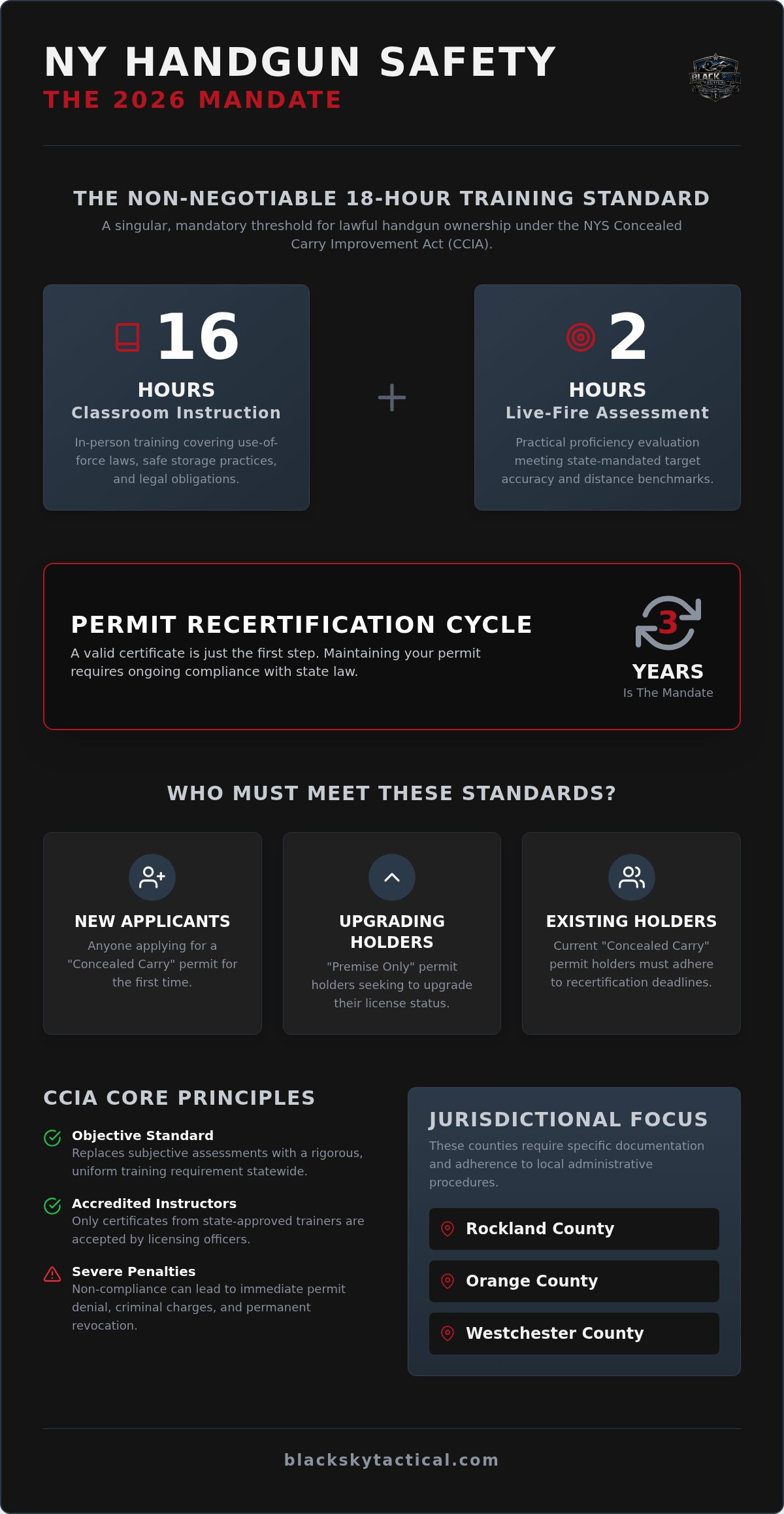
In 2026, the 18-hour training standard (comprising 16 hours of classroom instruction and 2 hours of live-fire assessment) isn't just a recommendation; it's the singular, non-negotiable threshold for lawful handgun ownership under the New York State Concealed Carry Improvement Act. Obtaining your handgun safety certification NY requires more than just a basic understanding of firearms, as the regulatory environment has shifted toward rigorous, multi-day instruction. You're likely feeling the weight of these evolving mandates. It's understandable to feel overwhelmed by the administrative complexity and the 16+2 hour training framework demanded by state authorities.
This guide provides the clarity you need to move forward with professional confidence, ensuring you meet jurisdictional standards for Rockland, Orange, or Westchester counties. We'll examine the specific 16-hour classroom and 2-hour live-fire components, clarify the three-year recertification deadlines for carry permits, and outline the exact steps to secure a valid training certificate that stands up to legal scrutiny. You'll gain peace of mind. By the end of this reference, you'll possess a comprehensive understanding of the procedural obligations necessary to maintain compliance with current New York law.
Key Takeaways
- Identify the specific 16-hour classroom and 2-hour live-fire training criteria mandated by the New York State Concealed Carry Improvement Act (CCIA).
- Determine the administrative procedures and jurisdictional requirements for submitting training credentials to the licensing authorities in Rockland, Orange, and Westchester counties.
- Understand the legal distinction between general firearms instruction and the formal handgun safety certification NY required for lawful permit acquisition and the three-year recertification cycle.
- Review the structural benefits of the NYSNRA101 curriculum, which facilitates the acquisition of both state-mandated and NRA-standard certifications within a single instructional framework.
- Evaluate the proficiency standards required during the live-fire assessment, including the specific target accuracy and distance benchmarks established by state oversight.
Understanding the NYS Handgun Safety Mandate in 2026
In 2026, the term handgun safety certification NY refers specifically to the mandatory educational curriculum enacted under the Concealed Carry Improvement Act (CCIA). This legislation fundamentally altered the prerequisites for firearm ownership by replacing subjective assessments with a rigorous, objective training standard. A brief safety briefing or a cursory overview of firearm mechanics is no longer sufficient to meet the legal threshold for permit issuance. Instead, the state mandates a comprehensive 18-hour program that integrates theoretical knowledge with practical proficiency. The New York State Police, in conjunction with local licensing officers, maintain strict oversight of this process. They'll only accept training certificates issued by accredited instructors who adhere to the state's specific syllabus. If an applicant fails to provide a valid certificate, the licensing officer will deny the permit application immediately.
It's vital to distinguish between the initial 18-hour training required for new applicants and the periodic recertification mandates. While the 18-hour course is a one-time requirement for the initial license, the legal obligation to maintain that license involves recurring administrative steps. The New York State Police now require concealed carry permits to be recertified every three years. This cycle ensures that permit holders remain within the state's registry and continue to meet the eligibility criteria defined by current New York gun laws. Understanding this distinction prevents the common error of assuming a single certificate grants lifetime compliance without further interaction with state authorities.
The Evolution of NY Firearm Training Requirements
The regulatory environment for New York's firearms underwent a seismic shift following the Supreme Court's Bruen decision, which prompted the state to implement the CCIA. Before this shift, training requirements were often inconsistent across different jurisdictions, with some counties requiring only a few hours of instruction. Today, the 16+2 hour structure is a statewide administrative mandate. This includes 16 hours of in-person classroom instruction followed by 2 hours of live-fire training. The legislative intent is to ensure that every permit holder possesses a standardized level of competency regarding use-of-force laws and safe storage practices. Penalties for non-compliance are severe; possessing a handgun without the requisite handgun safety certification NY can lead to criminal charges and the permanent revocation of all licensing privileges.
Who Must Seek Certification?
The requirement for formal certification primarily targets new applicants for a "Concealed Carry" permit. However, the 2026 regulations also impact "Premise Only" holders who wish to upgrade their license status. Current concealed carry permit holders must also pay close attention to their specific deadlines. Under current law, those who received their permits before September 1, 2020, were required to recertify by August 2023 to align with the new three-year cycle. Residents in Rockland and Westchester counties face additional administrative layers, as local licensing authorities in these areas require specific documentation to prove the training was completed through a recognized provider. Whether you're a first-time applicant in Orange County or a long-term permit holder in Westchester, staying current with these training standards is the only way to ensure your legal standing remains intact.
Comparison of Handgun Certification Levels in New York
Applicants must recognize that not all firearms training fulfills the administrative requirements for licensure. While many programs offer valuable marksmanship skills, a valid handgun safety certification NY must specifically adhere to the standards outlined in the Concealed Carry Improvement Act (CCIA). Administrative efficiency often dictates that an applicant selects a training path providing the broadest possible legal coverage. For instance, while a "Premise Only" permit might historically have required less rigorous training in certain jurisdictions, the current landscape of New York State Police firearm regulations suggests that pursuing the full 18-hour standard is the most prudent course of action. This proactive approach minimizes the need for redundant training should you later seek a full carry amendment or face updated county mandates.
NRA Basic Pistol vs. NYS CCW Training
The NRA Basic Pistol Shooting Course serves as a fundamental skill builder, focusing heavily on the mechanical operation of a firearm, stance, and marksmanship. It's a gold standard for technical proficiency. However, it doesn't satisfy the NYS Concealed Carry mandate on its own. The state-mandated 18-hour course includes specific modules on New York's use-of-force laws, conflict de-escalation, and the legalities of "sensitive locations" that aren't covered in a standard NRA curriculum. Combining these two frameworks ensures that you don't just know how to shoot, but you also understand when and where you're legally permitted to do so. For those requiring a comprehensive solution, the NYSNRA101 provides a streamlined path to achieving both state compliance and a nationally recognized skill credential.
Specialized Certifications: Youth and Private Instruction
Beyond the mandatory 18-hour classroom experience, many residents find that private firearm training for beginners NY is essential for building the confidence necessary to pass the live-fire assessment. One-on-one instruction allows for personalized corrections that a large classroom setting can't provide. Additionally, while individuals under the age of 21 aren't yet eligible for a pistol permit, a Youth Safety Course can establish a foundation of professional responsibility and safety awareness. These specialized certifications don't replace the handgun safety certification NY required for adults, but they function as critical supplements that enhance overall safety and preparation within the household. If you're considering expanding your legal carry options, you might also look into the NJSNRA101 to address the specific certification requirements for New Jersey reciprocity.
The 18-Hour NYS Concealed Carry Course Breakdown
The administrative framework for obtaining a handgun safety certification NY is divided into two distinct components: 16 hours of classroom-based instruction and 2 hours of live-fire range training. This 18-hour syllabus is a standardized requirement designed to ensure that every permit applicant possesses a foundational understanding of both the mechanical and legal aspects of firearm ownership. The classroom portion is exhaustive, covering topics such as safe storage requirements, the physical and psychological effects of a critical incident, and the specific provisions of the NY SAFE Act and the Concealed Carry Improvement Act. To receive a certificate of completion, students must attend all 18 hours and achieve a passing score of at least 80% on a final written examination that tests their knowledge of these regulatory and safety protocols.
Classroom Curriculum: Legal and Tactical Theory
The classroom instruction prioritizes legal theory, with a significant emphasis on "Article 35" of the New York State Penal Law, which governs the justification for the use of physical and deadly physical force. Understanding these statutes is essential, as the legal threshold for self-defense in New York is strictly interpreted by the courts. Instructors also facilitate modules on conflict de-escalation and situational awareness, teaching applicants how to recognize and avoid potential threats before they necessitate a kinetic response. This theoretical foundation is often supplemented by personal protection training NY, which provides the defensive mindset necessary to navigate current jurisdictional challenges. These modules collectively ensure that the applicant's handgun safety certification NY represents a comprehensive understanding of responsible ownership rather than just a procedural hurdle.
Live Fire Qualification Standards
Following the classroom sessions, applicants must participate in a 2-hour live-fire qualification conducted under the direct supervision of a certified instructor. The proficiency standard is specific; students must hit a 25.5-inch by 11-inch paper target with at least four out of five rounds from a distance of 4 yards. This assessment isn't a test of advanced marksmanship but rather a verification of safe handling and basic accuracy. Range safety protocols are strictly enforced, and any violation of safe muzzle discipline or trigger finger placement can result in immediate disqualification. If a student fails to meet the accuracy standard on their first attempt, state guidelines typically require a period of remedial instruction before a re-test can be administered. This ensures that the final certificate reflects a verified level of safe, practical skill.
Administrative Logistics: Rockland, Orange, and Westchester
Securing a handgun safety certification NY is a critical milestone, yet it represents only one portion of a complex administrative application. In the Lower Hudson Valley, licensing authority is decentralized, meaning the specific protocols for submitting your training credentials vary by county. Applicants must coordinate with their respective County Clerk or Sheriff’s Department to ensure every document, from the 18-hour course certificate to character reference letters, meets local standards. In 2026, these jurisdictions also require a thorough background check that includes social media disclosures and a minimum of four character references who can attest to the applicant’s temperament and moral character. Missing a single county-specific form can result in significant delays or an outright denial of the permit.
Timelines for permit issuance remain subject to the administrative workload of the local licensing officer. While state law aims for a six-month window, residents in high-volume areas often experience longer wait times. It’s essential to submit a complete and accurate package to minimize back-and-forth correspondence with the permit office. For residents ready to begin the administrative process, enrolling in the NYSNRA101 combined course ensures you receive the exact documentation required by these local boards.
Rockland County Specific Compliance
The Rockland County Pistol Permit Office operates with a high degree of procedural specificity. Beyond the state-mandated certificate, applicants must pay a $150 application fee and complete supplemental forms that are unique to the county's judicial oversight. Fingerprinting is a mandatory step that must be scheduled through a state-approved vendor, and the resulting records are sent directly to the Rockland authorities. It's recommended that you keep a physical copy of your handgun safety certification NY, as you'll need to present it during your scheduled interview with a licensing officer or judge. If you intend to add a firearm later, remember that Rockland charges a $5 cash fee for each license amendment.
Westchester and Orange County Nuances
Westchester and Orange counties present different administrative challenges and fee structures. In Westchester, the processing fee for a new pistol license application is $175, reflecting a more intensive review process that often includes a formal interview. Orange County requires a $111.50 fingerprinting fee, and like Rockland, charges $5 per transaction for license amendments. Both counties are strict regarding instructor credentials; they'll only accept certificates from trainers who have been pre-vetted or hold recognized certifications from both the NRA and state authorities. For individuals residing in New Jersey who frequently travel through these counties for work, obtaining a non-resident NY certification can be a complex but necessary step for legal compliance. Ensuring your instructor is recognized by these specific county boards is the only way to avoid having your 18 hours of training invalidated during the review phase.
NYSNRA101: The Gold Standard for Combined Certification
The NYSNRA101 represents a strategic instructional design that addresses the dual necessity of technical proficiency and administrative compliance. By integrating the state-mandated 18-hour curriculum with the NRA's foundational standards, this course provides a streamlined pathway for those seeking a handgun safety certification NY. Rather than treating these requirements as separate hurdles, the program acknowledges that a responsible permit holder needs both the mechanical skills of a shooter and the legal knowledge of a New York citizen. Instructors certified by both the NRA and state authorities lead these sessions, ensuring that the transition from classroom theory to range qualification is seamless and professional. These experts function as a bridge, translating complex penal codes into practical defensive strategies while maintaining a strict focus on the safety protocols required in 2026.
Why Dual Certification Matters
The value of a dual-certification approach lies in the breadth of the resulting credentials. While the NRA basic pistol shooting course establishes a national standard for firearm safety and marksmanship, it lacks the specific jurisdictional nuances required by New York's licensing officers. Conversely, the NY 18 hour concealed carry course is strictly tailored to ensure local legal compliance under the CCIA. Receiving two certificates for a single training investment is not merely a matter of convenience; it builds a more robust legal profile for the firearm owner. Should you ever need to demonstrate your commitment to safety in a legal or administrative setting, possessing both state and national certifications provides a layer of professional validation that a single certificate can't match. This dual-track training ensures you're prepared for the responsibilities of carrying a firearm in both New York and jurisdictions that recognize NRA standards.
Next Steps for Your Permit Application
For residents in Rockland, Orange, Westchester, and Bergen counties, the path toward a permit begins with identifying an accredited training date that fits within your licensing timeline. You should verify the current 2026 recertification deadlines if you're an existing permit holder, particularly in Rockland County, where administrative oversight is exceptionally precise. When preparing for the NYSNRA101, ensure you have valid identification and the necessary materials for extensive note-taking during the 16-hour classroom sessions. This isn't a casual orientation; it's a professional syllabus designed to prepare you for the gravity of handgun ownership in a highly regulated jurisdiction. Once you've completed the course and passed the written exam and live-fire assessment, you'll be prepared to submit your package to your local County Clerk or Sheriff with the confidence that your handgun safety certification NY meets every statutory requirement.
Register for the NYSNRA101: Combined 18-Hour Course today.
Securing Your Legal Standing in 2026
Adhering to the administrative requirements of the Concealed Carry Improvement Act is a prerequisite for any individual seeking to exercise their rights within the Lower Hudson Valley. You've learned that the 18-hour training standard, which includes a specific 16-hour classroom component and a 2-hour live-fire assessment, is the only path to a valid handgun safety certification NY. Navigating the jurisdictional nuances of Rockland, Orange, and Westchester counties requires meticulous attention to detail, particularly regarding the submission of accredited training certificates to local licensing officers. By selecting a curriculum that bridges the gap between state mandates and national safety standards, you ensure that your application remains beyond reproach.
Black Sky Tactical provides a professional environment where legal compliance meets expert instruction. Our instructors are certified by both the NRA and state authorities; furthermore, our Rockland County local training center is fully equipped to facilitate the 2026 CCIA mandates. You can secure your NYSNRA101 certification with Black Sky Tactical to gain the comprehensive foundation necessary for responsible ownership. Taking this step ensures you're prepared for the administrative and practical challenges of handgun licensing. We look forward to guiding you through the certification process with the precision and integrity your legal peace of mind deserves.
Frequently Asked Questions
Is the NY handgun safety certification valid for life?
No, the certification itself serves as a prerequisite for the initial permit application, but it doesn't grant permanent authorization. Concealed carry permits must be recertified with the New York State Police every three years to maintain legal standing. This recurring administrative requirement ensures that the state’s registry remains accurate and that permit holders continue to meet all eligibility criteria under current law.
Can I take the 18-hour CCW course if I don't own a handgun yet?
Yes, you can and often must complete the training before taking possession of a firearm. Since New York law requires a permit to even touch a handgun, instructors provide the necessary firearms and ammunition for the 2-hour live-fire portion of the course. This allows new applicants to fulfill their training obligations safely and legally before their permit is officially issued by the county.
Does the NYS handgun safety certification work for a New Jersey permit?
No, New York certifications are not recognized by New Jersey authorities for their Permit to Carry applications. Each state maintains its own specific training standards and jurisdictional mandates. If you require authorization for both states, you must complete separate courses that meet each state's criteria, such as the NJSNRA101 for New Jersey compliance and the NYSNRA101 for New York.
What is the passing score for the NYS CCW written exam in 2026?
Applicants must achieve a minimum score of 80% on the final written examination to receive their certificate. This assessment is administered at the conclusion of the 16-hour classroom session and covers essential topics such as safe storage, situational awareness, and New York State penal law. Failure to meet this threshold typically requires the student to undergo remedial instruction before they can attempt the exam again.
Are there any exemptions for the 18-hour training requirement for veterans or law enforcement?
Exemptions are extremely limited and generally only apply to active or recently retired police officers who have documented equivalent training through their departments. Most military veterans and retired peace officers are still required to complete the full 18-hour course to obtain their handgun safety certification NY. You should consult with your local licensing officer in Rockland or Westchester to verify your specific status before enrolling.
How much does the handgun safety certification cost in NY?
The cost for the mandatory 18-hour training is determined by individual private providers and is not governed by a fixed state fee schedule. Prices vary based on the facility, the inclusion of range fees, and the provision of firearms for the live-fire assessment. Applicants should ensure that any quoted rate covers the full 16-hour classroom and 2-hour live-fire components required by the CCIA to avoid redundant expenses.
What happens if my pistol permit recertification is denied due to lack of training?
If you fail to provide proof of the required training during your recertification cycle, your permit will likely be suspended or revoked by the New York State Police. Operating a handgun with an invalidated license is a serious criminal offense. In such cases, you must immediately surrender your firearms to local authorities or a licensed dealer until you can resolve the administrative deficiency and restore your legal compliance.
Can I use an online-only course for my NY handgun safety certification?
No, online-only courses are not legally sufficient for obtaining a permit in New York. State law specifically mandates 16 hours of in-person classroom instruction followed by a 2-hour live-fire proficiency assessment on a range. Any certificate issued by an online-only provider will be rejected by the licensing authorities in Rockland, Orange, and Westchester counties because it doesn't meet the physical attendance requirements of the CCIA.


