
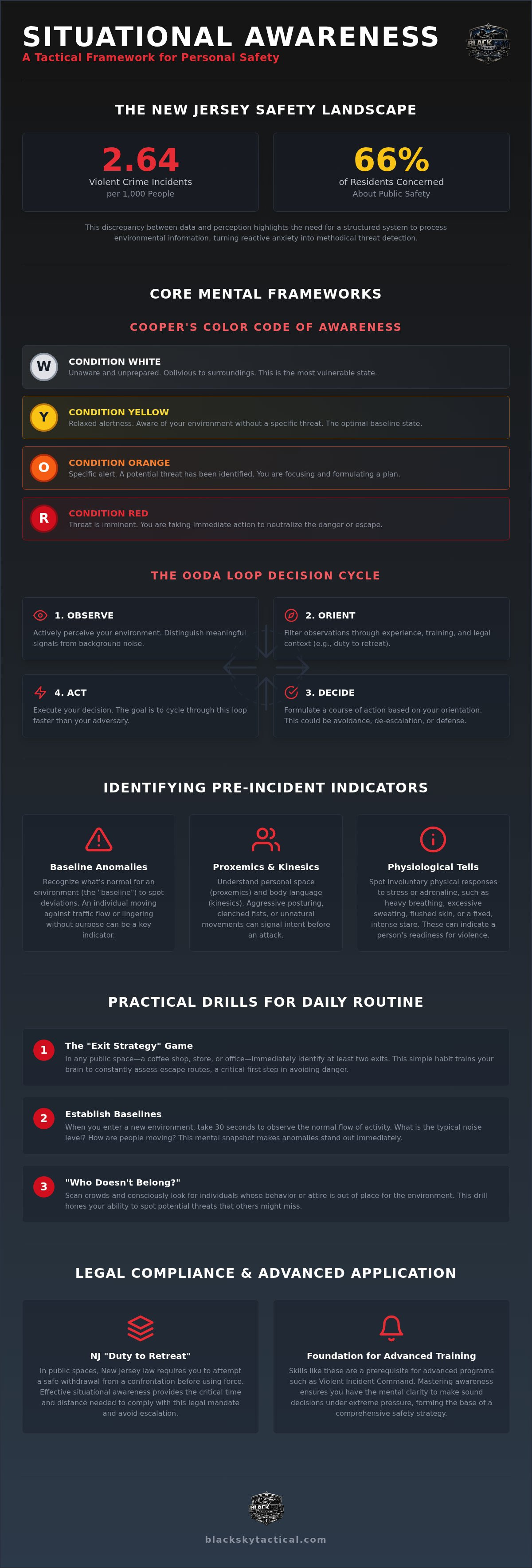
While New Jersey maintains a violent crime rate of 2.64 incidents per 1,000 people, a 2026 survey revealed that 66% of residents remain deeply concerned about public safety. This discrepancy between statistical data and personal security often stems from the absence of a structured framework for processing environmental information. You likely recognize that passive observation is insufficient, yet the distinction between being prepared and being paranoid remains difficult to define. By seeking out professional situational awareness training NJ residents can replace reactive anxiety with a methodical system for threat detection. This transition from a state of general alertness to one of tactical readiness is a critical requirement for those navigating the complex jurisdictional environments of the tri-state area.
This article provides a comprehensive overview of the mental frameworks and practical drills necessary to identify potential hazards during a daily commute or while in public spaces. We will examine how to maintain a baseline of awareness without succumbing to hyper-vigilance, ensuring your actions remain within the parameters of New Jersey's duty to retreat legal standards. You'll learn the specific observational techniques used to spot anomalies before they manifest into violent encounters. We also outline how these foundational skills serve as a prerequisite for advanced training, such as the Violent Incident Command program, ensuring you possess the clarity required to make informed decisions under pressure.
Key Takeaways
- The application of the OODA Loop and Cooper’s Color Code establishes a disciplined mental framework for evaluating environmental data and determining appropriate tactical responses.
- Engaging in structured situational awareness training NJ ensures that individuals can effectively distinguish between routine environmental noise and genuine pre-incident indicators in high-traffic public areas.
- Learning to recognize physiological tells and the principles of proxemics provides the technical basis for identifying a bad actor's intent before physical contact occurs.
- Integrating specific observational drills into your daily routine, such as the "Exit Strategy" game, reinforces the mental discipline required for consistent personal security in Bergen and Rockland Counties.
- Understanding how mental awareness integrates with professional tactical programs like Violent Incident Command Training is essential for those seeking a comprehensive and legally compliant approach to personal safety.
Understanding Situational Awareness within the NJ Safety Landscape
Situational awareness is not a vague feeling of unease but a disciplined cognitive process that requires active engagement with your surroundings. It is formally understood as the definition of situational awareness, which involves the perception of environmental elements, the comprehension of their meaning, and the projection of their future status. In the high-density corridors of Bergen and Rockland Counties, this formal approach is necessary because the sheer volume of stimuli can lead to cognitive overload. Without a structured framework, individuals often oscillate between total distraction and hyper-vigilance. The latter, often characterized as paranoia, is unsustainable and counterproductive. Effective situational awareness training NJ programs teach you to maintain a state of relaxed alertness, allowing for the detection of genuine threats without the psychological exhaustion of constant fear.
Understanding your environment is a prerequisite for legal compliance in New Jersey. As of August 2026, New Jersey remains a "duty to retreat" state in public spaces, meaning you must attempt to safely withdraw from a confrontation before using force. Early detection provides the time and distance required to fulfill this legal obligation. By identifying a potential threat before it closes the gap, you can choose an alternate route, thereby avoiding the legal and physical risks of a violent encounter. Early detection is your most effective tool for staying within the boundaries of the law while ensuring your personal safety.
The Role of Jurisdictional Context in Threat Detection
Operating within the tri-state area requires a nuanced understanding of how local mandates influence your safety strategy. A professional mindset involves recognizing that a threat in a New York City subway station may manifest differently than one in a suburban New Jersey shopping center. This awareness is particularly relevant for those pursuing NJ concealed carry permit training, as the Permit to Carry (PTC) carries significant administrative and legal responsibilities. Awareness acts as the first layer of defense, ensuring that a firearm is only considered when all other options, facilitated by early detection, have been exhausted.
Identifying High-Baseline vs. Low-Baseline Environments
A "baseline" represents the normal, expected behavior within a specific setting. In a major transit hub like Secaucus Junction, the baseline involves rapid movement and focused transit. An anomaly might be someone standing still, observing commuters, or moving against the flow of traffic. Conversely, the baseline in a quiet residential area of Westchester County is significantly lower; any unfamiliar vehicle or person lingering without an obvious purpose becomes an immediate anomaly. Developing environmental familiarity allows you to filter out noise and focus on these deviations, which are the primary indicators of potential danger.
The OODA Loop serves as a decision-making cycle consisting of the stages of Observe, Orient, Decide, and Act, which was originally developed by Colonel John Boyd to provide a tactical advantage in high-stakes environments. Within the curriculum of situational awareness training NJ, this framework is applied to minimize the "reaction gap," which is the physiological delay between the perception of a threat and the initiation of a response. By cycling through these stages more efficiently than a potential aggressor, you can maintain control over a developing situation and ensure your actions remain within legal and tactical boundaries.Deep Dive: The OODA Loop for Civilians
The first stage, Observation, involves the critical task of distinguishing a "signal" from the pervasive "noise" found in crowded New Jersey environments. Once you've identified an anomaly, the Orientation phase begins, where your perception is filtered through your personal experience and your understanding of local legal requirements, such as the duty to retreat. This interpretive stage is what allows you to comprehend the gravity of a situation before it escalates, a skill refined through consistent situational awareness training NJ. Finally, the Decision and Action phases require a commitment to a pre-planned response, ensuring that you don't waste valuable seconds in a state of indecision when a threat is confirmed.
Implementing Cooper’s Color Codes in Daily Life
The Cooper Color Code provides a structured way to categorize your level of mental readiness and manage your physiological response to danger. Condition White represents a state of total unawareness, which is frequently seen in individuals who are digitally distracted by their mobile devices in public settings. For those who prioritize their personal safety, Condition Yellow is the requisite professional standard. It's a state of relaxed alertness where you're cognizant of your surroundings without being hyper-vigilant. If you identify a specific anomaly, you transition to Condition Orange, which involves a focused evaluation of the potential threat.
Condition Red is the state of being prepared to fight or flee, while Condition Black represents a total breakdown of physical and mental faculties due to extreme stress. Resources like the Situational Awareness Training Program highlight that staying in Condition Yellow prevents the catastrophic physiological spikes associated with Condition Black. Mastering these frameworks is a necessary prerequisite for anyone considering private firearm training, as a disciplined mind must always precede a tactical response. By maintaining this mental discipline, you ensure that your reactions are measured, legal, and effective.
Identifying Pre-Incident Indicators: Spotting Threats Early
Professional situational awareness training NJ focuses on the recognition of pre-attack indicators, which are the observable behaviors and physiological changes that often precede a violent act. These indicators aren't based on vague suspicion but on objective, administrative data points. By applying CISA's framework for situational awareness to a personal safety context, we can categorize threat detection into structured phases of collection and analysis. This methodical approach allows you to process environmental cues, such as proxemics, to determine if a subject’s movement in a NJ parking lot is incidental or intentional. When an individual ignores established social boundaries or adjusts their path to intersect with yours, they're providing actionable data regarding their intent.
Targeting behaviors like staging, where a person positions themselves to intercept a target, or scanning, which involves looking for witnesses and security cameras, serve as critical warnings. While many people dismiss their "gut feeling," this sensation is more accurately described as the brain’s subconscious processing of high-volume environmental anomalies. In a professional safety context, we treat this intuition as a functional tool that prompts an immediate transition from Condition Yellow to Condition Orange. It’s the signal to begin a specific plan of avoidance or exit before a situation reaches the point of physical confrontation.
Physical Cues of Aggression and Intent
Subjects preparing for a violent encounter often exhibit "grooming gestures," such as touching the face, adjusting clothing, or clenching fists, which are involuntary responses to a significant adrenaline spike. Target fixation, where a subject’s gaze remains locked on you despite environmental distractions, is another high-priority indicator that signals intent. Additionally, you should be trained to look for "printing," where the outline of a concealed weapon is visible through clothing, or unnatural movement patterns like "blading" the body to hide an object from your field of vision.
Environmental Red Flags in Public Spaces
Effective awareness extends beyond human behavior to the physical architecture of your surroundings. In high-density areas like NJ shopping malls or transit hubs, you must identify "choke points" where movement is restricted and egress routes are limited. Recognizing the difference between cover, which consists of objects that can stop a projectile, and concealment, which only hides your position, is a fundamental skill. This environmental analysis is a core component of active shooter response training NY, as it dictates your movement and positioning during the initial moments of an incident. By identifying these red flags early, you maintain the tactical advantage of time and distance.
5 Practical Situational Awareness Drills for Your NJ Daily Routine
The transition from theoretical understanding to operational capability requires the consistent application of practical exercises. While formal situational awareness training NJ provides the foundational knowledge, these five drills are designed to be integrated into your daily routine without the need for a facilitator or specialized equipment. By performing these exercises, you internalize the decision-making cycles discussed previously and ensure that your mental state remains in Condition Yellow. Consistent practice turns these administrative safety tasks into a subconscious habit, reducing the cognitive load required to maintain security in high-density environments.
Drill 1: Mastering the Exit Strategy
Upon entering any public space, such as a local restaurant or the Garden State Plaza, your first tactical task is to identify the primary and secondary points of egress. While most people only recognize the door through which they entered, you must locate an alternative route, such as a service door or a kitchen exit. This drill ensures that if the primary exit is blocked by a hazard or a bad actor, you possess a pre-verified path to safety. This practice is essential for fulfilling your legal obligation to retreat whenever a safe withdrawal is possible under New Jersey law.
- Drill 2: The Anomaly Search. Identify three specific elements that don't fit the established baseline of your current location. This might include an individual wearing a heavy coat during the high temperatures of August or a vehicle idling in a restricted zone.
- Drill 3: The Window Reflection Technique. Use the reflective surfaces of storefront windows or parked vehicles to expand your field of view. This technique allows you to observe what's behind you without the need for an obvious and potentially provocative head turn.
- Drill 4: The Color Identification Challenge. Select a person in a crowd and quickly memorize their clothing colors and physical characteristics. This exercise strengthens your ability to provide accurate descriptions to law enforcement in the event of an incident.
Drill 5: Scenario Rehearsal for Commuters
Commuting on the PATH or NJ Transit presents unique challenges due to confined spaces and limited movement. Use your transit time to mentally walk through "What If" scenarios, such as a medical emergency on the platform or a violent encounter within a train car. During these rehearsals, focus on the "Decide" and "Act" phases of the OODA Loop to ensure your responses are immediate and legally sound. It's helpful to cross-reference these plans with the professional standards outlined in a NYS 18 hour pistol course checklist. If you're ready to move beyond self-guided drills and seek professional certification, you can enroll in Violent Incident Command Training to formalize your safety protocols.
Professional Tactical Training: Moving from Awareness to Response
Identifying potential threats is a prerequisite for safety, but awareness alone is insufficient if it isn't supported by physical proficiency and a rehearsed tactical response. In high-stakes environments, the ability to observe an anomaly must lead to a decisive action that's both legally compliant and physically effective. Engaging in professional situational awareness training NJ provides the mental framework, but the transition to operational readiness requires hands-on instruction. This is where specialized programs like Violent Incident Command Training become essential, as they bridge the gap between passive observation and active incident management.
For those who've obtained or are seeking a Permit to Carry (PTC) in New Jersey, the responsibility for safety extends beyond personal avoidance to the potential for defensive intervention. The Combined CCW and NRA class serves as a critical junction in this professional development. It ensures that your understanding of the OODA Loop and pre-incident indicators is solidified through rigorous firearm proficiency standards and administrative briefings. Transitioning from a general citizen to a responsible permit holder requires this level of comprehensive training to ensure any response to a violent encounter is measured, disciplined, and strictly adheres to the jurisdictional requirements of the tri-state area.
Black Sky Tactical: Your Partner in NJ Safety Compliance
Black Sky Tactical operates as a professional institution dedicated to safety and education. Our expert instructors provide instruction at our facilities in Bergen County, NJ, and Rockland County, NY, focusing on the meticulous details of state mandates. We prioritize hands-on drills in a controlled environment because virtual simulations don't replicate the physiological stress of a real-world incident. Our curriculum is designed to meet the current 2026 NJ PTC training requirements while exceeding basic standards to ensure our students possess a high degree of technical skill and legal clarity.
Next Steps: Enrolling in Professional Situational Awareness Training
Selecting the appropriate course depends on your current proficiency and specific safety goals. For individuals seeking a personalized approach to security planning, our Private Firearm Training offers a focused environment to address unique concerns. If your objective is to master the administrative and tactical complexities of public safety, registering for a Violent Incident Command or CCW session is the necessary next step. Moving beyond basic situational awareness training NJ ensures you're prepared to manage the entire lifecycle of a violent incident, from the initial detection of an anomaly to the post-incident legal obligations.
Establishing a Foundation for Professional Security
Mastering situational awareness is a continuous administrative and tactical commitment that extends far beyond simple observation. By internalizing the OODA Loop and integrating daily drills into your routine, you develop the ability to detect pre-incident indicators before they escalate into physical confrontations. This proactive approach is essential for maintaining safety in the high-density environments of the tri-state area. However, mental preparedness isn't the only phase of a comprehensive security strategy. To ensure your responses are both effective and legally compliant, you must bridge the gap between awareness and tactical proficiency.
Professional situational awareness training NJ provides the necessary foundation for those seeking to navigate complex jurisdictional requirements with confidence. Black Sky Tactical offers NYS and NJS 18-hour certified courses, along with comprehensive Violent Incident Command programs designed for residents in Bergen, Rockland, and Orange Counties. Our expert instruction ensures you possess the technical skills required for responsible permit ownership. Register for Professional Tactical Training with Black Sky Tactical today to formalize your safety protocols. Taking these steps demonstrates a disciplined commitment to your personal security and the safety of those around you.
Frequently Asked Questions
What is situational awareness training and why is it important in NJ?
Situational awareness training is a structured cognitive process for perceiving and analyzing environmental data to identify potential threats. In New Jersey, high-density areas and public transit hubs increase the volume of stimuli, making formal training necessary to filter routine noise from actual danger. It ensures residents can fulfill their legal duty to retreat by identifying hazards early enough to withdraw safely from a developing confrontation.
Can situational awareness really prevent a crime from happening?
Yes, situational awareness functions as a primary deterrent by removing the element of surprise and making you a difficult target for bad actors. Criminals often select victims who appear distracted or unaware of their surroundings. By demonstrating alertness and maintaining distance through early detection, you often disrupt the staging phase of an attack, causing the individual to abandon their intent before an engagement occurs.
How do I practice situational awareness without becoming paranoid?
You practice by maintaining Condition Yellow, which is a state of relaxed alertness rather than hyper-vigilance. Paranoia is an emotional response, whereas situational awareness is an administrative observation of facts. By focusing on identifying specific anomalies against an established baseline, you replace generalized anxiety with a methodical, data-driven assessment of your surroundings, which actually reduces psychological stress over time through increased confidence.
Is situational awareness training required for a NJ Concealed Carry Permit?
While there's no standalone mandate for a course specifically titled situational awareness, these principles are foundational to the required NJ Permit to Carry training. Comprehensive situational awareness training NJ is often integrated into the administrative and tactical briefings of certified CCW courses. Applicants must demonstrate an understanding of safe handling and legal obligations, both of which rely heavily on environmental awareness and threat detection.
What are the most common "red flags" I should look for in public spaces?
Common indicators include target fixation, where a subject’s gaze remains locked on you, and scanning behavior, where an individual repeatedly checks for witnesses or security cameras. You should also observe for grooming gestures or blading the body, which may signal an adrenaline spike or the presence of a concealed weapon. Recognizing these anomalies allows you to initiate an exit strategy before a confrontation begins or reaches a critical stage.
How does the OODA Loop apply to personal safety for civilians?
The OODA Loop provides a four-stage decision cycle that helps civilians process information faster than an aggressor. By observing an anomaly and orienting it within the context of local laws and personal safety protocols, you can decide on a course of action before the threat reaches a critical stage. This framework is essential for reducing the physiological reaction gap during a crisis, ensuring your actions are measured and effective.
Are there specific situational awareness drills for NJ Transit commuters?
Commuters can utilize the Anomaly Search drill to identify three elements that deviate from the standard baseline of a station or train car. Additionally, practicing the Exit Strategy game by identifying at least two egress points upon boarding helps prepare for unexpected emergencies. These drills turn passive transit time into active training, ensuring you remain cognizant of your surroundings while navigating high-traffic transit hubs like Secaucus Junction.
Where can I find professional situational awareness training in Bergen County?
Professional instruction is available through Black Sky Tactical, which provides expert-led safety programs in Bergen County, NJ, and Rockland County, NY. Our curriculum includes situational awareness training NJ as a core component of our Violent Incident Command and CCW certification courses. We emphasize hands-on drills and legal compliance to ensure students are prepared for the specific security challenges and administrative requirements of the tri-state area.


