
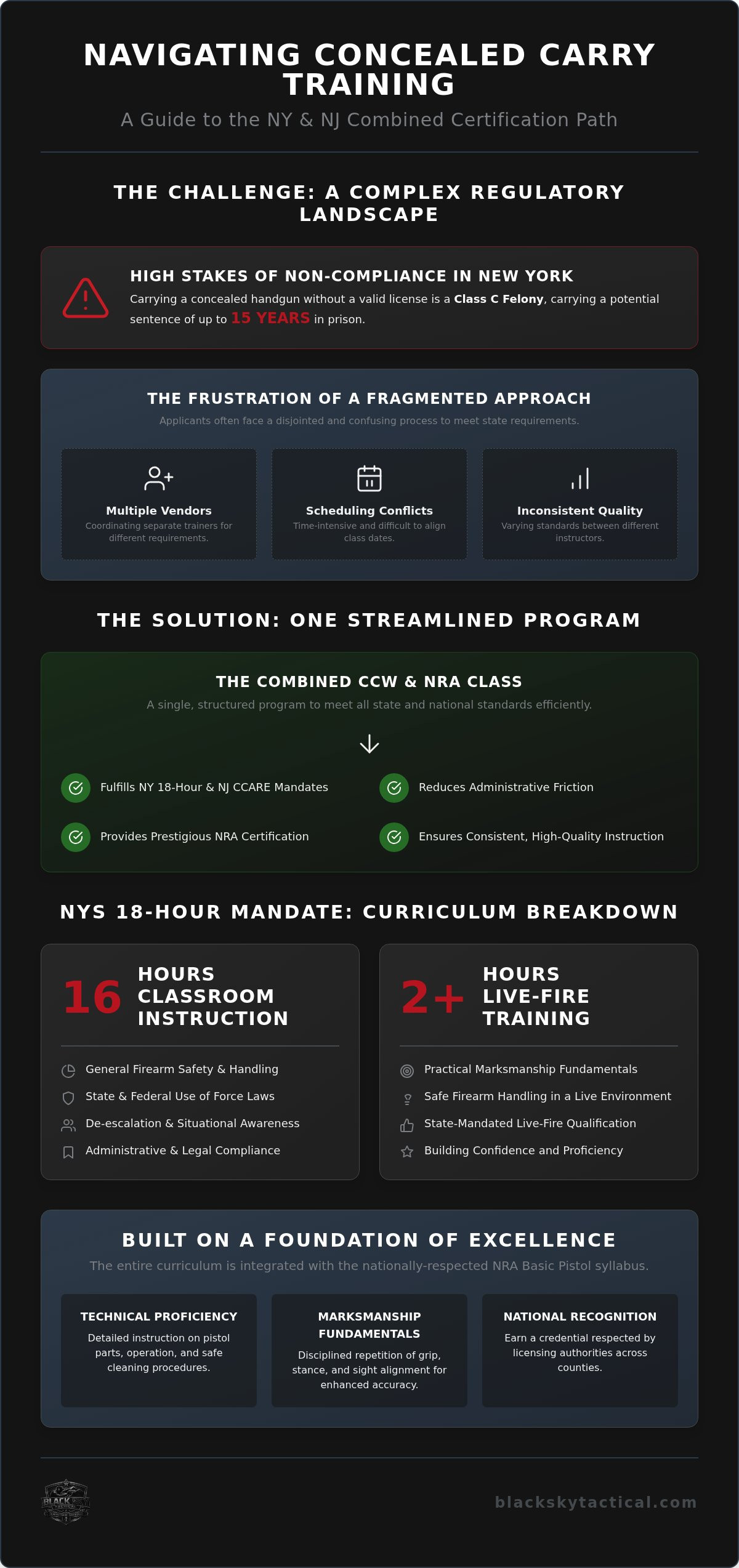
Carrying a concealed handgun in New York without a valid license is classified as a Class C felony, which carries a potential sentence of up to 15 years in prison. This reality underscores the absolute necessity of adhering to the stringent training mandates established by the state. For many residents in Rockland or Bergen counties, the primary challenge isn't the desire to comply, but rather the logistical difficulty of finding a Combined CCW and NRA class that satisfies every regulatory hurdle in a single session. You likely recognize that the 18-hour training requirement, which includes 16 hours of classroom instruction and 2 hours of live-fire training, is a significant administrative and time-intensive commitment.
We understand that the complexity of New York's 18-hour mandate and New Jersey's CCARE protocol can feel overwhelming. It's frustrating to manage multiple vendors just to secure the certifications required for your Permit to Carry. This guide will demonstrate how you can efficiently meet these mandatory state requirements while simultaneously earning prestigious NRA certifications through a streamlined, professional program. We'll examine the specific legal standards for both jurisdictions, the technical details of the live-fire qualification, and the procedural steps necessary to ensure your application is administratively sound.
Key Takeaways
- Understand how a Combined CCW and NRA class optimizes your path to licensure by integrating the New York State 18-hour mandate with the technical rigor of the NRA Basic Pistol syllabus.
- Identify the essential curriculum components required to satisfy the New Jersey CCARE protocol and the New York 16+2 instructional format within a single, unified program.
- Learn the critical criteria for evaluating training institutions in Rockland, Orange, and Bergen counties to ensure your certification meets the strict standards of local licensing authorities.
- Discover strategic logistical planning methods to manage the mandatory 18-hour training commitment through structured scheduling that maintains instructional focus and retention.
- Recognize the professional advantages of obtaining dual-state certifications through a disciplined training model that prioritizes administrative accuracy and tactical proficiency.
Understanding the Integrated CCW and NRA Training Model
The Combined CCW and NRA class functions as a comprehensive educational framework designed to satisfy specific jurisdictional mandates while simultaneously providing nationally recognized marksmanship credentials. This integrated model was developed as a direct response to the heightened regulatory environment following legislative shifts in the tri-state area. By merging the NYS 18-hour training requirement with the established NRA Basic Pistol Shooting Course, students can navigate the complex landscape of concealed carry in the United States with a single, structured program. This approach ensures that the rigorous safety standards of the NRA are maintained throughout the duration of the state-mandated curriculum, creating a relationship based on trust and expert guidance rather than mere procedural box-checking.
The NYS 18-Hour Mandate vs. NRA National Standards
New York State requires a "16+2" format, which consists of 16 hours of classroom instruction and a minimum of 2 hours of live-fire training. This mandate was established to provide a standardized baseline for firearm safety, use of force laws, and practical marksmanship in a post-Bruen legal environment. While the state focus is primarily on legal definitions and administrative compliance, the NRA standards provide the pedagogical foundation for firearm mechanics and safety protocols. An NRA-certified instructor possesses a credential that is widely respected by local licensing officers across Rockland, Orange, and Westchester counties. This dual-layered instruction ensures that participants don't just meet the bare minimum legal threshold, but also achieve a level of technical proficiency that aligns with national safety benchmarks.
Why a 'Combined' Class is the Strategic Choice
Choosing a combined program like the NYSNRA101 or NJSNRA101 reduces administrative friction by consolidating all necessary documentation under one training provider. This eliminates the need to coordinate between multiple vendors, which often leads to scheduling conflicts or inconsistent instructional quality. Bundling the 18-hour state mandate with the NRA curriculum is a cost-efficient strategy for applicants who seek both a state training certificate and a prestigious national credential. It's a methodical way to ensure consistent safety instruction across the entire 18-hour syllabus. This consistency is critical for those navigating the high-stakes requirements of NYS and NJS permit laws, where technical errors or administrative omissions can lead to application delays or denials.
Curriculum Breakdown: What the Combined NYSNRA101 Course Covers
The NYSNRA101 syllabus is a meticulously structured program that ensures participants meet the 18-hour New York State requirement while gaining a national certification. This Combined CCW and NRA class uses a modular approach to cover the 16 hours of classroom instruction and the mandatory 2-hour live-fire qualification. It doesn't just aim for compliance. It prioritizes the development of a tactical mindset and situational awareness, which are essential for responsible carry in densely populated areas like Westchester or Bergen County. Participants learn to identify potential threats before they escalate, focusing on de-escalation techniques and the psychological aspects of defensive encounters.
NRA Basic Pistol: The Foundation of Handgun Safety
The technical core of the program is the NRA Basic Pistol module. Students receive detailed instruction on pistol parts, mechanical operation, and safe cleaning procedures to ensure long-term equipment reliability. We emphasize the fundamentals of marksmanship, focusing on grip, stance, and sight alignment through disciplined repetition. This portion of the course is designed to build confidence in those who may feel anxiety regarding the live-fire qualification standards. The NRA Basic Pistol certificate serves as a foundational prerequisite for those seeking to progress into advanced tactical training programs. This module provides the technical proficiency required before moving into the high-stakes environment of live-fire qualification.
State-Specific Legal Requirements and Use of Force
A significant portion of the classroom hours is dedicated to the legal complexities of carrying a firearm. We provide a comprehensive review of Article 35 of the New York Penal Law, which governs the Defense of Justification. Understanding the strict legal thresholds for the use of force is a professional obligation for every permit holder. You can review the full text and additional guidance through New York State's official gun safety laws to understand your responsibilities. The curriculum also details the evolving list of sensitive locations and restricted areas where carry is prohibited by law. We instruct participants on the proper procedures for interacting with law enforcement while carrying to ensure every encounter is managed with professional composure. This includes the legal requirement to disclose the presence of a firearm during specific official interactions. Reviewing the NYSNRA101 enrollment details will help you prepare for these critical legal and technical requirements in a single, efficient program.
Evaluating Training Providers in Rockland, Orange, and Bergen Counties
Selecting a training institution in Rockland, Orange, or Bergen counties requires a rigorous assessment of the provider's professional standing and legal expertise. The high stakes of firearm licensure in the tri-state area demand more than basic marksmanship instruction. You must choose a school that demonstrates a deep understanding of the specific administrative nuances required by licensing officers in Westchester and Rockland counties. While many hobbyist instructors offer basic safety tips, a professional institution functions as a bridge between the applicant and the complex state mandates. It's essential to verify that your chosen Combined CCW and NRA class is led by experts with backgrounds in law enforcement or high-level tactical training, as these individuals provide a level of sobriety and practical context that is often missing from entry-level courses.
Certification Validity and Instructor Credentials
The integrity of your permit application rests entirely on the validity of your training certificate. You must confirm that your instructor is duly authorized by the New York State Police or the relevant local licensing authorities to conduct the 18-hour mandate. An NRA Instructor certification is a critical component of the combined model, but it must be paired with the specific state-level authorizations required for NYS and NJS compliance. We strongly advise against 'certificate mills' that promise to condense the instructional hours. These entities often fail to meet the full 18-hour instructional mandate, which can lead to the immediate rejection of your application and potential legal scrutiny. A professional Combined CCW and NRA class will always provide a detailed syllabus that accounts for every required minute of classroom and range time.
Range Facilities and Live Fire Qualification Standards
The 2-hour live-fire portion of the curriculum must occur at a certified range facility that meets stringent safety and instructional standards. Not every shooting range is equipped or authorized to host the official NYS CCW qualification. You should ensure your provider has secured access to a facility where the environment is controlled and professional. During this session, you'll be required to demonstrate technical proficiency through a series of specific shooting standards. These include safe drawing techniques, accurate target engagement, and proper clearing of malfunctions under supervision. To understand the exact metrics and drills you'll face, you should consult our detailed guide on the NYS concealed carry live fire qualification. Meeting these standards is a mandatory step for both NYS and NJS compliance, and training at an inferior facility can negatively impact your performance during this critical assessment.
Logistical Planning for Your 18-Hour Training Commitment
Successfully navigating the 18-hour training mandate requires more than just physical presence. It demands a structured approach to time management and administrative preparation. Because the New York State requirement is strictly defined as 16 hours of classroom instruction and 2 hours of live-fire training, this commitment cannot be condensed into a single day without violating state standards. Participants should prepare for a multi-day engagement, typically structured as weekend intensives or specific weekday blocks, to ensure all regulatory criteria are met. This Combined CCW and NRA class is designed to provide the necessary depth of instruction while maintaining a pace that prevents instructional fatigue, which is a common risk during such intensive classroom sessions.
Scheduling and Time Management for the 16+2 Hour Format
Black Sky Tactical structures its courses to maximize both information retention and legal compliance, recognizing that 16 hours of legal and technical theory is a significant mental burden. It's a mandatory requirement to attend every hour of the scheduled syllabus. Missing even a small portion of the classroom instruction will result in the withholding of the valid completion certificate, as instructors are legally obligated to certify the full duration of your participation. To ensure you have all necessary documentation ready for your session, you should review the NYS 18 hour pistol course checklist, which outlines the administrative requirements for both new applicants and those seeking recertification. Proper scheduling ensures that you arrive for the live-fire component with the mental clarity required to perform safely and accurately under supervision.
Essential Gear and Preparation for the Live Fire Component
Preparation for the 2-hour live-fire session involves both equipment readiness and a commitment to strict safety protocols. For the practical portion of the NRA CCW module, we recommend using a reliable, modern semi-automatic pistol and a high-quality holster that provides adequate retention and trigger guard coverage. Participants must also provide a sufficient quantity of ammunition as specified in the course materials, along with professional-grade eye and ear protection. During all phases of the practical instruction, we maintain a 'cold range' protocol, which means that all firearms must remain unloaded with actions open and magazines removed until the instructor gives a specific command to load. This disciplined environment is essential for maintaining safety while you demonstrate the marksmanship standards required for your permit. You can view upcoming course dates to begin coordinating your training schedule with these logistical requirements in mind.
Beyond equipment, physical and mental readiness are paramount. The live-fire qualification is an assessment of your ability to apply classroom theory under the stress of active range conditions. We advise participants to arrive well-rested and prepared to follow precise, methodical instructions. This sober approach to training ensures that every student leaves the range not only with a certificate but with the confidence that they can handle their firearm with professional-grade proficiency and safety.
Why Black Sky Tactical is the Choice for NY and NJ Residents
Black Sky Tactical functions as a professional institution dedicated to safety, education, and strict legal compliance. Unlike generic training providers, we offer a Combined CCW and NRA class that is specifically tailored to the rigorous standards of the tri-state area. Our instructors maintain a sober and disciplined environment, prioritizing technical accuracy over promotional excitement. This approach ensures that every participant is not only prepared for the range but also understands the grave legal responsibilities inherent in carrying a concealed weapon. By incorporating NRA membership directly into the program, we provide students with immediate access to national resources and insurance options that are often required for range access. This integration is a core component of our administrative efficiency, ensuring that all certifications are processed through the correct national and state channels simultaneously.
Local Expertise in Rockland and Westchester Jurisdictions
Navigating the administrative quirks of local licensing authorities, such as the specific requirements of the Rockland County Clerk's office, requires a training provider with deep jurisdictional roots. Our NYSNRA101 course is designed to simplify this application process by providing clear, methodical guidance on local procedures. We serve residents in Rockland, Orange, Westchester, and Bergen counties with a curriculum that reflects the most current regulatory updates. For New Jersey residents, the NJSNRA101 course addresses the CCARE protocol with the same meticulous attention to detail, ensuring that Bergen County applicants meet the specific shooting standards required by the state police. For a deeper analysis of the state-mandated syllabus, you may consult our NY 18 hour concealed carry course pillar. This local expertise reduces the risk of administrative errors that could delay your permit issuance.
Beyond the Permit: Advanced Tactical Training
Obtaining a permit is merely the first step in a lifelong commitment to firearm proficiency. Once you've completed the initial 18-hour program, we offer pathways for advanced skill-building through private firearm training and specialized tactical courses. This includes transitioning to Tactical response training in NJ, which focuses on high-stakes defensive scenarios and advanced movement drills. Additionally, our Active shooter response training NY provides the professional preparedness necessary for complex incident management and command. These programs are designed for those who recognize that tactical proficiency requires ongoing, disciplined practice beyond the basic mandate. We remain committed to functioning as your bridge to state compliance and tactical excellence, ensuring you meet every administrative obligation while building a foundation of safety. To secure your position in our next session, you can Register for the next Combined CCW and NRA class at Black Sky Tactical today.
Secure Your Compliance with Professional Certification
The path to obtaining a concealed carry permit in New York or New Jersey requires a disciplined commitment to both administrative accuracy and technical proficiency. By selecting a Combined CCW and NRA class, you ensure that your 18-hour training mandate is satisfied through a curriculum that meets the highest national safety standards. We've examined how the NYSNRA101 program integrates essential legal instruction with the foundational marksmanship of the NRA Basic Pistol course. This approach doesn't just fulfill a legal requirement. It builds a baseline of safety and tactical awareness that is critical for any responsible permit holder in the tri-state area.
Our flagship NYSNRA101 curriculum is led by certified NRA Instructors who possess the specific jurisdictional expertise needed for Rockland, Orange, and Bergen counties. You don't have to navigate these complex state mandates alone. We're here to function as your bridge to full legal compliance and enhanced tactical skill. Enroll in the NYSNRA101 Combined 18-Hour Class at Black Sky Tactical to begin your journey toward professional certification. We look forward to helping you achieve your goals with confidence, integrity, and a focus on safety.
Frequently Asked Questions
Is the NRA Basic Pistol course required for a New York CCW permit?
The NRA Basic Pistol course isn't explicitly mandated by name in the state legislation, but the New York State 18-hour training requirement is an absolute prerequisite for licensure. We integrate the NRA curriculum because it provides the standardized technical foundation necessary to meet the state's rigorous safety and marksmanship benchmarks. This dual-certification approach ensures that your training is recognized both by local licensing officers and national shooting organizations.
Can I use a single 18-hour class to apply for both NY and NJ carry permits?
Our NYSNRA101 and NJSNRA101 programs are specifically engineered to satisfy the overlapping mandates of both jurisdictions. By completing the 16 hours of classroom instruction and the 2-hour live-fire session, you meet the New York 18-hour requirement while also fulfilling the New Jersey CCARE protocol standards. This integrated model provides the administrative efficiency required for residents who live or work across state lines in the tri-state area.
What happens if I fail the 2-hour live-fire qualification portion of the CCW class?
If a student doesn't meet the shooting standards during the live-fire session, a completion certificate cannot be issued until proficiency is demonstrated. We maintain a high degree of professional responsibility and cannot certify an applicant who fails to engage targets accurately or handle malfunctions safely. In these instances, we recommend supplemental private firearm training to rectify technical errors before the student attempts the qualification again at a later date.
How long is the combined CCW and NRA certification valid in New York State?
The training certificate serves to satisfy the initial application requirement, but New York law requires permit holders to recertify every three years. While the NRA Basic Pistol certificate is a permanent record of your technical training, the state's administrative mandates involve periodic renewals to ensure ongoing compliance with current laws. You must stay informed of updates from your specific county clerk's office to maintain the validity of your permit.
Do I need to own my own firearm before taking the combined CCW and NRA class?
You don't need to own a handgun to attend the classroom modules, but the live-fire qualification requires the use of a suitable firearm. Many participants use this Combined CCW and NRA class as an opportunity to evaluate different platforms before making a purchase. We provide professional guidance on equipment selection to ensure your future firearm is compliant with the specific carry regulations of Rockland or Bergen counties.
Does the 18-hour course include the required legal training on Article 35?
The 18-hour syllabus includes a comprehensive and sober review of Article 35, which governs the Defense of Justification in New York. This legal module is a mandatory component that addresses the strict conditions under which the use of force is permitted by law. We prioritize clarity in this section to ensure every student understands the grave legal consequences of firearm discharge and the high-stakes nature of defensive encounters.
Is NRA membership included in the tuition for the combined class?
NRA membership is an independent administrative process, although we facilitate the integration of the membership application within our program. While the course tuition covers the instructional hours and certification costs, the membership itself provides additional national resources and insurance options. We assist students in navigating these administrative steps to ensure they have a complete portfolio of credentials for their state permit applications.
How do I find a combined CCW and NRA class near Rockland or Bergen County?
Black Sky Tactical conducts the Combined CCW and NRA class at professional facilities that are easily accessible to residents in Rockland, Orange, Westchester, and Bergen counties. Our schedule is structured to accommodate the intensive 18-hour format through methodical weekend or weekday blocks. You can access our current course calendar and registration portal online to secure a position in an upcoming session that fits your logistical needs.


