

What if the firearm you keep for protection results in a legal catastrophe simply because you misunderstood the nuances of New York Penal Law Article 35? It's a sobering reality for many residents who feel the weight of professional responsibility but struggle to comply with the state's complex and frequently updated statutes. You likely recognize that simple ownership isn't enough; you need a disciplined approach to safety that addresses both the physical and legal risks of a self-defense encounter. This guide provides the necessary framework to master home defense firearm training NY, offering a path to secure your family through professional instruction that balances tactical skill with strict legal compliance.
By following this comprehensive 2026 briefing, you'll gain a thorough understanding of your obligations under the Castle Doctrine and the specific administrative requirements for maintaining a valid permit. We'll outline how to develop a practical home defense plan, explore the implications of proposed 2026 legislation like Assembly Bill 360, and build the confidence required to handle a firearm safely and effectively under high-stress conditions. This methodical approach ensures you're prepared to protect your household while adhering to the highest standards of safety and jurisdictional authority.
Key Takeaways
- Understand the critical distinction between mandatory state-issued permit courses and specialized home defense firearm training NY, which addresses the unique tactical and legal demands of protecting a private residence.
- Learn to implement a "layered defense" strategy that prioritizes deterrence and detection while identifying safe rooms and tactical fatal funnels within your specific home layout.
- Gain a thorough understanding of NY Penal Law Article 35 to ensure any defensive actions meet the "reasonable person" standard and align with the state's justification statutes.
- Discover a methodical training approach that begins with NRA Basic Pistol fundamentals and utilizes dry fire practice to build muscle memory without the use of live ammunition.
- Evaluate how private instruction provides a tailored curriculum focused on your specific firearm and household needs, offering a level of proficiency that exceeds basic permit requirements.
What is Home Defense Firearm Training in NY (2026)?
In New York, home defense firearm training NY is defined as a specialized curriculum that integrates the legal standards of Penal Law Article 35 with the tactical requirements of protecting a private residence. This discipline focuses on the specific environmental and legal constraints of a domicile, ensuring that a homeowner's response to an imminent threat is both effective and legally defensible. Professional instruction in this field covers three core pillars: legal justification under the defense of justification, technical firearm proficiency, and the implementation of home hardening strategies designed to deter unauthorized entry.
The 2026 regulatory environment necessitates a higher standard of competence for New York residents. With the ongoing progression of Assembly Bill 360 and the Governor's July 2026 directives regarding in-person firearm sales and dealer inspections, the state continues to prioritize stringent oversight. Understanding the Castle Doctrine is fundamental to this training. While New York law generally imposes a duty to retreat when outside the home, this principle clarifies that individuals have no such duty before using deadly force within their own residence, provided they reasonably believe such force is necessary to prevent an imminent threat of death or serious injury.
The Difference Between Permit Compliance and Tactical Readiness
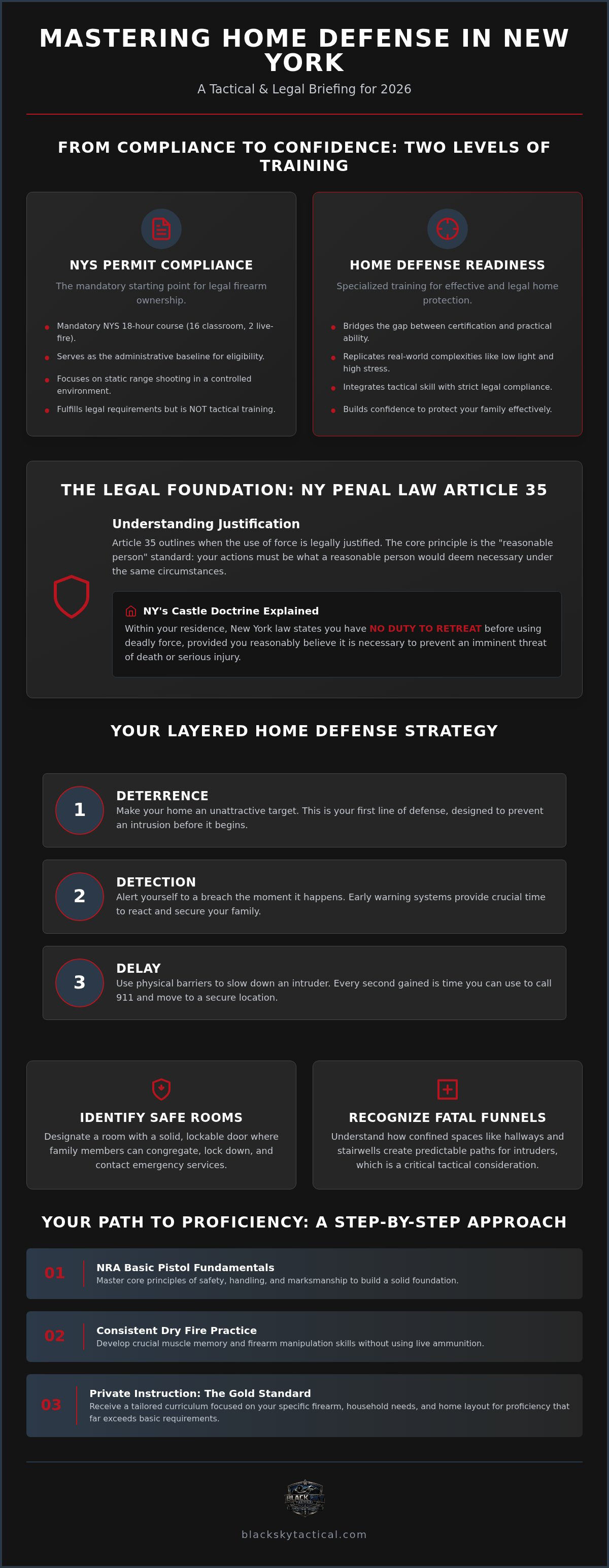
The mandatory NYS 18-hour course, which includes 16 hours of classroom instruction and 2 hours of live-fire training, serves as the administrative baseline for permit eligibility. It is a starting point for legal compliance but does not equate to tactical readiness. Static range shooting, often performed in a controlled environment, fails to replicate the complexities of a home defense scenario, such as low-light conditions or the presence of family members. Specialized firearm proficiency training NY is required to bridge the gap between administrative certification and the practical ability to secure a home under extreme stress.
Who Should Seek Specialized Home Defense Instruction?
This level of training is essential for several specific demographics within the Rockland, Orange, and Westchester County areas. New permit holders often find that the basic licensing requirements provide insufficient preparation for the realities of home security. Experienced shooters may also require specialized instruction to transition from a recreational or sporting mindset to a defensive one. Finally, families who wish to establish a unified safety protocol find that professional guidance helps coordinate roles and responsibilities, ensuring that every household member understands the procedural steps of a home defense plan.
Establishing a Home Defense Plan: More Than Just a Firearm
Effective home security is not a singular event but a series of overlapping protocols. Home defense firearm training NY emphasizes that a firearm is merely one component of a broader safety ecosystem. This "layered defense" strategy focuses on deterrence, which involves making the target unattractive to intruders, detection to alert the homeowner of a breach, and delay by using physical barriers to stall an unauthorized entry. By prioritizing these layers, you reduce the likelihood of a violent confrontation within your residence and maximize the time available to contact emergency services.
Within the home, tactical planning involves identifying "safe rooms" where family members can congregate behind a locked door. Identifying these rooms requires an assessment of your home's architecture, prioritizing spaces with solid doors and limited entry points. You must also recognize "fatal funnels," which are confined spaces like stairwells or narrow hallways that force an intruder into a predictable path. Establishing clear communication protocols is equally vital. During a high-stress incident, you must be prepared to provide concise information to 911 dispatchers while using pre-arranged code words to direct family members to safety without creating panic.
Home Hardening and Situational Awareness
Buying time is the primary goal of home hardening. Reinforcing entry points with high-grade deadbolts and security film on windows creates a physical buffer that can discourage or slow an intruder. Integrating these physical measures with National Safety Council firearm safety guidelines ensures that your defensive posture remains grounded in proven safety standards. A defensive mindset requires continuous situational awareness, where the priority is always the avoidance of conflict through early detection and proactive environmental control. This approach ensures that a firearm remains a tool of last resort rather than a primary solution.
Safe Firearm Storage Under NY Law
New York residents must navigate stringent storage mandates that have evolved through the NY Safe Act and subsequent 2022 and 2026 legislative updates. These laws require that firearms be secured from unauthorized access, particularly in households where minors or prohibited persons are present. The Governor's July 2026 focus on dealer inspections and in-person sales underscores the state's commitment to strict firearm oversight. Balancing the need for quick access with mandatory safety locks is a technical challenge that requires the use of high-quality, rapid-access safes. Under current New York administrative code, safe storage is defined as securing a firearm in a locked container or with a safety device that renders it incapable of being fired by anyone other than the authorized owner. For those in Rockland or Orange Counties seeking to integrate these requirements into a functional plan, private firearm training offers a structured environment to refine these protocols.
Understanding NY Legal Standards for Self-Defense (Article 35)
Legal literacy is the most critical component of home defense firearm training NY. The primary statute governing these encounters is NYS Penal Law Article 35, which outlines the "defense of justification." This law dictates that physical force is only permissible when a person reasonably believes it's necessary to prevent what they perceive as the imminent use of physical force by another. It's a complex framework that requires a homeowner to make split-second decisions that must later withstand intense legal scrutiny by a district attorney and, potentially, a jury of their peers.
The "Reasonable Person" standard is the metric used to evaluate your actions during a self-defense incident. A jury doesn't simply ask if you felt afraid; they ask if a reasonable person, in the same situation and with the same knowledge, would've believed that deadly force was necessary. This objective test means your background, your training, and the specific facts of the encounter are all subject to examination. In New York, the law distinguishes between the use of physical force and deadly physical force, with the latter being strictly reserved for instances where you reasonably believe an assailant is using or is about to use deadly physical force against you or a third party.
New York is not a "Stand Your Ground" state. While the law generally imposes a duty to retreat before using deadly force in public, the "Castle Doctrine" provides a significant exception within your own residence. You don't have a duty to retreat from an intruder inside your home. However, this exception is narrow. It doesn't apply if you're the initial aggressor or if the threat has already retreated. Understanding these nuances is essential to ensure that your defensive response remains within the boundaries of jurisdictional authority.
When is Deadly Physical Force Justifiable in NY?
Deadly physical force is only justifiable in New York when there's an imminent threat of death or serious physical injury. It's a common misconception that the mere presence of an intruder justifies the use of a firearm. The force you use must be proportional to the threat you face. Crucially, New York law does not permit the use of deadly force solely to protect property. If an intruder is fleeing with a television and poses no immediate physical threat, the use of a firearm is legally indefensible. For a broader understanding of how these laws interact with permit requirements, consult our guide on handgun safety certification NY.
Navigating the Legal Aftermath
The moments following a defensive encounter are fraught with legal risk. Your priority must be to secure the scene and contact 911, but you should limit your statements to responding officers until you have legal representation. Provide your name, your location, and a brief description of the threat, then clearly state that you'll cooperate fully after speaking with an attorney. Professional training records from a structured home defense firearm training NY program can serve as vital evidence. They demonstrate a disciplined, responsible mindset and a commitment to safety, which can be influential if a district attorney in Rockland or Westchester County is deciding whether to pursue charges.
How to Train for Home Defense: A Step-by-Step Approach
Training for a residential encounter requires a methodical progression that moves beyond basic marksmanship. Home defense firearm training NY begins with the mastery of core fundamentals, specifically those outlined in NRA Basic Pistol standards. These standards provide a reliable baseline for safe handling, administrative loading, and precision, all of which are essential before advancing to more complex tactical applications. By integrating these high quality standards, homeowners in Rockland and Westchester Counties ensure their skill set is built on a foundation of professional responsibility and technical accuracy.
Dry fire practice is a critical, non-ballistic method for building muscle memory and refining trigger control without the use of live ammunition. This allows you to practice presentations and administrative handling within the actual environment you intend to protect. Additionally, since the majority of residential incidents occur during periods of limited visibility, low-light training is a mandatory component of a complete regimen. Learning to identify targets and navigate obstacles using a handheld or weapon-mounted light ensures that you don't compromise your safety or legal standing in the dark. This disciplined approach minimizes the risk of accidental discharge and ensures that every action taken is deliberate and controlled.
Mastering Firearm Fundamentals Under Stress
The "Four Rules of Gun Safety" remain the foundation of all instruction, but they must be practiced until they're instinctive, even in high-stress environments where cognitive load is high. Training drills should focus on rapid target acquisition and the efficient clearing of mechanical malfunctions. While traditional sight alignment is preferred for accuracy, point shooting is a vital skill for close-quarters home defense where time and distance are severely limited. Transitioning to private firearm training for beginners NY allows for the customization of these drills to your specific residence, ensuring that your practice is directly applicable to your home's layout.
Simulated Home Defense Scenarios
Safe practice within the home is achieved through the use of inert training aids, such as "blue guns" or SIRT laser pistols. These tools allow you to clear your residence and identify tactical fatal funnels without the risk associated with live firearms. This simulation should eventually be validated through a NYS concealed carry live fire qualification to ensure your skills meet state standards. Incorporating family members into structured "fire drills" further enhances safety by establishing clear roles and movement patterns during an incident. To refine these protocols under professional supervision, you should consider enrolling in private firearm training to ensure your home defense plan is both tactically sound and legally compliant.
Why Private Instruction is the Gold Standard for NY Homeowners
While group classes fulfill the necessary administrative requirements for permit acquisition, they often fail to address the unique variables of a student's private residence and personal skill level. Private instruction represents the gold standard for those seeking home defense firearm training NY, as it allows for a curriculum that is specifically calibrated to the homeowner's chosen firearm platform, whether that is a handgun, shotgun, or rifle. This focused environment ensures that technical skills are developed with a high degree of precision, prioritizing safety and legal compliance over the generalized pace of a large classroom setting where individual nuances are frequently overlooked.
One-on-one sessions provide the critical benefit of immediate, expert correction of mechanics that might otherwise go unnoticed. Dangerous habits, such as improper muzzle discipline or inefficient malfunction clearing, are identified and rectified in real-time by a certified instructor. Black Sky Tactical's specialized approach to personal protection training NY emphasizes this level of meticulous detail, ensuring that every movement is both tactically sound and legally defensible within the current 2026 regulatory landscape. This relationship-based guidance fosters a sense of trust and professional responsibility, which is essential when preparing for the high-stakes nature of a residential encounter.
The Benefits of One-on-One Coaching
The private format allows for the development of personalized drills that account for your physical capabilities and the specific architectural layout of your home. It provides a confidential and controlled environment to address specific concerns or anxieties, which can be difficult to navigate in a public group setting. By opting for a private format, homeowners can ensure their home defense firearm training NY is conducted at a pace that facilitates deep retention of complex administrative procedures. Additionally, this tailored coaching ensures that your training remains strictly aligned with the specific permit restrictions and jurisdictional mandates enforced in Rockland, Orange, and Westchester Counties.
Next Steps: Booking Your Home Defense Session
Preparing for your first private training session involves ensuring your equipment is in professional working order and your mindset is focused on disciplined education. When selecting an instructor, you should verify they hold current NYS and NRA certifications, which serves as a benchmark for quality and safety. To move beyond basic permit compliance and establish a truly robust home safety protocol, you should schedule your private firearm instruction with Black Sky Tactical today. This proactive step ensures you receive the expert guidance necessary to navigate the complexities of New York's firearm laws while securing your household with confidence.
Advancing Toward Household Security and Legal Proficiency
Achieving a secure residence in New York requires a disciplined integration of tactical proficiency and a comprehensive understanding of the mandates outlined in Penal Law Article 35. As this briefing has established, successful protection is built upon a layered defense strategy that prioritizes legal justification and environmental hardening over mere firearm ownership. By transitioning from basic permit compliance to specialized home defense firearm training NY, you ensure that your response to a residential threat is both effective and defensible within the specific jurisdictional standards of Rockland, Orange, and Westchester Counties. This professional commitment to safety is the most reliable method for protecting your family while maintaining strict adherence to state requirements.
Our certified NYS and NRA instructors provide the necessary bridge between administrative certification and real-world readiness through our comprehensive 18-hour CCW courses and private instruction. We invite you to Secure Your Home with Professional Training from Black Sky Tactical to refine your skills and establish a robust safety protocol tailored to your unique needs. Taking these proactive steps today ensures you're prepared to handle the complexities of the 2026 defensive landscape with calm assurance and technical precision.
Frequently Asked Questions
Is home defense training mandatory for a NY pistol permit?
No, specialized home defense training is not a legal mandate for permit issuance; however, the state requires the completion of a specific 18-hour concealed carry course. While the mandatory curriculum covers basic safety and legal standards, it doesn't provide the tactical depth necessary for protecting a private residence. Homeowners often seek additional instruction to bridge the gap between administrative compliance and practical readiness for a residential encounter.
What is the best firearm for home defense in New York?
The optimal firearm for home defense depends on your individual proficiency and the architectural constraints of your residence, provided the choice complies with NY SAFE Act regulations. Handguns offer superior maneuverability in confined spaces, while compliant shotguns or rifles may provide ballistic advantages. Professional instruction helps you evaluate which platform aligns with your physical capabilities and the specific layout of your household while maintaining legal compliance.
Does NY have a 'Stand Your Ground' law for homeowners?
New York does not have a "Stand Your Ground" law, but it does recognize the "Castle Doctrine" within a person's residence. This means that while you generally have a duty to retreat when in public, you aren't required to retreat from an intruder inside your home. You may use deadly force if you reasonably believe it's necessary to prevent an imminent threat of death or serious physical injury.
Can I use a firearm to protect my property in NY?
No, New York law strictly prohibits the use of deadly physical force solely for the protection of property. Under Penal Law Article 35, the use of a firearm is only justified when you reasonably believe it's necessary to defend yourself or another person from an imminent threat of serious physical injury or death. Using deadly force against an intruder who is only stealing property is legally indefensible.
What are the storage requirements for home defense guns in Westchester County?
Westchester County residents must comply with state laws that require firearms to be secured in a locked container or with a safety device when minors or prohibited persons are present. These mandates, reinforced by the NY SAFE Act, aim to prevent unauthorized access. You must implement a storage solution that balances these strict legal obligations with your tactical need for rapid access during a high-stress emergency incident.
How often should I practice my home defense drills?
You should conduct procedural drills and dry fire practice at least once a month to maintain essential muscle memory. Consistency in home defense firearm training NY ensures that your response to a breach remains instinctive and controlled. Additionally, live-fire training should occur at least quarterly to validate your skills and ensure you can clear malfunctions or engage targets accurately under realistic conditions.
Will taking a home defense course help me get a NY concealed carry permit?
A specialized home defense course builds advanced tactical skills but doesn't replace the mandatory 18-hour NYS concealed carry course required for permit eligibility. While the advanced instruction provides a deeper understanding of legal standards and firearm proficiency, you must still complete the state-mandated curriculum to satisfy administrative requirements. These courses are best viewed as complementary steps in a comprehensive professional safety plan.
What should I tell the police if I use my gun for self-defense at home?
You should provide responding officers with essential information, such as your identity, the location of the threat, and any visible evidence, then clearly state that you'll cooperate fully after consulting with an attorney. It's critical to avoid providing detailed accounts or justifications immediately following a high-stress incident. Professional legal representation is necessary to ensure your statements are accurate and that your rights are protected during the investigation.


