
The submission of a firearm permit application in New York is no longer a simple administrative task but a rigorous certification process where a single oversight in documenting the NYS CCW 18 hour course requirements can lead to an immediate rejection. You likely feel the weight of this responsibility, especially given the technical nature of the 16+2 hour training split and the stringent live-fire standards mandated by the Concealed Carry Improvement Act. It's a complex landscape to navigate, particularly when renewal obligations vary across specific jurisdictions like Westchester and Rockland counties.
This guide is designed to help you master the mandatory training standards necessary to secure or renew your New York State Concealed Carry Firearm Safety certificate with absolute certainty. We provide a meticulous breakdown of the 16 hours of classroom instruction and the subsequent two-hour live-fire assessment, ensuring you understand the 80% written exam threshold and the specific target accuracy required for compliance. By the end of this briefing, you'll possess a clear roadmap for achieving full legal compliance and the professional confidence required for successful permit issuance in 2026.
Key Takeaways
- Understand the comprehensive legal framework of the Concealed Carry Improvement Act and the procedural necessity of the 16-hour classroom and 2-hour live-fire training split.
- Identify the specific NYS CCW 18 hour course requirements, including the mandatory 80% passing grade on written examinations and the five-round proficiency standard for live-fire qualification.
- Navigate the administrative nuances of regional jurisdictions, focusing on the renewal cycles in Westchester County and the certificate submission protocols for the Rockland County Clerk.
- Master the 2026 protocols for "sensitive" and "restrictive" locations to ensure strict adherence to state and federal firearm statutes during daily carry.
- Learn the criteria for selecting duly authorized instructors and the professional advantages of completing a combined curriculum like the NYSNRA101 for enhanced tactical depth.
The Framework of the NYS CCW 18-Hour Training Mandate
The implementation of the Concealed Carry Improvement Act (CCIA), which became effective in late 2022, continues to serve as the primary regulatory framework for firearm licensing in 2026. This legislation replaced the previous "proper cause" standard with a rigorous, objective set of criteria designed to ensure that every permit holder possesses a baseline of both legal knowledge and tactical proficiency. Central to this framework are the NYS CCW 18 hour course requirements, which mandate a specific curriculum that must be delivered by duly authorized instructors. This training is not merely a recommendation; it is a statutory obligation for all new carry license applicants and for individuals seeking renewals in specific jurisdictions such as Westchester, Nassau, Suffolk, and New York City.
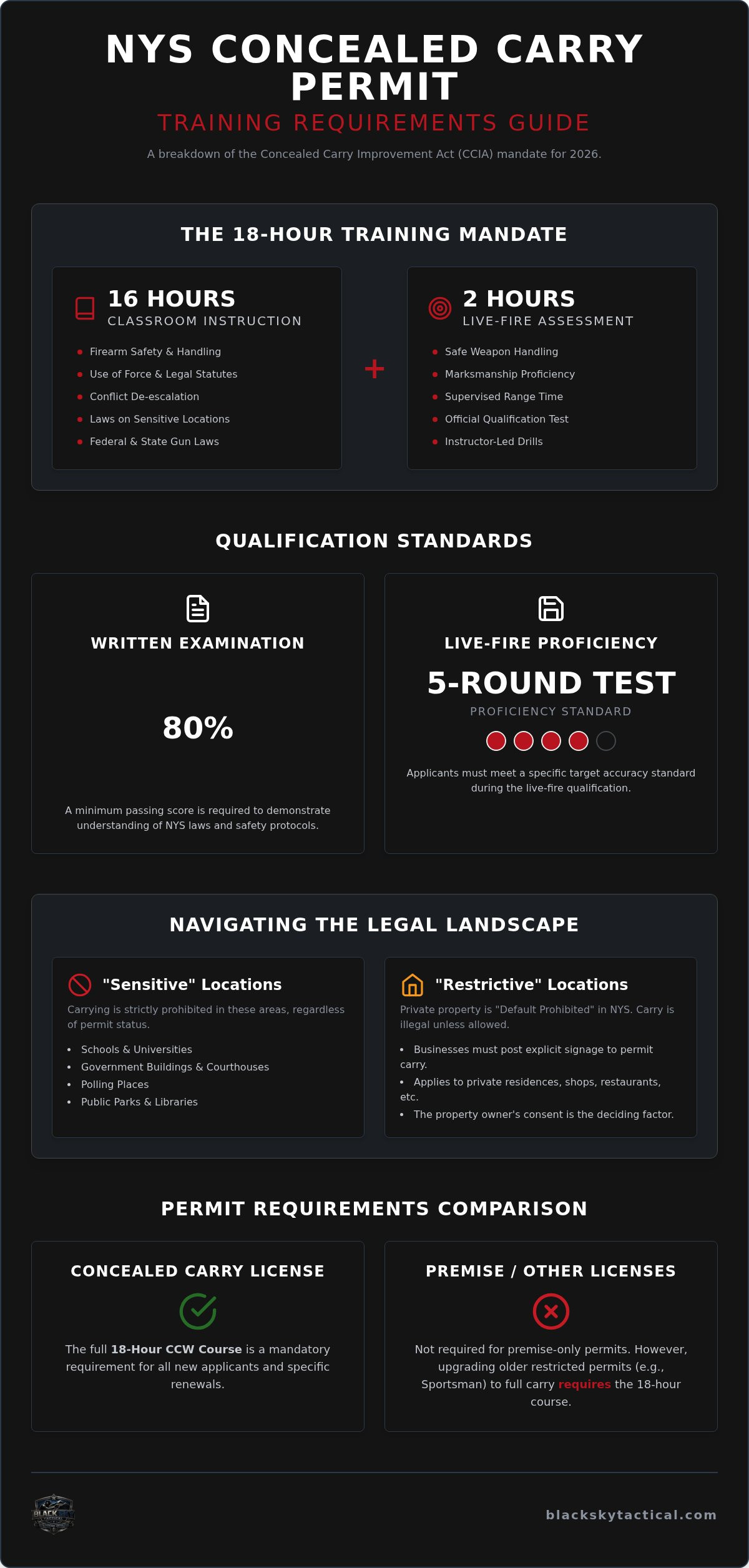
The curriculum is strictly divided into a 16+2 structure to balance theoretical knowledge with practical application. The first 16 hours consist of in-person classroom instruction covering critical topics such as firearm safety, dispute resolution, and the lawful use of deadly force. The final two hours are dedicated to live-fire training, where applicants must demonstrate safe handling and marksmanship on a supervised range. Certification is only valid if issued by an instructor authorized by the New York State Police or the Division of Criminal Justice Services. For those in Rockland, Orange, and Westchester counties, completing a combined curriculum like the NYSNRA101 ensures that these state mandates are met while also providing the depth of the NRA Basic Pistol syllabus.
Why 18 Hours? The Legal Necessity
Standardization is the primary driver behind the 18-hour mandate. Before the CCIA, training requirements often varied significantly between counties, leading to a fragmented understanding of New York gun laws. The current 18-hour standard ensures that every licensee receives identical instruction on sensitive locations and jurisdictional authority. Attempting to submit a certificate from a non-authorized provider or a course that fails to meet the 16+2 hour split will result in the immediate denial of a permit application, as licensing officers are required to verify the credentials of the training entity. This uniform approach aims to reduce liability and increase public safety through professional education.
Key Differences Between Premise and Carry Requirements
It's essential to distinguish between a "Possess on Premise" license and a "Concealed Carry" license. A premise permit is restricted to the home or a specific place of business; consequently, it does not require the completion of the NYS CCW 18 hour course requirements. However, those holding older "Sportsman" or "Business" permits must recognize that these designations no longer provide the same carry privileges they once did. In 2026, most individuals with these restricted permits are choosing to upgrade to a full carry license. This process necessitates completing the full 18-hour curriculum to ensure they are compliant with modern state standards and authorized for public carry.
The 16-Hour Classroom Syllabus: Legal and Tactical Theory
The 16-hour classroom component serves as the foundational pillar of the NYS CCW 18 hour course requirements. This instruction is not a high-level overview; it's a comprehensive examination of the legalities governing firearm ownership in New York. The curriculum is designed to cover federal statutes and the specific nuances of the Concealed Carry Improvement Act. Students must develop a firm grasp of jurisdictional authority, which dictates where a permit is valid and where it is superseded by local or federal regulations. This theoretical foundation is essential for any applicant seeking to navigate the state's complex licensing environment without legal error.
Navigating Sensitive and Restrictive Locations
One of the most complex aspects of the 2026 legal landscape is the categorization of "Sensitive" and "Restrictive" locations under NY Penal Law 265.01-e. Sensitive locations include schools, government buildings, and public parks, where carrying is strictly prohibited regardless of permit status. Restrictive locations refer to private property. In New York, the "Default Prohibited" rule means carrying on private property is illegal unless the property owner has clearly posted signage authorizing it or has given express consent. Accidental violations in these areas carry severe legal consequences, making this module a critical component of professional compliance.
Beyond location-based laws, the syllabus mandates training in conflict de-escalation and the management of deadly physical force. This includes understanding the "duty to retreat" and the legal thresholds for self-defense. Additionally, the course addresses suicide prevention and the ethical responsibilities of firearm owners to secure weapons safely. These topics ensure that permit holders are not just technically proficient but also mentally prepared for the responsibilities of carrying a concealed weapon.
The Written Exam: Scoring the Mandatory 80%
To successfully complete the classroom portion, every student must pass a state-mandated written examination with a minimum score of 80%. This test focuses heavily on legal terminology and the application of use-of-force laws. If a student fails to meet this 80% threshold, they generally must retake the classroom instruction or specific modules before they can proceed to the live-fire qualification. Given the high stakes, many applicants find that the NYSNRA101 combined course provides the necessary academic depth to pass the exam with confidence on the first attempt. The exam serves as the final administrative gatekeeper, ensuring that only those with a thorough understanding of the law move forward to the range.
The 2-Hour Live Fire Qualification: Performance Standards
The transition from the classroom to the firing line represents the final phase of the NYS CCW 18 hour course requirements. This two-hour live-fire session is not merely a practice period; it's a formal assessment of an applicant's ability to safely operate a firearm under the direct supervision of an authorized instructor or Range Safety Officer (RSO). The RSO maintains absolute control over the range environment, ensuring that all participants adhere to strict safety protocols while executing specific tactical maneuvers. Every action on the range is monitored to verify that the student can translate theoretical safety rules into practical, safe habits.
A significant portion of this block is dedicated to safe drawing from concealment and holster techniques, a requirement that often causes the most anxiety for new applicants. Unlike basic target practice, the state mandate requires students to demonstrate the ability to draw a firearm from a holster and return it to the holster without endangering themselves or others. This process involves meticulous attention to finger discipline and muzzle awareness. Instructors also evaluate loading and unloading procedures, along with the student's ability to clear common malfunctions, such as "stovepipes" or "double feeds," in a controlled and professional manner. Mastery of these fundamentals is essential before the graded shooting portion begins.
The Shooting Qualification Process
The state-mandated shooting qualification is conducted at a distance of four yards. To satisfy the certification standards, an applicant must fire a total of five rounds at a paper target measuring 11 inches by 25.5 inches. Successful completion requires at least four of the five rounds to impact within the target area. Before live ammunition is ever introduced, the two-hour block typically begins with dry-fire exercises. This progression allows the instructor to verify the student's grip, stance, and trigger control without the distraction of recoil, ensuring a higher probability of success during the graded portion of the qualification. Proficiency is measured by both accuracy and the consistent application of safety rules throughout the drill.
Equipment Requirements for the Live Fire Session
Applicants must arrive at the range with appropriate equipment to meet the certification standards. This includes an approved firearm and a holster specifically designed for that firearm; flimsy or "universal" holsters are generally prohibited due to safety risks during the drawing and re-holstering process. Students should prepare for an ammunition count that exceeds the five rounds required for the final qualification, as instructional drills often precede the graded assessment. Standard safety gear, including wrap-around eye protection and high-decibel hearing protection, is mandatory. For many, integrating the foundational skills from an NRA Basic Pistol Course provides the necessary technical proficiency to excel during this high-stakes performance evaluation.
County-Specific Nuance: Rockland, Orange, and Westchester
While the NYS CCW 18 hour course requirements are technically standardized at the state level, the administrative execution and renewal triggers vary significantly by county jurisdiction. Applicants in the Hudson Valley must align their training schedule with the specific procedural timelines of their local licensing officer or county clerk to avoid administrative delays. This is particularly relevant for those transitioning from restricted permits or managing the recertification process in downstate regions where oversight is exceptionally rigorous. Each county maintains its own fee structure and submission protocol that functions alongside the state-mandated curriculum.
In Rockland County, the County Clerk's office requires the original training certificate as a prerequisite for the formal application packet, which carries an initial application fee of $150.00. Orange County maintains a similar focus on documentation, requiring a fingerprinting fee of $111.50 and strict adherence to the 16+2 hour instruction split. Generally, the training certificate remains valid for the duration of your current application or renewal cycle, but most licensing officers prefer the training to have been completed within one year of the submission date to ensure the applicant is current on the latest legal updates.
Westchester County Renewal Mandates
Westchester County follows a strict three-year renewal cycle for concealed carry licenses, a requirement that differs from many upstate jurisdictions. This cycle serves as a mandatory trigger for training; permit holders must complete the 18-hour curriculum to maintain their carry privileges during each recertification period. The county charges a recertification fee of $175.00, and failure to submit the certificate to the Department of Public Safety by the designated deadline results in the automatic expiration of the permit. For those beginning this process, understanding the how long to get a concealed carry permit in NY timeline is essential for planning these mandatory updates without a lapse in coverage.
Rockland and Orange County Application Tips
Residents of Rockland and Orange counties should prioritize the administrative order of operations to minimize processing times. Because these counties have high volumes of applicants, you should enroll in a Pistol Permit Safety Class NY early in your journey. Completing the training before your background check is finalized ensures that your certificate is ready for submission the moment the licensing officer requests it. To ensure your training meets all local and state standards, you should register for an authorized Hudson Valley training session that specifically addresses these regional nuances. Professional instructors in these counties are familiar with the specific preferences of local judges and clerks, which can be the difference between a seamless issuance and a protracted request for additional information.
Choosing an Authorized NYS CCW Training Provider
Selecting a training provider is the final administrative decision in the certification process, and it's one that carries significant legal weight. To satisfy the NYS CCW 18 hour course requirements, an applicant must ensure their instructor is "duly authorized" by the New York State Police or the Division of Criminal Justice Services. Certificates issued by unauthorized individuals or entities that fail to adhere to the strict 16+2 hour instructional split will be rejected by licensing officers, potentially forcing the applicant to restart the entire process at their own expense. Verification of credentials should be your first priority before enrolling in any session.
The classroom environment itself should reflect the high-stakes nature of firearm responsibility. While some providers operate as "diploma mills" that prioritize speed over substance, a professional institution focuses on meticulous detail and safety-first education. A disciplined environment ensures that you don't just receive a certificate but actually master the legal and tactical complexities discussed in previous sections. This professional standard is particularly important for residents in high-volume areas who need reliable NYS CCW permit training NYC resources to navigate the specific local mandates of the five boroughs and surrounding counties.
The Value of the Combined NYSNRA101 Class
While the state mandate provides a necessary legal baseline, many serious-minded applicants seek a higher level of tactical proficiency. The NYSNRA101 curriculum is specifically designed to merge the 18-hour state requirement with the NRA Basic Pistol syllabus, offering a more robust educational experience than a standard compliance course. This combined approach allows students to gain proficiency beyond the minimum legal standards, focusing on the mechanical fundamentals of handgun operation alongside the required legal theory. By choosing a curriculum that exceeds the NYS CCW 18 hour course requirements, you're investing in a deeper level of safety and skill that serves you long after the permit is issued.
Finalizing Your Application Package
Once you've successfully completed the classroom exam and the live-fire qualification, you'll receive a formal Certificate of Completion. This document is a critical component of your total application package, which also includes your fingerprints, character references, and county-specific forms. You must organize these documents carefully; licensing authorities in Rockland, Orange, and Westchester counties require precise submissions to avoid processing delays. Ensure that the instructor's authorization number is clearly visible on your certificate before you submit it to your local licensing officer.
The path to lawful concealed carry in New York is structured to ensure that only the most prepared and informed individuals are granted carry privileges. Taking the next step in this process requires a commitment to both time and rigorous study. If you're ready to secure your certification through a professional, safety-oriented institution, you should enroll in the next Combined NYS 18-Hour Conceal Carry + NRA Basic Pistol Class at Black Sky Tactical to ensure your training meets every 2026 compliance standard.
Achieving Compliance and Tactical Proficiency
Navigating the administrative complexities of the Concealed Carry Improvement Act requires a methodical approach to both legal education and tactical documentation. Successfully meeting the NYS CCW 18 hour course requirements is the primary hurdle for any applicant, but this process also serves as the essential foundation for safe and lawful firearm carry in 2026. By mastering the 16+2 hour instructional split and understanding the specific renewal triggers in counties like Westchester and Rockland, you ensure your application remains in good standing with local licensing authorities. This structured training path provides the clarity necessary to navigate sensitive and restrictive location protocols without legal error.
Professional certification represents a commitment to the highest standards of safety and individual responsibility. Black Sky Tactical offers a disciplined environment where duly authorized instructors for both NYS and NJS guide you through every regulatory and tactical requirement. Our comprehensive curriculum includes the NRA Basic Pistol Certification to provide academic depth beyond the state minimums for residents in Rockland, Westchester, and Orange counties. You can register for the NYS 18-Hour Conceal Carry + NRA Basic Pistol Class to begin your certification process with confidence. Completing this training is a significant milestone in your journey toward responsible firearm ownership and legal compliance.
Frequently Asked Questions
Who is required to take the NYS 18-hour concealed carry course in 2026?
All new applicants for a concealed carry license in New York must satisfy the NYS CCW 18 hour course requirements as mandated by the Concealed Carry Improvement Act. Additionally, individuals seeking to renew their existing licenses in New York City, Westchester, Nassau, and Suffolk counties are also subject to this training obligation. This ensures a uniform standard of safety and legal knowledge across the state's most densely populated jurisdictions.
Do I need to own a firearm to take the NYS CCW 18-hour course?
You don't need to own a firearm to enroll in the course. Since New York law prohibits handgun possession without a permit, most new applicants do not yet own a pistol. Authorized training providers typically supply the necessary firearms and ammunition for the live-fire portion of the curriculum. This allows students to demonstrate proficiency and safety in a controlled environment before they are legally permitted to purchase their own firearm.
Is the 18-hour course required for a NYS pistol permit renewal?
The 18-hour training is mandatory for renewals in Westchester, Nassau, and Suffolk counties, as well as New York City. While the state has standardized the curriculum, the requirement for renewals is currently limited to these specific jurisdictions. If you reside in another county, you should consult your local licensing officer to determine if your recertification process involves additional training or simply a standard administrative update.
What is the passing score for the NYS CCW written exam?
A minimum score of 80% is required to pass the state-mandated written examination. This test evaluates your understanding of firearm safety, dispute resolution, and the lawful use of deadly force. If an applicant fails to reach this threshold, they are typically required to review the specific curriculum modules before attempting the exam again. The goal is to ensure every permit holder possesses a thorough grasp of the legal responsibilities associated with carry privileges.
Are active or retired law enforcement officers exempt from the 18-hour requirement?
Active duty law enforcement officers are generally exempt from the training requirements. However, the exemptions for retired officers are more nuanced and depend on their specific date of retirement and their status under the federal Law Enforcement Officers Safety Act (LEOSA). Retired professionals should verify their specific status with the Division of Criminal Justice Services to determine if their prior service satisfies the current NYS CCW 18 hour course requirements.
Can I take the 16-hour classroom portion and 2-hour live fire separately?
The 16-hour classroom instruction and the 2-hour live-fire session are components of a single, unified curriculum. While they are distinct phases of the training, they must be completed through a "duly authorized" instructor who can certify that the full 18-hour standard has been met. Most providers schedule these sessions consecutively to ensure students maintain a logical progression from theoretical legal knowledge to practical range proficiency.
Does the NYS 18-hour course satisfy requirements for other states like NJ?
The NYS course does not automatically satisfy the requirements for a New Jersey permit. New York does not recognize permits from any other state, and New Jersey maintains its own specific training and qualification standards. However, some providers offer a combined curriculum that addresses the mandates of both states. If you require multi-state compliance, you must ensure your instructor is authorized to certify you for each specific jurisdiction.
How long is the NYS CCW training certificate valid for?
Most licensing authorities expect the training certificate to be completed within one year of the application submission. While the state legislation does not explicitly define an expiration date for the certificate, local licensing officers in Rockland and Orange counties often require recent proof of proficiency. It's advisable to complete your training in close proximity to your application date to ensure your legal and tactical knowledge is current with 2026 standards.


