
In New York State, the path to lawful firearm carry is defined by a rigorous 18-hour legal and tactical commitment that demands absolute precision from every applicant. The transition to the mandatory 16-hour classroom and 2-hour live-fire structure, which became effective under Penal Law §400.00, has introduced significant layers of procedural complexity. You're likely feeling the pressure of these heightened standards, particularly the anxiety surrounding the live-fire proficiency test or the challenge of locating a "duly authorized instructor" within the Lower Hudson Valley. Securing a Pistol permit safety class NY that satisfies both state mandates and your own need for competent instruction is the most critical step in this administrative journey.
We've developed this guide to provide clarity on the 2026 compliance landscape, ensuring you understand the curriculum approved by the Division of Criminal Justice Services and the Superintendent of State Police. You'll learn exactly how to prepare for the mandatory written examination, which requires a minimum score of 80%, and what to expect during the range assessment. This briefing outlines the specific requirements to obtain your certificate of completion, allowing you to approach your licensing officer with the necessary documentation and a foundational level of firearm handling confidence.
Key Takeaways
- Identify the specific 16-hour classroom and 2-hour live-fire requirements mandated by the NY Concealed Carry Improvement Act to ensure your training meets current state standards.
- Verify the credentials of a "duly authorized instructor" when selecting a Pistol permit safety class NY to ensure your certificate is accepted by the licensing officer.
- Understand the comprehensive 18-hour syllabus, which includes essential instruction on NY Article 35 regarding the use of deadly force and federal firearm regulations.
- Prepare for the mandatory proficiency assessments, including the written examination requiring an 80% minimum score and the range-based live-fire qualification.
- Explore the procedural efficiency of the NYSNRA101 course, which fulfills both the New York State mandate and the NRA Basic Pistol certification requirements simultaneously.
Understanding the Mandatory NYS Pistol Permit Safety Course Requirements
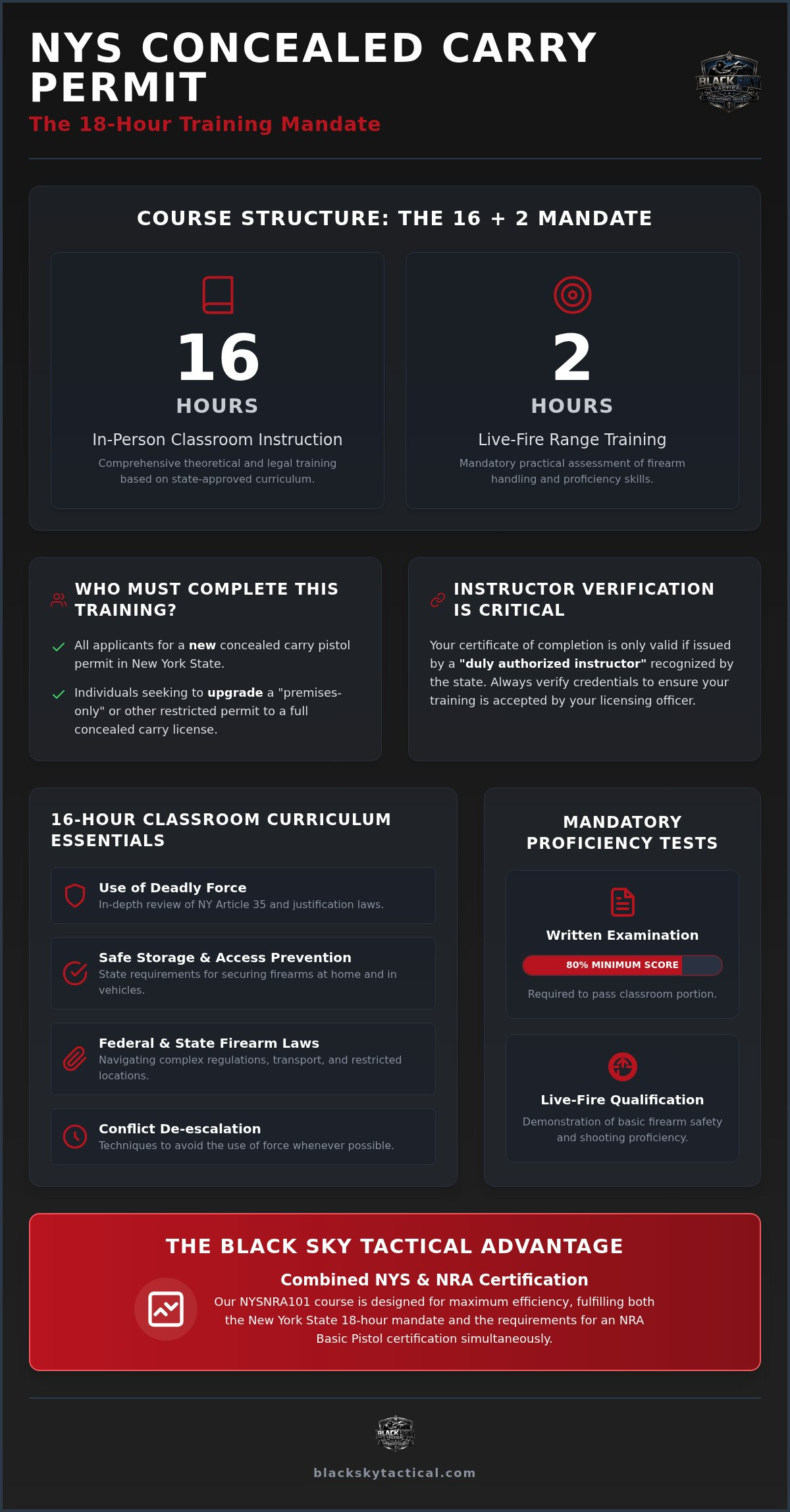
The regulatory landscape for firearm ownership in New York underwent a fundamental shift with the enactment of the Concealed Carry Improvement Act (CCIA). This legislation established a rigorous 18-hour training mandate that serves as the primary educational prerequisite for all concealed carry permit applicants. Unlike the brief safety briefings of the past, a modern Pistol permit safety class NY must adhere to a strict 16+2 hour structure. This involves 16 hours of comprehensive in-person classroom instruction followed by a mandatory 2-hour live-fire range component. This requirement is not merely a recommendation; it's a statutory obligation under NYS Penal Law §400.00 that must be fulfilled before a licensing officer can even consider an application for a concealed carry license.
The certificate of completion you receive after this course functions as a sworn document. It's affirmed by a duly authorized instructor under penalty of perjury, verifying that you've met every state-mandated standard. In the broader application timeline, this certification typically occurs after you've decided to apply but before you submit your final paperwork to the county clerk or police department. It's the technical foundation upon which your "good moral character" and "firearm proficiency" are assessed during the background investigation process.
The Legal Framework of the CCIA
The CCIA was enacted on September 1, 2022, and its provisions remain the governing standard in 2026. This law shifted the burden of safety training from local discretion to a centralized, state-approved curriculum. The New York State Police and the Division of Criminal Justice Services (DCJS) hold the authority to dictate exactly what instructors must teach. Understanding the historical context of New York State Gun Laws is vital for any applicant, as the CCIA fundamentally altered the licensing process. The mandated syllabus includes high-stakes topics such as the use of deadly force under NY Article 35, safe storage requirements to prevent unauthorized access, and conflict de-escalation techniques designed to prevent the discharge of a firearm whenever possible.
Who Needs the 18-Hour Certification?
Under current 2026 law, the 18-hour requirement applies to all individuals seeking a new concealed carry pistol permit across New York. This includes residents of Rockland, Orange, and Westchester counties who are pursuing their initial license. While existing permit holders who already possess a concealed carry license are generally focused on the three-year recertification cycle with the State Police, any individual seeking to upgrade a "premises-only" or "restricted" permit to a full concealed carry license must complete the full 18-hour Pistol permit safety class NY. It's essential to recognize that while the training standard is statewide, the administrative processing of your certificate remains a county-level function. The training you receive from a certified instructor in one county is valid for applications in others, provided the instructor is recognized by the state as "duly authorized."
The 18-Hour Curriculum: Breaking Down the 16+2 Structure
The 18-hour mandate is a structured educational framework designed to ensure that every applicant possesses a standardized baseline of knowledge before carrying a firearm in public. Attending a Pistol permit safety class NY requires a significant time investment, split specifically into 16 hours of theoretical classroom study and 2 hours of practical range application. This division ensures that the legal and administrative foundations are established before a student ever handles a live firearm in a training environment. It's a methodical approach where the classroom provides the "why" and the "where," while the range provides the "how."
Success in the classroom portion is contingent upon passing a state-mandated written examination. Applicants must achieve a minimum score of 80% to receive their certification of completion. Preparation for these sessions typically involves securing necessary administrative documents, such as a valid state ID, and bringing materials for extensive note-taking. Since the curriculum covers a vast array of penal codes and safety protocols, meticulous attention to detail is required throughout the instructional hours. Students don't need to bring their own firearms to the classroom, but they should be prepared for a rigorous academic environment that prioritizes legal compliance over recreational shooting.
Classroom Instruction: Laws and Responsibilities
The legal component of the curriculum is particularly dense, focusing heavily on the "sensitive locations" defined by the CCIA where firearm carry remains strictly prohibited. This includes schools, government buildings, and various public gatherings. Understanding the NRA-ILA Guide to New York Gun Laws provides a vital supplementary resource for navigating these jurisdictional complexities. Instructors also cover safe storage requirements, emphasizing the legal obligations to prevent unauthorized access by minors or prohibited persons. Additionally, the course addresses the psychological aftermath of a defensive encounter, which is a critical topic that prepares individuals for the legal and emotional realities of using deadly force in a civilian context.
Range Instruction: The 2-Hour Live Fire Segment
Transitioning from the classroom to the range marks the final phase of the certification process. This 2-hour segment begins with dry-fire practice and holster draw fundamentals to ensure safe handling before loading live ammunition. Students are expected to adhere to strict range commands and safety etiquette, as any violation can result in immediate disqualification from the course. The live-fire requirement serves as a mandatory demonstration of proficiency under the direct supervision of a certified instructor. For those seeking a professional environment that prioritizes both legal compliance and tactical skill, enrolling in a comprehensive safety program is a prudent step toward responsible ownership.
Selecting a Certified Safety Class: Evaluating Instructors and Locations
Choosing an authorized provider for your Pistol permit safety class NY is an administrative decision with significant legal implications. While many entities offer firearm instruction, only a "duly authorized instructor" recognized by the New York State Police can issue the valid certificate required for your application. In the Lower Hudson Valley, where licensing officers often apply meticulous scrutiny to training credentials, verifying the legitimacy of your instructor is the first step toward a successful permit issuance. You should prioritize facilities that offer both professional classroom environments and dedicated range access to ensure the 16+2 requirement is met without logistical delays or the need for secondary travel between locations.
Evaluating an instructor's professional background is just as vital as checking their certification status. A disciplined instructor provides more than just a signature on a form; they provide a foundation of safety that remains with you long after the 18 hours conclude. When researching potential classes, review the instructor's history in law enforcement, military service, or professional safety education. These backgrounds often translate into a more structured, no-nonsense training environment where legal compliance and tactical proficiency are treated with the sobriety the subject matter requires.
Regional Compliance in the Hudson Valley
In Rockland County, licensing officers typically expect a rigorous adherence to the state-mandated syllabus, with a specific focus on the applicant's ability to demonstrate safe handling during the live-fire segment. Westchester County residents face a unique set of administrative hurdles, often requiring additional background investigation fees and specific photo requirements that must align with their training timeline. For those residing near the five boroughs or seeking information on how these requirements shift within the city limits, our NYS CCW Permit Training NYC: 18-Hour Course & Resource Guide (2026) provides essential jurisdictional context. Each county clerk maintains a list of recognized instructors, and it's your responsibility to ensure your chosen provider appears on these authorized registries before committing to the course.
Instructor Credentials and Experience
While the state sets the minimum training standard, the depth of instruction varies based on the professional background of the trainer. Instructors with law enforcement or military experience often provide superior context regarding the legalities of NY Article 35 and the practicalities of situational awareness. In addition, prioritizing NRA-certified instructors ensures that your training follows a standardized, nationally recognized safety protocol that exceeds the basic state requirements. This dual certification approach is particularly valuable for residents of Orange and Bergen counties who seek a higher level of tactical proficiency. A "one-stop" course, such as the NYSNRA101, streamlines this process by combining the state mandate with the NRA Basic Pistol curriculum, ensuring that your certificate of completion is accepted by your specific county clerk and represents a disciplined foundation in firearm safety.
Preparing for the Live Fire Qualification and Background Check
The transition from classroom theory to the shooting range represents the most significant hurdle for many applicants attending a Pistol permit safety class NY. This phase isn't merely a practice session; it's a formal proficiency assessment that licensing officers review to determine an individual's fitness to carry a concealed firearm. Mental preparation is vital. You must approach the range with a disciplined mindset, focusing on the core safety principles established during the 16-hour classroom portion. Physical fatigue or range anxiety can negatively impact your performance, so it's recommended to be well-rested and familiar with the basic administrative handling of your specific firearm before the 2-hour live-fire segment begins.
Understanding the timeline for these requirements is essential for managing your expectations throughout the licensing process. For a detailed breakdown of the procedural steps following your training, you should consult our guide on How Long to Get a Concealed Carry Permit in NY: 2026 Timeline & Guide. This resource clarifies how your 18-hour certificate integrates with the background investigation conducted by your local law enforcement agency.
The Shooting Qualification Walkthrough
The 2026 standards for the NYS live-fire qualification require students to demonstrate consistent marksmanship and safe handling protocols under the supervision of a certified instructor. The assessment typically involves firing standardized strings, such as 4-shot and 5-shot sequences, at a target positioned at a distance of 4 yards. While the accuracy requirement is a factor, instructors prioritize safety above all else. Common mistakes that lead to failure include "anticipating the shot" or failing to maintain proper trigger finger discipline. It's critical to remember that any safety violation, such as "muzzling" another person or failing to follow range commands, results in immediate dismissal from the range and a failure to qualify for the certificate.
Administrative and Background Compliance
Completing the range portion is only one part of the certification process. You must also ensure that your 18-hour certificate is properly signed by the instructor and, in many jurisdictions, notarized before it's submitted to the county clerk. During this phase, you'll need to organize your four character references, ensuring they meet the specific residency and non-familial requirements of your county. The background investigation often includes a review of social media accounts and a formal interview with a licensing officer or judge. To ensure your training meets these rigorous administrative standards, you can register for a combined certification course that provides the necessary documentation for your application. This interview is a professional briefing where you'll be expected to demonstrate a sober understanding of your legal responsibilities as a permit holder.
The Black Sky Tactical Advantage: Combined NYSNRA101 Certification
The decision to enroll in a Pistol permit safety class NY shouldn't be viewed as a mere administrative hurdle, but as a foundational investment in responsible firearm ownership. Black Sky Tactical addresses this by offering the NYSNRA101: Combined NYS 18-Hour Conceal Carry + NRA Basic Pistol Class. This specific course architecture ensures that students don't just meet the minimum state requirements; they exceed them by adhering to the rigorous safety protocols established by the National Rifle Association. While the state-mandated 16+2 structure focuses heavily on legal compliance, the integration of the NRA curriculum provides a deeper emphasis on technical marksmanship and mechanical safety that the state minimum often lacks.
For those seeking a thorough understanding of the requirements, our Comprehensive Guide to the NY 18-Hour Concealed Carry Course (2026) details the specific administrative steps necessary for permit submission. By choosing a combined course, residents of Rockland, Orange, and Westchester counties can secure two distinct certifications within a single 18-hour training block, streamlining their path to lawful carry. This dual certification provides a standardized baseline of safety that is recognized and respected by licensing officers across the Hudson Valley.
Efficiency Through Combined Training
The NYSNRA101 course is designed for administrative efficiency, allowing applicants to fulfill both the New York State mandate and the NRA Basic Pistol requirement simultaneously. This integrated approach allows instructors to weave legal theory directly into practical marksmanship exercises, creating a more cohesive learning experience. Students benefit from a curriculum that links the legalities of NY Article 35 with the physical realities of safe firearm operation. This synchronization reduces the total timeline from initial training to final permit submission, as all necessary certifications are handled in one structured environment. The benefits of this combined approach include:
- Simultaneous completion of the NYS CCIA mandate and the NRA Basic Pistol requirement.
- Direct access to instructors with professional law enforcement or military backgrounds.
- Standardized safety protocols that exceed the state's minimum training threshold.
- A streamlined administrative process for receiving your signed and notarized certificates.
Professional Instruction in Rockland County
Operating out of Rockland County, Black Sky Tactical provides access to expert instructors for your Pistol permit safety class NY, ensuring a sober and disciplined training environment. These instructors, who possess extensive backgrounds in law enforcement and tactical training, ensure that safety isn't just taught but strictly enforced throughout the 18-hour block. Small class sizes are maintained to facilitate personalized safety supervision during the live-fire segment, which is a critical component for those who may feel anxiety regarding the shooting qualification. For individuals ready to proceed, the next steps involve selecting an available date and ensuring all administrative prerequisites, such as valid identification and character reference lists, are prepared before the first classroom session begins.
Securing Your Certification and Advancing to Licensure
Navigating the administrative and tactical requirements of the New York State licensing process requires a disciplined approach to education and safety. By successfully completing the 16-hour classroom component and the 2-hour live-fire qualification, you satisfy the statutory mandates established by the Concealed Carry Improvement Act. It's essential to ensure your training is conducted by a "duly authorized instructor" whose curriculum is recognized by the New York State Police and the Division of Criminal Justice Services. Selecting a Pistol permit safety class NY that integrates these state standards with the technical rigor of the NRA provides a superior foundation for your responsibilities as a permit holder.
Black Sky Tactical offers the NYSNRA101, which stands as the most comprehensive permit training available in the Hudson Valley. Our certified NRA and NYS instructors have served residents of Rockland, Orange, and Westchester with a focus on professional responsibility and tactical proficiency. You can Register for the Combined NYS 18-Hour + NRA Basic Pistol Class to begin the process of securing your certification. With the proper instruction and a commitment to safety, you'll gain the confidence necessary to manage the complexities of firearm ownership with legal and practical assurance.
Frequently Asked Questions
Is the 18-hour pistol permit safety class required for all NY counties?
Yes, the 18-hour training mandate is a statewide requirement for all new concealed carry applicants in New York. This standard was established under the Concealed Carry Improvement Act and applies uniformly across all 62 counties. While administrative procedures may vary by jurisdiction, the 16-hour classroom and 2-hour live-fire curriculum remains the legal baseline for permit issuance.
Can I take the 16-hour classroom portion and the 2-hour live fire portion on different days?
Instructors frequently schedule the 16-hour classroom portion and the 2-hour live-fire segment across multiple days to ensure students can absorb the dense legal material. The state doesn't require the full 18 hours to be completed in a single continuous session. You should verify the specific scheduling structure with your chosen provider to ensure it fits your availability.
What happens if I fail the written exam or the shooting qualification?
Students who fail to achieve the mandatory 80% score on the written examination or demonstrate unsafe handling during the range portion cannot receive a certificate. In these instances, you'll typically need to retake the failed segment or the entire Pistol permit safety class NY. The state requires a formal demonstration of both academic and practical proficiency before an instructor can affirm your completion.
Do I need to own a handgun before taking the pistol permit safety class in NY?
You aren't required to own a handgun before attending the course, as New York law prohibits the possession of a pistol without a valid permit. Authorized instructors provide the necessary firearms and ammunition for the 2-hour live-fire qualification. This allows students to gain supervised experience and demonstrate marksmanship proficiency before they're legally eligible to purchase their own firearm.
How long is the 18-hour safety course certificate valid for my application?
The 18-hour safety course certificate is generally submitted as part of your initial application, and its validity is often tied to the specific processing timelines of your county licensing officer. While the state doesn't specify a universal expiration date for the initial training certificate, many counties expect the training to have occurred within a reasonable timeframe prior to submission. You should consult your local county clerk for specific administrative windows.
Does the NY safety class certificate allow me to carry in other states?
The NY safety class certificate is exclusively designed to satisfy the training requirements for a New York State concealed carry permit. It doesn't grant you the authority to carry in other states, nor does it automatically translate to out-of-state reciprocity. However, completing a Pistol permit safety class NY that includes NRA certification may assist you when applying for non-resident permits in jurisdictions that recognize NRA standards.
What should I bring to the 18-hour pistol permit safety course?
You should bring a valid government-issued photo ID and materials for taking extensive notes during the 16-hour classroom sessions. While instructors usually provide the firearm and ammunition for the range portion, you may be asked to bring your own eye and ear protection if the facility doesn't provide them. It's also advisable to bring a copy of your character reference list to review with the instructor.
Are social media checks still a requirement for the NY pistol permit in 2026?
Social media reviews remain a component of the background investigation process for pistol permit applicants in 2026. Licensing officers utilize these reviews to assess "good moral character" as required by state law. You'll be expected to provide a list of your current and former social media accounts from the past three years so that investigators can verify your eligibility under the CCIA standards.


