

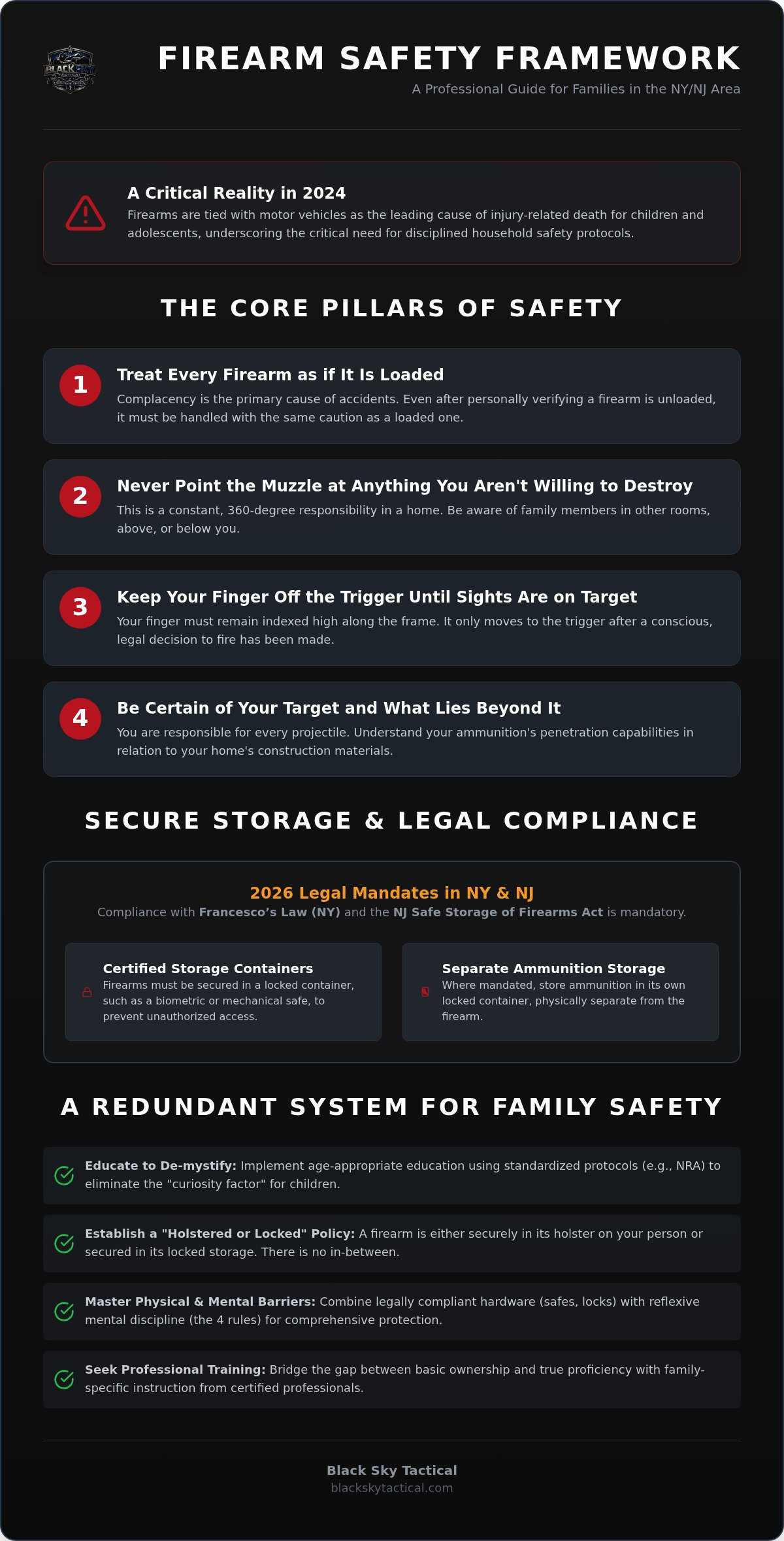
In 2024, firearms were tied with motor vehicles as the leading cause of injury-related death for children and adolescents, a statistic that underscores the high-stakes nature of maintaining a weapon within a residential setting. While you likely value the protection a firearm provides, the fear of accidental discharge by a minor or the confusion regarding the evolving 2026 legal landscape in the NY/NJ area can create significant stress. This guide establishes a professional framework for firearm safety for families, offering a methodical approach to securing your household while exercising your Second Amendment rights. It serves as a bridge between the practical needs of a gun owner and the strict regulatory requirements mandated by local jurisdictions.
You will gain a complete understanding of how to implement a redundant security system that aligns with the standards set by Francesco’s Law in New York and the New Jersey Safe Storage of Firearms Act. We will outline the administrative steps required for legal compliance in Rockland and Bergen counties, including the proper use of certified storage containers and the separation of ammunition. By the conclusion of this checklist, you will have the tools to replace curiosity with education, ensuring your children are informed while your home remains a disciplined environment where safety and proficiency are the primary objectives.
Key Takeaways
- Identify the specific hardware requirements and 2026 legal mandates for New York and New Jersey to ensure your household remains in full compliance with current safe storage statutes.
- Learn how to eliminate the curiosity factor by implementing age-appropriate education and the standardized NRA protocol to de-mystify firearms for children.
- Establish rigorous daily operational protocols, including the "Holstered or Locked" policy, to prevent administrative accidents during routine firearm maintenance and handling.
- Master a redundant system of physical barriers and mental training that defines comprehensive firearm safety for families living in the Rockland and Bergen county regions.
- Evaluate the role of professional third-party instruction in bridging the gap between basic ownership and the high level of proficiency required for a secure home environment.
The Core Pillars: Universal Firearm Safety Rules for the Household
Establishing a culture of firearm safety for families begins with an absolute commitment to foundational handling principles. These mandates function as a redundant system designed to prevent catastrophic failure, ensuring that a lapse in one area is caught by the strict adherence to another. You must internalize these rules until they become reflexive, leaving no room for casual or inconsistent application. The gravity of ownership requires a disciplined approach to the four Universal Firearm Safety Rules, which serve as the baseline for all subsequent security measures.
- Treat every firearm as if it is loaded. Complacency is the primary cause of administrative accidents. Even if you have personally verified that a chamber is empty, you must continue to handle the weapon with the same level of caution as a chambered firearm.
- Never point the muzzle at anything you aren't willing to destroy. This rule applies to interior walls, furniture, and any area where a family member might be located. In a residential setting, you don't have the luxury of a designated impact berm.
- Keep your finger off the trigger until your sights are on target. Your finger should remain indexed high along the frame or slide. It only moves to the trigger once you have identified a threat and made a conscious, legal decision to fire.
- Be certain of your target and what lies beyond it. You are legally and morally responsible for every projectile that leaves your barrel. You must account for the penetration capabilities of your specific caliber and how it interacts with your home's construction.
Adapting Range Rules for the Living Room
Applying safety protocols within a residential environment requires a higher level of vigilance than a controlled range setting. You should establish "No-Go" zones where firearms are never unholstered or handled for any reason. Administrative tasks, such as loading or unloading for daily carry, must occur in a dedicated, child-free space far from common areas. In a household, the definition of a "safe direction" is dynamic; it changes based on who is in the adjacent room or whether a family member is sleeping on the other side of a partition. Maintaining this awareness ensures that even a mechanical failure doesn't result in an injury.
The Role of Muzzle Awareness in Multi-Story Homes
Suburban construction in Rockland and Bergen counties typically utilizes materials like drywall and softwoods, which offer negligible resistance to modern ballistic projectiles. Muzzle awareness must extend vertically. You need to identify "safe backstops" within your specific home architecture, such as a concrete basement floor or an exterior brick wall, where a discharge would be contained. Every adult in the household should receive training in basic muzzle discipline to ensure they don't inadvertently point a weapon at a floor or ceiling where another person might be located. This structural awareness is a critical component of firearm safety for families, transforming a general rule into a specific protocol tailored to your residence.
Secure Storage Checklist: Hardware and Legal Compliance in NY and NJ
While mastering the universal rules provides the necessary mental framework, physical barriers represent the second layer of a redundant security system. Firearm safety for families requires more than just intent; it necessitates the procurement of hardware that meets both tactical needs and strict legal mandates. In 2026, the distinction between a "hidden" firearm and a "secured" firearm is not merely a matter of preference but a significant legal boundary in the tri-state area. You must evaluate your storage solutions based on their ability to prevent unauthorized access while allowing for authorized retrieval during an emergency.
Choosing between biometric and mechanical rapid-access safes involves balancing speed against mechanical reliability. Biometric handgun safes, which are available for approximately $109.99 as of June 2026, allow for immediate access through fingerprint recognition. These systems are highly effective for bedside storage, provided you perform consistent battery maintenance. Mechanical keypad versions, often priced near $69.99, eliminate electronic failure points but may be more difficult to operate under the fine motor skill degradation common during high-stress incidents. For long guns, you should prioritize heavy-duty safes with verified pry-resistance and fire ratings, such as those found in the $1,199.99 price range for established 24-gun models.
Implementing a "Double Lock" rule adds a critical layer of protection that exceeds basic requirements. This protocol involves placing a locked safe within a room that is also secured or utilizing a secondary trigger lock on the weapon inside the safe. Ammunition should be audited monthly and stored in a separate, climate-controlled container. This ensures that even if a child manages to bypass one security layer, they don't gain access to a functional, loaded weapon system.
Navigating the NY SAFE Act and NJ Storage Mandates
In New York, Penal Law §265.45 mandates that firearms be securely stored if a person under 18 resides in the household or is present. Failure to comply can result in serious legal exposure, especially with the 2026 legislative focus on Francesco's Law, which classifies negligent storage as a Class A misdemeanor. Residents in Rockland and Westchester must remain vigilant as these regulations evolve toward universal safe storage requirements. Understanding how firearm safety for beginners NJ aligns with these state-mandated protocols is essential for staying within the bounds of the law. Academic research into Best Practices for Teaching Firearm Safety suggests that physical barriers are most effective when paired with clear, age-appropriate educational initiatives.
Staging vs. Storage: Finding the Tactical Balance
Many owners believe that placing a firearm on a high shelf or behind a false panel constitutes safety. This is a dangerous misconception that ignores the "curiosity factor" inherent in children. "Out of reach" is not a substitute for a mechanical lock, as children are often more observant and mobile than parents assume. Staging a firearm for home defense requires rapid-access technology that maintains a balance between readiness and absolute security. To ensure your storage plan fits your specific home layout and family dynamic, you may find it beneficial to schedule Private Firearm Training to receive professional guidance on safe placement and administrative handling.
The Conversation: Age-Appropriate Education and De-Mystification
Physical barriers, while essential for legal compliance in New York and New Jersey, represent only one component of a comprehensive safety plan. Firearm safety for families must also address the cognitive aspect of ownership, specifically the inherent curiosity children possess regarding items they perceive as "forbidden." By providing supervised, controlled exposure to firearms, you can effectively de-mystify the mechanics and eliminate the allure of the unknown. This process involves regular check-ins to gauge a child's understanding and ensuring they can distinguish between the consequence-free behavior of "toy" guns and the permanent, real-world mechanics of an actual firearm. Removing the "forbidden fruit" factor reduces the likelihood that a child will attempt to interact with a weapon in an unsupervised setting.
The primary instructional tool for younger household members is the NRA protocol, which dictates a four-step response upon encountering an unsecured firearm: "Stop, Don't Touch, Leave the Area, Tell an Adult." This procedural response should be rehearsed until it is instinctive. It's the responsibility of the adult to ensure that the child understands that this protocol applies in every environment, whether at home, at a neighbor's residence, or in a public space. A disciplined household requires that children feel comfortable reporting the presence of a firearm without fear of reprisal, ensuring that administrative oversights are corrected immediately by a responsible adult.
Guidelines for Toddlers and Young Children
For toddlers and children in early primary education, instruction should focus on immediate avoidance and reporting. You should use simple, concrete analogies to explain that firearms are tools that cause permanent damage, avoiding abstract concepts they cannot yet grasp. Establishing clear boundaries is the first step, which is why the Youth Firearm Safety Training approach emphasizes that certain areas of the home are strictly off-limits when administrative handling is occurring. Consistency in this messaging prevents the confusion that often leads to accidental contact. You must reinforce that only authorized adults are permitted to touch these tools, regardless of the circumstances.
Educating Teens and Young Adults
As children transition into adolescence, the educational focus must shift from simple avoidance to supervised proficiency and a deep understanding of legal obligations. Firearm safety for families with teenagers involves discussing the life-altering consequences of misuse, including the criminal liability that can arise under the strict 2026 statutes in Rockland and Orange counties. You should address the reality of social pressure, preparing them for scenarios where they may encounter unsecured weapons at a friend's house. At this developmental stage, the goal is to foster a disciplined mindset where they recognize that a firearm is a serious responsibility requiring constant vigilance and strict adherence to established safety mandates. Proficiency training under professional supervision can further solidify this respect for the tool's capabilities.
Operational Protocols: Managing Firearms During Daily Family Life
Maintaining firearm safety for families requires the implementation of strict operational protocols that govern the transition between active carry and residential storage. The most critical of these is the "Holstered or Locked" policy, which dictates that a firearm must never be placed on a counter, nightstand, or shelf unless it is secured within a functional safe or remains under direct physical control in a holster. Administrative accidents frequently occur during these brief moments of transition when an owner assumes a weapon is out of reach or temporarily forgotten. By adhering to a disciplined ritual, you eliminate the possibility of a child encountering an unsecured firearm during the course of daily family life.
Firearm maintenance and cleaning should only be performed in designated, secure areas that are inaccessible to children and other unauthorized household members. This process requires a "Clear and Safe" ritual, where the weapon is physically and visually inspected in a safe direction before any tools are introduced. To maintain the integrity of your security hardware, you should conduct a monthly audit of all storage locations. This includes verifying the structural stability of safes, testing the responsiveness of biometric sensors, and replacing batteries before they reach a critical failure point. If you require assistance in developing these specific protocols for your residence, you should consider engaging in Private Firearm Training to ensure your procedures meet professional standards.
The "Transition Zone" Protocol
The "Transition Zone" protocol is a methodical approach to moving from concealed carry to home storage without exposing the firearm to the household. You should designate a specific area, ideally equipped with a clearing bucket or a verified safe direction, where loading and unloading procedures occur. This is especially vital when guests or contractors are present in the home, as your legal responsibility to maintain secure storage remains absolute regardless of who is visiting. Managing these transitions with a predictable, structured rhythm reduces the risk of administrative errors during the most vulnerable moments of gun handling.
Ammunition Management and Inventory
Ammunition management is a secondary but equally vital component of household security. Mixing different calibers within a single container is a safety hazard that can lead to catastrophic mechanical failure if an incorrect round is chambered. You should label all magazines clearly and perform regular checks for "setback," a condition where the bullet is pushed deeper into the casing due to repeated chambering, which can cause dangerous pressure spikes. Ammunition must be treated with the same level of administrative control as the firearms themselves, ensuring it remains inaccessible to minors and stored in a separate, climate-controlled environment to preserve its ballistic integrity.
Professional Integration: Why Family-Specific Training is Essential
While implementing hardware and establishing household protocols are necessary steps, they represent the static portion of a safety plan. Firearm safety for families requires a transition from theoretical knowledge to dynamic proficiency, which is best achieved under professional supervision. Engaging a neutral, third-party expert often proves more effective than parent-led instruction alone, as children and spouses frequently respond with greater discipline to a certified instructor. This professional oversight ensures that the nuances of administrative handling are mastered in a controlled environment before they are integrated into the complexities of a residential setting.
Enrolling in a Gun ownership safety course NJ provides a structured environment where technical skills are paired with the ethical and legal realities of 2026 mandates. You gain the ability to customize a home defense plan that accounts for the specific locations of family members, identifying safe fields of fire and hardened shelter-in-place points. This level of preparation moves beyond basic storage and addresses the high-stress reality of a home incident, where fine motor skills degrade and clear communication becomes paramount. Moving from static safety to dynamic proficiency ensures that every capable member of the household understands their role during a crisis.
The Black Sky Tactical Youth Safety Course
The Youth Safety Course is designed for parents and children to participate together, fostering a shared culture of respect rather than fear. You'll learn how to reinforce the boundaries established in previous sections while your children receive standardized instruction on avoidance and reporting. Obtaining a professional certification for household members can also serve to lower liability, demonstrating a proactive and documented commitment to safety standards. This course functions as the logical next step for families who have already secured their hardware and wish to formalize their educational framework within the Rockland and Orange County areas.
Next Steps: From Safety to Proficiency
Achieving full household security is an ongoing process of skill-building that requires regular validation. You can integrate your safety protocols into the NRA basic pistol shooting course, which provides the foundational mechanics required for responsible ownership and legal compliance. Scheduling private family sessions allows you to practice drills within your specific home layout, ensuring every adult is proficient in clearing and securing weapons. For residents seeking a higher level of assurance, contacting Black Sky Tactical for a comprehensive home safety audit provides an expert evaluation of your storage locations and administrative procedures, ensuring your household remains a model of tactical readiness.
Establishing a Culture of Professional Responsibility
Maintaining a secure household while exercising your Second Amendment rights requires a transition from passive ownership to active, professional management. You've learned that comprehensive safety is a redundant system where physical barriers, such as biometric safes, must overlap with a disciplined mental framework. By adhering to the 2026 legal mandates in the NY/NJ area and implementing rigorous administrative protocols, you ensure that your residence remains compliant and protected from the risks of unauthorized access. Integrating these specific procedures into your daily routine is the most effective way to achieve lasting firearm safety for families.
Our NRA Certified Instructors provide the expert guidance necessary to move from basic security to dynamic proficiency. We offer specialized youth and family programs throughout Rockland, Orange, and Westchester Counties, focusing on building a culture of respect and clarity rather than fear. You can take the final step in your home security checklist by engaging with a knowledgeable expert who understands the unique jurisdictional requirements of our region. Secure your family’s future—Enroll in our Youth Safety Course today. We look forward to assisting you in establishing a disciplined and safe environment for your entire household.
Frequently Asked Questions
Is it legal to keep a loaded gun for home defense in New York?
Under current New York statutes, specifically Penal Law §265.45, you're required to store firearms unloaded and secured with a locking device if a person under 18 resides in or is present at the home. While the law focuses on accessibility to minors, the 2026 legislative trend, including the proposed Francesco's Law, emphasizes universal safe storage. Practical safety protocols suggest maintaining weapons in a rapid-access safe rather than staged in an unsecured, loaded state to prevent administrative accidents.
At what age should I start talking to my children about firearm safety?
You should initiate discussions regarding firearm safety for families as soon as a child is capable of following basic household instructions, typically around the age of three or four. Early education centers on the "Stop, Don't Touch" protocol rather than technical mechanics or ballistic capabilities. By establishing these boundaries early, you replace dangerous curiosity with a disciplined understanding of the tool's permanence, ensuring that the presence of a firearm is treated with sobriety rather than interest.
What is the best type of gun safe for a family with small children?
The most effective storage solution for households with small children is a biometric or mechanical rapid-access safe that provides a physical barrier while allowing for emergency retrieval. Biometric models, which utilize fingerprint recognition, offer high security against unauthorized access by minors who may attempt to guess a keypad code. You should prioritize safes with heavy-duty steel construction and verified pry-resistance to ensure the unit can't be easily manipulated or removed from its mounting point in your residence.
Do I need a separate lock for my ammunition in New Jersey?
Current New Jersey regulations mandate that firearms be stored unloaded in a securely locked container, with ammunition stored in a separate, locked location. This administrative requirement is designed to prevent an unauthorized user from immediately rendering a firearm functional if they gain access to the primary safe. Adhering to this protocol is essential for full legal compliance and serves as a critical redundancy in your home security checklist, particularly in jurisdictions with strict negligent storage penalties.
How do I explain the difference between video game guns and real guns to my teen?
Explaining this distinction requires a focus on the lack of a "reset" button and the absolute permanence of real-world ballistic effects. You should discuss the mechanical realities of firearm discharge, emphasizing that video games sanitize the consequences of misuse and ignore the gravity of muzzle discipline. Professional instruction can bridge this gap by allowing teens to observe the actual power and responsibility associated with handling a firearm, reinforcing that real-world safety mandates are not optional or virtual.
What should my child do if they find a gun at a friend’s house?
Your child must immediately execute the "Stop, Don't Touch, Leave the Area, Tell an Adult" protocol if they encounter an unsecured firearm outside your home. They should be instructed to leave the room immediately and contact you or another trusted adult to report the situation. This response must be practiced until it's reflexive, ensuring that the child understands their responsibility to remove themselves from a potentially hazardous environment regardless of social pressure or the presence of their peers.
Does New York require a specific type of trigger lock?
New York law doesn't mandate a specific brand, but it requires a "safety locking device" that, when installed, renders the firearm incapable of being fired. This can include trigger locks, cable locks, or storage within a securely locked container as defined by state administrative standards. You must ensure that any device used is of sufficient quality to prevent tampering by minors, as the legal standard focuses on the effectiveness of the barrier provided rather than the specific mechanism used.
Can I be held liable if my child accesses my properly locked firearm?
Liability in the NY/NJ area often hinges on whether the owner exercised "reasonable care" in securing the weapon according to current mandates. If you've utilized a state-approved locking device or safe, your legal exposure is significantly reduced; however, 2026 statutes are increasingly strict regarding the accessibility of firearms to prohibited persons. Maintaining detailed records of your safety hardware and participation in professional training can serve as evidence of your commitment to responsible firearm safety for families.


