
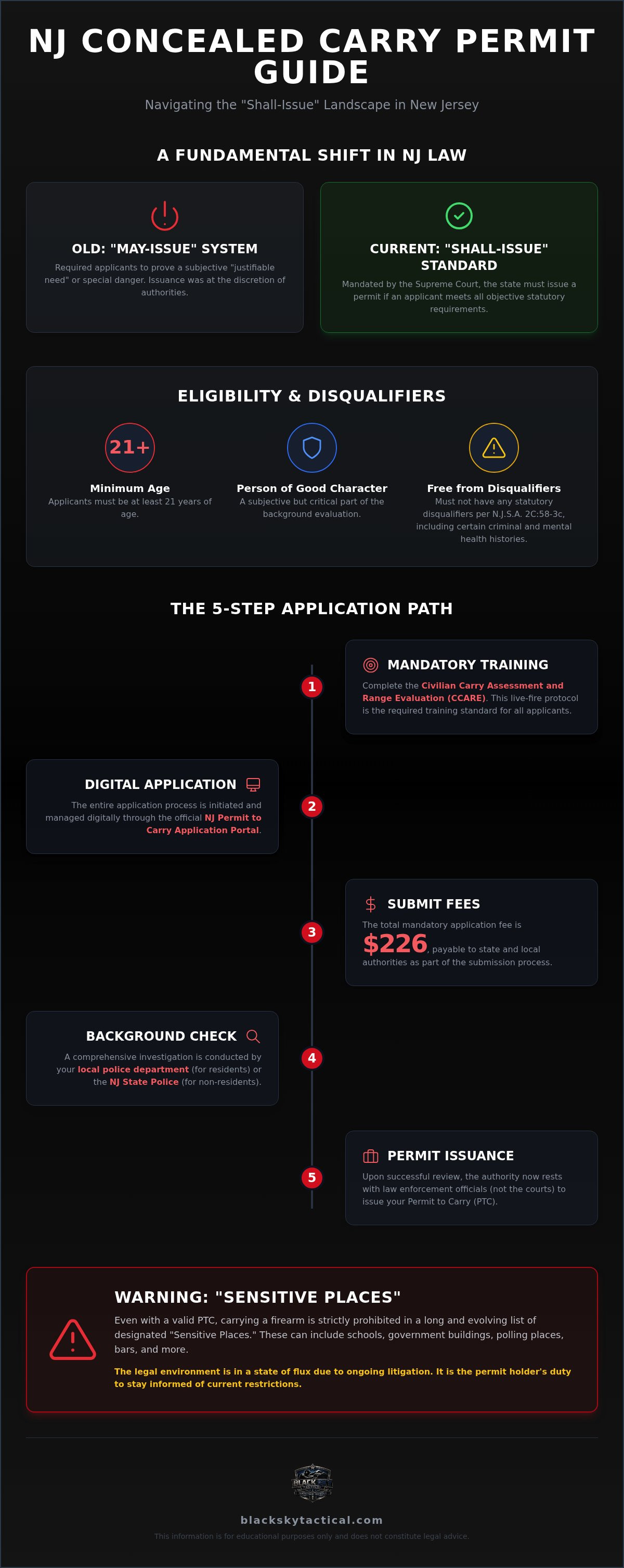
Since the 2022 Supreme Court ruling, obtaining a permit in New Jersey is no longer a matter of proving a "justifiable need," but rather a high-stakes test of administrative and technical proficiency. Understanding the current NJ concealed carry permit laws is essential for any resident or non-resident looking to exercise their rights while maintaining strict legal compliance. You likely feel the weight of the $226 total application fee and the pressure of the mandatory Civilian Carry Assessment and Range Evaluation (CCARE) live-fire training. The complexity of the digital application process, combined with the shifting list of "sensitive places" where carrying remains restricted, can feel overwhelming for even the most law-abiding citizen.
This guide provides the expert clarity you need to master these regulations, ensuring you meet every regulatory mandate with precision and confidence. We'll break down the 2026 fee structure, the specific requirements of the CCARE protocol, and the current jurisdictional restrictions on where you can legally carry. By the end of this briefing, you'll have a clear, linear path to obtaining and maintaining your Permit to Carry (PTC) in the state of New Jersey.
Key Takeaways
- Gain clarity on how the transition to objective "Shall-Issue" standards affects your eligibility and compliance under the latest NJ concealed carry permit laws.
- Review the exhaustive list of statutory disqualifiers, including mental health and criminal history evaluations, to confirm your standing before beginning the administrative process.
- Master the specific components of the Civilian Carry Assessment and Range Evaluation (CCARE) protocol, which serves as the mandatory live-fire training standard for all applicants.
- Secure a comprehensive breakdown of the digital application portal, current fee obligations, and the evolving list of restricted "Sensitive Places" within the state jurisdiction.
- Evaluate the procedural advantages of integrated training programs that satisfy New Jersey mandates while providing additional professional certification through the NJSNRA101 curriculum.
The Current Landscape of NJ Concealed Carry Permit Laws in 2026
The New Jersey Permit to Carry (PTC) serves as the primary legal mechanism for individuals seeking to carry a concealed handgun within the state's jurisdiction. While New Jersey gun laws remain some of the most stringent in the nation, the regulatory framework has undergone a fundamental transformation. This shift is characterized by the transition from a "may-issue" system, which historically required applicants to prove an urgent "justifiable need," to an objective "shall-issue" standard. For permit holders in 2026, this means that the state must issue a permit if the applicant meets all statutory requirements. However, the administrative burden remains significant, requiring a meticulous approach to compliance to avoid application denials or legal jeopardy.
The legislative adjustments enacted between 2024 and 2025 have solidified the digital issuance process and refined the background investigation criteria. These updates emphasize the necessity for permit holders to maintain constant legal awareness. Judicial rulings frequently alter the enforceability of specific restrictions, particularly regarding location-based prohibitions. It's the permit holder's duty to stay informed about which areas are currently designated as restricted, as the legal environment remains in a state of flux due to ongoing litigation.
Understanding the 'Shall-Issue' Standard
The U.S. Supreme Court's decision in NYSRPA v. Bruen effectively eliminated the requirement for applicants to demonstrate a "good cause" or special danger. Consequently, NJ concealed carry permit laws now focus on objective qualifications rather than subjective needs. It's a mistake to assume "shall-issue" implies a simple or automatic approval process. The state has responded to the removal of the need-based standard by implementing rigorous training mandates, such as the CCARE protocol, and exhaustive background investigations. If an applicant fails to meet any single requirement, the issuing authority retains the power to deny the application based on statutory disqualifiers. Success requires a disciplined adherence to every procedural step and a commitment to maintaining high proficiency standards.
Key Regulatory Bodies in New Jersey
Navigating the application process requires an understanding of the specific roles played by state and local authorities. The New Jersey State Police (NJSP) maintains primary oversight of the digital application portal and establishes the statewide training standards. Despite this centralized oversight, the initial review and investigation of an application fall to the local police chief in the applicant's municipality. For non-residents, the NJSP handles the process directly through specific barracks. A notable change for the 2026 cycle is the reduced role of the Superior Court; while judges previously had the final say in permit issuance, that authority now rests primarily with law enforcement officials. The court system now functions primarily as the venue for appeals and legal challenges regarding NJ concealed carry permit laws.
Eligibility Requirements and Statutory Disqualifiers for NJ PTC
To qualify for a Permit to Carry (PTC) in New Jersey, an applicant must first meet several foundational criteria that distinguish this specific authorization from other firearm credentials. Under NJ concealed carry permit laws, an individual must be at least 21 years of age and demonstrate that they're a person of good character who isn't subject to any of the disabilities set forth in N.J.S.A. 2C:58-3c. It's important to recognize the distinction between a Firearms Purchaser Identification Card (FID) and a Carry Permit; while the FID allows for the legal purchase and limited transport of firearms, the PTC is the only administrative mechanism that permits the concealed carrying of a handgun in public spaces. Both NJ residents and out-of-state applicants may apply, though non-residents must submit their documentation through the nearest New Jersey State Police (NJSP) barracks rather than a local municipal department.
The application process is strictly digital and initiated through the NJ Permit to Carry Application Portal. As part of the initial background investigation, applicants must undergo a mandatory fingerprinting process via the IdentoGO system to facilitate a comprehensive criminal history check. You'll need to provide four character references who aren't related to you by blood or marriage and have known you for at least three years. These references will be contacted to verify your temperament and fitness to carry a firearm, reflecting the state's cautious approach to public safety.
Mental Health and Background Records
A critical component of the eligibility phase is the submission of the Consent for Mental Health Records Search (Form SP-066). This document authorizes the state to examine institutional records to ensure the applicant hasn't been committed for a mental health condition that would pose a risk to themselves or others. For individuals who have lived outside of New Jersey within the last ten years, the administrative burden increases, as they must provide mental health records from every jurisdiction in which they resided. Common administrative errors, such as incomplete address histories or mismatched names on secondary forms, frequently lead to significant application delays. Ensuring that your documentation is meticulously organized can prevent these procedural hurdles.
Criminal and Domestic Disqualifiers
New Jersey maintains an uncompromising stance regarding criminal history and domestic stability. Any conviction for a crime of the first, second, third, or fourth degree serves as an automatic disqualifier. Furthermore, the state pays close attention to "disorderly persons offenses," particularly those involving domestic violence. If you're currently subject to a restraining order or have a history of domestic violence incidents, your application will be denied under statutory mandates. Perhaps the most significant hurdle is the "Public Health, Safety, and Welfare" clause, which grants local police chiefs the discretion to deny a permit if they believe the applicant's past behavior, even without a formal conviction, suggests a lack of essential self-discipline. For those seeking to ensure their training and background preparation meet these high standards, enrolling in professional certification courses can provide the necessary foundation for a successful application.
Mandatory Training Standards: The CCARE Protocol
The Civilian Carry Assessment and Range Evaluation (CCARE) protocol represents the mandatory training benchmark for individuals seeking to comply with NJ concealed carry permit laws. This evaluation isn't a mere introductory course; it's a specialized, live-fire assessment designed to verify that an applicant possesses both the technical proficiency and the legal knowledge required for public carry. Unlike standard introductory firearm classes, which may focus solely on basic marksmanship, the CCARE protocol mandates a demonstration of safe holstering techniques and a comprehensive understanding of New Jersey's specific use-of-force statutes. It's a professional requirement that training certificates remain valid for a period of exactly two years from the date of issuance, necessitating that applicants time their training to coincide with their application or renewal window.
Relying on a standard "basic" pistol class is often insufficient for meeting state mandates. The CCARE protocol is a rigorous administrative hurdle that integrates skill-based performance with legal accountability. If an instructor doesn't provide the specific certification forms required by the New Jersey State Police, the application will be rejected, regardless of the applicant's prior experience or military background. This structured approach ensures a uniform standard of safety and proficiency across the state's entire permit-holding population.
NJ Carry Permit Qualification Course Shooting Standards
The physical evaluation consists of a 50-round qualification course that tests accuracy across multiple distances. Applicants must discharge their firearm from the 3, 5, 7, 10, and 15-yard lines, achieving a minimum passing score of 80 percent, which equates to 40 hits within the designated scoring area of the target. This standard ensures that permit holders can maintain precision under varied conditions. For a more granular breakdown of the specific strings of fire and equipment requirements, you should consult our detailed guide on the NJ Carry Permit Qualification Course: Mastering the CCARE Protocol.
Use of Force and Legal Education
Physical proficiency is only one aspect of the mandate; the state also requires formal classroom instruction regarding the legalities of self-defense. New Jersey operates under a strict "Duty to Retreat" law, which dictates that an individual must exhaust all safe avenues of retreat before resorting to deadly force in public spaces. Understanding this legal threshold is paramount, as the misuse of a firearm can lead to severe criminal penalties regardless of the initial provocation. Instruction must also cover the principles of de-escalation, emphasizing that the primary goal of a responsible concealed carrier is the avoidance of conflict whenever possible. This educational component ensures that permit holders aren't just capable of using their firearm, but are also fully aware of the immense legal responsibilities that accompany that capability.
Navigating the Application Process and Restricted Locations
Completing the administrative phase of the Permit to Carry process requires the same level of meticulous attention as the physical qualification. The state has centralized this procedure through the online NJ Portal for Firearms Registration and Permits, which handles both initial applications and biennial renewals. For those applying through a local police department, the total statutory cost is $226, which is divided into a $76 online payment for the background check and service fees, and a $150 payment made directly to the municipal department. It's essential to recognize that these fees are non-refundable, meaning any administrative error that leads to a denial results in a total loss of the initial investment. Understanding the specific restrictions within NJ concealed carry permit laws is just as vital as the application itself, as ignorance of jurisdictional boundaries isn't a valid legal defense.
The Step-by-Step Application Workflow
The digital application requires you to provide four character references who aren't related to you by blood or marriage and have known you for a minimum of three years. These individuals must be reputable persons who can attest to your temperament and fitness to carry a firearm in public. Additionally, you'll need to upload your CCARE training certificate and the SP-182 form, which serves as the official record of your firearms qualification. For a granular breakdown of the documentation requirements and portal navigation, you can review our How to Get a Concealed Carry Permit in NJ: A 2026 Step-by-Step Guide. Ensuring every field is populated correctly is the most effective way to prevent the lengthy delays common in high-volume jurisdictions.
Sensitive Places and Gun-Free Zones in 2026
The legal landscape regarding where you can carry is particularly complex due to ongoing litigation surrounding Chapter 131. While certain aspects of the law have been subject to judicial stays, permit holders must strictly adhere to the current list of "Sensitive Places," which includes schools, government buildings, polling places, and courtrooms. Carrying in public parks, beaches, and entertainment venues remains a point of legal contention, so you must verify the current status of these locations before entry. A significant regulatory hurdle is the "Default Rule" for private property; in New Jersey, carrying on private property that's open to the public is prohibited unless the owner has provided express consent through posted signage or verbal permission.
Furthermore, the regulations concerning vehicle transport are equally stringent. If you aren't wearing the firearm in a holster on your person, it must be stored in a securely fastened case or locked in the trunk of the vehicle. Failure to comply with these storage mandates can lead to felony-level charges, even for valid permit holders. To ensure your equipment and carry methods meet these rigorous standards, seeking expert consultation on legal compliance is a prudent step for any responsible citizen.
Professional Training and Legal Readiness with Black Sky Tactical
Achieving full compliance with NJ concealed carry permit laws requires more than a cursory understanding of the statutes; it demands a structured approach to both technical proficiency and administrative accuracy. Black Sky Tactical facilitates this through the NJSNRA101, which is a combined NJS Conceal Carry and NRA Basic Pistol Class. This curriculum is specifically engineered to bridge the gap between rigorous state-mandated qualifications and the foundational safety standards established by the National Rifle Association. By integrating these two distinct educational tracks, applicants can ensure they meet the CCARE protocol requirements while simultaneously establishing a robust foundation in firearm mechanics and defensive theory. It's a professional necessity to view the initial permit as the beginning of a long-term commitment to Defensive Pistol Training NJ, ensuring that skills remain sharp well beyond the initial certification.
Our instructors provide localized expertise that's particularly relevant for residents of Bergen, Rockland, Orange, and Westchester counties. Because we operate within the complex jurisdictional intersection of New York and New Jersey, we're uniquely positioned to guide applicants through the nuances of both states' regulatory environments. This dual-state perspective is invaluable for those who frequently commute across state lines and must remain cognizant of varying use-of-force standards and transport regulations.
Why Choose Combined CCW and NRA Training?
The primary advantage of the NJSNRA101 course is its efficiency, as it allows students to satisfy multiple administrative and educational requirements within a single, comprehensive program. Beyond the immediate goal of state compliance, the inclusion of the NRA Basic Pistol curriculum provides a nationally recognized certificate. This credential carries significant weight when applying for non-resident permits in other jurisdictions, potentially expanding your carry reciprocity. Our instructors focus on the specific nuances of the law, ensuring that every student understands the grave responsibility of carry while possessing the technical skill to execute the CCARE strings of fire with precision.
Preparing for Your Qualification in Bergen County
Preparation for the live-fire assessment begins long before you arrive at the range in Bergen County. Students must bring an approved firearm that's in good working order, along with a high-quality holster that meets state safety standards for concealment and retention. Mental preparation is equally critical, as the CCARE protocol is a high-pressure evaluation where every round counts toward your final score. We provide the structured environment necessary to manage this stress, focusing on the mechanical consistency required for a passing grade. Once you've completed the educational requirements, the next step is booking your session at Black Sky Tactical to finalize your certification and move forward with your application in the digital portal.
Establishing Your Path to Legal Carry Compliance
Maintaining a Permit to Carry in New Jersey requires a persistent commitment to both administrative accuracy and technical proficiency. By mastering the digital application portal and adhering to the rigorous CCARE qualification standards, you ensure that your right to carry is supported by a foundation of legal readiness. It's essential to stay informed about the evolving landscape of NJ concealed carry permit laws, particularly as judicial rulings continue to shape the definition of restricted locations and sensitive places.
Our NRA Certified Instructors provide the comprehensive CCW and safety training necessary to navigate these complex requirements with confidence. To secure your certification and prepare for the administrative process, you should enroll in the NJSNRA101: Combined NJS Conceal Carry + NRA Basic Pistol Class. Serving Bergen and Rockland Counties, Black Sky Tactical functions as your professional bridge to state compliance. With the right education and a disciplined approach to the law, you can achieve the peace of mind that comes from being a fully compliant and prepared citizen.
Frequently Asked Questions
Does NJ recognize concealed carry permits from other states?
No, New Jersey doesn't maintain reciprocity agreements with any other jurisdiction. Even if you possess a valid permit from a state like Pennsylvania or Florida, you must obtain a specific New Jersey Permit to Carry to legally carry a handgun within this state. Non-residents are eligible to apply through the New Jersey State Police, provided they meet all training and background requirements established by the state's regulatory framework.
How often must I renew my NJ Permit to Carry?
A New Jersey Permit to Carry is valid for a period of exactly two years from the date of issuance. To avoid a lapse in your legal authorization, you should initiate the renewal process through the digital portal approximately four months before your current permit expires. Renewal requires a $200 statutory fee and updated proof of qualification under current NJ concealed carry permit laws, ensuring continued proficiency.
Do I need to list specific firearms on my NJ carry permit?
Yes, you're required to identify the specific handguns you intend to carry during the application process. While the digital permit itself may not display every serial number, your application records must reflect the firearms you've qualified with. Carrying a firearm that isn't documented in your official file could lead to administrative complications or legal challenges during a law enforcement interaction, as accuracy in documentation is a primary mandate.
What is the total cost of obtaining a carry permit in NJ in 2026?
The total administrative cost for an initial permit in 2026 is $226. This figure includes the $200 statutory permit fee, an $18 background check fee, and an $8 online service fee. Applicants applying through local police departments pay $76 online and $150 directly to their municipality. These fees don't include the costs for mandatory fingerprinting or the required CCARE training course, which are handled by third-party providers.
Can I carry a concealed firearm in a vehicle in New Jersey?
Yes, valid permit holders may carry a concealed firearm in a vehicle, but it must remain in a holster on their person. If the firearm isn't being worn, it must be stored in a securely fastened case or locked in the trunk. Failure to adhere to these storage mandates while in a vehicle is a serious violation of NJ concealed carry permit laws and can result in felony-level charges for the permit holder.
Are the references for my NJ PTC application required to be NJ residents?
No, your character references don't need to be residents of New Jersey. However, they must be reputable persons who aren't related to you by blood or marriage. Each of the four required references must have known you for at least three years and must be willing to provide a statement regarding your temperament and fitness to carry a firearm. Their responses are a critical component of the background investigation process.
What happens if my NJ PTC application is denied?
If your application is denied, you'll receive a formal notification outlining the specific statutory reasons for the rejection. You have the right to appeal this decision by filing a request for a hearing in the Superior Court within 30 days of receiving the denial. This legal process is complex and typically requires the assistance of an attorney familiar with New Jersey’s administrative firearm regulations and the judicial appeals process.
Is liability insurance required to carry a concealed weapon in NJ?
As of 2026, the mandatory liability insurance requirement remains a subject of significant judicial litigation and is currently not enforceable due to court-ordered stays. While the state legislature attempted to mandate insurance coverage for all permit holders, federal courts have intervened. You should monitor official NJSP bulletins for any changes to this requirement, as the legal landscape regarding insurance mandates remains in a state of constant flux.


