
If a defensive encounter occurs in a high-density area like Rockland or Bergen County, do you know exactly how the first sixty seconds of your response will be scrutinized by a grand jury? Most responsible individuals understand that physical survival is only the first half of a violent encounter, yet the psychological and legal aftermath often remains a source of deep anxiety. This guide provides a comprehensive framework for Violent Incident Command, ensuring you can manage high-stress events with tactical precision while strictly adhering to the complex jurisdictional mandates of New York and New Jersey.
You'll learn to master a structured 60-second response framework that prioritizes situational awareness and the protection of your team or family. We'll examine the specific decision-making structures needed to bridge the gap between immediate action and long-term legal compliance. This includes a detailed look at post-incident obligations and the nuances of multi-jurisdictional protocols, providing the clarity required to navigate the period following a high-stakes event. By the end of this professional briefing, you'll possess the tools necessary to maintain control when every second carries significant legal and personal consequences.
Key Takeaways
- Understand the critical distinction between a tactical operator and an incident commander to ensure clear leadership during high-stress encounters.
- Identify the three essential pillars of tactical management, focusing on maintaining strict legal compliance within New York and New Jersey use-of-force statutes.
- Implement a rapid decision-making framework for Violent Incident Command that applies the OODA Loop to regain control during the critical first minute of an active threat.
- Learn how private command protocols integrate with local law enforcement agencies across Rockland, Westchester, and Bergen counties to ensure a unified response.
- Discover how professional instruction bridges the gap between basic firearm proficiency and the complex administrative requirements of managing a tactical incident.
What is Violent Incident Command? Defining Tactical Leadership
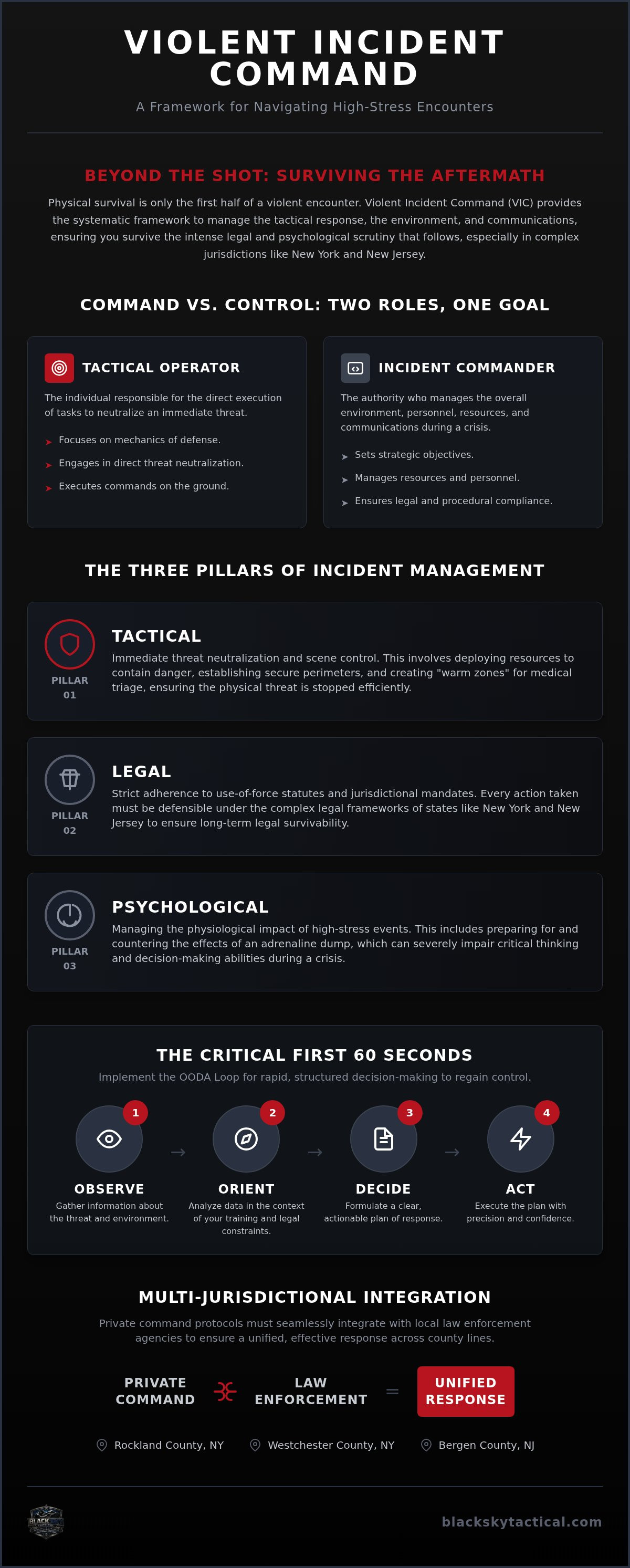
Violent Incident Command is defined as the systematic management of a tactical response to an active threat. While standard firearm training often focuses exclusively on the mechanics of a defensive shot, this discipline addresses the broader organizational and administrative requirements of a high-stakes encounter. There's a fundamental distinction between a tactical operator, who is primarily responsible for direct threat neutralization, and an incident commander, who manages the environment, personnel, and communications. For private security teams, corporate safety departments, and high-level permit holders in the tri-state area, this distinction is critical for maintaining order during a chaotic event.
The primary objective of this framework is to mitigate the immediate threat while simultaneously prioritizing the preservation of life and ensuring legal survivability. It's not enough to survive the physical event; one must also survive the subsequent administrative and legal scrutiny that follows an incident in jurisdictions like Rockland or Westchester County. Professional Violent Incident Command training ensures that every action taken is defensible and that the transition from initial response to law enforcement arrival is handled with precision.
The Evolution of Incident Command Systems (ICS)
Modern tactical management has its roots in the Incident Command System (ICS), which was originally developed in the 1970s to coordinate multi-agency responses to wildfires. Over the following decades, law enforcement agencies adapted these protocols for high-risk tactical operations, such as active shooter responses and hostage negotiations. Today, the civilian sector and private security firms have integrated these standards to create a structured approach to active violence. In the complex multi-jurisdictional environment of New York and New Jersey, the shift toward a Unified Command model allows private entities to integrate with arriving law enforcement, ensuring that resources aren't duplicated and that communication remains clear during a crisis.
Command vs. Control: Understanding the Nuance
Understanding the difference between command and control is essential for any professional safety team. Command refers to the established authority to direct resources and set strategic objectives, while control involves the actual execution of those tasks by individuals on the ground. In a rapidly evolving violent encounter, decentralized command becomes vital. This allows individuals closest to the threat to make life-saving decisions without waiting for a central authority that may be disconnected from the immediate danger. In a private property context, command authority represents the legal and operational right of an authorized individual to dictate defensive measures and resource allocation to neutralize an immediate threat.
The Three Pillars of Tactical Incident Management
Effective Violent Incident Command relies on a balanced integration of three distinct pillars: tactical, legal, and psychological. While the tactical response is often the most visible aspect of an incident, the legal and psychological pillars are what determine the long-term viability of the defense. A failure in any one of these areas can lead to catastrophic failure, regardless of how efficiently the threat was neutralized. These pillars function as a triad, where each element supports the others to create a sustainable defense strategy that survives both the immediate encounter and the subsequent investigation.
The Tactical Pillar focuses on the immediate requirements of threat neutralization and the establishment of a secure perimeter. This includes the deployment of resources to contain the threat and the creation of a "warm zone" for medical triage. The Legal Pillar involves strict adherence to use-of-force statutes, particularly in the highly regulated environments of New York and New Jersey. Finally, the Psychological Pillar addresses the physiological impact of a high-stress encounter, including the "adrenaline dump" that can impair decision-making. Frameworks like the Critical Incident Preparedness toolkit from the DOJ emphasize that command is as much about preparation as it is about response.
Legal Compliance in NY and NJ Jurisdictions
Navigating the legal landscape of the NY/NJ region requires an understanding of "Duty to Retreat" mandates, which often differ significantly from "Stand Your Ground" jurisdictions. In New York, for example, the legal obligation to retreat if it can be done with complete safety is a critical factor in determining the justification of use of force. Consulting with a private firearms instructor NY helps commanders internalize these requirements before an incident occurs. Documentation is equally vital; commanders must be prepared to provide a detailed, objective account of the tactical necessity for every action taken. This documentation should include:
- The specific nature of the perceived threat and the imminence of danger.
- Attempts made to de-escalate or retreat, if applicable under state law.
- A clear timeline of the incident from the first observation to the arrival of law enforcement.
- The status and location of all personnel and bystanders involved in the event.
Psychological Triage and Scene Management
Scene management begins with controlling the "Startle Response" within yourself and your team. This involuntary physiological reaction can lead to "tunnel vision" or "auditory exclusion," which severely limits a commander's ability to process information. Once the threat is contained, the commander's role shifts to victim stabilization and psychological triage. You must manage the immediate aftermath by providing clear instructions to survivors and ensuring that basic life-saving measures are applied before EMS arrival. When first responders arrive, your communication must be brief and precise. Identify yourself clearly, state that the threat has been neutralized, and follow all law enforcement commands without hesitation. Refining these skills through structured Violent Incident Command Training ensures your team is prepared for every phase of a crisis.
The First 60 Seconds: A Framework for Rapid Decision-Making
The initial minute of a violent encounter often determines the outcome of the entire event. Successful Violent Incident Command requires an immediate transition from a reactive state, where one is simply absorbing sensory data, to a proactive command state. This transition is facilitated by the OODA Loop: a continuous cycle of observing the environment, orienting to the threat, deciding on a course of action, and acting decisively. In the high-stress environments of Rockland or Bergen County, the speed at which a commander can cycle through this loop directly impacts life-safety outcomes. You must train to shorten this cycle, allowing you to get inside the decision-making process of the adversary.
Effective command is impossible without disciplined communication. Commands must be clear, concise, and delivered with professional authority to prevent panic among team members or bystanders. Shouting is rarely as effective as controlled, authoritative voice commands. Prioritizing tasks is equally vital during these initial moments. A commander must address the immediate threat first, followed by the safety of bystanders and the preservation of their own tactical position. Without this hierarchy of priorities, resources are often wasted on secondary concerns while the primary danger remains unmitigated.
Step-by-Step Command Initiation
Initiating command requires a structured approach to prevent the scene from devolving into chaos. First, you must confirm the nature of the threat and clearly announce your command status to your team; this establishes a single point of authority. Second, establish a "hot zone" where the threat is localized and direct all non-combatants to pre-identified areas of safety. Third, coordinate with local law enforcement dispatch using specific, professional terminology to ensure they understand the situation before they arrive. Utilizing a victim-based response checklist ensures that your initial actions align with recognized standards for managing mass violence incidents while prioritizing the needs of those affected.
Situational Awareness and Threat Assessment
Beyond the primary threat, a commander must remain vigilant for secondary threats, such as additional attackers or environmental hazards like fire or structural damage. Using the environment for tactical advantage is a core component of this assessment. You must distinguish between cover, which can stop incoming rounds, and concealment, which only hides your position from view. Identifying "stop-gap" measures, such as locking down a specific corridor or utilizing vehicles as temporary barriers, can provide the time needed for law enforcement to intervene. Situational awareness serves as the indispensable foundation of the OODA loop by providing the raw data necessary for accurate orientation and decision-making.
Implementing VIC Protocols in Rockland, Westchester, and Bergen Counties
Implementing Violent Incident Command protocols within the specific regulatory environments of Rockland, Westchester, and Bergen counties necessitates a meticulous approach to jurisdictional compliance. The NJ concealed carry permit training requirements, for instance, mandate specific proficiency standards that a commander must account for when deploying personnel in New Jersey. These standards influence how an incident is managed, as they define the baseline capabilities of those authorized to carry firearms in a professional or defensive capacity. In New York, the NY 18 hour concealed carry course serves as the primary educational foundation, ensuring that all participants understand the legal constraints regarding the use of force before they ever step into a command role.
Inter-agency cooperation is the cornerstone of successful incident management in the tri-state area. Private command structures must be designed to integrate seamlessly with local law enforcement agencies, such as the Rockland County Sheriff's Office or the Bergen County Police Department. This integration requires a shared vocabulary and an understanding of how local police prioritize scene stabilization. For corporate security teams operating in Orange and Westchester counties, training must extend beyond basic firearm safety to include the administrative procedures required for multi-agency coordination. Establishing these relationships before an event occurs is essential for ensuring that private responders are viewed as professional assets rather than liabilities during a crisis.
Regional Legal Nuances for Commanders
Commanders must be acutely aware of the specific reporting protocols in Rockland County, where any defensive discharge of a firearm necessitates immediate and specific administrative notifications. In New Jersey, the Permit to Carry (PTC) standards create a different set of operational constraints that influence how a commander directs their team during a tactical encounter. Maintaining NRA-certified training records is a vital component of establishing professional credibility if an incident eventually moves to a courtroom. These certifications provide an objective benchmark of proficiency that can be used to justify the selection and deployment of specific personnel in high-stakes environments.
Multi-Jurisdictional Incident Management
Managing a tactical response for businesses with locations in both New York and New Jersey presents unique challenges that require a standardized training approach. To achieve consistent tactical outcomes, organizations must align their internal protocols with the most stringent requirements of both states. This standardization ensures that a security team in Bergen County operates with the same level of discipline and legal awareness as a team in Westchester. Building this advanced proficiency starts with a solid foundation, which is why private firearm training for beginners NY is so critical for developing the fundamental skills necessary for future command roles. To ensure your organization is prepared for these complex multi-state requirements, consider enrolling your leadership in professional Violent Incident Command Training today.
Professional Violent Incident Command Training with Black Sky Tactical
Professional Violent Incident Command training provides the essential bridge between theoretical knowledge and operational execution. At Black Sky Tactical, our curriculum moves methodically from classroom-based theory regarding jurisdictional authority to high-intensity live-fire scenarios designed to test a commander's decision-making under stress. We focus on the practical application of the frameworks discussed in previous sections, ensuring that participants can manage a scene with the sobriety and precision required by the high-stakes environments of the NY and NJ region. This comprehensive approach ensures that leaders aren't just proficient with a firearm, but are also capable of managing the complex administrative and tactical requirements of a violent encounter.
Integrating this advanced training with the NRA basic pistol shooting course creates a complete safety profile for the responsible individual. While the NRA curriculum establishes the foundation of handgun safety and compliance, our specialized command programs build the leadership skills necessary to direct others during a crisis. This tiered educational structure is why businesses, private security teams, and high-net-worth individuals in Rockland and Orange counties trust Black Sky Tactical for their emergency management solutions. We provide a disciplined environment where professional responsibility is prioritized over tactical theatre.
Customized Training for Groups and Security Teams
We recognize that the tactical requirements of a house of worship differ significantly from those of a corporate office or a private residence. To address these unique needs, we offer tailored scenarios based on your specific facility layout and personnel requirements. These sessions include advanced tactical response drills such as room clearing, perimeter control, and the establishment of "safe rooms" for non-combatants. For organizations looking to train multiple leaders, we provide group discounts for teams of four or more in the NY/NJ area. This collective training ensures that your entire leadership team operates from a unified playbook, reducing the risk of communication failure during a real-world incident.
The Black Sky Tactical Difference
The hallmark of our instruction is a commitment to sobriety, legal compliance, and professional duty. We strictly avoid the "lifestyle" approach to firearms, focusing instead on the meticulous attention to detail required to survive the legal and psychological aftermath of a defensive encounter. Our small class sizes are a deliberate choice, ensuring that every commander receives personalized feedback and rigorous evaluation from our expert instructors. This focused environment allows for the correction of subtle errors in command presence or tactical positioning before they can lead to failure in the field. When you are ready to elevate your preparedness beyond basic certification, you can register for our next Violent Incident Command session today to begin your professional development.
Mastering Tactical Leadership for Long-Term Safety
Managing a high-stakes encounter requires more than just basic firearm proficiency; it demands a disciplined command structure that prioritizes legal compliance and scene stabilization. By internalizing the three pillars of tactical management and mastering the first sixty seconds of an incident, you ensure that your response is both effective and defensible. We've outlined how Violent Incident Command provides the necessary framework to navigate the complex jurisdictional mandates of Rockland, Westchester, and Bergen counties. This level of preparation is the logical progression for any responsible permit holder or security professional who understands that the aftermath of an event is as critical as the event itself.
Black Sky Tactical provides expert instruction for NY/NJ residents, utilizing NRA Certified training standards to ensure a complete safety profile. Our curriculum is specifically designed to bridge the gap between initial certification and advanced tactical proficiency, focusing on the professional duty to protect life while adhering to state regulations. You can Enroll in Professional Violent Incident Command Training to secure your leadership skills today. We look forward to helping you achieve a higher standard of professional readiness.
Frequently Asked Questions
Is Violent Incident Command training only for law enforcement?
No, this training is designed for a broad range of professionals, including private security teams, corporate safety officers, and responsible citizens holding high-level permits. While law enforcement agencies use similar Incident Command System frameworks, our program focuses on the unique requirements of private-sector leadership. It's essential for anyone in the Rockland or Bergen area responsible for the safety of a team, family, or facility during an active threat.
How does VIC training differ from a standard concealed carry course?
A standard concealed carry course focuses primarily on individual firearm proficiency and the legalities of carrying a weapon. In contrast, Violent Incident Command training emphasizes the management of the entire event. You'll learn to direct others, coordinate with emergency services, and establish perimeters. It's the difference between being a tactical operator and becoming a tactical manager who oversees the incident's outcome and ensures organizational compliance.
What are the legal benefits of having professional command training in NY or NJ?
Professional training provides a documented record of your commitment to due diligence and professional responsibility. In the highly scrutinized legal environments of Westchester and Orange counties, being able to demonstrate that you followed a structured, recognized command framework can be vital. It shows that your actions were based on established protocols rather than panic. This training helps ensure your tactical decisions remain within the bounds of complex state use-of-force statutes.
Can I take this course if I don't have a CCW permit yet?
Yes, you can enroll in this program without a concealed carry permit, as the curriculum focuses on leadership and management rather than just live-fire mechanics. However, we highly recommend completing your initial permit training first, as it provides the foundational legal knowledge required for command. Many students view this as the logical next step after finishing their combined NYS or NJS 18-hour concealed carry and NRA Basic Pistol classes.
What kind of scenarios are covered in the Violent Incident Command program?
The curriculum covers a variety of high-stakes situations, including active shooter responses, facility lockdowns, and perimeter establishment. We utilize both theoretical briefings and practical drills, such as room clearing and victim stabilization, to prepare you for real-world chaos. These scenarios are often customized for the specific environments our clients operate in, such as corporate offices in Westchester or houses of worship throughout the tri-state area.
How often should tactical command skills be refreshed or updated?
We recommend refreshing your tactical command skills at least once every twelve to eighteen months. Tactical proficiency and decision-making speed can degrade over time without consistent practice. Additionally, legal requirements and jurisdictional protocols in New York and New Jersey are subject to change. Regular updates ensure your command strategies remain compliant with the latest 2026 standards and that your team's response stays sharp and coordinated.
Does this training include active shooter response protocols for workplaces?
Yes, our program specifically addresses active shooter response protocols tailored for workplace and corporate environments. We teach commanders how to direct employees to safety, coordinate with local law enforcement dispatch, and manage the scene until first responders arrive. This training is a critical component of emergency management for businesses in Rockland and Bergen counties, providing a structured approach to mitigating threats while minimizing the risk to non-combatants.
What equipment is required for the VIC training course?
The required equipment typically includes your daily carry gear, a reliable notepad for administrative logging, and appropriate attire for both classroom and range environments. If the session includes live-fire scenarios, you'll need your firearm, a suitable holster, and eye and ear protection. We provide a detailed equipment list upon registration to ensure every participant is prepared for the specific drills scheduled for their Rockland or Orange county training session.


