

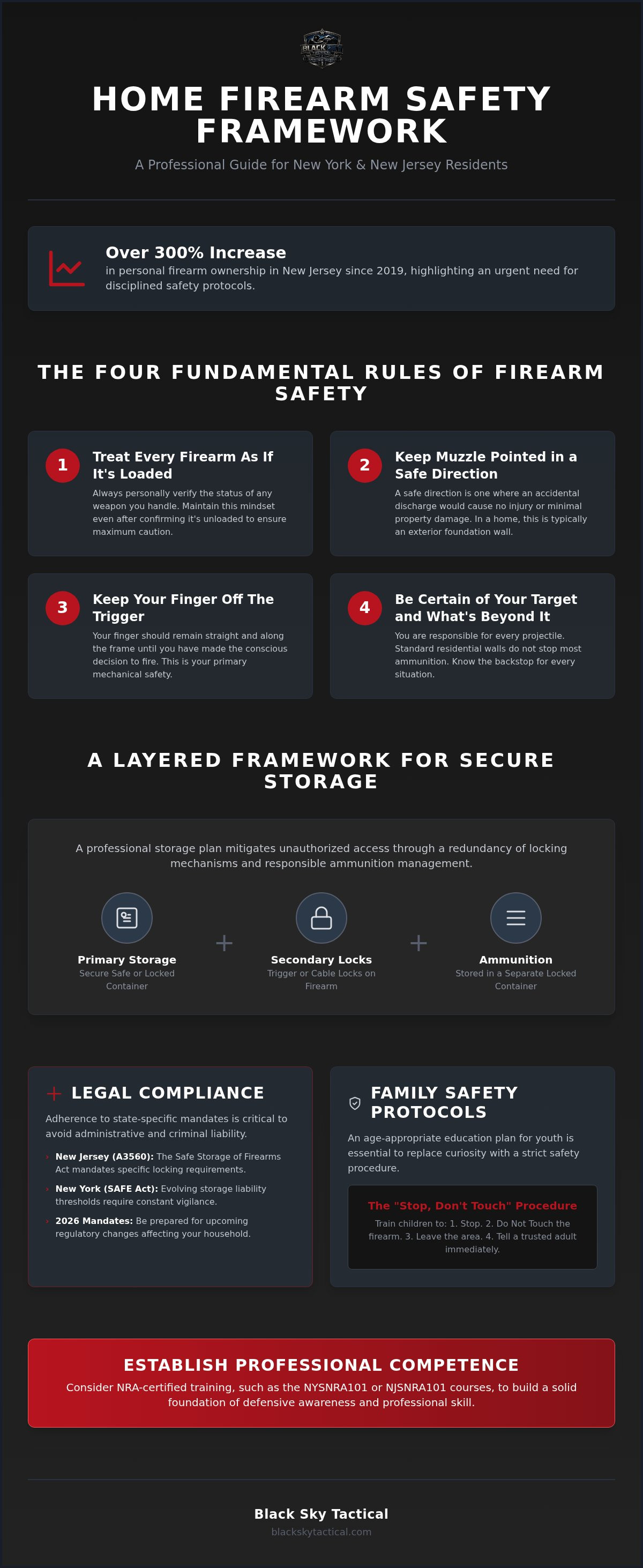
Since 2019, New Jersey has experienced a more than 300% increase in personal firearm ownership, a statistic that underscores an urgent need for rigorous adherence to established safety protocols. You likely recognize that the presence of a firearm in the home necessitates a disciplined approach to prevent unauthorized access while maintaining the capability for lawful defense. It's often a source of significant concern for residents in our region who must reconcile these practical needs with the increasingly complex legislative environments of New York and New Jersey.
This guide serves as a professional resource to help you master essential home firearm safety rules and ensure your household remains in full compliance with 2026 regulatory mandates. We'll provide a detailed analysis of the New Jersey Safe Storage of Firearms Act (A3560) and New York's evolving storage liability thresholds. You'll gain a clear understanding of how to implement a structured safety plan that integrates mechanical security, such as locked containers and separate ammunition storage, with a comprehensive educational strategy for every family member. Our objective is to replace uncertainty with a methodical framework for secure, legal, and responsible firearm management.
Key Takeaways
- Master the application of universal home firearm safety rules within your residence, including the identification of safe directions for muzzle control in a multi-room layout.
- Implement a professional, layered storage framework that combines secondary locking mechanisms with secure safes to prevent access by unauthorized individuals or minors.
- Develop an age-appropriate education protocol for youth that replaces curiosity with a strict "Stop, Don't Touch" procedure to mitigate the risk of accidental discharge.
- Identify the specific 2026 legal requirements of the NY SAFE Act and New Jersey's storage mandates to protect your household from administrative and criminal liability.
- Evaluate the necessity of NRA-certified training, such as the NYSNRA101 or NJSNRA101 courses, to establish a foundation of professional competence and defensive awareness.
The Four Fundamental Rules of Home Firearm Safety
Adhering to a standardized set of The Four Fundamental Rules of Firearm Safety is the baseline requirement for any individual possessing a weapon in a residential environment. These home firearm safety rules function as a series of redundant safeguards; if one rule is momentarily breached, the others prevent a catastrophic outcome. In the high-stakes context of NY and NJ residency, where population density is high and legal scrutiny is intense, there's no margin for error. Professional discipline starts with internalizing these four mandates:
- Treat every firearm as if it's loaded: You must personally verify the status of any weapon you handle. Even after verification, you must continue to handle the firearm as if it's capable of discharging to maintain a high level of caution.
- Keep the muzzle pointed in a safe direction: In a home setting, this requires identifying "safe directions" where an accidental discharge would be contained. This typically includes exterior foundation walls or floors, provided you've confirmed no one is on the level below.
- Keep your finger off the trigger: Your finger must remain indexed along the frame, outside the trigger guard, until you've made a conscious decision to fire. Mechanical safeties are secondary to this manual discipline.
- Be certain of your target and what's beyond it: You're responsible for every projectile that leaves your barrel. You must account for the fact that standard residential materials, such as drywall and wood studs, don't stop most modern ammunition.
While these principles are universal, their application within a home requires a specific understanding of ballistics and structural layout. For instance, in an apartment or a multi-family dwelling common in Northern NJ or NYC, a "safe direction" is often limited by the presence of neighbors in adjacent units. You must analyze your specific living environment to pre-determine where a muzzle can be safely pointed during administrative handling.
Safe Handling During Routine Maintenance
Cleaning and maintenance procedures often involve significant administrative handling, which increases the risk of an incident if protocols aren't strictly followed. You should establish a dedicated, distraction-free zone where you won't be interrupted. It's a mandatory safety requirement to ensure that no live ammunition is present in the room during these procedures. Before beginning work, perform a "double-clear" protocol, involving both a physical and visual inspection of the chamber and magazine well to confirm the weapon is inert.
Showing Firearms to Others Safely
When presenting a firearm to a guest or family member for educational purposes, you must adhere to the "action open" rule. Never pass a weapon with the slide forward or the cylinder closed. By keeping the action open, both parties can immediately verify the unloaded status. The exchange requires a specific verbal confirmation; the recipient shouldn't take control of the firearm until they've visually inspected it and acknowledged the status. Only when both individuals have verbally confirmed the weapon is clear should the physical transfer be completed, maintaining muzzle discipline throughout the process.
Secure Storage: Balancing Accessibility with Responsibility
Effective storage functions as the mechanical enforcement of home firearm safety rules. While the previous section detailed the behavioral discipline required for handling, secure storage addresses the periods when a firearm is not under your immediate control. The primary objective of any storage strategy is the absolute mitigation of risk regarding unauthorized access, particularly by children, prohibited persons, or intruders. Achieving this requires a transition from simple concealment to a professional, layered security framework that prioritizes reliability and legal adherence.
A robust safety plan utilizes a redundancy of locking mechanisms. This layered approach often involves a primary external safe combined with secondary devices, such as trigger or cable locks, which ensure the weapon remains inert even if the safe's perimeter is breached. Ammunition management is equally critical; rounds should be secured in a separate, locked container to prevent the immediate loading of a weapon by an unauthorized individual. When evaluating placement, you must avoid high-traffic areas or locations with high visibility, such as glass-fronted cabinets, as these increase the likelihood of discovery by visitors or opportunistic thieves. Reviewing the New York Safe Storage Mandates provides a clear baseline for the minimum legal requirements necessary to maintain a compliant household.
Comparing Storage Hardware Options
The selection of storage hardware requires an objective analysis of your specific defensive needs versus the inherent limitations of different technologies. Biometric safes utilize fingerprint recognition to provide rapid access, which is often desirable for home defense scenarios; however, these systems remain dependent on battery power and electronic sensors that may fail under duress. Mechanical keypad safes, utilizing Simplex-style locks, offer superior long-term durability and do not require power sources, though they may be slightly slower to operate. For temporary situations or transport, trigger and cable locks provide a minimalist solution, but they should never be considered a substitute for a dedicated, bolted-down security container.
The Myth of the "Hidden" Firearm
There is a persistent and dangerous misconception that concealment serves as a viable alternative to mechanical locking. Relying on "hiding spots," such as high shelves or closets, fails to account for the curiosity-driven persistence of children or the thoroughness of a motivated intruder. Professional private firearm training for beginners NY emphasizes that a firearm is either on your person or behind a lock; there is no middle ground. If you require personalized guidance on integrating these hardware solutions into your specific residential layout, our private firearm training programs offer comprehensive consultations on establishing a professional storage mindset.
Family Safety and Youth Education Protocols
New York and New Jersey recorded some of the lowest firearm death rates for children and adolescents in the United States between 2020 and 2024, with figures at 1.1 and 0.9 per 100,000 respectively. While these statistics are encouraging, maintaining this level of security requires a proactive educational framework that addresses the primary risk factor: curiosity. Effective home firearm safety rules must extend beyond mechanical storage to include a structured protocol for every member of the household. By demystifying the firearm through controlled exposure and strict behavioral mandates, you transition the child's perspective from one of intrigue to one of sober respect for a dangerous tool.
The NRA Eddie Eagle GunSafe Program
For younger children, the educational focus remains entirely on avoidance and immediate reporting. We recommend implementing the four-step safety mantra: Stop, Don't Touch, Run Away, Tell a Grown-up. This protocol should be reinforced through role-playing scenarios that simulate the discovery of a firearm in various residential settings. You can formalize this instruction through our Youth Firearm Safety Training, which provides a disciplined environment for children to learn these boundaries. As the child matures, the curriculum shifts toward supervised proficiency, ensuring they understand the mechanical functions and the gravity of the four fundamental rules of handling.
Communicating with Other Parents
Safety responsibility extends beyond your own front door, particularly when your children visit the homes of peers. You should normalize the practice of asking other parents about their firearm storage protocols as part of your routine parental due diligence. This conversation is not a political inquiry but a professional safety check. Referencing the pending New Jersey Safe Storage of Firearms Act can serve as a neutral starting point for these discussions, as it outlines the state's expectations for secure containment. Establishing these shared expectations ensures that your child is protected by consistent standards across different environments.
When you host visiting families, it's your duty to ensure your own household boundaries are clearly communicated. If you possess firearms, you must verify that all weapons are in a "zero-access" state before guests arrive. This administrative preparation prevents curiosity-driven incidents and provides a secure environment for visitors. Data from New York City indicates that shooting incidents involving children under 18 decreased to 120 in 2025, a trend that is only sustainable if every firearm owner adopts a rigorous, community-wide approach to educational transparency and secure storage.
Legal Compliance: NY and NJ Home Storage Mandates
Adherence to home firearm safety rules is not merely a matter of personal discipline; it is a strict legal obligation within the jurisdictions of New York and New Jersey. Both states have established rigorous statutory frameworks that dictate how firearms must be secured when not in the owner's immediate possession. Failure to comply with these mandates can result in severe criminal penalties, the revocation of licensing privileges, and significant civil liability. As of 2026, legislative trends in both states indicate a move toward universal storage requirements, making professional compliance more critical than ever for the responsible gun owner.
In New York, the SAFE Act remains the primary regulatory instrument for residential storage. Specifically, any household where a person under the age of 16 resides, or where a resident is legally prohibited from possessing a firearm, must utilize a secure locking device or a state-approved safe. This mandate is triggered the moment the firearm is no longer within the owner's "immediate control." In counties such as Westchester and Rockland, administrative requirements for handgun permit holders often exceed state minimums, requiring meticulous documentation of storage methods during the licensing process. Negligent storage that leads to unauthorized access is prosecuted aggressively, often resulting in felony charges if an incident occurs.
New York State Storage Standards
New York law requires that all firearms be rendered inoperable or secured in a locked container whenever a minor or prohibited person is present in the home. These regulations were further tightened in May 2026 with new restrictions targeting 3D-printed components and conversion devices. Understanding these nuances is a core component of the NY 18 hour concealed carry course, which provides the legal foundation necessary for permit eligibility. If you need to fulfill these requirements, you can enroll in our NYSNRA101 course to ensure your home environment meets all current administrative standards.
New Jersey PTC Storage Compliance
New Jersey residents must monitor the "New Jersey Safe Storage of Firearms Act" (A3560), which was introduced in early 2026 to mandate that all firearms be stored unloaded in a securely locked safe with ammunition kept in a separate container. For Permit to Carry (PTC) holders, particularly in Bergen County, administrative expectations regarding vehicle versus home storage are distinct. While a firearm may be on your person while carrying, it must be secured immediately upon entering a residence or leaving it unattended in a vehicle. Detailed updates on these evolving statutes are provided throughout our NJ concealed carry permit training to help owners maintain continuous compliance.
Implementing a Professional Safety Plan
The transition from understanding home firearm safety rules to implementing them within a high-stress residential environment requires more than casual self-study. While digital resources provide a necessary introduction, they can't replace the objective oversight and diagnostic feedback provided by a certified professional. In the complex legal landscapes of New York and New Jersey, a minor procedural error in storage or handling can result in catastrophic legal and physical consequences. Establishing a professional safety plan ensures that your defensive strategy is grounded in verified best practices rather than assumptions. This methodical approach transforms safety from a passive concept into a disciplined daily operation.
The Combined NYS and NRA Training Advantage
A comprehensive safety strategy begins with a structured educational foundation. Our NRA basic pistol shooting course serves as the primary entry point for establishing essential marksmanship and handling discipline. For residents seeking to carry a firearm outside the home, this foundation is seamlessly integrated into the 18-hour CCW certification required by New York State. Engaging a private firearms instructor NY allows for a customized audit of your specific residential layout, identifying potential vulnerabilities in your storage and defensive protocols that generic courses might overlook. This personalized approach ensures your safety plan is both practical and fully compliant with local administrative mandates.
Finalizing Your Home Safety Checklist
A professional safety plan is a living document that requires regular maintenance and verification. You should establish a written protocol for the entire household that details the location of secure storage, the status of ammunition, and the specific emergency procedures for family members. This plan must be audited annually to ensure all equipment remains functional and that every resident understands their role. Your annual safety audit should include several critical technical and educational checks:
- Testing all biometric and electronic locks to confirm battery integrity and sensor reliability.
- Verifying the structural security of safe mountings and anchors to prevent unauthorized removal.
- Conducting supervised "dry-fire" and safety drill sessions to maintain handling proficiency without live ammunition.
- Reviewing household boundaries and reporting procedures with children and guests to ensure awareness of current protocols.
Integrating these actions into your routine establishes a culture of responsibility that far exceeds the minimum legal requirements. To formalize your safety foundation and meet the 2026 state mandates, you should Register for our next NYS 18-Hour Concealed Carry Course. This professional certification provides the final layer of expertise necessary to secure your home and protect your family with confidence.
Establishing a Foundation for Long-Term Household Security
Maintaining a secure residence requires more than the passive acquisition of hardware; it demands the active integration of home firearm safety rules into your daily routine. Effective security relies on a dual-layered approach where mechanical storage solutions, such as biometric or mechanical safes, are reinforced by a family-wide educational framework. As the legal landscape in New York and New Jersey continues to evolve, your commitment to documenting these safety protocols and conducting regular audits will ensure your household remains both protected and compliant with state mandates.
Professional guidance is the most reliable method for navigating these high-stakes requirements. Our certified NYS and NRA instructors specialize in helping residents across Rockland, Orange, Westchester, and Bergen Counties establish a foundation of tactical proficiency and legal awareness. You can secure your household's future by choosing to Enroll in the NYSNRA101: Combined NYS 18-Hour CCW + NRA Basic Pistol Class. This comprehensive 18-hour curriculum provides the certification and skill-building necessary to manage firearms with the highest degree of professional responsibility. We look forward to assisting you in achieving a state of total preparedness.
Frequently Asked Questions
Do I legally need a gun safe in New York if I live alone?
Living alone in New York doesn't provide total immunity from storage requirements. While current laws focus on households with minors or prohibited persons, proposed 2026 legislation seeks to mandate secure storage for all owners. Beyond legal mandates, you must consider the risk of theft or unauthorized access by visitors. Utilizing a professional safe ensures you meet the administrative expectations of licensing officers in Rockland or Westchester counties while maintaining a responsible defensive posture.
What is the best way to talk to my kids about gun safety?
The most effective method involves replacing curiosity with structured education and clear behavioral boundaries. For young children, you should implement the "Stop, Don't Touch" protocol, which is a core element of our Youth Safety Course. It's better to provide supervised exposure in a controlled environment rather than relying on avoidance alone. This approach demystifies the firearm and ensures your children understand the gravity of handling and the necessity of immediate reporting.
Can I keep a loaded gun in my nightstand for home defense in NJ?
Under the New Jersey Safe Storage of Firearms Act (A3560), keeping a loaded weapon in a nightstand is generally prohibited. The statute requires that firearms not in use be stored unloaded in a securely locked container, with ammunition kept in a separate locked location. While you may prioritize quick access for defense, you must comply with these mandates to avoid criminal liability. Our NJSNRA101 course provides the specific legal updates needed for continuous compliance.
Does a trigger lock satisfy the NY SAFE Act requirements?
A trigger lock may fulfill the minimum requirement to render a firearm inoperable when a minor is present, but it's often insufficient for total compliance. In counties like Westchester and Rockland, administrative standards for handgun permit holders frequently favor the use of a bolted-down safe. A trigger lock doesn't prevent the theft of the entire weapon, which remains a significant liability. For maximum security, we recommend a layered approach that combines mechanical locks with a safe.
What should I do if a guest brings a firearm into my home?
You possess the jurisdictional authority to establish the safety standards within your own residence. If a guest brings a firearm into your home, you should require them to follow your established home firearm safety rules, which may include securing the weapon in a locked container. If you are uncomfortable with the firearm's presence, you are legally entitled to ask that it be removed from the property or stored securely in the guest's vehicle.
Are biometric safes reliable enough for emergency use?
Biometric safes provide rapid access for home defense, but they aren't completely infallible for emergency use. These devices rely on battery power and electronic sensors that can fail or struggle to read fingerprints under high-stress conditions. We suggest choosing a model that includes a mechanical override, such as a physical key or a backup keypad. Regular maintenance, including sensor cleaning and battery checks, is essential to ensure the device functions correctly during a critical incident.
How often should I review safety rules with my family?
You should conduct a formal review of your home firearm safety rules with all residents at least every six months. These sessions should involve a physical inspection of storage hardware and a refresher on emergency reporting protocols. For families with children, regular drills help reinforce the "Stop, Don't Touch" mantra and maintain the necessary level of safety awareness. Consistent communication ensures that everyone understands their specific responsibilities and remains disciplined in their handling habits.
Is professional training required for home firearm ownership in NY?
Obtaining a handgun permit in New York now requires the completion of a state-mandated 18-hour training program. Our NYSNRA101 course fulfills this requirement by integrating the NYS Concealed Carry curriculum with NRA Basic Pistol instruction. Even if you only possess long guns, professional training is highly recommended to establish the technical proficiency and legal knowledge required for safe ownership. This is especially important in high-density areas like Bergen County or the lower Hudson Valley.


