
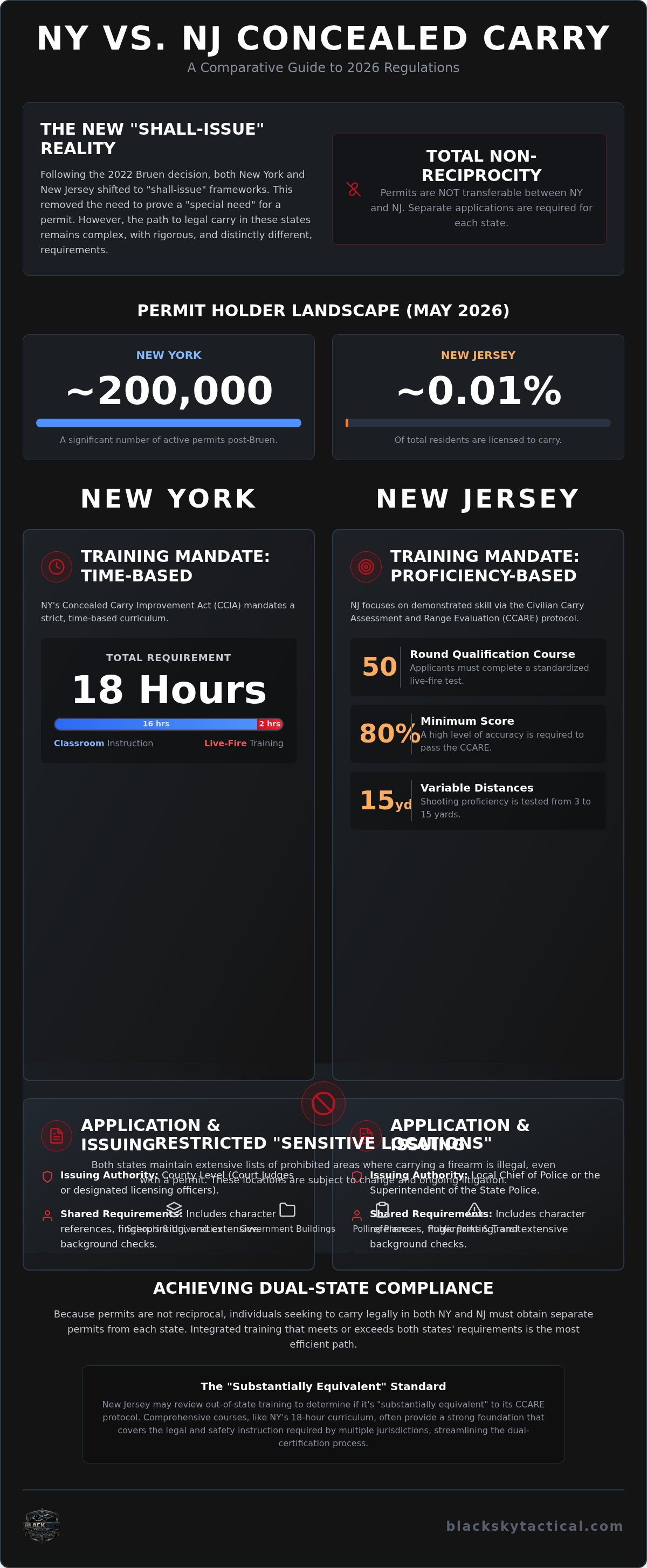
Did you know that as of May 2026, only approximately 0.01 percent of New Jersey residents were licensed to carry, even as New York's permit numbers reached nearly 200,000? While the 2022 Bruen decision shifted both states to a shall-issue framework, the administrative reality of NY vs NJ concealed carry laws remains a fragmented landscape of strict mandates and total non-reciprocity.
It's likely that you find the contrasting lists of sensitive locations and the high training hour requirements, particularly the 18-hour mandate in New York, to be a significant barrier to your personal safety goals. We understand the professional responsibility involved in staying compliant when the legal environment is in a state of constant flux due to ongoing litigation and legislative updates.
This guide serves as a technical briefing to clarify the distinct application fees, live-fire standards, and prohibited zones in each jurisdiction. We will provide a professional comparison of the New Jersey CCARE protocol and the New York training curriculum; ultimately, this analysis outlines a clear path toward achieving dual-state compliance through integrated certification courses.
Key Takeaways
- Understand the specific training hour requirements, including the mandatory 18-hour curriculum for New York and the proficiency-based CCARE protocol for New Jersey.
- Navigate the administrative complexities of NY vs NJ concealed carry laws to identify where permits are non-reciprocal and how to apply for non-resident status.
- Identify the specific "sensitive locations" in each state, such as public parks and transportation hubs, where carrying a firearm remains strictly prohibited under 2026 statutes.
- Discover how integrated training solutions like the NYSNRA101 course allow residents to meet multiple jurisdictional requirements through a single, streamlined certification process.
- Gain clarity on the procedural steps required to maintain legal compliance in both states, ensuring your training meets the "substantially equivalent" standards often debated in licensing.
Navigating the Concealed Carry Landscape in NY and NJ
The legal environment for firearm carry in the Northeast has undergone a fundamental transformation since the 2022 Supreme Court ruling. Following that decision, both New York and New Jersey transitioned from "may-issue" to "shall-issue" standards, removing the subjective requirement for applicants to prove a "special need" for self-defense. However, the administrative reality of NY vs NJ concealed carry laws in 2026 demonstrates that "shall-issue" does not equate to a simplified or "easy" process. Applicants must still navigate a dense thicket of procedural mandates, extensive background investigations, and rigorous training requirements that vary significantly across state lines. Understanding the nuances of NY vs NJ concealed carry laws is essential for any resident of the tri-state area who prioritizes strict legal adherence.
The Evolving Legal Framework of 2026
New York continues to operate under the Concealed Carry Improvement Act (CCIA), which established the current 18-hour training mandate and a comprehensive list of sensitive locations. In New Jersey, the 2026 administrative updates have refined the Permit to Carry (PTC) process, focusing heavily on standardized qualification through the CCARE protocol. Residents in border regions, such as Rockland County in New York and Bergen County in New Jersey, face the unique challenge of maintaining compliance with two distinct sets of New Jersey gun laws and New York statutes if they intend to carry in both jurisdictions. The legal landscape remains dynamic, with ongoing litigation frequently affecting the enforceability of specific provisions.
Licensing Authorities and Application Paths
A primary distinction between the two states lies in the jurisdictional authority responsible for permit issuance. In New York, the process is typically handled at the county level, where County Court Judges or designated licensing officers review applications and issue final determinations. New Jersey utilizes a system where the local Chief of Police or the Superintendent of the State Police serves as the primary licensing authority. Both states require comprehensive background checks, fingerprinting, and the submission of character references to verify the applicant's suitability. The timeline for processing can range from several months to over a year, depending on the specific municipality and the current volume of applications being reviewed.
Achieving compliance in these jurisdictions requires a methodical approach to both documentation and skill building. Because neither state offers reciprocity, obtaining dual certification is the only legal path for individuals who reside or work across the state line. Professional instruction serves as the necessary bridge between a citizen's intent to carry and the successful acquisition of the required permits, ensuring that all state-specific standards are met without procedural errors.
Comparing Training Mandates: NY 18-Hour vs. NJ PTC Standards
The administrative burden of obtaining a permit is most visible within the training requirements. Under New York's concealed carry law, applicants must complete a rigorous 18-hour curriculum. This consists of 16 hours of classroom instruction and 2 hours of live-fire training. In contrast, New Jersey utilizes the Civilian Carry Assessment and Range Evaluation (CCARE) protocol. While New Jersey does not mandate a specific number of classroom hours, it requires a high level of demonstrated proficiency. Applicants must pass a 50-round qualification course with a minimum score of 80 percent at distances ranging from 3 to 15 yards. This divergence is a central theme in the discussion of NY vs NJ concealed carry laws.
Understanding the nuances of NY vs NJ concealed carry laws requires a close look at the "substantially equivalent" debate. New Jersey often reviews out-of-state training to see if it matches their specific proficiency standards. For many, the NY 18 hour concealed carry course is considered the gold standard because its comprehensive nature covers nearly every administrative requirement found in neighboring states. It provides a level of legal and safety instruction that exceeds the baseline in many other jurisdictions.
Curriculum Requirements: Classroom vs. Range
The classroom portion in New York is exhaustive. It includes mandatory modules on conflict de-escalation, suicide prevention, and the legalities of the use of force. New Jersey’s focus remains on practical application, including safe handling and holster draws. Many students find that the NRA basic pistol shooting course provides the mechanical foundation needed to succeed in both jurisdictions. It bridges the gap between theoretical knowledge and the technical skill required for the range, particularly regarding the different qualification distances and scoring methods used by each state.
Black Sky Tactical’s Combined Training Approach
We provide a structured path through the NYSNRA101 course, which fulfills the 18-hour New York mandate and includes NRA certification. For those targeting a New Jersey Permit to Carry, the NJSNRA101 course ensures all CCARE standards are met. Because the 80 percent qualification score can be challenging for those without recent experience, private firearm training for beginners NY is a recommended step for building confidence before the evaluation. This approach ensures your documentation is accurate for Rockland and Orange county officials. If you are starting this process, integrated certification classes offer the most efficient route to legal carry.
Sensitive Locations and Restrictions: Where Carry is Prohibited
Even after securing the necessary certifications, permit holders must recognize that a license does not grant universal access. The distinction between "sensitive" and "restricted" locations is a fundamental aspect of NY vs NJ concealed carry laws that demands constant situational awareness. In both states, the list of prohibited areas is extensive and often subject to change based on ongoing judicial reviews. Failure to adhere to these boundaries, even unintentionally, can result in severe legal consequences including felony charges and the permanent revocation of carry privileges.
Defining Sensitive Locations in New York
Under the Concealed Carry Improvement Act (CCIA), New York designates a broad array of public and private spaces as "sensitive locations." These include government buildings, schools, daycare centers, and public transportation hubs. Notably, the list extends to healthcare facilities, houses of worship, and high-traffic areas like Times Square. One of the most restrictive provisions is the "Restricted Locations" rule, which establishes a default prohibition on all private property. Unless a property owner has posted clear signage or given express verbal consent, carrying a firearm is legally prohibited. Additionally, the "Vampire Rule" forbids carry in any establishment that serves alcohol for on-site consumption. Recent 2026 court rulings have continued to shape the enforceability of these zones, making it imperative for permit holders to verify the current status of specific locations before entry.
New Jersey Restrictions for Permit Holders
New Jersey’s framework, governed by N.J.S.A. 2C:58-4.6, mirrors many of New York’s restrictions but includes its own specific prohibitions. Permit holders are barred from carrying in public parks, beaches, casinos, and entertainment venues such as stadiums or arenas. Public gatherings and designated "safe zones" are also strictly off-limits. Regarding vehicle transport, New Jersey law requires the firearm to remain under the "immediate control" of the permit holder, which typically means it must be on their person or in a securely fastened holster. While New Jersey doesn't currently enforce the same "default no" policy for all private property that New York utilizes, individual property owners still retain the absolute right to prohibit firearms. Understanding these jurisdictional differences in NY vs NJ concealed carry laws is the only way to ensure total compliance while traveling through the region.
Reciprocity and Non-Resident Permit Challenges
The lack of reciprocity between New York and New Jersey represents one of the most significant administrative hurdles for permit holders in the tri-state area. Under the current interpretation of NY vs NJ concealed carry laws, neither state honors the credentials issued by the other. This means a New York permit is invalid the moment you cross the George Washington Bridge, and a New Jersey Permit to Carry (PTC) offers no legal protection in Rockland or Orange counties. For those who frequently travel across state lines, the only legal solution is to obtain a non-resident permit for the adjacent jurisdiction.
For New York residents, the path to a New Jersey permit involves a rigorous application through the New Jersey State Police. Conversely, New Jersey residents seeking to carry in New York must apply through the licensing officer of a specific county, often starting with those bordering their home state, such as Rockland or Westchester. Utilizing comprehensive NJ concealed carry permit training is essential for ensuring your application file meets the exacting standards of the 2026 administrative review process. Proper documentation ensures that your training is recognized as "substantially equivalent" during the background check phase.
The Non-Resident Application Process
Applicants should prepare for mandatory in-person requirements. Both states require out-of-state residents to appear for fingerprinting at authorized centers within the target jurisdiction. Administrative fees are substantial; New York’s application and fingerprinting costs total approximately $428.25, while New Jersey’s fees are approximately $226. Professional training documentation remains the most critical component of the non-resident file. Licensing officers scrutinize these certificates to ensure the curriculum aligns with their state's specific mandates, such as the 18-hour requirement in New York or the CCARE proficiency standards in New Jersey.
Travel and Transport Laws (FOPA)
While the Federal Firearm Owners Protection Act (FOPA) provides some protection for interstate travel, its scope is frequently misunderstood. FOPA allows a person to transport a firearm from one place where they can legally possess it to another place where they can legally possess it, provided the firearm is unloaded and stored in a locked container not readily accessible from the passenger compartment. It's vital to remember that FOPA is a transport law, not a carry law. It does not authorize you to have a concealed weapon on your person while stopping for gas or meals in a non-reciprocal state. If you are ready to secure your legal status in both jurisdictions, we invite you to view our upcoming dual-certification courses to begin your application process.
Achieving Dual Compliance: Integrated Training Solutions
For individuals residing in one jurisdiction and maintaining professional or personal obligations in the other, the non-reciprocal nature of NY vs NJ concealed carry laws necessitates a dual-permit strategy. Rather than completing two entirely separate, multi-day curricula, applicants can utilize integrated training solutions designed to overlap the core administrative and safety requirements. The NYSNRA101 course, for example, is specifically structured to satisfy the 18-hour New York State mandate while simultaneously meeting the proficiency standards required for the New Jersey Permit to Carry (PTC) and providing a national NRA certification. This approach eliminates redundant classroom hours while ensuring that every state-specific legal module is thoroughly addressed.
Residents in Orange and Westchester counties frequently prefer these integrated certifications because they provide the necessary documentation for local licensing officers who are increasingly focused on the technical details of training certificates. Navigating the administrative complexities of NY vs NJ concealed carry laws requires a training file that is beyond reproach. Preparing for the live-fire qualification is a critical component of this process, as the standards for New York and New Jersey involve different distances and scoring metrics. By consolidating these requirements into a single educational block, students can focus on mastering the safe handling and marksmanship skills required to pass both evaluations in a controlled, professional environment.
The Black Sky Tactical Advantage
Our instructors maintain a specialized understanding of the administrative procedures in both New York and New Jersey, providing a bridge between the classroom and the permit application. We offer classroom locations that are strategically situated near the Rockland and Bergen county borders to accommodate commuters and local residents alike. Beyond the initial training, we provide essential post-course support, which includes guidance on application submission and navigating the character reference requirements that often complicate the process for out-of-state applicants.
Continuing Education and Proficiency
Securing a permit is merely the first step in a long-term commitment to responsible firearm ownership. We encourage permit holders to engage with a private firearms instructor NY to maintain their tactical proficiency and stay updated on legislative changes. For those looking to expand their capabilities, advanced tactical training options are available to build upon the foundation established during the initial certification. Additionally, we offer youth safety and family protection programs, ensuring that the principles of safety and compliance are integrated into the entire household's routine.
Securing Your Path to Multi-State Compliance
Understanding the administrative complexities of NY vs NJ concealed carry laws is the first step toward responsible firearm ownership in the tri-state area. We've analyzed the specific 18-hour training mandate for New York and the proficiency-based requirements of New Jersey's CCARE protocol, noting that neither state recognizes the other's permit. Maintaining legal standing requires meticulous attention to jurisdictional boundaries and prohibited locations; a single oversight can lead to severe administrative or criminal penalties. As an NRA Certified Training Center, we provide the expertise needed to navigate these evolving regulatory frameworks with precision. Our Rockland and Bergen County expert instructors specialize in bridging the gap between these two non-reciprocal states. You can fulfill your obligations efficiently by enrolling in our NYSNRA101 course, which is a combined 18-hour course fully compliant with 2026 standards. We invite you to view our upcoming NYS and NJS Combined Concealed Carry Classes to begin your certification process. Taking this proactive step ensures you're prepared, informed, and legally protected as you exercise your rights across the region.
Frequently Asked Questions
Does New York recognize a New Jersey Concealed Carry Permit?
No, New York State doesn't recognize concealed carry permits issued by New Jersey or any other jurisdiction. To carry legally within New York, you must obtain a New York State permit through the specific county licensing officer where you reside or maintain a place of business. This lack of reciprocity is a central challenge in understanding NY vs NJ concealed carry laws, making it necessary for residents of Bergen or Rockland counties to secure dual certification.
How many hours of training are required for a NYS Concealed Carry Permit in 2026?
Under the current 2026 standards, New York requires a minimum of 18 hours of training for all new concealed carry applicants. This mandate is divided into 16 hours of comprehensive classroom instruction and 2 hours of supervised live-fire training on a range. The curriculum covers essential topics such as conflict de-escalation, suicide prevention, and the legalities surrounding the use of force. Our NYSNRA101 course is specifically designed to meet this mandatory 18-hour requirement.
Can a NJ resident get a non-resident NY Concealed Carry Permit?
Yes, residents of New Jersey can apply for a non-resident New York State concealed carry permit. The application is typically processed through the licensing officer of a New York county, such as Rockland, Orange, or Westchester. Applicants must fulfill the same 18-hour training mandate and background check requirements as New York residents. This process is essential for individuals who live in Bergen County but frequently travel into New York for professional or personal reasons.
What are the sensitive locations where I cannot carry in New Jersey?
New Jersey law prohibits carrying firearms in several designated sensitive locations despite holding a valid Permit to Carry. Prohibited areas include schools, child care facilities, government buildings, courthouses, and police stations. Additionally, you cannot carry in bars or restaurants that serve alcohol, healthcare facilities, casinos, or public parks and beaches designated as gun-free zones. Understanding these restrictions is vital for navigating NY vs NJ concealed carry laws without incurring severe legal penalties or permit revocation.
Is the NRA Basic Pistol course sufficient for a NYS permit?
The NRA Basic Pistol course alone isn't sufficient to meet the 18-hour New York State training mandate. While it provides an excellent foundation for handgun safety, it doesn't cover the specific legal modules required by the New York Concealed Carry Improvement Act. However, we integrate the NRA curriculum into our NYSNRA101 class. This combined approach ensures that students receive both the nationally recognized safety training and the state-mandated legal instruction in a single, efficient block.
How often do I need to renew my NY and NJ carry permits?
New Jersey Permits to Carry (PTC) must be renewed every two years to maintain legal standing. In contrast, New York State concealed carry licenses typically require renewal every three years, though specific county procedures may vary slightly. Both states require applicants to submit updated documentation and, in many cases, proof of continued proficiency or training. Keeping track of these differing expiration dates is a critical administrative responsibility for those holding dual permits in Rockland and Bergen counties.
What is the live-fire qualification standard for the NJ PTC?
The current standard for the New Jersey Permit to Carry is the Civilian Carry Assessment and Range Evaluation (CCARE) protocol. This evaluation requires the shooter to demonstrate safe handling and marksmanship by firing a minimum of 50 rounds at various distances, ranging from 3 to 15 yards. A minimum passing score of 80 percent is required for certification. This proficiency-based evaluation is distinct from New York's time-based training mandate and requires specific preparation to ensure success.
Do I need to live in Rockland County to take a CCW course there?
No, you don't need to be a resident of Rockland County to attend a concealed carry course at our facility. We welcome students from Orange, Westchester, and Bergen counties who are seeking to fulfill their mandatory training requirements. Our instructors provide specialized guidance for both New York and New Jersey administrative processes. Whether you're a New York resident seeking a local permit or a New Jersey resident pursuing non-resident status, our training is accessible to all qualified applicants.


