
Can you distinguish between the technical ability to discharge a firearm and the legal justification required to do so under the complex mandates of New York and New Jersey? For residents in Rockland and Bergen County, the path to responsible firearm ownership is often obscured by dense regulatory requirements and the legitimate concern that standard range practice doesn't prepare one for a high-stress encounter. You likely recognize that owning a tool for protection is only the first step in a much larger commitment to safety and legal compliance. This guide explores how professional Tactical Training bridges the gap between mere ownership and true readiness, ensuring you meet the strict 18-hour New York State requirement while developing the disciplined mindset necessary for personal protection.
By focusing on the integration of mechanical proficiency and jurisdictional law, you'll learn exactly how to navigate the certification process for a concealed carry permit. We will examine the necessity of building reliable muscle memory for defensive scenarios and provide clarity on the legalities of lethal force within the Tri-State area. This methodical approach transforms skepticism into confidence, replacing military-style theatrics with the practical, administrative, and tactical skills that modern civilian life demands.
Key Takeaways
- Understand why static range practice isn't enough to prepare you for the dynamic realities and physiological stress of a defensive encounter.
- Identify the core pillars of defensive proficiency, focusing on weapon manipulation and marksmanship under the strict observation of professional standards.
- Clarify the specific 18-hour New York State mandate and the New Jersey Permit to Carry standards to ensure your training meets all jurisdictional requirements.
- Professional Tactical Training in the Tri-State area provides a structured path for integrating legal compliance with practical, life-saving skills.
- Explore how specialized safety programs for youth and organizations foster a culture of responsibility and preparedness across different environments.
Defining Tactical Training: Beyond Basic Firearms Safety
Professional Tactical Training is often misunderstood as a purely physical exercise or a recreational simulation of military maneuvers. In a disciplined context, it represents the deliberate application of firearm skills under conditions of physiological stress and realistic environmental variables. While basic safety courses focus on the technical operation of a handgun, tactical instruction requires the student to integrate their mechanical abilities with situational judgment. This discipline originated from the rigorous standards established by a Police Tactical Unit, where the objective isn't merely to hit a target, but to resolve a high-stakes encounter within strict legal and ethical boundaries.
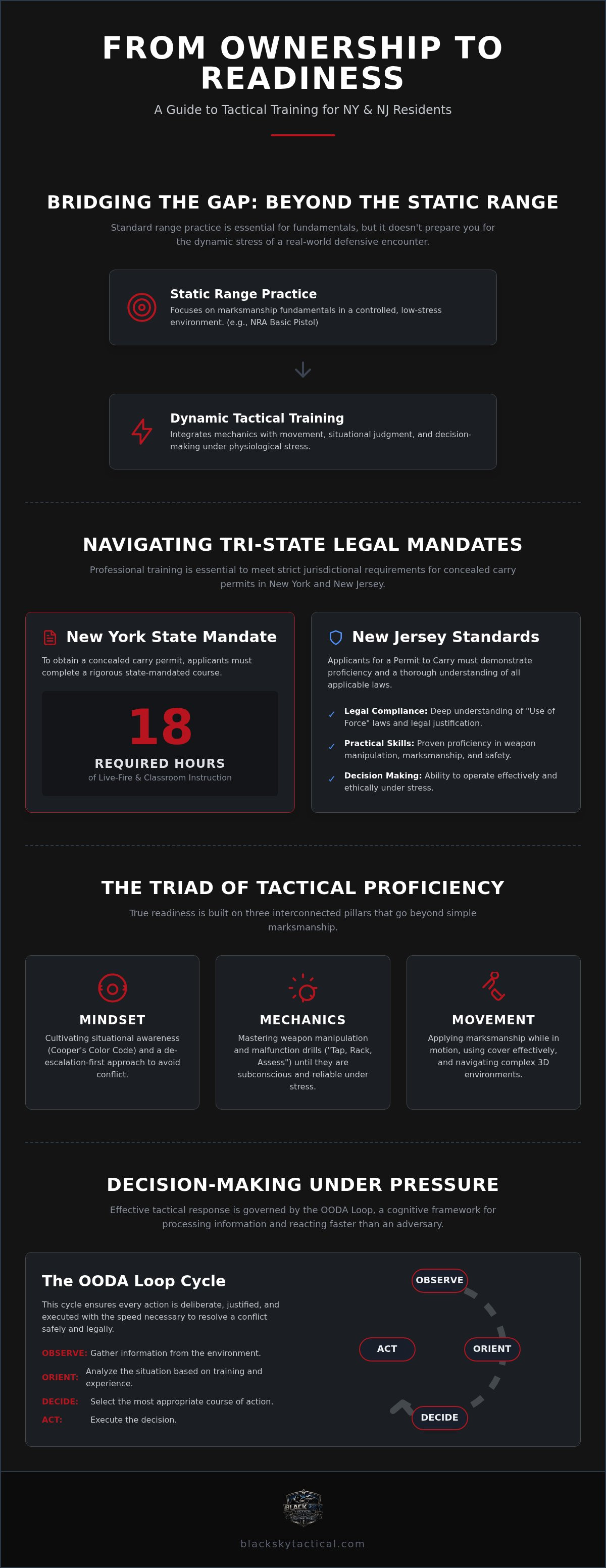
For residents in the Tri-State area, this journey begins with a firm grasp of fundamentals. We emphasize a triad of proficiency: Mindset, Mechanics, and Movement. Before a student can move effectively or make split-second decisions, they must master the administrative handling of their equipment. This is why we recommend the NRA basic pistol shooting course as the essential prerequisite. It establishes the safety protocols and marksmanship standards required before advancing to dynamic scenarios. Without these basics, advanced maneuvers become unsafe and ineffective.
The Role of Situational Awareness in Tactical Defense
Situational awareness is the primary tactical tool for conflict avoidance. It's the practice of observing one's environment to identify potential threats before they escalate. We utilize the Color Code of Mental Awareness, often referred to as Cooper's Color Code, to help students categorize their state of readiness. By maintaining "Condition Yellow," which is a state of relaxed alertness, individuals can often avoid the need for a kinetic response entirely. Awareness training isn't about paranoia; it's about the professional responsibility to recognize and de-escalate risks before they require the use of force.
Static vs. Dynamic Training: Why Mechanics Matter
Static range shooting involves firing at two-dimensional paper targets from a fixed position. While this is necessary for developing accuracy, it doesn't replicate the complexities of a real-world defensive scenario. Dynamic Tactical Training introduces three-dimensional decision-making drills where the student must account for movement, cover, and bystanders. A common pitfall for self-taught shooters is attempting dynamic movements before their mechanics are subconscious. Without a foundation of perfect marksmanship, accuracy degrades rapidly under stress. We bridge this gap by ensuring every movement is supported by disciplined, repeatable mechanics.
The Pillars of Defensive Tactical Proficiency
Defensive proficiency is built on a foundation of technical skill, cognitive agility, and legal comprehension. While basic marksmanship is a starting point, Tactical Training demands that an individual operates effectively under the biological effects of stress, such as auditory exclusion and diminished fine motor skills. Central to this development is the OODA Loop (Observe, Orient, Decide, Act), a decision-making cycle that allows a person to process information and react faster than an adversary. This cognitive framework ensures that every action taken is deliberate, justified, and executed with the necessary speed to resolve a conflict safely.
In the high-stakes legal environments of New York and New Jersey, technical skill is secondary to legal literacy. Understanding "Use of Force" laws and the specific criteria for "justification" is essential for any responsible firearm owner. Proficiency means knowing not only how to engage a threat, but more importantly, when the law permits it and when it requires a different course of action. This holistic approach ensures that your response is as legally sound as it is tactically effective.
Mastering Weapon Manipulation and Malfunction Drills
Mechanical failures are a reality in high-stress environments, making administrative handling as important as accuracy. We teach the "Tap, Rack, Assess" method as a universal response to common pistol stoppages, ensuring the shooter can return the firearm to a functional state without conscious thought. Distinguishing between an emergency reload, performed when the magazine is empty, and a tactical reload, which involves retaining a partially full magazine during a lull in the encounter, is a critical skill. For those starting their journey, private firearm training for beginners NY provides the individualized attention needed to build these habits correctly from the first day. These standards mirror the rigorous curricula found at the Federal Law Enforcement Training Centers, where administrative handling is treated with the same gravity as marksmanship.
Tactical Movement and Use of Cover
Movement is a defensive necessity, yet it must be executed with precision to maintain a stable shooting platform and minimize exposure. We emphasize the clear distinction between "cover," which can stop incoming rounds, and "concealment," which only hides one's position from view. Techniques such as "slicing the pie" allow for the methodical clearing of corners while exposing the minimum amount of one's profile to potential threats. If you are seeking to refine these technical skills, exploring our comprehensive course offerings can provide the structured environment necessary for growth. Mastering Tactical Training requires a commitment to these fundamentals until they become subconscious reactions.
Navigating Tactical Training Requirements in NY and NJ
The regulatory landscape for firearm owners in the Tri-State area is exceptionally dense, requiring a methodical approach to Tactical Training that prioritizes administrative compliance alongside skill development. For residents of Rockland, Orange, and Westchester Counties, the transition from ownership to lawful carry is governed by the Concealed Carry Improvement Act (CCIA), which established rigorous new standards for permit applicants. Understanding these mandates is the first step in ensuring that your training is not only effective but also recognized by jurisdictional authorities during the application process.
To maximize efficiency, we offer the NYSNRA101, which is a combined NYS 18-hour Conceal Carry and NRA Basic Pistol class. This integrated format allows students to fulfill state requirements while simultaneously earning a nationally recognized certification, addressing the administrative needs of local permit offices. By consolidating these requirements, applicants avoid the redundancy of separate courses, ensuring a more streamlined path toward their certification goals.
The NYS 18-Hour Concealed Carry Course (16+2)
The New York State mandate requires a minimum of 18 hours of instruction, structured as 16 hours of in-person classroom training and 2 hours of live-fire proficiency. The curriculum, set by the Division of Criminal Justice Services, covers essential topics such as conflict de-escalation, safe storage requirements, and an exhaustive review of sensitive locations where carry is prohibited. Our NY 18 hour concealed carry course ensures that every participant meets the live-fire standard, which requires firing at least four out of five rounds on a 25.5 inch by 11 inch target from a distance of 4 yards. Additionally, students must achieve a minimum score of 80% on the written examination to demonstrate their understanding of the legal and safety protocols discussed.
NJ Permit to Carry (PTC) Compliance and Training
For those seeking a permit in Bergen County or elsewhere in New Jersey, the requirements focus heavily on the Permit to Carry (PTC) qualification standards. This process involves demonstrating proficiency through a specific course of fire, such as the CCARE protocol, which evaluates accuracy and safe handling at various distances. Our NJ concealed carry permit training is designed to prepare applicants for these rigorous shooting standards while ensuring they understand the administrative nuances of the NJ application. Unlike New York, New Jersey requires recurring qualifications to maintain PTC status, making ongoing Tactical Training a logistical necessity for continued compliance with state law.
Specialized Tactical Programs: From Youth Safety to Incident Command
While much of the public discourse surrounding Tactical Training focuses on individual concealed carry permits, a comprehensive approach to safety must account for the broader social and professional environments in which we operate. Responsibility doesn't begin and end with the individual firearm owner; it extends to the family unit and the organizational structures of our communities. By diversifying training to include youth education and professional incident management, we create a more resilient and informed public. For those in the early stages of adulthood, understanding the specific firearm laws for young adults NY is a critical prerequisite for responsible participation in this discipline.
Private firearm instruction serves as a vital bridge for those who require personalized attention to refine their tactical skills. Unlike group settings, private sessions allow for a meticulous focus on an individual's specific biomechanics and administrative habits, ensuring that the transition from basic safety to advanced proficiency is handled with the highest degree of precision. This tailored approach is particularly beneficial for professionals who must integrate their training with specific workplace protocols or unique personal protection requirements. Every session is structured to build a disciplined foundation that respects both the technical and legal complexities of the Tri-State area.
Youth Firearm Safety and Family Responsibility
Education is the most effective tool for removing the mystery that often surrounds firearms in a household. Our Youth Safety Course is designed to replace curiosity with a disciplined understanding of hazard recognition. We prioritize the "Stop, Don't Touch, Leave the Area, Tell an Adult" protocol to ensure that children and adolescents know exactly how to respond if they encounter an unsecured firearm. From a tactical perspective, home safety isn't merely about handling; it's about the administrative discipline of secure storage and the establishment of family-wide safety standards that prevent accidents before they occur.
Violent Incident Command (VIC) for Professionals
For school administrators, security personnel, and business owners, tactical proficiency involves more than individual marksmanship; it requires the ability to manage a crisis effectively. Violent Incident Command (VIC) training provides the framework for tactical management during high-stress, active-threat environments. This program focuses on command and control, teaching professionals how to coordinate with law enforcement and execute emergency management protocols under extreme pressure. By integrating these command skills with existing safety procedures, organizations can significantly improve their response capabilities during a critical incident. If you are responsible for the safety of an organization, you can view our specialized training schedules to begin the certification process.
Advancing Your Skills with Black Sky Tactical
Black Sky Tactical functions as a professional institution dedicated to the disciplined integration of safety, education, and regulatory compliance. Our approach to Tactical Training is characterized by a high degree of sobriety and professional responsibility, ensuring that every student understands the gravity of firearm ownership within the Tri-State area. Serving Rockland, Westchester, and Bergen Counties, we provide a centralized resource for residents who require not only the technical skills for personal protection but also the administrative certifications mandated by state law. We position ourselves as a bridge between complex state mandates and the practical proficiency required for responsible ownership.
Why Choose Combined CCW and NRA Certification?
The decision to enroll in a combined course, such as our NYSNRA101 or NJSNRA101, offers a significant advantage over programs that only meet the bare minimum legal requirements. By integrating the NRA Basic Pistol curriculum with the mandatory state safety training, students receive a nationally recognized certification that validates their foundational proficiency. This dual-certification model ensures a greater depth of instruction, as our NRA-certified instructors bring a professional background focused on meticulous attention to detail and safety. We don't merely teach you how to pass a qualification; we provide a comprehensive syllabus that builds a complete understanding of weapon manipulation and legal obligations in a structured, instructional environment.
Getting Started: Your Tactical Training Roadmap
Navigating the multi-step process of permit training requires a methodical plan to ensure all jurisdictional mandates are satisfied. We recommend following this structured roadmap to achieve your certification goals:
- Step 1: Identify your jurisdictional needs. Determine whether you require the New York State 18-hour course or the New Jersey Permit to Carry (PTC) qualification based on your primary residence and carry intentions.
- Step 2: Enroll in the appropriate combined course. Register for either the NYSNRA101 or NJSNRA101 to fulfill your initial classroom and live-fire requirements efficiently within a single program.
- Step 3: Schedule private follow-up sessions. Once initial certification is achieved, engage in focused training to refine tactical movement and decision-making under the guidance of a professional.
Achieving a permit is the beginning of a long-term commitment to proficiency rather than a final destination. To maintain the necessary muscle memory and situational judgment, we encourage students to seek ongoing instruction from a private firearms instructor NY. Regular, disciplined practice ensures that the skills developed during your initial Tactical Training remain sharp and ready for the complexities of real-world defensive scenarios, ensuring you remain both safe and legally compliant.
Committing to Disciplined Firearm Responsibility
Mastering the integration of mechanical proficiency and legal awareness is a professional obligation for every firearm owner in the Tri-State area. This guide has outlined how professional Tactical Training transforms basic safety into a comprehensive defensive mindset, ensuring you're prepared for both the physical and administrative realities of personal protection. By choosing combined certification programs led by NRA Certified Instructors, you ensure that your training meets the rigorous 18-hour New York State requirement or the New Jersey Permit to Carry standards without unnecessary redundancy.
Serving Rockland, Orange, Westchester, and Bergen Counties, we provide the structured environment needed to bridge the gap between state mandates and real-world skills. Whether you're a new applicant or an experienced owner seeking to refine your situational awareness, the right education is your most critical tool. You can Enroll in the NYSNRA101 Combined 18-Hour Concealed Carry Course Today to begin your journey toward responsible, legally compliant ownership. We look forward to helping you achieve the confidence and proficiency that modern safety demands.
Frequently Asked Questions
What is the NYS 18-hour concealed carry course requirement?
The New York State mandate for a concealed carry permit requires 16 hours of in-person classroom instruction and 2 hours of live-fire training. This 18-hour curriculum covers essential topics such as conflict de-escalation, safe storage, and sensitive locations. Students must achieve a minimum score of 80% on the written examination and demonstrate proficiency by hitting a specific target four out of five times at a distance of 4 yards during the live-fire portion.
Do I need tactical training if I only want a pistol permit for home defense?
While a basic safety course provides the technical foundation for handgun operation, Tactical Training is highly recommended for home defense scenarios. Standard range practice doesn't account for the physiological stress or complex decision-making required in a household environment. Training that involves situational awareness and movement ensures that your response is both effective and legally justifiable, providing a layer of preparedness that goes beyond static target shooting.
What is included in the NYSNRA101 combined class?
The NYSNRA101 is a combined course that fulfills the mandatory New York State 18-hour concealed carry requirement while simultaneously providing the NRA Basic Pistol certification. This integrated syllabus includes the full 16-hour classroom block and the 2-hour live-fire qualification. By completing this combined program, students receive both the state-mandated training certification and a nationally recognized NRA certificate, ensuring their credentials meet professional standards for administrative and jurisdictional permit applications.
Is the NJ Permit to Carry training valid for NY residents?
Training requirements for a New Jersey Permit to Carry (PTC) are distinct from New York mandates and don't fulfill the NYS 18-hour requirement. New York residents seeking to carry in both states must complete the specific certifications required by each jurisdiction. We offer the NJSNRA101 for those needing New Jersey compliance, but this is a separate administrative process from the New York CCIA standards. You should verify current reciprocity agreements with legal counsel.
How often should I undergo tactical proficiency training after getting my permit?
Proficiency is a perishable skill that requires regular maintenance through ongoing Tactical Training. We recommend a structured practice session or private instruction at least every quarter to maintain muscle memory and situational judgment. While New Jersey requires recurring qualifications to maintain a Permit to Carry, New York permit holders should self-impose a similar schedule of professional review. Consistent training ensures that your technical handling and legal knowledge remain sharp under stress.
Can beginners enroll in private firearm instruction at Black Sky Tactical?
Beginners are encouraged to enroll in private firearm instruction to build correct habits from their first day of handling. Personalized sessions allow our instructors to focus on your specific biomechanics and administrative handling without the distractions of a group setting. This individualized attention is the most efficient way to master the fundamentals of safety and marksmanship before advancing to more complex scenarios, ensuring that you develop a disciplined foundation for long-term proficiency.
What gear do I need to bring to a tactical training session?
Participants should typically bring a reliable firearm, a high-quality holster, at least three spare magazines, and appropriate eye and ear protection. It's also necessary to wear a sturdy belt and clothing suitable for movement. Since specific requirements can vary based on the course level, we provide a detailed equipment list upon registration. For the NYSNRA101 or NJSNRA101 classes, administrative details regarding ammunition counts and target standards will be communicated to you before the first session.
Does Black Sky Tactical offer NRA membership enrollment assistance?
We provide administrative assistance for NRA membership enrollment as part of our commitment to professional firearm responsibility. Becoming an NRA member is a standard step for those seeking to participate in our combined certification programs and gain access to nationally recognized safety resources. Our instructors can guide you through the registration process during your initial course, ensuring that your membership and training certifications are properly aligned with your long-term educational goals.


