
Obtaining a concealed carry permit in the Rockland and Bergen region isn't a matter of simple application; it's a rigorous administrative and tactical process defined by strict state mandates. You're likely aware that the legal landscape for carrying a firearm has become significantly more complex following recent legislative changes and judicial rulings. For many residents, the primary challenge lies in deciphering the 18-hour New York State training requirement or the specific live-fire standards necessary for a New Jersey Permit to Carry. Professional Firearms Instruction serves as the essential bridge between these high-stakes regulatory hurdles and your ability to exercise your rights responsibly.
It's understandable to feel a sense of anxiety regarding the Civilian Carry Assessment and Range Evaluation protocol or the logistical difficulty of finding an instructor who understands the nuances of both New York and New Jersey law. This article outlines the precise steps required to achieve legal compliance and tactical proficiency in 2026. You'll learn about the integrated training modules that satisfy the NYS 18-hour mandate, the specific live-fire qualifications for New Jersey, and the foundational safety protocols necessary to protect your home and family. By the end of this briefing, you'll have a clear, methodical roadmap for securing your certifications and maintaining the highest standards of professional responsibility.
Key Takeaways
- Identify the specific administrative requirements for the New York 18-hour mandate and the New Jersey CCARE live-fire protocol to ensure full legal compliance.
- Understand why professional Firearms Instruction has transitioned from a voluntary skill to a mandatory certification process within the current 2026 regulatory framework.
- Evaluate the curriculum of the NRA Basic Pistol Shooting Course as the foundational requirement for both safety proficiency and state-mandated licensing.
- Learn how to verify the credentials of state-authorized instructors to ensure your training hours are recognized by licensing authorities in Rockland, Westchester, and Bergen counties.
- Discover the logistical advantages of integrated course formats, such as the NYSNRA101 and NJSNRA101, which combine foundational safety with state-specific carry requirements.
The Mandate for Professional Firearms Instruction in NY and NJ
In 2026, professional Firearms Instruction is defined by its strict adherence to state-certified curricula and administrative rigor. It's no longer merely a voluntary pursuit for those seeking to refine their marksmanship; it's a mandatory procedural step for any resident of Rockland, Orange, or Bergen County seeking to exercise their Second Amendment rights. This shift reflects a broader evolution in Concealed carry regulations in the U.S., where states have replaced subjective "justifiable need" standards with exhaustive, objective training requirements. Administrative compliance, which involves the meticulous documentation of training hours and shooting scores, is now as critical as the tactical proficiency demonstrated on the range.
The current legal framework requires a transition from recreational shooting to a structured, syllabus-driven educational environment. Instructors must function as authorized conduits between the citizen and the state's licensing bureaus, ensuring that every procedural obligation is met. For the applicant, this means that the choice of instruction isn't just about learning to shoot; it's about ensuring that every hour spent in the classroom and every round fired on the range is legally recognized by the relevant jurisdictional authorities.
Legal Requirements for NYS Concealed Carry
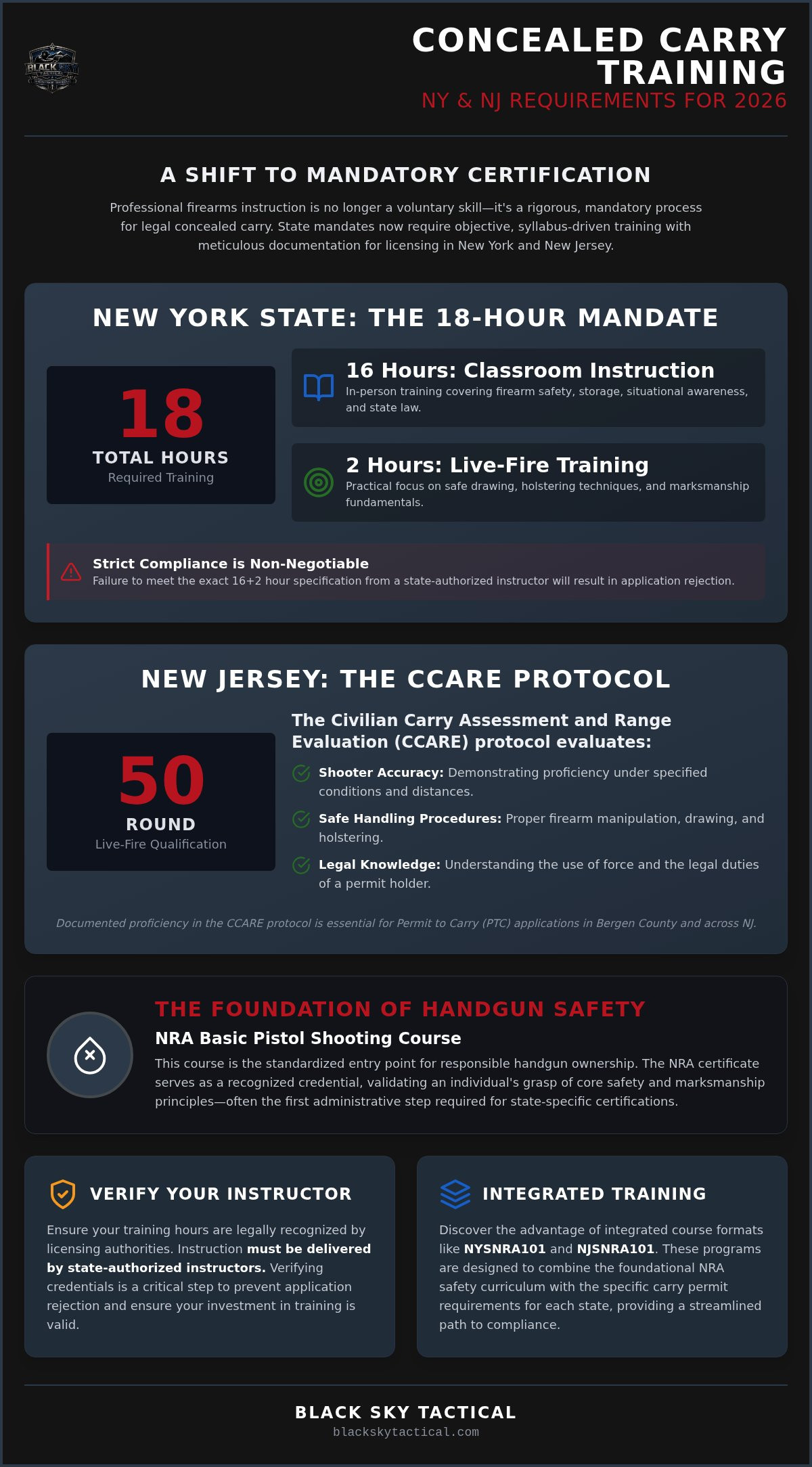
New York State law mandates a comprehensive 18-hour training course for all concealed carry license applicants. This requirement is strictly partitioned into 16 hours of in-person classroom instruction (covering firearm safety, storage, and situational awareness) and 2 hours of live-fire training (focusing on safe drawing and holstering techniques). To satisfy the standards in Rockland and Orange counties, this instruction must be delivered by state-authorized instructors, many of whom utilize NRA-certified materials to fulfill the safety portions of the mandate. If an applicant submits a certificate from a course that fails to meet the 16+2 hour specification, even by a small margin, the licensing officer will likely reject the application, necessitating a full restart of the training process. This makes verified Firearms Instruction the only viable path to licensure.
NJ PTC Training Standards for 2026
New Jersey residents seeking a Permit to Carry (PTC) must adhere to the Civilian Carry Assessment and Range Evaluation (CCARE) protocol. This protocol is a 50-round live-fire qualification course that evaluates a shooter's accuracy and safe handling procedures under specific conditions. In Bergen County, where local law enforcement conducts thorough reviews of all PTC applications, having a documented record of this proficiency is essential. The instruction doesn't solely focus on marksmanship; it includes mandatory briefings on the legal use of force and the specific duties of a permit holder. These documented standards provide a formal layer of protection for the individual, establishing a clear record of compliance with the state's rigorous safety expectations.
NRA Basic Pistol Shooting Course: The Foundation of Handgun Safety
The NRA basic pistol shooting course serves as the standardized entry point for responsible handgun ownership across the United States. While advanced tactical training focuses on dynamic environments, this foundational curriculum prioritizes the mechanical and ethical prerequisites of firearm operation. In the context of professional Firearms Instruction, the NRA certificate is a recognized credential that validates an individual's grasp of core safety and marksmanship principles. This validation is often the first administrative step required before an applicant can proceed to specialized state-mandated certifications in the NY/NJ region.
According to the New York State Police firearms information, applicants must demonstrate a thorough understanding of safety and law to successfully navigate the permit process. The NRA curriculum provides the instructional framework to meet these expectations, ensuring that the student is prepared for the higher-stakes requirements of a concealed carry permit. It bridges the gap between total unfamiliarity and the disciplined proficiency demanded by law enforcement agencies in Rockland and Bergen counties. By establishing these fundamentals early, students avoid the common pitfalls of self-taught habits that can lead to safety violations or qualification failure.
Essential Firearm Safety Protocols
Professional responsibility begins with the four universal rules of firearm safety: treating every firearm as if it's loaded, keeping the finger off the trigger until ready to fire, never pointing at anything you aren't willing to destroy, and being certain of your target and what's beyond it. These aren't suggestions; they're absolute mandates that form the backbone of high-quality Firearms Instruction. Modern handgun owners must also understand the legal and physical requirements for safe storage to prevent unauthorized access. This course instills a mindset of sobriety and meticulous attention to detail that must persist long after the classroom session concludes.
Marksmanship Fundamentals and Proficiency
The transition from theory to range application requires mastering the pillars of accurate shooting: grip, stance, and sight alignment. Without these fundamentals, any subsequent tactical training is ineffective and potentially hazardous. Students learn to maintain their equipment through proper cleaning and inspection, ensuring long-term reliability. By focusing on these basics, individuals build the muscle memory necessary to perform under the stress of a live-fire qualification. For those seeking to streamline their certification process, enrolling in a comprehensive safety and carry program ensures that these foundational skills are correctly aligned with current state mandates.
Comparing NY and NJ Concealed Carry Training Standards
Residents living near the state border, particularly those in Rockland and Bergen counties, must navigate two fundamentally different regulatory frameworks. While both states have increased their training requirements in response to federal judicial rulings, the structural implementation of their Firearms Instruction programs varies significantly. New York prioritizes a heavy classroom-based curriculum designed to ensure a deep understanding of sensitive locations and de-escalation techniques. Conversely, New Jersey places a greater emphasis on demonstrated range proficiency and the specific legal thresholds for the use of force within its jurisdiction.
It is a common misconception that a permit in one state grants reciprocity in the other. Currently, New York does not recognize New Jersey permits, and New Jersey does not recognize New York permits. This lack of reciprocity means that residents who frequently cross the border for work or personal reasons must complete the specific instructional mandates for both jurisdictions to remain in legal compliance. Professional instruction that addresses both sets of standards is the most efficient way to manage this administrative burden.
The NYS 18-Hour Combined Course Structure
New York's mandate is characterized by its temporal requirement, necessitating a total of 18 hours of instruction. This is strictly divided into 16 hours of in-person classroom education and a minimum of 2 hours of live-fire training. The classroom portion is exhaustive, covering topics such as conflict de-escalation, the legal principles of self-defense, and a detailed review of sensitive and restricted locations where carry is prohibited. For a deeper analysis of these specific modules, applicants should consult the NY 18 hour concealed carry course guide. Failure to document the full 18 hours with a state-authorized instructor will result in an administrative denial of the permit application.
NJ Shooting Qualification and Use of Force
New Jersey's Permit to Carry (PTC) standards are anchored in the Civilian Carry Assessment and Range Evaluation (CCARE) protocol. Unlike New York's time-based requirement, the NJSP mandates a rigorous 50-round shooting qualification that tests accuracy at specific distances. Applicants must demonstrate consistent proficiency to satisfy the safety standards required for public carry. Additionally, NJ Firearms Instruction must include a formal briefing on the legal use of force, emphasizing the duty to retreat and the specific conditions under which lethal force is permitted. Documentation of this qualification is valid for two years, after which the permit holder must re-qualify under the latest state standards. Following successful completion, applicants must manage the $200 permit fee and the administrative submission process through their local municipality or the NJSP portal.
Selecting a Firearms Instructor: Criteria for Legal and Tactical Excellence
Selecting an instructor for professional Firearms Instruction requires a rigorous vetting process that extends beyond simple marksmanship. In the current 2026 legal environment, an instructor acts as a certified witness to your proficiency and legal understanding. You must ensure they possess the specific authorizations required by the New York State Police and the New Jersey State Police. A formal syllabus isn't optional; it's a procedural necessity that ensures every mandatory topic, from use-of-force laws to safe storage, is covered according to state standards. For those just beginning their journey, private firearm instruction NY offers a controlled environment where technical errors can be corrected immediately without the distractions of a large group.
Range safety protocols and insurance coverage are equally critical benchmarks. A professional training facility must maintain a high standard of administrative discipline, including documented safety briefings and clear range commands. If an instructor cannot provide a structured lesson plan or proof of liability insurance, it suggests a lack of professional sobriety that could jeopardize the validity of your certification. Your choice of instructor directly impacts the integrity of your permit application.
Credential Verification and Compliance
Verification of credentials should be your first administrative step. You can verify an instructor's NRA status through the official NRA instructors portal and cross-reference their state-specific certifications with the list of authorized providers in Rockland or Bergen County. An instructor's depth of knowledge regarding current 2026 firearm statutes is a critical indicator of their professionalism. Avoid facilities that lack clear range safety protocols or fail to provide proof of comprehensive liability insurance. These omissions suggest a lack of administrative discipline that could jeopardize the validity of your certification. Red flags include a lack of written materials or a refusal to explain the specific legal basis for their curriculum.
Specialized Training for Families and Youth
Responsible handgun ownership involves every member of the household. Implementing youth firearm safety training is an essential component of a comprehensive home safety plan. This instruction focuses on the "stop, don't touch, leave the area, tell an adult" protocol for younger children, while progressing to mechanical safety and supervised handling for older adolescents. Parents must also establish strict home storage protocols, utilizing biometric or high-security safes that exceed the minimum legal requirements. Effective instruction adapts these technical concepts to the developmental level of the student, ensuring that safety becomes a disciplined habit rather than a set of abstract rules. To ensure your training meets all current jurisdictional mandates, you can view our certified course schedule and secure your instructional dates.
Black Sky Tactical: Integrated Training for NYS and NJS Compliance
Black Sky Tactical provides a structured, professional environment where the complexities of multi-state compliance are managed with administrative precision. For residents of Rockland, Orange, Westchester, and Bergen counties, the primary obstacle to obtaining a carry permit is often the logistical difficulty of coordinating mandatory training hours across different jurisdictions. By offering specialized Firearms Instruction that integrates national standards with local mandates, the institution ensures that students receive a comprehensive education that satisfies both tactical and legal requirements. This approach treats the permit process not as a series of disconnected hurdles, but as a linear path toward professional responsibility and legal certification.
The transition from a permit applicant to a proficient carrier requires a disciplined instructional framework. Every course is conducted with a focus on professional sobriety, ensuring that the gravity of carrying a firearm in the NY/NJ region is fully understood. The goal is to provide a streamlined experience that moves the student from initial enrollment to state-recognized certification without the administrative friction often found in fragmented training programs.
Combined CCW and NRA Basic Pistol Classes
The NYSNRA101 and NJSNRA101 programs represent the most efficient path to compliance for modern permit applicants. The NYSNRA101 course is specifically designed to satisfy the 18-hour New York State mandate by combining the 16+2 hour curriculum with the NRA Basic Pistol Class. This integration allows students to receive their state-required certificate alongside a nationally recognized NRA credential within a single, cohesive training schedule. Similarly, the NJSNRA101 format addresses the unique requirements of the New Jersey Permit to Carry, including the mandatory CCARE live-fire qualification protocol. These combined formats eliminate the need for redundant training sessions, providing a clear administrative record for busy professionals who require documented proficiency for their permit applications in Rockland or Bergen.
Tactical Response and Incident Management
The scope of professional instruction at Black Sky Tactical extends beyond the basic requirements for a carry permit. For those seeking a higher level of preparedness, the Violent Incident Command Training provides a rigorous framework for managing high-risk environments and incident management. This program is tailored for professionals and individuals who require a deeper understanding of situational awareness and proactive safety strategies. Additionally, Private Firearm Training is available for those who prefer a one-on-one instructional environment to develop specific tactical skills or address individual proficiency gaps. Each program is delivered with a commitment to professional standards, ensuring that every student is prepared not just to carry a firearm, but to handle the immense legal and ethical duties that accompany it.
Securing Your Certification Through Professional Compliance
Achieving a concealed carry permit in the current regulatory environment requires a methodical approach to state mandates and tactical proficiency. You've seen that professional Firearms Instruction is no longer an elective skill but a necessary administrative bridge for residents of Rockland and Bergen counties. By prioritizing a curriculum that integrates NRA fundamentals with specific New York and New Jersey statutes, you ensure your training hours are recognized by licensing bureaus and your defensive skills are grounded in legal reality.
The path to lawful carry is defined by meticulous attention to detail. It's a commitment to professional responsibility. Our NYS and NJS State-Certified Instructors provide the local expertise and comprehensive, state-mandated curriculum necessary to navigate these high-stakes requirements with confidence. Whether you're seeking to fulfill the 18-hour New York requirement or the New Jersey live-fire qualification, our integrated course formats provide the most efficient route to compliance. Take the definitive step toward responsible firearm ownership and administrative readiness today.
Enroll in the NYSNRA101 Combined 18-Hour CCW Course Today and secure your instructional dates with a trusted institutional partner.
Frequently Asked Questions
How long does the NYS 18-hour concealed carry course take to complete?
The NYS 18-hour course takes exactly 18 hours to complete because it's a rigid statutory requirement. This is partitioned into 16 hours of classroom education and 2 hours of live-fire range training. Most professional instructors schedule these hours over consecutive days or multiple sessions to ensure the student absorbs the dense legal and safety curriculum. It's a non-negotiable temporal mandate that must be fully documented for any resident in Rockland or Orange county seeking a concealed carry license.
Does New York recognize a New Jersey carry permit or vice versa?
No, New York doesn't recognize a New Jersey carry permit and New Jersey doesn't recognize a New York permit. Each state maintains its own autonomous licensing authority and specific training mandates. If you reside in Bergen County but frequently travel to Rockland, you'll need to obtain both the NJ Permit to Carry and the NYS Concealed Carry License. This requires completing the distinct Firearms Instruction requirements for both jurisdictions to ensure you're in full legal compliance.
What is included in the NYS 2-hour live fire qualification?
The NYS 2-hour live-fire component is a mandatory assessment that includes safe firearm handling, drawing from a holster, and a specific shooting proficiency evaluation. You'll be required to demonstrate accuracy and safe mechanical operation under the direct supervision of a certified instructor. This isn't a recreational practice session; it's a formal evaluation designed to ensure you can safely deploy a firearm in a defensive context. Successful completion is a prerequisite for your final certificate of compliance.
Can I take the NRA Basic Pistol course if I don't own a firearm yet?
Yes, you can enroll in the NRA Basic Pistol course even if you don't yet own a firearm. Many Firearms Instruction providers offer a selection of handguns for student use during the range portion of the curriculum. This is often the most responsible way to begin. It allows you to learn fundamental safety and marksmanship before making a financial commitment. You'll gain a technical understanding of different mechanical platforms in a controlled, professional environment.
What are the age requirements for youth firearm safety training in NY?
Youth safety training is available for minors, focusing on age-appropriate safety protocols. The curriculum generally follows these guidelines:
- For younger children, the emphasis is on the "stop, don't touch, leave the area" protocol.
- For older adolescents, instruction includes mechanical safety and supervised handling.
It's best to consult with a professional instructor to determine which course level is appropriate for your child's age and developmental readiness for responsible safety education.
How often do I need to renew my firearms instruction for a CCW permit?
In New Jersey, you must renew your firearms instruction and re-qualify under the CCARE standards every two years to maintain your Permit to Carry. New York's recertification timelines are subject to specific county regulations and evolving state statutes. It's critical to monitor the expiration of your training certificates alongside your permit. Staying connected with a professional training institution helps you navigate these periodic administrative requirements and ensures your documentation remains current and legally valid.
What documents will I receive after completing the NYSNRA101 course?
Upon successful completion of the NYSNRA101 course, you'll receive two essential administrative documents:
- The official New York State 18-hour training certificate required for your concealed carry application.
- The NRA Basic Pistol Shooting certificate, which is a nationally recognized credential for foundational safety.
These records are necessary for your submission to local licensing bureaus in Rockland or Westchester and serve as formal proof of your professional certification and compliance.
Is private firearm instruction better than a group class for beginners?
Private instruction is often superior for beginners because it provides a dedicated environment for correcting technical errors. The instructor can focus entirely on your specific grip, stance, and sight alignment without the logistical constraints of a larger group. While group classes follow a structured syllabus, a one-on-one session allows for immediate feedback and a pace tailored to your learning curve. It's an efficient way to achieve tactical proficiency before moving into the more rigorous state-mandated certification courses.


