
True safety is not a passive state of being; it is a disciplined, regulated proficiency that requires strict adherence to state mandates and rigorous professional standards. You likely feel a profound sense of responsibility regarding the protection of your household, yet the complexity of New York and New Jersey legal requirements often leads to significant uncertainty. The anxiety of managing shifting administrative procedures, such as the updated 2026 mandates for school water safety information and child abuse reporting curriculum, can make the path to comprehensive Safety Education feel inaccessible.
This article provides the clarity necessary to transition from concern to competence by outlining the foundational principles of professional training. You will gain a thorough understanding of the mandatory requirements needed to protect your family and community while ensuring full legal compliance. We will examine the specific structure of the Combined NYS 18-Hour Conceal Carry + NRA Basic Pistol Class, detail the jurisdictional nuances of the permit application process, and preview the essential certifications required for modern situational awareness.
Key Takeaways
- Understand how comprehensive Safety Education transitions from basic home awareness to specialized proficiency in high-stakes environments.
- Learn the essential pillars of situational awareness and legal literacy required to navigate complex state mandates and use-of-force boundaries.
- Identify the specific procedural requirements for the Combined NYS 18-Hour Conceal Carry + NRA Basic Pistol Class to ensure jurisdictional compliance.
- Explore specialized training options, such as Youth Safety and Violent Incident Command, to establish a holistic safety framework for your family.
- Discover how integrating NRA Basic Pistol fundamentals into your certification process provides a reliable foundation for professional responsibility.
Defining Safety Education in a High-Stakes Environment
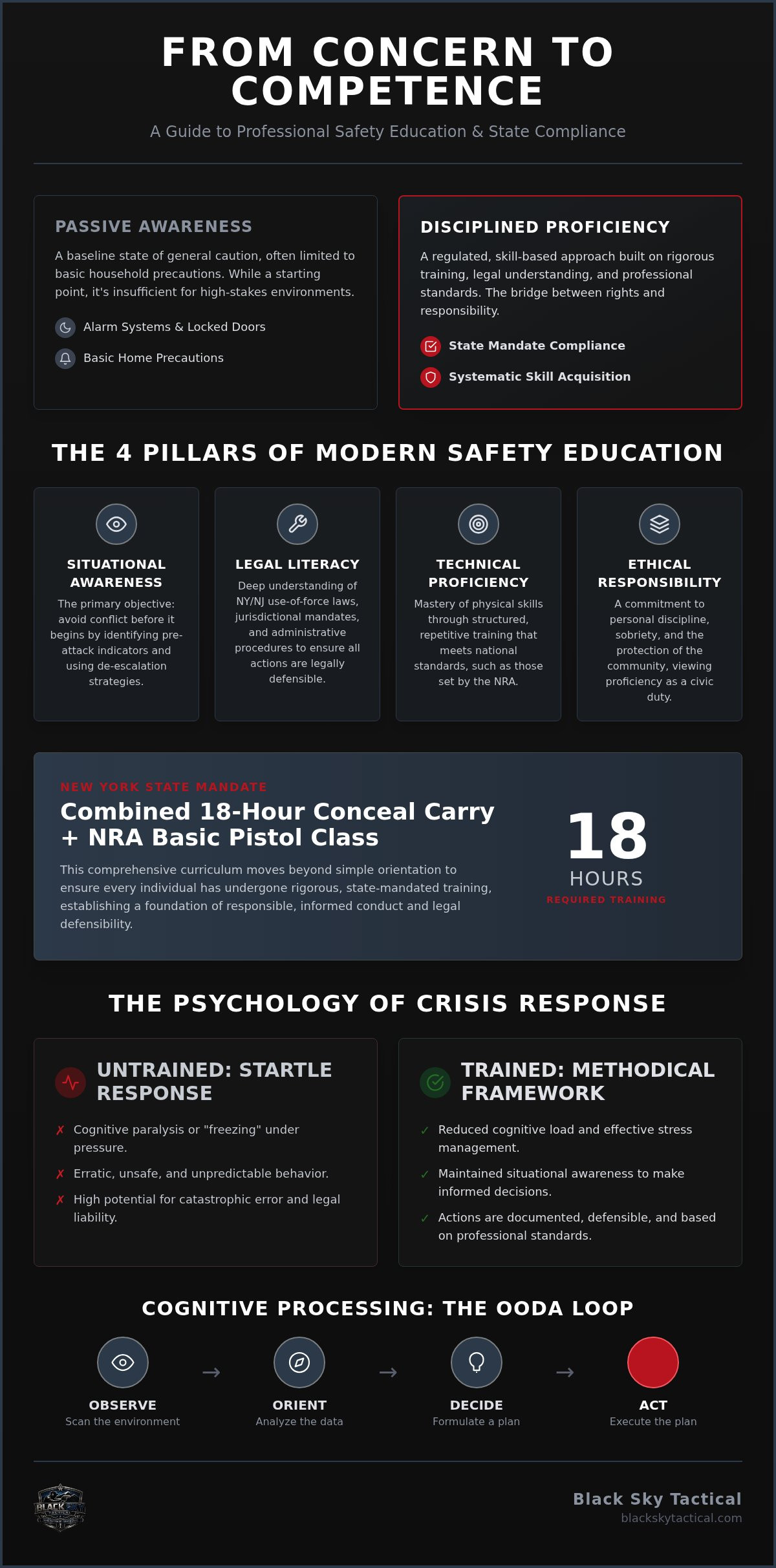
Defining Safety within a professional and legal context involves the systematic acquisition of knowledge and specific physical skills designed to mitigate environmental risks and prevent accidental or intentional harm. While many residents of Orange County initially associate safety with basic household precautions, such as installing alarm systems or locking doors, true proficiency requires a transition from passive awareness to specialized technical training. In 2026, formal safety education stands as a fundamental pillar of civil responsibility, serving as the necessary bridge between individual rights and the collective obligation to maintain public order through disciplined proficiency. This evolution prioritizes administrative compliance, ensuring that every participant understands the rigorous legal frameworks and jurisdictional mandates governing their actions.
The Evolution of Safety Training Standards
Passive awareness is a prerequisite for safety, but it's entirely insufficient in high-stakes tactical environments where hesitation or technical error can lead to catastrophic outcomes. New York State has addressed this reality by moving beyond simple orientations toward comprehensive mandates, specifically the requirements found in the Combined NYS 18-Hour Conceal Carry + NRA Basic Pistol Class. This transition ensures that individuals don't merely possess a conceptual understanding of safety but have instead undergone a rigorous 18-hour curriculum. By integrating NRA standards into these modern state-mandated curricula, the training achieves a level of national consistency that reinforces local jurisdictional authority and professional accountability.
The Psychology of Risk Mitigation
Formal Safety Education fundamentally alters how the human brain processes a crisis. When an individual lacks structured training, they often succumb to a "startle response" that can result in cognitive paralysis or erratic, unsafe behavior. Professional instruction provides a methodical framework that reduces this cognitive load, allowing the participant to manage physiological stress while maintaining high levels of situational awareness. Beyond the immediate physical response, there's a critical link between documented training and legal defensibility. Proving that an individual has completed a state-mandated course demonstrates a proactive commitment to professional standards. This documentation is vital if an individual's actions are ever scrutinized within the judicial system, as it establishes a foundation of responsible, informed conduct rather than negligence.
The Core Pillars of Modern Safety Education
Modern Safety Education rests upon four distinct yet interconnected pillars that ensure an individual is prepared for the legal, psychological, and physical demands of personal protection. These foundational elements include situational awareness, legal literacy, technical proficiency, and ethical responsibility. Each component is essential to a comprehensive safety strategy; for instance, achieving high technical skill without a thorough understanding of the legal boundaries regarding the use-of-force creates significant personal and civil liability. To meet the rigorous standards of State-Mandated Safety Education, one must view these elements as a cohesive system rather than a collection of isolated skills.
The ethical responsibility inherent in carrying a concealed weapon requires a high degree of sobriety and personal discipline. Legal literacy involves more than just a passing familiarity with local statutes. It requires a deep, functional understanding of the administrative procedures and jurisdictional mandates that govern New York and New Jersey. This proficiency ensures that if a defensive action is ever necessary, it remains within the strict confines of the law, protecting both the individual and the community from the consequences of uninformed decisions.
Situational Awareness and Conflict De-escalation
The primary objective of any professional safety strategy is the avoidance of conflict before it begins. This is achieved through the OODA Loop (Observe, Orient, Decide, Act), which is a cognitive process that allows individuals to process environmental data and react before a threat escalates. Residents in Westchester and Rockland County environments should learn to identify "pre-attack indicators," such as target glancing, unnatural posturing, or grooming gestures, which often precede physical altercations. By recognizing these cues early, you can implement non-violent resolution strategies or exit the area entirely, effectively neutralizing the risk without engaging in a high-stakes encounter.
Firearm Safety Fundamentals
Technical proficiency begins with the four universal rules of firearm safety: treating every firearm as if it's loaded, never pointing the muzzle at anything you don't intend to destroy, keeping your finger off the trigger until you're ready to fire, and being certain of your target and what's beyond it. Beyond these rules, responsible owners must implement safe storage protocols for families to prevent unauthorized access and ensure a secure home environment. Regular maintenance of these skills isn't optional. Perishable skills degrade quickly without practice, making consistent training a requirement for those who take their duty of protection seriously. If you're ready to formalize this commitment, enrolling in a professional course through Black Sky Tactical provides the structured environment and expert guidance necessary for true mastery.
Navigating State-Mandated Safety Education in NY and NJ
Navigating the regulatory environment of the Tri-State area requires a precise understanding of jurisdictional authority and the administrative mandates governing firearm carry permits. For residents in Orange and Rockland counties, Safety Education is no longer a voluntary pursuit but a formal requirement defined by the Concealed Carry Improvement Act. This legislation established the 18-hour training standard as a prerequisite for licensure. Similarly, residents in Bergen County must adhere to the stringent New Jersey Permit to Carry (PTC) protocols. These frameworks ensure that applicants possess not only technical skill but also a documented comprehension of the legal obligations inherent in public carry.
The 2026 standards for licensure emphasize a dual-track approach that combines classroom theory with practical application. Applicants must successfully navigate administrative background checks and mental health records reviews before their training certifications are even considered. By completing the Combined NYS 18-Hour Conceal Carry + NRA Basic Pistol Class, residents ensure they meet the gold standard for compliance while gaining the foundational knowledge required to operate safely within their respective communities.
The NYS 16+2 Hour CCW Course Syllabus
The New York curriculum is divided into 16 hours of classroom instruction and a mandatory 2-hour live-fire component. During the classroom sessions, participants analyze use-of-force statutes, conflict de-escalation, and safe storage requirements. The 2-hour live-fire qualification requires the student to demonstrate safe handling and marksmanship proficiency under the supervision of a certified instructor. By utilizing the Combined NYS 18-Hour Conceal Carry + NRA Basic Pistol Class, students also receive the NRA Basic Pistol certificate, which provides a nationally recognized credential alongside state-specific compliance.
NJ PTC Training and Qualification Standards
As of 2026, New Jersey maintains rigorous training and qualification standards that differ significantly from New York's requirements, particularly regarding the frequency of qualification and the specific background check procedures. Bergen County residents seeking a permit must complete a course that includes classroom instruction on the lawful use of force and a specific shooting performance test. For those managing compliance across state lines, it's vital to review NJ concealed carry permit training to understand how these standards interact with NY reciprocity. While both states prioritize Safety Education, the administrative pathways remain distinct and require meticulous attention to detail during the application process.
Specialized Safety Education for Families and Professionals
Specialized Safety Education extends beyond foundational licensing to address the specific vulnerabilities of families and the complex operational requirements of professional institutions. While the 18-hour state-mandated curriculum provides a necessary baseline for legal compliance, true resilience requires a multi-layered approach that includes specialized instruction for diverse demographics and high-stress environments. This comprehensive framework incorporates technical skill building with emergency management protocols to ensure a holistic defense posture for residents in Orange and Rockland counties. By moving beyond general awareness, individuals and organizations can establish a disciplined environment that prioritizes procedural accuracy and risk mitigation.
Youth Firearm Safety and Home Defense
Instilling responsibility in children and young adults is a critical component of a secure household. The Youth Safety Course focuses on age-appropriate education that prioritizes respect for firearms and the absolute necessity of safe storage. It's essential to establish clear protocols for unauthorized access prevention, ensuring that every family member, including non-owners, understands the administrative and physical barriers in place. This proactive communication reduces curiosity-driven risks and establishes a disciplined environment where safety is a shared responsibility rather than a source of anxiety. Training young adults in these principles ensures that the next generation approaches firearm safety with the sobriety and caution required for responsible citizenship.
Professional Violent Incident Command Training
For businesses and institutions, Safety Education must scale to meet the demands of active threat scenarios through Violent Incident Command Training. This specialized instruction prepares professionals to manage tactical responses during an emergency, focusing on situational awareness and the coordination of personnel. Effective incident command requires a deep understanding of how to interface with local law enforcement during a crisis, ensuring that the transition from internal management to official intervention is seamless and structured. This level of training minimizes chaos and provides a methodical syllabus for protecting employees and assets in a corporate or institutional setting. It's a vital investment for organizations that operate in high-traffic or sensitive environments where the stakes of an incident are exceptionally high.
A complete safety profile also requires proficiency in emergency medical basics, such as "Stop the Bleed" protocols, which address the immediate medical aftermath of a violent encounter. For those with unique requirements or schedules, Private Firearm Training offers a personalized setting to refine specific skills under expert supervision. If you're ready to expand your protection strategy beyond the basics, you can register for specialized safety training to secure your home or business today.
Achieving Certification and Proficiency with Black Sky Tactical
Achieving a professional standard of Safety Education requires a methodical approach to certification that aligns with specific jurisdictional needs. Residents in the Tri-State area must first determine whether the NYSNRA101 or the NJSNRA101 is the appropriate path for their residency and carry objectives. These courses facilitate compliance by integrating NRA Basic Pistol Shooting Course fundamentals into the state-mandated curriculum. This ensures that every student receives a nationally recognized foundation in handgun safety while satisfying the rigorous 18-hour requirement established by current legislation. In Rockland and Orange Counties, this certification serves as the primary evidentiary document required for the formal permit application process.
Preparing for the Combined NYS 18-Hour Conceal Carry + NRA Basic Pistol Class involves both logistical and mental readiness. Students should arrive with valid government identification and the necessary materials for extensive note-taking on legal statutes and administrative procedures. The path from the classroom to the permit office is a structured one; the proficiency demonstrated during the course provides the legal basis for your application. It's a sober process that reflects the high-stakes nature of carrying a concealed weapon in public spaces.
The Black Sky Tactical Difference
The instructors at Black Sky Tactical possess a unique combination of specialized tactical experience and deep administrative knowledge, which is essential for guiding students through complex legal frameworks. By maintaining small class sizes, the institution facilitates personalized private firearm training that focuses on individual skill gaps rather than generic instruction. This commitment to student proficiency ensures that every graduate isn't just certified but is also capable of meeting the high standards of professional responsibility required in today's environment. The focus remains strictly on legal compliance and the practical application of safety principles.
Next Steps: Enrollment and Preparation
Registering for either the NYSNRA101 or NJSNRA101 is a straightforward procedural step that initiates your path toward legal compliance. Preparing for the 18-hour training involves more than just logistical planning; it requires a mental readiness to absorb high-stakes information regarding the use of force and situational awareness. Beyond the initial certification, ongoing education and NRA membership benefits provide a structured way to maintain proficiency and stay informed about legislative changes. This methodical progression ensures that your safety strategy remains current and effective over the long term, reinforcing the discipline required for responsible firearm ownership.
Securing Your Family's Future through Professional Certification
Establishing a comprehensive protection strategy requires more than just good intentions; it demands a commitment to formal instruction and rigorous administrative compliance. By understanding the core pillars of situational awareness and technical proficiency, you transition from a state of general concern to one of disciplined readiness. This guide has detailed the specific pathways for meeting official state requirements, ensuring that residents of Rockland, Orange, Westchester, and Bergen Counties can navigate the permit process with clarity and confidence.
Investing in professional Safety Education isn't merely a legal obligation but a profound responsibility to your household and community. Our certified NRA instructors provide the expert guidance necessary to master the official NYS/NJS compliant 18-hour curriculum, bridging the gap between complex state mandates and practical, life-saving skills. You can secure your standing as a responsible, informed citizen through methodical training and verified proficiency.
Take the definitive step toward securing your rights and your family's safety by enrolling in our official curriculum. Enroll in the Combined NYS 18-Hour Conceal Carry + NRA Basic Pistol Class today to begin your journey toward mastery and compliance. You have the capacity to build a safer future through disciplined education and professional guidance.
Frequently Asked Questions
What is included in the NYS 18-hour safety education course?
It consists of 16 hours of classroom instruction and 2 hours of live-fire training. Key topics include firearm safety, safe storage, situational awareness, conflict de-escalation, and the lawful use of force. Our Combined NYS 18-Hour Conceal Carry + NRA Basic Pistol Class specifically integrates these state mandates with NRA standards. This comprehensive curriculum ensures that applicants meet all administrative requirements for a New York concealed carry permit while establishing a high standard of technical proficiency.
Is the NRA Basic Pistol course mandatory for a NY pistol permit?
While the NRA Basic Pistol course is not explicitly named as a standalone requirement in the state statute, its fundamentals are essential for achieving the level of proficiency required by the Concealed Carry Improvement Act. We integrate the NRA curriculum into our flagship courses because it provides a nationally recognized standard of technical skill. This integration ensures that students receive a foundation in handgun safety that exceeds basic administrative compliance while satisfying the 18-hour state mandate.
How often do I need to renew my safety education certification in NY?
In New York State, concealed carry permit holders must generally complete recertification training every three years to maintain their licensure. Specific deadlines can vary by jurisdiction, so residents in Rockland County should verify current 2026 renewal training deadlines with their local licensing authority. Maintaining an active record of Safety Education is a critical component of ongoing legal compliance and ensures that your proficiency remains consistent with updated state standards and jurisdictional statutes.
Can I take a NJ concealed carry course if I live in Rockland County?
Yes, residents of Rockland County who wish to carry in New Jersey must complete a course that satisfies the New Jersey Permit to Carry (PTC) standards. Our NJSNRA101 course is designed specifically for this purpose, providing the necessary training and qualification for those seeking non-resident permits. It's important to recognize that New York and New Jersey have distinct administrative procedures, and possessing a permit in one state doesn't grant automatic reciprocity in the other.
What is Violent Incident Command training and who is it for?
Violent Incident Command training is a specialized emergency management program designed for business owners, school administrators, and institutional leaders. It focuses on the tactical management of active threat scenarios and the coordination of personnel during a crisis. This instruction provides a methodical syllabus for identifying situational risks and interfacing effectively with local law enforcement. It's an essential resource for professionals responsible for the safety of employees and the public in high-traffic or sensitive environments.
Does the youth safety course involve live-fire training?
The Youth Safety Course is primarily designed as a non-shooting program that focuses on the foundational principles of responsibility, respect, and safe storage. The curriculum emphasizes unauthorized access prevention and teaches children how to behave safely if they encounter a firearm. While technical skill building is important for older demographics, the priority for this demographic is instilling a disciplined mindset and a thorough understanding of the administrative and physical barriers required in a secure household.
How do I prepare for the live-fire qualification part of the CCW course?
Preparation for the live-fire component involves ensuring you have the appropriate equipment and a solid grasp of the four universal safety rules. During the Combined NYS 18-Hour Conceal Carry + NRA Basic Pistol Class, instructors provide the technical guidance necessary to meet the marksmanship standards. You should arrive mentally prepared to follow strict range commands and demonstrate safe handling procedures. Consistent practice of the fundamentals of Safety Education is the most effective way to ensure success.
What are the safety education requirements for Bergen County residents?
Residents of Bergen County must complete a state-approved training course that includes classroom instruction on the lawful use of force and a specific shooting performance qualification. These standards are outlined in the New Jersey PTC requirements, which are updated periodically to reflect new legislative mandates. Completing the NJSNRA101 course ensures that applicants meet these rigorous technical and administrative standards, providing a clear pathway toward obtaining a New Jersey permit while maintaining strict legal compliance.


