
In the current regulatory environment of New York and New Jersey, the possession of a firearm is not merely a right, but a continuous obligation to maintain legal and technical proficiency. You probably feel the weight of the recent shifts in the NYS CCIA and NJ PTC requirements, which have made the path to compliance feel like a moving target for many residents in Rockland and Orange counties. Achieving true Responsible Ownership requires more than just basic familiarity with a handgun; it demands a meticulous understanding of shifting state statutes and a commitment to rigorous, certified training.
This article provides the clarity you need to manage these complex mandates with confidence. We'll outline the specific 18-hour training requirements for New York concealed carry applicants and the current certification processes in New Jersey, ensuring you meet every administrative hurdle. By following this roadmap, you'll gain a thorough understanding of safe storage practices for the home, the technical skills verified through NRA-standard instruction, and the specific defensive mindset required to carry a firearm legally and ethically in the tri-state area.
Key Takeaways
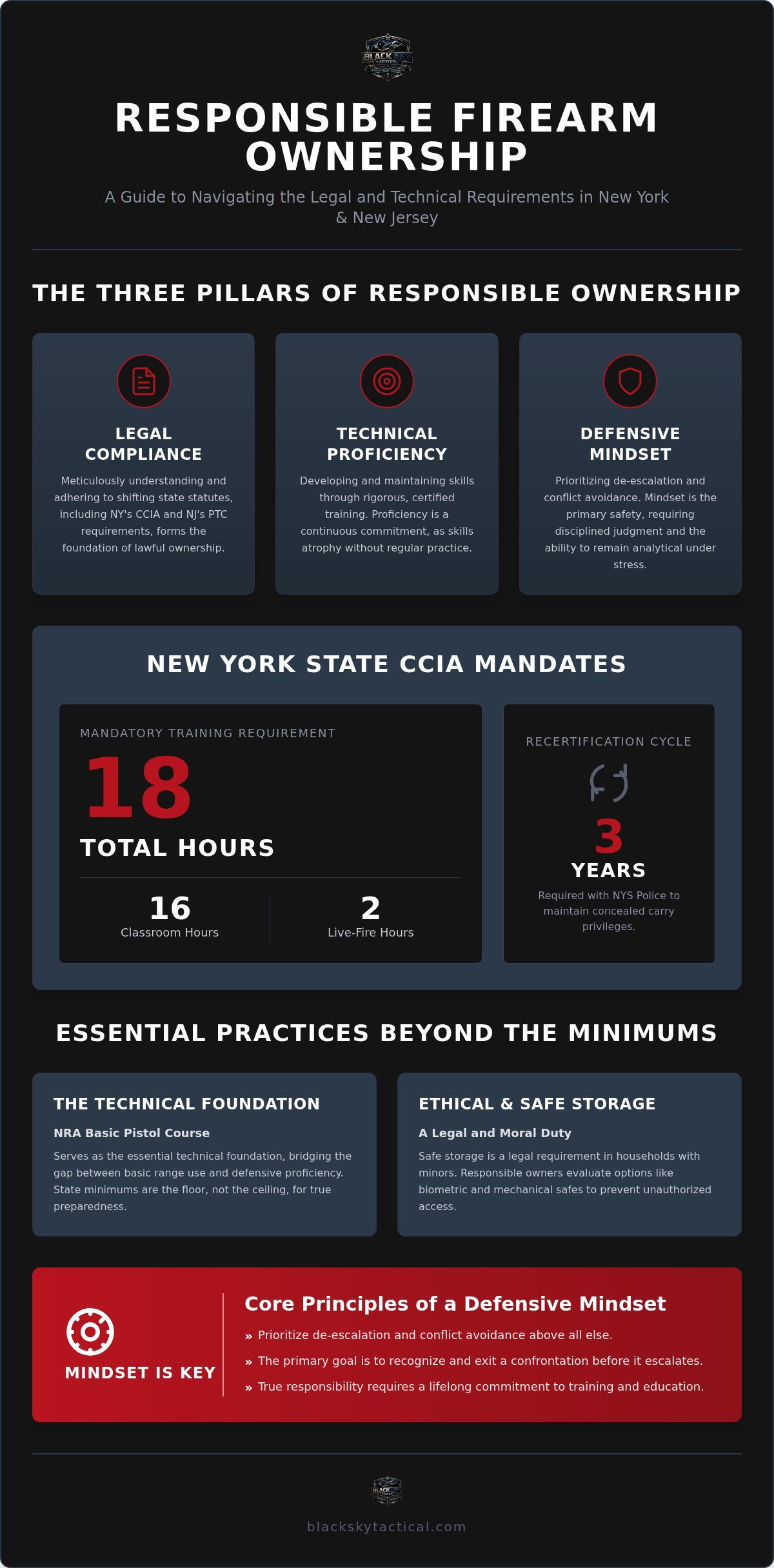
- Understand the specific mandates of the NYS Concealed Carry Improvement Act, including the mandatory 18-hour training requirement and the three-year recertification cycle.
- Learn why the NRA Basic Pistol course serves as the essential technical foundation for all owners, bridging the gap between basic range use and defensive proficiency.
- Identify the legal requirements for safe storage in households with minors and evaluate the functional differences between biometric and mechanical rapid-access safes.
- Master the three pillars of Responsible Ownership by integrating strict legal adherence with technical skill and a disciplined defensive mindset.
- Discover how professional certification courses like the NYSNRA101 provide a streamlined path to fulfilling both state mandates and personal safety goals.
Defining Responsible Ownership in the Modern Firearm Landscape
In New York and New Jersey, possessing a firearm carries a gravity that extends beyond mere property rights. True Responsible Ownership is defined as the precise intersection of administrative legal compliance, technical proficiency, and disciplined ethical judgment. It isn't a static achievement or a single box to check. Instead, it's a continuous obligation to the community. This involves understanding the "Duty to Inform," where an owner recognizes that their conduct reflects upon the broader firearm community and directly impacts public safety. Every owner acts as a representative of the approximately 30% of Americans who choose to exercise this right, making personal conduct a matter of communal importance.
The sober reality of lethal force dictates that mindset is the primary safety mechanism. While mechanical safeties and holsters are vital, the most critical component is the owner's ability to remain calm and analytical. Adhering to the fundamental principles of gun safety provides a necessary foundation, but true responsibility requires a lifelong commitment to training. Skills atrophy over time. A certification earned years ago doesn't guarantee proficiency today, making regular practice and updated legal knowledge essential for any resident in Rockland or Orange County.
The Ethical Weight of Firearm Possession
Firearm ownership requires a fundamental psychological transition. You're no longer a passive observer of your surroundings; you're a prepared individual who must prioritize de-escalation and conflict avoidance above all else. A defensive mindset means you actively seek to exit a confrontation before lethal force becomes a consideration. It's about the discipline to walk away. Professional instruction from experts who understand local tri-state dynamics is the only reliable path to ensuring your reactions remain precise and legally sound under extreme stress.
Legal vs. Practical Responsibility
There's a stark difference between being "legal to own" and being "proficient to use." While New York and New Jersey laws set specific minimums for certification, these standards are often the floor, not the ceiling. For example, an applicant may satisfy the 18-hour NYS mandate but still lack the muscle memory required to clear a firearm malfunction during a crisis. Exceeding state minimums isn't just about compliance; it's about personal and family safety. Responsible ownership is a commitment to safety, legality, and ongoing education that ensures an owner is prepared for the practical realities of firearm possession.
The Pillar of Legal Compliance: Navigating NY and NJ Mandates
The foundation of Responsible Ownership in the tri-state area is a thorough understanding of jurisdictional boundaries and the specific statutes that govern them. Residents in Rockland and Orange counties must comply with the New York State Concealed Carry Improvement Act (CCIA), which established a rigorous framework for licensure in 2022. This legislation shifted the requirements from a "proper cause" standard to a mandate centered on objective training and character assessments. Staying current with New York's gun laws is a continuous obligation, especially as recertification for concealed carry licenses is now required every three years with the New York State Police. Failure to adhere to these renewal cycles can result in the immediate suspension of carry privileges.
A central component of this compliance is the 18-hour training mandate. This standard requires 16 hours of classroom instruction coupled with 2 hours of live-fire range training. This isn't merely a procedural hurdle; it's a comprehensive evaluation designed to ensure that every permit holder possesses the legal knowledge and technical skill necessary to carry a firearm in public spaces. Understanding the nuances of these laws ensures that you remain within the bounds of the law while exercising your rights.
New York State 18-Hour CCW Requirements
The NY 18 hour concealed carry course syllabus is designed to cover essential topics, including conflict de-escalation, the lawful use of deadly force, and safe storage practices. For residents in Rockland and Westchester, the live-fire qualification is a critical practical assessment. It verifies that an applicant can safely handle, load, and discharge their firearm under the supervision of a certified instructor. Maintaining compliance also involves monitoring updated background check procedures, which now include a review of social media accounts and character references as part of the application process.
New Jersey PTC and Firearms Purchaser ID Standards
Bergen County residents seeking a Permit to Carry (PTC) must meet the standards set by the CCAARE (Civilian Carry Assessment and Range Evaluation) protocol. This involves a specific qualification course that tests accuracy and safe handling at various distances. Completing NJ concealed carry permit training is the primary method for fulfilling these requirements. Many applicants utilize the NRA Basic Pistol certificate as a foundational credential to prepare for this more advanced qualification. Additionally, owners must strictly observe "Sensitive Locations" laws, which prohibit carrying in schools, parks, and government buildings, as these restrictions are strictly enforced under NJ statutes.
It's vital to recognize that there is no reciprocity between New York and New Jersey. A permit issued in Rockland County isn't recognized in Bergen County, and a NJ PTC doesn't grant carry rights in New York. To ensure you meet the exact standards for your specific jurisdiction, you can enroll in a structured program with Black Sky Tactical, where instructors provide the specific certifications required for both states.
Safety and Proficiency: Beyond the Basic Certificate
While administrative compliance is the primary legal gateway, technical skill is the literal mechanism that ensures safety during a critical incident. The NRA basic pistol shooting course serves as the industry-standard foundation, providing the mechanical knowledge necessary to operate a firearm safely. However, Responsible Ownership requires recognizing the vast difference between static range shooting and defensive proficiency. Punching holes in paper under ideal conditions doesn't replicate the physiological stress or the rapid decision-making required during a violent encounter. Many new owners in the tri-state area benefit from private firearm training for beginners NY to ensure they don't develop dangerous habits that could compromise their safety or legal standing under New York Firearm Laws. True proficiency is an active state of readiness, not a static certificate on a wall.
The Four Universal Rules of Firearm Safety
Safety isn't a suggestion; it's a series of non-negotiable protocols that must be followed without exception. These rules must be internalized until they're instinctive, regardless of the environment or the type of firearm being handled. Adherence to these standards prevents negligent discharges and ensures that the owner remains in full control of the tool at all times:
- Treat every firearm as if it's loaded at all times, regardless of what you believe the status to be.
- Maintain strict muzzle discipline by never pointing a firearm at anything you aren't willing to destroy.
- Keep your finger off the trigger and outside the trigger guard until your sights are on the target and you've made the conscious decision to shoot.
- Be certain of your target and what lies beyond it, as you're legally and ethically responsible for every projectile that leaves your barrel.
Building Technical Proficiency
Mastery of stance, grip, and sight alignment provides the mechanical consistency needed for accuracy. It's not enough to simply understand these concepts intellectually. You must develop deep muscle memory through repetitive, high-quality practice. Dry fire training at home is an excellent way to build this memory without the distractions of a loud range environment, allowing you to focus on the precision of your trigger press. For those seeking to advance beyond the basics, working with a private firearms instructor NY allows for personalized diagnostic feedback that group classes cannot provide. This level of instruction helps owners prepare for the "worst day" by integrating situational awareness and tactical response into their skillset. It ensures you can act decisively while remaining within the strictures of the law, protecting both your life and your legal future.
Ethical Storage and Community Responsibility
The practice of Responsible Ownership extends far beyond the range or the carry holster; it encompasses the secure management of the firearm at all times, particularly when it's not under your immediate control. While New York and New Jersey statutes provide a legal baseline for storage, the ethical obligation of the owner is to ensure that no unauthorized person can gain access to the weapon. In New York, the law mandates that firearms be secured with a locking device if a person under the age of 16 resides in the home. New Jersey maintains similarly strict standards. These regulations are designed to prevent tragic accidents and unauthorized use, but a disciplined owner views these laws as a minimum starting point for home security.
Selecting the appropriate storage solution requires balancing security with accessibility. Biometric safes offer the advantage of rapid access through fingerprint recognition, though they require consistent battery maintenance to remain functional. Mechanical safes, such as those utilizing Simplex locks, provide a battery-free alternative that remains highly reliable over time. For many residents, a rapid-access electronic safe provides a middle ground. Regardless of the locking mechanism, preventing theft is paramount. This responsibility includes the vehicle. Firearms should never be left in an unattended car unless they're secured in a locked, bolted-down vehicle safe, as glove compartments and center consoles aren't sufficient deterrents for motivated criminals.
Family and Youth Safety Protocols
Effective safety planning involves the entire household. It's essential to talk to children about firearms in a way that removes curiosity without creating fear. Utilizing the "Stop, Don’t Touch, Leave the Area, Tell an Adult" curriculum provides children with a clear, actionable plan if they encounter an unsecured firearm. As children age, the conversation must evolve to include the specific firearm laws for young adults NY, ensuring they understand the legal consequences of possession and use. Implementing a "layered" security approach, where the firearm is locked and the ammunition is stored separately, adds an extra margin of safety for the family.
Social Responsibility and Public Carry
When carrying in public, the ethical standard is "concealed means concealed." Responsible Ownership means ensuring your firearm isn't visible to others, which prevents unnecessary public alarm and maintains your tactical advantage. Interacting with law enforcement while carrying requires a calm and professional demeanor. You should keep your hands visible and follow all officer instructions without sudden movements. In certain jurisdictions, you're legally required to immediately disclose the presence of a firearm when stopped by law enforcement. Maintaining this level of transparency and discipline protects both the owner and the officer. To build a comprehensive safety plan for your home and family, consider enrolling in professional safety training that addresses these ethical and practical nuances.
Professional Certification with Black Sky Tactical
Black Sky Tactical serves as a disciplined bridge between the complex administrative mandates of the tri-state area and the technical proficiency required for safe firearm handling. While the legal landscape in New York and New Jersey continues to shift, the necessity for high-standard instruction remains a constant. Our curriculum is designed to ensure that residents don't just meet the minimum legal criteria for licensure but actually possess the skills required to manage a firearm under pressure. By prioritizing clarity and professional responsibility, we help students navigate the procedural heavy nature of state applications while building a foundation of technical skill that exceeds basic requirements.
The core of our offering for Rockland and Orange residents is the NYSNRA101. This is a combined 18-hour course that fulfills the New York State mandate while integrating the NRA Basic Pistol syllabus. This dual-certification approach ensures that every student receives a comprehensive education covering both the legal use of force and the mechanical fundamentals of pistol shooting. Our instructors are retired law enforcement officers and certified NRA trainers who bring a sober, reality-based perspective to the classroom. This expert guidance is critical when preparing for the NYS live-fire qualification, as it provides students with the confidence to demonstrate safe handling and accuracy during the official assessment.
Our Combined Training Approach
We integrate the NRA Basic Pistol course into the mandatory NYS 18-hour syllabus because we believe that technical mastery is inseparable from legal compliance. Many state-mandated courses focus heavily on the law but leave little time for the development of shooting fundamentals. Our approach corrects this imbalance. By maintaining small class sizes, we provide personalized feedback that allows students to correct mechanical errors in real time. This instructional rhythm ensures that you leave the range not just with a certificate, but with a defensive mindset and the muscle memory needed for true Responsible Ownership. We don't view training as a one-time event; we view it as the beginning of a professional commitment to safety.
Enrollment and Next Steps for Tri-State Residents
Registering for an upcoming session is the first step toward achieving full compliance with NY and NJ statutes. We offer regular training dates tailored to the needs of residents in Rockland, Orange, and Bergen counties, including the NJSNRA101 for those seeking a New Jersey Permit to Carry. When you prepare for your 18-hour session, you can expect a methodical briefing that covers everything from administrative paperwork to advanced safety protocols. You'll join a community of owners who are dedicated to maintaining the highest standards of safety and integrity. To secure your seat in an upcoming class and begin your path toward certified proficiency, visit Black Sky Tactical to view our current course schedule and registration details.
Securing Your Future as a Prepared Citizen
Achieving full compliance with New York and New Jersey firearm statutes is a meticulous process that requires a dedicated approach to safety and education. You've learned that the foundation of this commitment lies in understanding the shift in state mandates, such as the 18-hour training requirement, and the necessity of exceeding these minimums through continuous technical practice. Maintaining a secure home environment through ethical storage and disciplined family protocols is equally vital to protecting your household and the broader community.
Embracing the principles of Responsible Ownership means acknowledging that your training is never truly finished. To bridge the gap between administrative requirements and genuine proficiency, you can leverage our Rockland County local training facility and the expertise of our NYS and NJS certified instructors. We provide a combined NRA and state mandated curriculum designed to build your confidence and legal knowledge simultaneously. This professional approach ensures you're ready for the gravity of public carry.
Enroll in the NYSNRA101 Combined 18-Hour CCW Course Today to ensure you're fully prepared for the legal and practical realities of firearm possession in the tri-state area. We look forward to helping you build the skills necessary for a lifetime of safety and compliance.
Frequently Asked Questions
What is the NYS 18-hour concealed carry course requirement?
The NYS 18-hour concealed carry course requirement consists of 16 hours of classroom instruction and 2 hours of live-fire range training. This mandate, established by the Concealed Carry Improvement Act, covers critical topics including the lawful use of deadly force, conflict de-escalation, and safe firearm handling. Applicants must pass a written exam and a practical range qualification to receive their certification. This standard ensures that every permit holder possesses the foundational knowledge necessary for public safety.
Does a NY pistol permit work in New Jersey?
No, a New York pistol permit is not recognized in the state of New Jersey. There's currently no reciprocity between these jurisdictions, meaning a resident of Rockland or Orange County must apply for a separate New Jersey Permit to Carry to carry legally across state lines. Each state maintains its own specific training and qualification standards, such as the CCAARE protocol in New Jersey. Carrying without the proper state-specific permit can lead to severe legal consequences.
Is the NRA Basic Pistol course mandatory for a NY CCW permit?
While the NRA Basic Pistol course isn't strictly mandatory under NYS law, it's often integrated into professional certification programs to provide a higher standard of technical instruction. Many residents choose combined courses like the NYSNRA101 because they fulfill the state's 18-hour requirement while adding the recognized technical foundation of the NRA. This integration ensures that applicants don't just meet the legal minimum but also develop the mechanical proficiency required for Responsible Ownership.
How often do I need to renew my concealed carry training in NY?
You must recertify your concealed carry license every three years with the New York State Police to maintain legal compliance. This renewal cycle is designed to ensure that permit holders remain current with shifting state laws and safety protocols. While the specific training requirements for renewal can vary by county, maintaining an active certification is an essential part of Responsible Ownership and administrative adherence within the tri-state area. Failure to recertify can result in the immediate suspension of your license.
What are the safe storage laws for firearms in New York 2026?
New York law requires that firearms be secured with a locking device or in a safe whenever a person under age 16 is present in the household. Additionally, as of May 2026, state regulations have tightened regarding the possession of 3D-printed parts and conversion devices. Owners must ensure their storage solutions prevent unauthorized access by any person prohibited from possessing a weapon. Failure to secure a firearm properly can result in criminal charges and significant civil liability.
Can I take a private firearm lesson before applying for my permit?
Yes, you can and should take private firearm training to build foundational skills before beginning the formal permit application process. These sessions allow beginners to focus on safety protocols, grip, and stance without the pressure of a state qualification exam. Working with a certified instructor early helps correct mechanical errors and ensures you approach the mandatory 18-hour course with confidence. It's a proactive step for anyone serious about safety and professional skill development.
What happens if I fail the NYS live-fire qualification?
If you fail the NYS live-fire qualification, you'll generally be required to undergo remedial training before attempting the assessment again. Instructors provide specific feedback on the technical errors, such as poor muzzle discipline or insufficient accuracy, that led to the failure. You cannot receive your 18-hour certification until you successfully demonstrate all safety and proficiency standards on the range. Most professional programs offer additional coaching to help students meet these mandatory performance benchmarks.
Are there specific firearm safety courses for youth in Rockland County?
Yes, specialized Youth Safety Courses are available in Rockland County to educate children on how to react if they encounter an unsecured firearm. These programs focus on the "Stop, Don't Touch" curriculum rather than actual shooting, aiming to eliminate curiosity and prevent accidents. It's a critical component of a family's overall safety plan. These courses provide a controlled environment where children can learn the gravity of firearm safety from professional, certified instructors without unnecessary exposure.


