
If you were forced to defend your life tonight in Rockland or Westchester, would your understanding of New York’s "duty to retreat" keep you out of a courtroom or lead you into a felony conviction? Most responsible citizens recognize that the desire to protect oneself is often complicated by a dense web of jurisdictional mandates and administrative requirements. It’s natural to feel a sense of hesitation when the legal repercussions of a self-defense incident are as high-stakes as the physical encounter itself. Complying with the specific regulations of New York and New Jersey requires more than just intent; it demands a disciplined approach to legal literacy and tactical preparedness.
This guide provides a comprehensive framework to help you master the legal, physical, and psychological components of your safety while adhering to the strict standards of local law. You’ll gain a clear understanding of the "Duty to Retreat" versus the "Castle Doctrine" and receive a structured roadmap for obtaining a concealed carry permit in both states. Through situational awareness and certification, you can transform uncertainty into a reliable foundation of skill and compliance. We’ll outline the procedural steps necessary to ensure your actions remain within the bounds of professional responsibility.
Key Takeaways
- Gain a definitive understanding of New York Penal Law Article 35 to ensure any use of force meets the rigorous standards of legal justification.
- Learn how to implement the "Self Defense Pyramid" by prioritizing situational awareness and de-escalation as your primary tactical advantages.
- Evaluate the legal and administrative requirements for carrying defensive tools in New York and New Jersey to avoid the risk of serious felony charges.
- Adopt the "Violent Incident Command" methodology to maintain psychological control and manage the complexities of a scene following a critical incident.
- Identify the most efficient paths to state compliance, including the mandatory 18-Hour Concealed Carry Course and combined certification options for multi-state permits.
The Legal Framework: Self-Defense and NY Penal Law Article 35
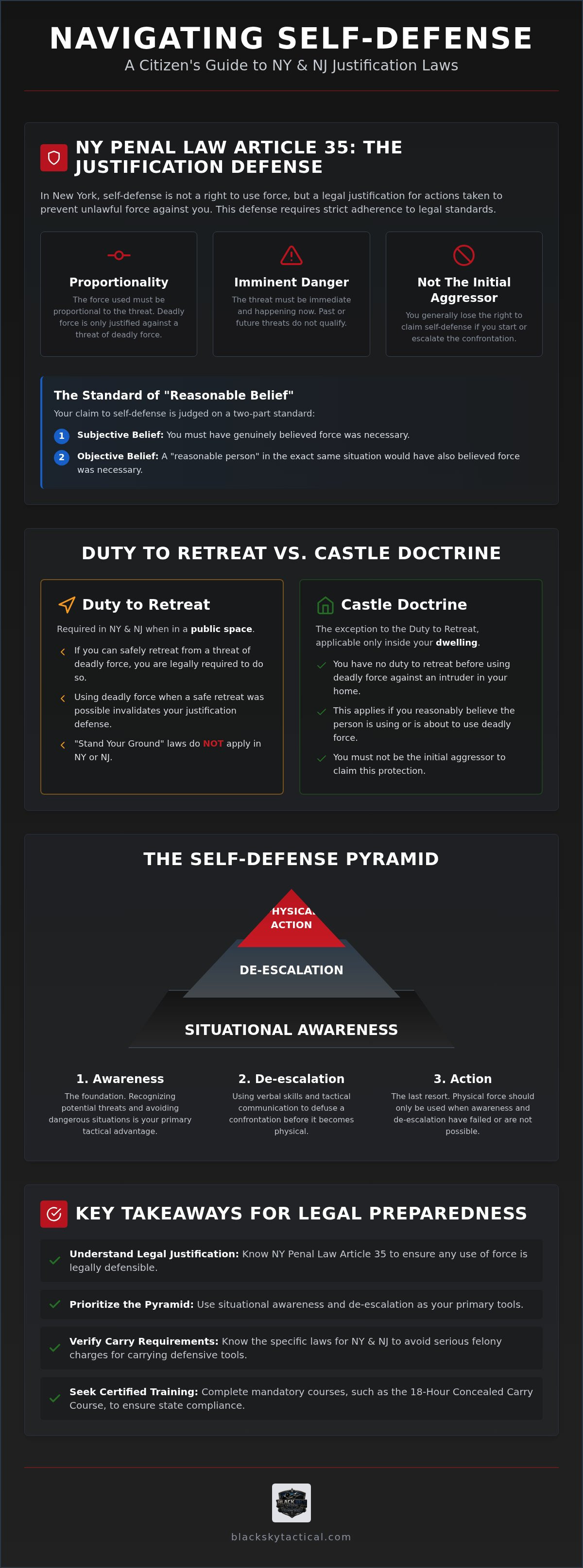
In the jurisdictions of Rockland and Westchester, Self Defense isn't categorized as a proactive right to use violence, but rather as a "justification" defense under New York State law. This means that while the use of force is generally prohibited, Penal Law Article 35 provides specific circumstances where such actions are legally excused. To successfully claim this defense, an individual must demonstrate that their actions were necessary to thwart an illegal use of force by another. While Self-defense laws in the U.S. vary significantly by state, New York remains one of the more restrictive jurisdictions, requiring a strict adherence to procedural and statutory standards.
The foundation of any legal defense in a high-stress encounter rests on the concept of "Reasonable Belief." This standard is two-fold. First, you must actually believe that force is necessary to protect yourself. Second, a "reasonable person" in your exact position, possessing the same knowledge, must also conclude that force was necessary. The law further distinguishes between physical force, such as a push or a restraint, and deadly physical force, which is force capable of causing death or serious physical injury. Using a firearm always constitutes deadly physical force, which triggers a much higher burden of proof regarding the perceived threat.
Duty to Retreat vs. The Castle Doctrine
New York and New Jersey both impose a "duty to retreat" when an individual is in a public space. If you can move to a position of complete safety for yourself and others without using deadly physical force, the law mandates that you do so. Failing to exhaust these avenues of retreat before resorting to force can result in the loss of your legal justification. Many citizens mistakenly believe "Stand Your Ground" principles apply in the tri-state area, but this is a dangerous misconception that often leads to severe criminal charges. The only major exception to this requirement is the Castle Doctrine. In New York, the Castle Doctrine provides that a person who isn't the initial aggressor has no duty to retreat before using deadly physical force if they reasonably believe another person is using or about to use deadly physical force within their own dwelling.
Proportionality and Imminent Danger
Legal justification requires that the force used must be proportional to the threat encountered. You cannot legally respond to a simple verbal argument with physical force, nor can you respond to minor physical force with a deadly weapon. Furthermore, the threat must be "imminent," meaning it's happening at that very moment or is about to happen immediately. Past threats or the fear of what someone might do tomorrow don't meet this threshold. Finally, you must not be the "initial aggressor." If you started the confrontation or escalated a verbal dispute into a physical one, you generally forfeit the right to claim justification unless you've clearly withdrawn from the fight and communicated that withdrawal to the other party.
The Three Pillars of Personal Protection: Awareness, De-escalation, and Action
Effective Self Defense is best understood through a hierarchical pyramid where physical action occupies only the smallest, final peak. At the foundation lies situational awareness, followed by verbal de-escalation. Only when these layers fail does physical intervention become a legal and practical necessity. Professional training is the mechanism that shifts a citizen's mindset from a reactive victim to a proactive responder. By internalizing safety protocols before an incident occurs, you replace panic with a structured, disciplined response. This transition is essential for anyone living in high-density areas where the margin for error in a public encounter is slim.
Foundational skill-building often begins with standardized instruction, such as NRA Basic Pistol courses, which instill the mechanical proficiency and safety habits required for responsible ownership. For families throughout Rockland and Westchester, integrating a Youth Safety Course ensures that every household member understands the gravity of firearm safety and situational vigilance. This comprehensive approach creates a culture of responsibility rather than just a collection of tactical tools.
Situational Awareness and Conflict Avoidance
The OODA Loop (Observe, Orient, Decide, Act) serves as the primary cognitive framework for maintaining safety in public spaces. You must constantly observe your environment to identify pre-attack indicators, such as "target glancing," where an aggressor looks at your pockets or neck, or unnatural movements that suggest a concealed weapon. In local venues across Rockland and Bergen Counties, awareness means maintaining a clear line of sight to exits and distinguishing between cover (objects that stop bullets) and concealment (objects that only hide your position). Awareness isn't about living in fear; it's about processing environmental data to avoid a conflict before it begins.
Verbal De-escalation and Boundary Setting
Maintaining a "Command Presence" involves using authoritative but non-provocative language to deter a potential threat. One effective method is the "Fence" technique, where you keep your hands open and elevated at chest level. This posture appears non-aggressive to bystanders or cameras but creates a physical barrier and prepares you for a defensive strike if necessary. You must recognize the "Point of No Return," which is the moment a verbal dispute transitions into an imminent physical threat. If an aggressor continues to close the distance despite clear verbal commands to stop, the window for de-escalation has closed, and the transition to physical protection must be immediate and decisive.
Armed vs. Unarmed Defense: Tools and Tactical Thresholds
Selecting a tool for Self Defense requires an objective assessment of both jurisdictional legality and your personal level of tactical proficiency. In the high-stakes environment of the tri-state area, the possession of a defensive tool is an administrative and legal responsibility that begins long before a conflict occurs. You must distinguish between tools that provide a "less-lethal" response and those that constitute deadly physical force, as the legal justification for each differs significantly. Relying on a tool without professional instruction creates a "training gap" that can lead to catastrophic failure during a pressurized encounter.
For those seeking a structured entry into responsible tool ownership, private firearm training for beginners NY offers the personalized attention necessary to build safe habits and mechanical mastery. This individualized approach ensures that you understand the specific operational requirements of your chosen equipment within the context of New York's strict regulatory environment.
The Role of the Firearm in Personal Protection
A firearm is legally and ethically a tool of last resort. Its deployment is only justified when you reasonably believe it's necessary to defend yourself or others from the imminent use of deadly physical force. Understanding the distinction between "stopping power" and the intent to use deadly force is critical for your legal defense. To meet state mandates and build a safe foundation, completing the NRA basic pistol shooting course is an essential step for compliance and safety. This certification process provides the technical framework required to handle firearms with the sobriety and discipline the law demands.
Non-Ballistic Tools: Pepper Spray and Tactical Pens
Non-ballistic tools provide a secondary tier of Self Defense for environments where firearms are prohibited or inappropriate. In New York, pepper spray possession is restricted to individuals 18 or older with no felony convictions; the canister must not exceed 0.75 ounces, and the concentration is capped at 0.7% capsaicinoids. New Jersey maintains similar volume restrictions of 0.75 ounces for chemical agents. Because these items must be purchased in person from licensed firearms dealers or pharmacists in New York, you should verify the specific canister labels to ensure they meet state mandates.
Tactical pens and high-lumen flashlights represent viable alternatives for those navigating "Sensitive Location" bans. These items often bypass the strict prohibitions found in schools or government buildings while providing a functional defensive capability. However, owning these tools isn't the same as being able to use them effectively. Without pressurized training, many individuals find that they lack the fine motor skills required to deploy chemical sprays or striking tools when their heart rate exceeds 120 beats per minute. Professional guidance is not merely an option; it's a necessary component of your defensive plan.
Developing a Personal Protection Plan: Mindset and Command
A reactionary mindset is one of the most significant liabilities in a high-stakes encounter. When you wait for an aggressor to dictate the terms of an engagement, you're operating behind the curve of action, which often leads to poor decision-making under pressure. Self Defense requires the cultivation of a command mindset where you've mentally rehearsed your response to various tactical scenarios. This preparation is vital for managing the physiological "adrenaline dump," which can cause auditory exclusion and tunnel vision, making it difficult to process complex information during a crisis.
The psychological impact of a violent incident doesn't end when the threat is neutralized. You must be prepared for the intense emotional and physical crash that follows a life-threatening event. Professional preparation involves understanding that your fine motor skills will diminish, and your ability to articulate details to authorities may be temporarily compromised. Establishing a disciplined post-incident protocol is the only way to protect your legal standing and your mental well-being in the aftermath of a conflict.
Violent Incident Command Training
Applying professional incident management to personal safety ensures that you remain the commander of the scene until law enforcement arrives. This role involves more than just neutralizing a threat; it requires you to manage bystanders, check for injuries, and secure the environment. Communicating with 911 must be deliberate and concise. You should provide your location, state that you were the victim of a crime, and give a clear description of your clothing to avoid a "Blue on Blue" incident where responding officers mistake you for the aggressor. For those seeking to master these professional scene management skills, we offer specialized Violent Incident Command Training to bridge the gap between the incident and the arrival of official help.
Home Defense Protocols for Families
Within the home, a protection plan relies on environmental control and pre-established family movements. You should identify "safe rooms" that provide ballistic protection and a single point of entry, which creates a "fatal funnel" for any intruder. This structural advantage allows you to maintain a defensive position rather than attempting to clear your home, which is a high-risk activity even for trained professionals. Consider the following elements for your household plan:
- Communication Codes: Establish simple words or phrases that signal family members to move to a safe room without alerting an intruder.
- Staging Equipment: In Rockland or Westchester residences, defensive tools must be staged in secure, rapid-access safes that balance child safety with immediate availability.
- Safe Room Logistics: Ensure your safe room contains a secondary phone and a flashlight to manage the scene if the power is cut.
Mastering Compliance: Certified Training Paths in NY and NJ
Achieving professional proficiency in Self Defense requires navigating a complex administrative landscape defined by state-specific training mandates. For residents of Rockland and Westchester, the path to legal compliance is strictly regulated and demands a significant commitment to formal education. These requirements aren't merely suggestions; they're the legal prerequisites for the lawful exercise of your rights. By choosing a certified training path, you ensure that your certification meets the rigorous standards of both New York and New Jersey, providing a seamless bridge between your current status and full state compliance.
The NYS 18-Hour CCW Syllabus
The NY 18 hour concealed carry course is the mandatory foundation for any applicant seeking a concealed carry permit in New York. This curriculum is divided into 16 hours of classroom instruction and 2 hours of live-fire training. The classroom portion covers critical administrative and legal topics, including conflict de-escalation, suicide prevention, and the mandates for safe storage of firearms. During the 2-hour live-fire qualification, applicants must demonstrate mechanical proficiency and accuracy under the supervision of a certified instructor. This rigorous standard ensures that every permit holder possesses the basic skills necessary to handle a firearm safely and responsibly.
While the NYS requirements are extensive, many individuals find that the NRA Basic Pistol certification serves as a necessary prerequisite for true proficiency. This foundational course builds the fundamental safety habits and mechanical skills that the 18-Hour Concealed Carry Course then applies to specific legal scenarios. For those living near the state line, the NYSNRA101 and NJSNRA101 combined courses optimize the training process by merging state mandates with NRA standards into a single, efficient schedule.
NJ Permit to Carry (PTC) Requirements
Residents in Bergen County and surrounding areas must follow the specific NJ concealed carry permit training guidelines to obtain a Permit to Carry (PTC). New Jersey law mandates specific "Use of Force" training and requires applicants to qualify with the specific firearm they intend to carry under the CCARE (Civilian Carry Assessment and Range Evaluation) protocol. As of 2026, these permits remain valid for two years, and renewal requires updated proof of qualification. Staying current with these legal updates is essential, as New Jersey operates as a "shall-issue" state but maintains strict enforcement of its administrative procedures and qualification standards.
Securing Your Professional Foundation in Personal Safety
Mastering Self Defense requires a disciplined synthesis of legal literacy, tactical awareness, and state-mandated certification. You've explored the rigorous standards of New York Penal Law Article 35 and the administrative requirements necessary to carry a defensive tool lawfully in the tri-state area. By shifting from a reactive mindset to one of command and situational vigilance, you ensure that your actions remain within the bounds of professional responsibility and legal justification. True preparedness isn't a one-time event; it's a continuous commitment to education and skill-building.
We provide the bridge between your safety goals and strict state compliance through expert instruction serving Rockland, Orange, Westchester, and Bergen Counties. Our curriculum includes professional Violent Incident Command training to help you manage the complexities of a scene after a threat is neutralized. To begin your path toward certification, Register for the NYSNRA101: Combined NYS 18-Hour Concealed Carry + NRA Basic Pistol Class. This combined 18-hour certification meets all NYS and NRA requirements, ensuring your training is both efficient and comprehensive. Building a foundation of knowledge is the most effective way to protect yourself and your family with confidence.
Frequently Asked Questions
Is self-defense legal in New York if I use a firearm?
Yes, the use of a firearm for Self Defense is legal in New York provided the actions meet the criteria of "justification" under Penal Law Article 35. You must possess a reasonable belief that another person is using or about to use deadly physical force against you. However, you maintain a legal duty to retreat if you can do so with complete safety, except when you're inside your own dwelling.
What is the "Duty to Retreat" in New Jersey self-defense law?
The "duty to retreat" in New Jersey mandates that an individual must attempt to safely withdraw from a confrontation before resorting to deadly force in a public setting. This obligation only exists if the retreat can be accomplished with complete safety for oneself and others. It's important to recognize that this duty is suspended within your own home, where the Castle Doctrine allows you to stand your ground against an intruder.
How long is the mandatory concealed carry course in NY?
The 18-Hour Concealed Carry Course is the mandatory training duration required by New York State law for all concealed carry permit applicants. This curriculum consists of 16 hours of comprehensive classroom instruction followed by two hours of live-fire training on a range. The classroom portion covers topics such as conflict de-escalation and safe storage, while the live-fire component requires applicants to demonstrate mechanical proficiency and accuracy to a certified instructor's satisfaction.
Can I defend my property with physical force in Rockland County?
New York law allows for the use of non-deadly physical force to prevent what you reasonably believe to be a larceny or criminal mischief involving your property. However, the use of deadly physical force is strictly prohibited when the threat is solely directed at property rather than a person. In Rockland County, escalating a property dispute into a deadly force encounter will likely result in the loss of your legal justification defense under Article 35.
What happens if I use self-defense in a "Sensitive Location"?
Using a firearm for Self Defense in a "Sensitive Location" creates a complex legal crisis because the mere possession of the weapon in such areas is often a felony. Even if the use of force is deemed justified under Penal Law, you may still face prosecution for criminal possession of a weapon in a prohibited zone. These locations include schools, government buildings, and public parks, where state mandates strictly forbid the presence of firearms.
Do I need a separate permit for pepper spray in NY or NJ?
You don't need a specific permit to possess pepper spray in New York or New Jersey, but you must adhere to strict administrative regulations regarding its composition and purchase. In New York, canisters are limited to 0.75 ounces with a maximum capsaicinoid concentration of 0.7 percent and must be purchased in person from a licensed dealer. New Jersey also limits canister size to 0.75 ounces of active ingredient for individuals without criminal convictions.
How often do I need to renew my self-defense training for a CCW?
Renewal requirements for training vary by state and specific jurisdictional mandates within the tri-state area. In New Jersey, a Permit to Carry is valid for two years, and renewal requires updated proof of qualification under the CCARE protocol. New York applicants should consult their specific county licensing officer, as recertification cycles and training updates are subject to administrative changes, though the state generally requires periodic recertification of the underlying pistol permit information through the state police.
What is the "Castle Doctrine" and does it apply to my yard?
The "Castle Doctrine" is a legal principle stating that you have no duty to retreat from an intruder within your own dwelling before using deadly physical force. In New York, this protection generally doesn't extend to your yard, driveway, or detached structures. The law defines the dwelling as the building where you usually lodge at night, meaning that once you step outside the threshold of your home, the standard duty to retreat often resumes.


