
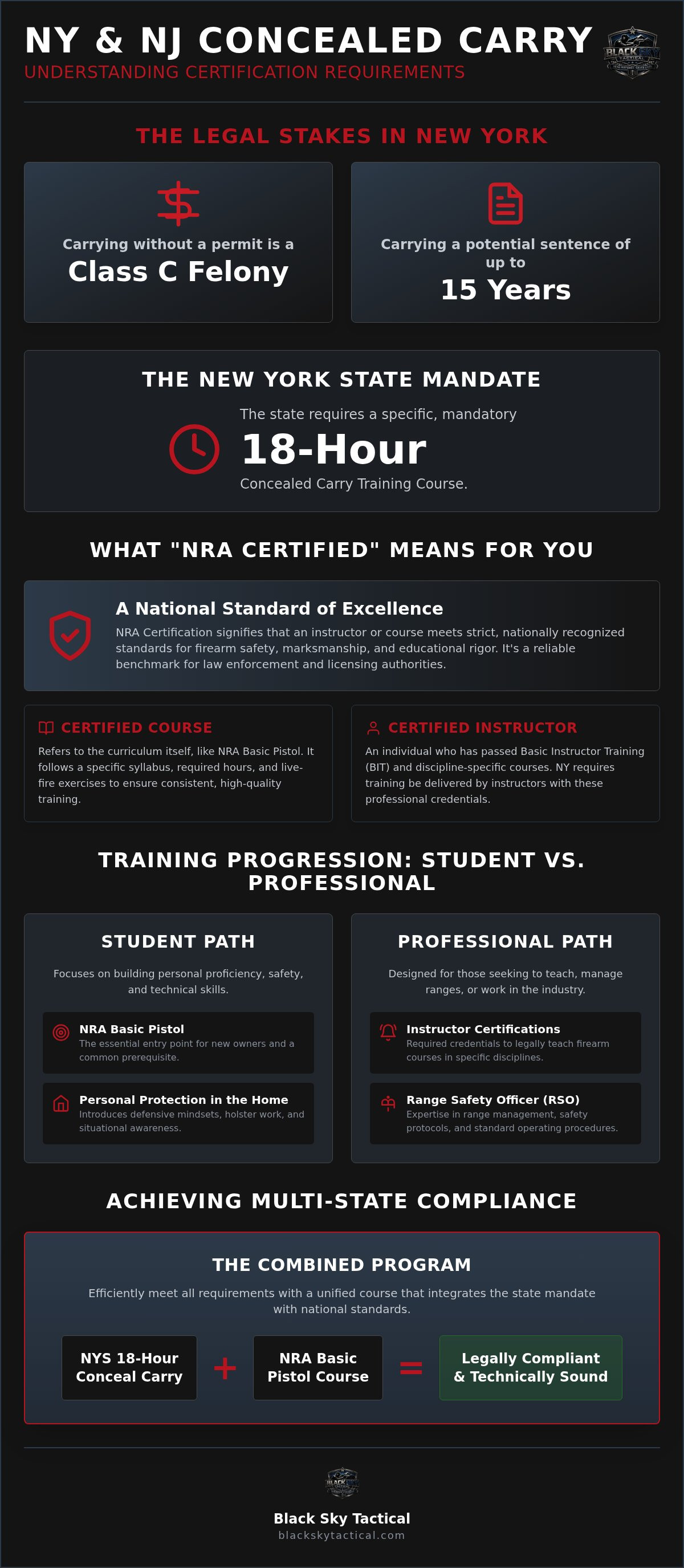
In New York, carrying a concealed handgun without the proper administrative credentials isn't just a procedural oversight; it's a Class C felony that carries a potential sentence of up to 15 years in prison. You likely recognize that obtaining a permit in Rockland or Westchester requires more than just intent. It demands a rigorous adherence to evolving state mandates and a commitment to professional safety standards. Many residents feel a legitimate sense of anxiety when trying to distinguish between a standard safety course and the specific 18-hour training now required by the state. This confusion often centers on whether a trainer is NRA Certified and if their curriculum satisfies the administrative requirements of the local licensing authority.
This guide will clarify how the NRA curriculum provides the necessary pedagogical foundation to meet both New York and New Jersey's stringent legal standards. We'll explain the integration of the NRA Basic Pistol curriculum within the Combined NYS 18-Hour Conceal Carry course to ensure your training is both legally compliant and technically sound. By the end of this article, you'll understand the distinctions between student and instructor certifications, how to verify that a local course meets state administrative requirements, and the specific steps required to establish genuine firearm proficiency in a complex regulatory environment.
Key Takeaways
- Identify the national standards of firearm safety and how they provide the formal foundation for local regulatory compliance.
- Differentiate between student-level proficiency courses and professional instructor certifications to better evaluate your training options.
- Understand how an NRA Certified curriculum serves as a core component of the mandatory 18-hour training for NY and NJ permit applicants.
- Learn the administrative steps for verifying an instructor's current status and specific discipline expertise through official portals.
- Discover the efficiency of combined programs, such as the Combined NYS 18-Hour Conceal Carry + NRA Basic Pistol Class, for meeting multi-state requirements.
What is NRA Certified? Defining the National Standard for Firearm Safety
The term NRA Certified serves as a designation of professional compliance and standardized educational rigor within the firearm industry. It indicates that a specific training program or individual instructor has met the strict pedagogical requirements established by the National Rifle Association (NRA). This certification isn't merely a participation credential; it's a formal verification that the instruction follows a nationally recognized syllabus. For administrative bodies and law enforcement agencies in Rockland and Westchester, this provides a reliable benchmark for evaluating whether an applicant has received a sufficient baseline of safety and marksmanship training before being granted a permit.
It's vital to distinguish between a certified course and a certified instructor. An NRA Certified Course refers to the specific curriculum, such as Basic Pistol, which must follow a set number of instructional hours and include specific live-fire exercises. Conversely, an NRA Certified Instructor is an individual who has successfully completed the NRA Basic Instructor Training (BIT) and a discipline-specific instructor course. This distinction is critical for residents seeking to satisfy New York's 18-hour mandate, as the state requires the training to be delivered by individuals who hold these specific professional credentials to ensure the legitimacy of the certification process.
The History and Evolution of NRA Training Standards
Since its founding in 1871, the organization has transitioned from a focus on marksmanship to a comprehensive safety and defensive education system. The current 2026 standards reflect decades of refinement in safety protocols and instructional methods. This evolution ensures that the curriculum remains relevant to modern firearm technology, including the use of semi-automatic pistols and contemporary concealment holsters. By maintaining these high standards, the NRA has established a global reputation that serves as the primary benchmark for civilian firearm proficiency and responsible ownership.
Why Certification Matters for New Firearm Owners
For the novice owner, certification establishes a foundation of safety that exceeds basic mechanical instruction. It provides a structured environment where the psychological aspects of firearm ownership are addressed alongside physical skills. Law enforcement agencies and licensing officers often view a course completion certificate as a trust signal, indicating that the individual has been vetted through a professional syllabus. This formal recognition is often the first step in demonstrating the technical competence and safety awareness required by many local jurisdictions in the tri-state area.
Types of NRA Certifications: Student vs. Professional Designations
The hierarchy of NRA firearm training courses is structured to provide a clear progression from foundational safety to advanced instructor-level expertise. It's essential for Rockland and Westchester residents to distinguish between these designations to ensure their NRA Certified training aligns with their specific legal or professional goals. While many individuals start with basic safety to satisfy home defense concerns, others require specialized certifications for range management or professional instruction. By identifying the correct certification level, you can streamline your path toward meeting the specific requirements of Rockland or Westchester County authorities and prevent administrative delays during the permit application process.
Student Certifications: The Path to Proficiency
Student-level certifications focus on individual proficiency and technical skill. The NRA Basic Pistol course is the most common entry point, often serving as a mandatory prerequisite for advanced tactical programs. For those moving toward a defensive mindset, courses like Personal Protection in the Home introduce holster work and situational awareness. Non-shooting certifications, such as Home Safety courses, provide a foundation for general safety without the live-fire component, ensuring every family member understands safe firearm handling protocols.
Professional Designations: The Instructor's Credential
Achieving the status of an NRA Certified Instructor involves a rigorous administrative vetting process. Candidates must complete Basic Instructor Training (BIT) and demonstrate technical mastery in their chosen discipline. Above this level, Training Counselors are responsible for certifying new instructors to maintain national standards. Range Safety Officer (RSO) certification is a specialized designation focused on the supervision of shooting activities. These professionals ensure that all range activities comply with established safety benchmarks, managing range commands and clearing stoppages to prevent incidents.
Administrative procedures for receiving your certificate are methodical and require precise record-keeping. Once a course is finished, the instructor submits the training report to the national database, which triggers the generation of your official credentials. Students then access their records through an official portal to verify their status, a step that is often required by licensing officers during the permit application process. This verification ensures that the training you received meets the required benchmarks for safety and proficiency, providing peace of mind for both the permit applicant and the state. If you're unsure which path fits your specific needs, seeking private firearm training can help clarify your objectives before committing to a formal certification track.
NRA Certification and the NY/NJ Concealed Carry Mandates
In the complex regulatory environments of Rockland and Westchester, being NRA Certified is frequently viewed by local licensing authorities as a necessary prerequisite for demonstrating technical competence. While state laws dictate the specific duration and topics of training, the NRA Firearm Training curriculum provides the pedagogical framework that many instructors use to satisfy these mandates. In local firearm circles, this certification has become a shorthand for state compliance, as it assures administrative bodies that the applicant has been trained under a vetted, national standard rather than an arbitrary or unverified syllabus.
The NYS 16+2 Hour Requirement and NRA Integration
The NY 18 hour concealed carry course is structured into 16 hours of classroom instruction and 2 hours of live-fire training. This mandate, which became effective under the Concealed Carry Improvement Act, requires a deep dive into firearm safety, situational awareness, and the legalities of the use of force. By integrating the NRA basic pistol shooting course into this syllabus, instructors provide students with a foundational understanding of handgun mechanics and marksmanship that directly supports the state's safety goals. For residents in Rockland and Westchester, the administrative benefit of a combined course is significant; it allows for the simultaneous acquisition of a national credential and the fulfillment of state-specific licensing requirements in a single, streamlined program.
NJ Carry Permit Standards: NRA vs. State Qualifications
New Jersey's CCARE (Concealed Carry and Responsible Engagement) protocol standards present a different set of challenges, focusing heavily on specific shooting proficiency and holster work. While the New Jersey State Police outline the qualification course, the techniques taught in NRA Certified defensive pistol modules are instrumental in preparing students for these high-stakes evaluations. Applicants in Bergen County often find that NJ concealed carry permit training is most effective when it pairs state-mandated shooting drills with the disciplined approach of NRA marksmanship. This dual-focus training ensures that the student isn't just "shooting for a score" but is developing the tactical proficiency required for responsible carry in a densely populated metropolitan area. This methodical preparation is essential for meeting the rigorous standards required to secure a NJ Permit to Carry (PTC).
How to Verify NRA Certified Instructors in NY and NJ
Confirming that a trainer is truly NRA Certified is a vital administrative step for any permit applicant in the tri-state area. It isn't enough to simply see a logo on a website. Applicants must confirm that the trainer holds current, discipline-specific credentials that align with the firearm type they intend to carry. For instance, an instructor certified only in "Rifle" cannot legally certify the pistol training required for a NYS Concealed Carry permit. This verification protects you from "certificate mills" that may issue credentials that local licensing officers in Rockland or Westchester will ultimately reject during the background check process.
One of the most significant red flags in the industry involves instructors who offer "shortcuts" regarding state mandates. In New York, the 18-hour requirement is a strict legal standard. Any trainer suggesting they can condense the 16 hours of classroom instruction or the 2 hours of live-fire training is compromising your legal standing. Carrying a firearm based on an invalid training certificate can lead to severe criminal penalties, including the Class C felony charges mentioned previously. Ensuring your instructor adheres to the full duration of the syllabus is the only way to maintain procedural integrity.
Step-by-Step Verification Process
Before you commit to a course or submit payment, request the instructor's NRA ID number. You can then use the official NRA Instructors portal and the "Find an Instructor" tool to cross-reference their name and current status. It's also necessary to verify if the instructor holds the additional state-level authorizations required for NYS CCW training. Many jurisdictions now require instructors to be registered with the State Police or local county sheriff's offices. Validating these credentials upfront prevents the administrative headache of having your permit application returned due to unauthorized training sources.
The Value of Local Expertise in Bergen and Rockland Counties
A private firearms instructor NY must possess more than just technical skill; they need an intimate understanding of local jurisdictional nuances. Permit requirements in Rockland County may differ slightly in administrative execution from those in Westchester or Bergen County. Instructors familiar with local range protocols and the specific preferences of local licensing officers can provide guidance that goes beyond the standard NRA syllabus. They understand the legal codes of both NY and NJ, ensuring that your training covers the specific "duty to retreat" or "use of force" statutes relevant to your primary residence. To ensure your training meets these rigorous professional and local standards, consider enrolling in a program through Black Sky Tactical.
Achieving Compliance with Black Sky Tactical's Certified Programs
Black Sky Tactical functions as the bridge between national safety standards and the specific mandates of New York and New Jersey. The flagship offering, the NYSNRA101: Combined NYS 18-Hour Conceal Carry + NRA Basic Pistol Class, is meticulously designed to satisfy the 16+2 hour requirement while awarding students a nationally recognized credential. For residents of Rockland and Westchester, this integrated approach eliminates the need to seek disparate training sessions, ensuring that every hour spent in the classroom contributes directly to both legal compliance and technical mastery. Similarly, the NJSNRA101: Combined NJS Conceal Carry + NRA Basic Pistol Class provides a streamlined path for those seeking a New Jersey Permit to Carry, aligning the state's shooting qualifications with NRA Certified training methodologies to ensure all administrative standards are met without compromise.
Efficiency Through Combined Certification Courses
The administrative burden of tracking multiple safety certificates can be significant for permit applicants. By integrating the NRA Basic Pistol curriculum into the state-mandated tracks, Black Sky Tactical ensures that students receive a comprehensive education that exceeds the minimum legal benchmarks. This model serves the specific needs of residents in Rockland, Orange, Westchester, and Bergen Counties, where local licensing officers expect a high degree of procedural transparency. Receiving multiple certifications in a single training block not only saves time but also ensures that the pedagogical foundation remains consistent throughout the entire 18-hour syllabus. It's a methodical way to navigate the multi-step process required to secure carry privileges in the tri-state area.
Professional Instruction for Tactical Proficiency
Securing a permit is merely the first step toward responsible ownership; true safety is found in genuine tactical proficiency. For those starting their journey, private firearm training for beginners NY utilizes NRA Certified methods to build confidence in a controlled, one-on-one environment. Beyond the basic mandates, the institution offers advanced curricula such as Violent Incident Command and Youth Safety Course programs. These courses move the student from a state of basic awareness to one of proactive preparedness, addressing situational awareness and tactical response in high-stress scenarios. By choosing a program that adheres to these rigorous standards, you aren't just checking a box for a permit; you're building a disciplined foundation for personal protection that adheres to the highest professional standards.
Securing Your Administrative Compliance and Tactical Foundation
Navigating the complex administrative landscape of New York and New Jersey requires a methodical approach to both training and certification. By selecting a program that is NRA Certified, you ensure that your education adheres to national safety standards while simultaneously satisfying the specific legal mandates of your local jurisdiction. This structured path doesn't just mitigate the legal risks of unauthorized instruction; it establishes the technical proficiency required for responsible concealed carry in Rockland and Westchester.
Black Sky Tactical provides the professional guidance necessary to bridge the gap between state requirements and tactical skill. Our expert instructors serve Rockland, Westchester, and Bergen Counties, delivering a curriculum that prioritizes safety and procedural integrity. You can Enroll in the NYSNRA101 Combined 18-Hour CCW Course to benefit from our Combined NYS 18-Hour & NRA Basic Pistol Curriculum. We also offer NRA Membership enrollment support to help you maintain your credentials and stay informed on safety protocols. It's the most reliable way to prepare for the responsibilities of firearm ownership with confidence and legal clarity.
Frequently Asked Questions
Is NRA certification required for a New York pistol permit?
New York state law doesn't explicitly mandate a specific brand of certification by name, but the 18-hour training requirement is frequently satisfied by instructors using the NRA curriculum. Most licensing authorities in Rockland and Westchester recognize this as the professional benchmark for safety. It provides the administrative proof of proficiency that licensing officers require to verify that an applicant has met the state's rigorous safety and marksmanship standards.
Does an NRA Basic Pistol certificate expire?
NRA certificates don't have a formal expiration date from the organization's perspective, yet New York and New Jersey licensing authorities often impose their own recency requirements. Some counties require training to have been completed within a specific timeframe, such as the last three years, before an application is submitted. You should verify the local administrative rules in your specific jurisdiction to ensure your credentials remain valid for your permit.
Can I use my NRA certificate from another state for my NJ carry permit?
New Jersey's CCARE protocol requires specific shooting qualifications that aren't always covered in standard courses from other states. While an NRA Certified curriculum provides a technical foundation, it must align with the specific NJSP standards to be accepted. You'll likely need to complete a NJ-specific qualification session to satisfy the administrative requirements of the Permit to Carry (PTC) application process in Bergen County or other local jurisdictions.
What is the difference between an NRA instructor and a state-certified instructor?
An NRA instructor is vetted through a national pedagogical standard focusing on safety and marksmanship. A state-certified instructor is authorized by local law enforcement or state agencies to teach specific mandated curricula, such as the NYS 18-hour course. Many professionals hold both designations, allowing them to provide a nationally recognized certificate while fulfilling the state's legal requirements for concealed carry licensing in Rockland or Westchester counties.
How do I verify if my instructor is actually NRA Certified?
You should request the instructor's unique identification number and verify it through the official instructors portal. This allows you to confirm that the individual is currently NRA Certified in specific disciplines like Pistol or Defensive Pistol. Administrative transparency is vital; if an instructor isn't listed, their training certificates may not be recognized by licensing authorities during your background check or permit renewal process.
Does the NRA 18-hour course include the live fire qualification?
Yes, the Combined NYS 18-Hour Conceal Carry + NRA Basic Pistol Class includes the mandatory two-hour live-fire session. This component is essential for demonstrating safe handling and marksmanship proficiency under professional supervision. Completing this live-fire portion is a strict administrative requirement for any New York concealed carry permit application. It ensures that the applicant can safely operate their firearm in a range environment before carrying in public spaces.
Can I take NRA Certified courses online for a CCW permit?
New York state law requires the 18-hour training to be conducted in person to ensure the integrity of the classroom instruction and the live-fire qualification. While some introductory safety theory can be studied online, the administrative mandates for a concealed carry permit in Rockland and Westchester cannot be satisfied through virtual training alone. Physical attendance is necessary to verify identity, participation, and technical competence during the required range exercises and classroom discussions.
What should I bring to an NRA Certified Basic Pistol class?
You should bring a valid government-issued photo ID, a notebook for administrative notations, and any specific safety equipment requested by the instructor, such as eye and ear protection. If the course is a non-shooting safety class, firearms are generally prohibited in the classroom environment. For live-fire sessions, follow the instructor's specific protocols regarding ammunition and holster requirements. Always verify the range facility's administrative rules before arriving to ensure full compliance.


