
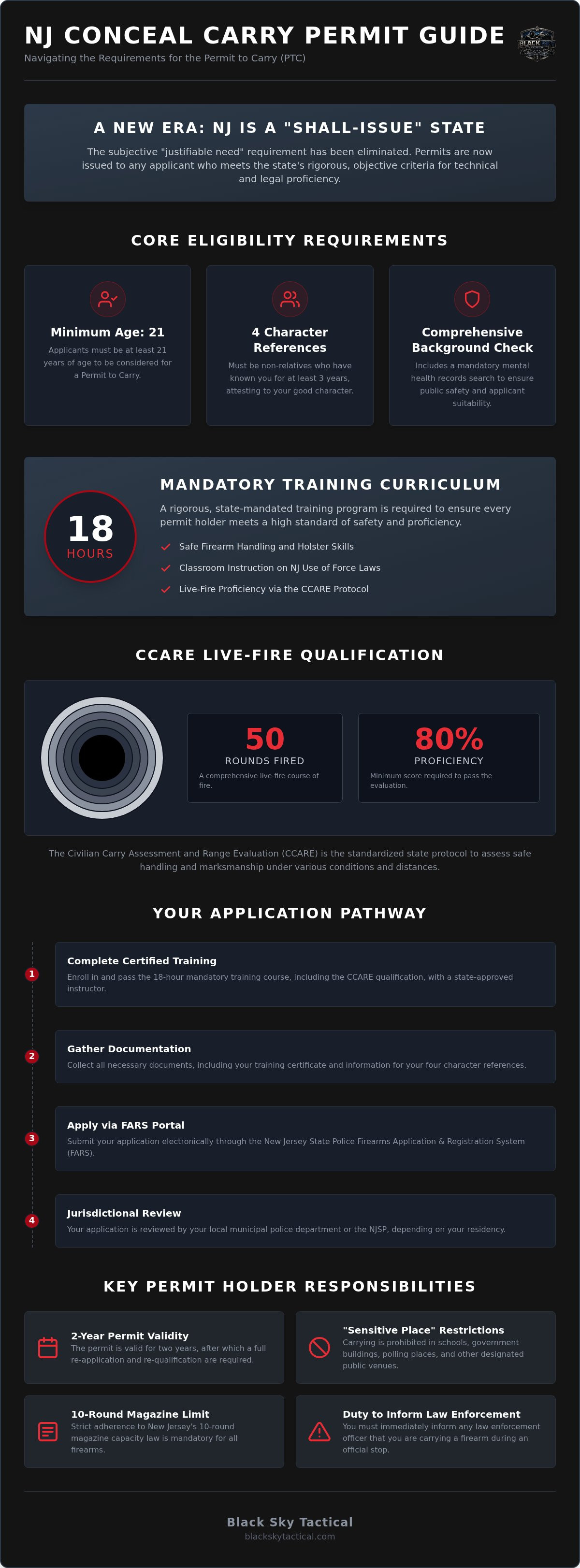
Achieving a NJ Conceal Carry permit in 2026 is no longer a matter of demonstrating "justifiable need," yet it requires meeting a rigorous, standardized threshold of technical and legal proficiency. For many residents in Bergen County, the transition to the Civilian Carry Assessment and Range Evaluation (CCARE) protocol and the digital FARS portal represents a significant hurdle. You likely feel a sense of apprehension regarding the 50 round live fire qualification or the complexity of the state's administrative mandates. It's a common concern, as the margin for error in legal compliance is narrow and the stakes for public safety are exceptionally high.
By following a disciplined training regimen, you can master the legal requirements and shooting standards necessary to secure your New Jersey Permit to Carry (PTC) with professional guidance. This article provides a comprehensive overview of the certification process, including the specific yardage requirements for the CCARE protocol and the tactical safety skills required for holster draws. We will also clarify the current use of force laws and the logistical steps for navigating the online application system. This methodical approach ensures you're prepared for both the range and the legal responsibilities of carrying a firearm.
Key Takeaways
- Understand the administrative transition to the "shall-issue" standard and how it defines the current legal framework for obtaining a Permit to Carry (PTC).
- Identify the mandatory components of the 18-hour training syllabus, ensuring your certification aligns with both state protocols and NRA safety standards.
- Gain clarity on the CCARE protocol shooting distances and scoring zones to ensure your live-fire performance meets the 80% proficiency threshold.
- Navigate the FARS online application system efficiently by gathering the required documentation and character references before beginning the digital process.
- Explore the advantages of the NJSNRA101 course as a comprehensive solution for fulfilling NJ Conceal Carry mandates through a single, professional training program.
Navigating NJ Conceal Carry Laws and the Permit to Carry (PTC) Framework
The New Jersey Permit to Carry (PTC) serves as the primary legal instrument authorizing an individual to carry a concealed handgun for self-defense within the state. Since the Supreme Court's ruling in NYSRPA v. Bruen, New Jersey has functioned as a "shall-issue" state, meaning that administrative authorities must grant a permit to any applicant who meets the objective statutory criteria. While this transition removed the subjective "justifiable need" requirement, the regulatory environment remains complex and demanding. Navigating NJ Conceal Carry Laws in 2026 involves adhering to a multi-tiered verification process designed to ensure that only qualified individuals possess this authority.
Eligibility for NJ Conceal Carry is strictly defined by age, background, and character standards. An applicant must be at least 21 years of age and is required to provide four character references. These individuals must not be related to the applicant by blood or marriage and must have known the applicant for a minimum of three years. This requirement, paired with a mandatory mental health records search, forms the basis of the "good moral character" evaluation. Maintaining compliance in this evolving landscape requires a commitment to understanding both the administrative steps and the tactical responsibilities inherent in the permit.
New Jersey Jurisdictional Authority and Residency
The specific agency responsible for processing a PTC application depends on the applicant's legal residence. For those living in Bergen County, the application is typically managed by the municipal police department in the town of residence. The local Chief of Police conducts the initial review before the application moves through the state's digital system. Conversely, out-of-state residents or those living in municipalities without a full-time police department must apply through the New Jersey State Police (NJSP). The NJSP maintains the Firearms Application and Registration System (FARS), which centralizes the oversight of all firearm-related certifications and ensures that training standards, such as the CCARE protocol, are applied uniformly across all jurisdictions.
The Legal Gravity of Concealed Carry in NJ
Possessing a PTC in New Jersey demands a high level of professional responsibility and administrative sobriety. It's not a permanent right. The permit is valid for exactly two years, after which the holder must undergo the entire re-qualification and application process again. Permit holders must also strictly observe "sensitive place" restrictions, which prohibit carrying in government buildings, schools, and various public venues. Non-compliance with these zones or with the state's 10-round magazine capacity limit can lead to immediate permit revocation and criminal prosecution. New Jersey law also requires permit holders to inform law enforcement officers of their armed status if they are stopped while carrying a firearm, emphasizing the state's focus on transparent interaction between citizens and authorities.
Mandatory Training Requirements: The CCARE Protocol and NRA Fundamentals
The current regulatory framework for NJ Conceal Carry necessitates a rigorous 18-hour training curriculum that combines classroom instruction with live-fire proficiency. Central to this requirement is the Civilian Carry Assessment and Range Evaluation (CCARE) protocol, which replaced previous disparate standards to ensure a uniform level of competency across the state. This protocol is not merely a shooting test; it is a comprehensive assessment of an applicant's ability to safely manage a firearm in a public environment. Before beginning the formal process on the NJ Permit to Carry Application Portal, candidates must secure certification from a state-approved instructor who can verify completion of all mandatory modules.
The 18-hour mandate is designed to move beyond basic marksmanship, focusing instead on the administrative and tactical obligations of a permit holder. This training must include detailed instruction on safe handling, holster retention, and the legalities of firearm ownership in New Jersey. By standardizing these requirements, the state ensures that every individual authorized to carry a concealed weapon has undergone a uniform vetting process regarding their physical skills and their understanding of jurisdictional mandates.
Understanding the CCARE Syllabus
The CCARE syllabus is structured to address the high-stakes nature of carrying a concealed weapon. It mandates specific instruction on safe handling and storage, emphasizing New Jersey's strict laws regarding firearm accessibility in the home and the use of locking devices. Beyond physical safety, the curriculum includes a vital use-of-force module. This section provides the legal foundation necessary for an applicant to understand the specific circumstances under which the use of deadly force is permitted under state law. Additionally, the syllabus requires demonstrated proficiency in holster work. This involves the safe drawing and re-holstering of a firearm from a concealed position, a skill that serves as a critical safety barrier against accidental discharges during movement.
Why NRA Basic Pistol Classes Enhance NJ Compliance
While state-specific mandates are the primary concern, incorporating the NRA basic pistol shooting course into your preparation offers a national standard of safety that supports NJ requirements. The NRA curriculum provides a structured pedagogical foundation that reinforces the fundamentals of handgun operation and maintenance. By receiving an NRA certificate alongside state-specific training, applicants demonstrate a commitment to safety that exceeds the minimum administrative threshold. This dual approach ensures that the permit holder is not just legally compliant but technically proficient. For those seeking a streamlined path to certification, the NJSNRA101 course combines these essential elements into a single, professional syllabus designed for Bergen County residents.
Mastering the NJ Carry Permit Qualification Shooting Standards
The shooting qualification for NJ Conceal Carry is an objective, performance-based evaluation designed to verify that an applicant can operate their firearm under specific time and accuracy constraints. In 2026, the standard remains the Civilian Carry Assessment and Range Evaluation (CCARE) protocol, which utilizes a 50-round course of fire. To achieve a passing score, the applicant must demonstrate an 80% proficiency rate, which equates to 40 hits within the designated scoring zones of the target. Typically, the FBI Q-target is employed for this purpose, where any strike inside the "bottle" outline is counted toward the final score.
It is a specific administrative requirement that the applicant must qualify with the handgun they intend to carry. This ensures that the individual is proficient with the specific manual of arms, recoil impulse, and holster interface of their selected firearm. The evaluation is conducted in a "cold" environment, meaning the applicant does not receive warm-up rounds or practice strings immediately prior to the scored event. This approach simulates the reality of a defensive encounter, where technical skills must be accessible without prior preparation.
Course of Fire: Distances and Round Counts
The CCARE protocol is divided into five distinct distance segments, requiring the shooter to engage the target from 3, 5, 7, 10, and 15 yards. At each stage, the applicant must follow a specific string of fire within set time limits. A critical component of this evaluation is the transition from concealment to engagement. Unlike basic range practice, the qualification requires the applicant to draw from a secured holster, clear any concealment garments, and achieve accurate hits under time pressure. This process tests the integrity of the holster system and the applicant's ability to maintain safe muzzle direction during high-stress movement.
Tactical Proficiency and Safety Evaluations
Beyond marksmanship, the instructor evaluates the applicant's administrative firearm handling. This includes the ability to perform emergency reloads and clear common malfunctions without violating safety protocols. Any breach of the four fundamental rules of firearm safety, such as "sweeping" a bystander or placing a finger on the trigger before being on target, results in an automatic failure of the entire evaluation. For those who feel the need to refine these technical skills before attempting the formal qualification, seeking firearm proficiency training can provide the necessary skill-building to exceed the state's minimum standards. This preparation ensures that the applicant is not merely aiming for a passing score but is truly capable of safe and effective firearm management.
Step-by-Step NJ PTC Application Process for 2026
Successfully completing your NJ Conceal Carry training is the first technical milestone, but the administrative phase requires equal attention to detail. The application process is centralized through the NJSP Firearms Application and Registration System (FARS), a digital portal where you must submit your training certificates, mental health releases, and character reference information. Before accessing the portal, ensure you have your S.P. 182 training form as proof of CCARE protocol compliance. You'll also need the specific Originating Agency Identifier (ORI) code for your local Bergen County municipal police department. Selecting the incorrect ORI will result in the application being routed to the wrong jurisdiction, leading to unnecessary delays or administrative rejection.
Once the digital application is submitted, you must schedule a fingerprinting appointment through the state-contracted vendor, IdentoGO. This step is mandatory for every initial application and certain renewals to facilitate a comprehensive criminal history background check. After your prints are processed, the application is forwarded to your local police department for the investigative phase. It's vital to monitor your email for automated notifications from the FARS system, as these will indicate when your references have completed their questionnaires and when your background check has been initiated.
The Role of the Municipal Police Chief
In New Jersey, the municipal Chief of Police holds the statutory authority to review your background investigation and determine your eligibility for a Permit to Carry (PTC). While the state has moved to a shall-issue standard, the Chief must still verify that you don't possess any disqualifying factors under NJ law. In Bergen County, processing timelines for 2026 vary significantly by municipality, often ranging from 60 to 90 days depending on the volume of applications. If your application remains pending beyond the typical window, it's appropriate to contact the firearms licensing officer of your local department for a status update, provided the inquiry is conducted with professional decorum and administrative sobriety.
References and the Background Investigation
The background investigation is thorough, encompassing a review of criminal history and mental health records. A critical component is the vetting of four character references. These individuals must be non-relatives who have known you for at least three years. The investigating officer will contact these references to confirm your temperament and suitability to carry a firearm. Total transparency is mandatory during this stage. Any omission of prior legal issues or mental health treatments, even if they occurred decades ago, can be classified as "falsification" of a government document. This is a common cause for denial and can carry separate legal consequences. To ensure your documentation meets these rigorous standards, consider enrolling in the NJSNRA101 training course, which provides guidance on the administrative requirements alongside tactical certification.
Black Sky Tactical: Combined NJS Conceal Carry + NRA Basic Pistol Training
The NJSNRA101: Combined NJS Conceal Carry + NRA Basic Pistol Class represents a comprehensive solution for individuals seeking to fulfill the state's rigorous certification requirements. This course is specifically designed to meet the 2026 New Jersey training mandates while integrating the foundational safety principles of the NRA syllabus. By choosing a combined program, applicants benefit from a dual-certification approach that addresses both the legal specifics of the NJ Permit to Carry (PTC) and the technical fundamentals of handgun operation. The training environment at Black Sky Tactical is defined by administrative sobriety and professional responsibility, prioritizing skill-building and legal literacy over recreational excitement.
Training with instructors who possess expertise in both New York and New Jersey jurisdictional nuances is a significant advantage for Bergen County residents. This dual-state familiarity ensures that students understand the subtle differences in use-of-force laws and administrative procedures that exist across the border. It's not just about passing a test; it's about developing a disciplined mindset that respects the gravity of carrying a firearm in a densely populated region. This professional environment fosters a relationship based on expert guidance, ensuring every student feels informed and technically prepared for the responsibilities ahead.
Course Logistics and Syllabus Highlights
The 18-hour instructional block is methodically structured to transition students from classroom theory to practical range proficiency. The initial phase focuses on the legalities of NJ Conceal Carry, covering the specific use-of-force statutes and safe storage requirements mandated by the state. Following the theoretical instruction, students engage in intensive range time dedicated to holster work and tactical safety. Successful completion of the course results in the issuance of an NRA Basic Pistol certificate, a recognized national credential that supports the applicant's record of safety. Key outcomes of the NJSNRA101 program include:
- Verification of technical proficiency in holster draws and re-holstering from concealment.
- Comprehensive understanding of New Jersey's 2026 use-of-force and sensitive location statutes.
- Successful completion of the 50-round CCARE live-fire qualification at required distances.
- Issuance of the official S.P. 182 form for submission via the FARS online portal.
Why Local Expertise Matters in Bergen County
Navigating the requirements for a Permit to Carry requires an understanding of the specific expectations held by municipal police departments within Bergen County. Instructors at Black Sky Tactical possess extensive expertise in the jurisdictional nuances of both New Jersey and New York, providing a unique perspective for residents who live or work across state lines. This local expertise ensures that all training documentation, including the S.P. 182 form, is completed with the accuracy required by municipal licensing officers. The proximity of training locations to Rockland and Bergen County residents facilitates a streamlined process for those balancing professional obligations with their certification goals. To begin your certification process, you may secure your seat in the next NJSNRA101: Combined NJS Conceal Carry + NRA Basic Pistol Class and ensure your training meets the highest professional standards.
Securing Your Professional Certification for 2026
Obtaining a Permit to Carry (PTC) in New Jersey requires a disciplined commitment to both tactical proficiency and administrative accuracy. As the state maintains its "shall-issue" framework, the focus has shifted entirely to objective standards. You must demonstrate a high level of competency through the 50-round CCARE protocol and navigate the digital FARS portal with total transparency. Meeting these NJ Conceal Carry mandates is a significant responsibility that extends beyond the initial application. It's a process that involves a two-year renewal cycle and ongoing adherence to strict use-of-force laws. By prioritizing professional instruction, you ensure that your certification is grounded in safety and legal compliance.
Success in this process depends on choosing a training partner with specific expertise in local Bergen and Rockland County jurisdictional requirements. Our integrated 18-hour syllabus provides the most efficient path to meeting state mandates while reinforcing the safety standards of the NRA. You can enroll in the NJSNRA101: Combined NJS Conceal Carry + NRA Basic Pistol Class to begin your certification journey with confidence. We look forward to guiding you through every step of this rigorous and rewarding process.
Frequently Asked Questions
Do I need a separate permit for every handgun I want to carry in New Jersey?
No, the current New Jersey Permit to Carry (PTC) allows you to carry any handgun you legally own. However, administrative standards require that you demonstrate proficiency with the specific type of firearm you intend to carry. You must ensure that the handgun used during your CCARE qualification is documented on your training record. It's your responsibility to maintain technical proficiency with any firearm you choose to carry for self-defense.
How long is the NJ Permit to Carry (PTC) valid before I need to renew?
A New Jersey Permit to Carry is valid for a period of exactly two years from the date of issuance. To prevent a lapse in your legal authority, you should initiate the renewal process through the FARS portal approximately four months before your current permit expires. Renewal requires a complete background investigation, updated character references, and a fresh certification under the most recent shooting standards mandated by the state.
Can I use my NY 18-hour CCW course certificate for a NJ permit application?
No, a New York 18-hour CCW certificate is not sufficient for a New Jersey application. While the safety fundamentals are similar, New Jersey requires specific instruction on its own use-of-force statutes and the completion of the CCARE live-fire protocol. Applicants should enroll in a course like the NJSNRA101 to ensure they meet all state-mandated administrative and tactical requirements. Relying on out-of-state certificates will lead to application rejection.
What happens if I fail the NJSP CCARE shooting qualification?
If you fail to achieve the 80% passing score on the CCARE protocol, you must undergo remedial training before attempting the evaluation again. There's no statutory limit on the number of attempts, but most professional instructors require a separate session to correct technical errors. Achieving success in NJ Conceal Carry requires consistent accuracy at distances up to 15 yards. You should focus on holster draw speed and grip consistency during your practice sessions.
Are there specific "sensitive locations" in NJ where I cannot carry even with a permit?
Yes, New Jersey law prohibits carrying firearms in numerous "sensitive places," including schools, government buildings, bars, and public parks. Additionally, carry is prohibited on private property open to the public unless the owner has provided express consent through signage or verbal permission. Violating these restrictions is a serious offense that can lead to permit revocation and criminal prosecution. You must stay informed about current litigation regarding these restricted zones.
How do I find my municipal ORI code for the Bergen County FARS application?
Your municipal ORI (Originating Agency Identifier) code is available on the official website of your local Bergen County police department or by contacting their firearms licensing officer. This code ensures your NJ Conceal Carry application is routed to the correct jurisdictional authority for the mandatory background investigation. Entering an incorrect ORI code will result in the administrative rejection of your application and the forfeiture of certain processing fees.
Does the NJ PTC allow for open carry or only concealed carry?
The New Jersey Permit to Carry only authorizes the concealed carry of a handgun. Open carry remains illegal for civilians under all circumstances within the state. The firearm must be secured in a holster on your person and remain entirely hidden from public view. Failure to maintain concealment can be interpreted as a violation of the permit's conditions. This may result in immediate legal intervention and the permanent loss of your carry privileges.
What are the requirements for out-of-state residents applying for a NJ non-resident permit?
Out-of-state residents must meet the same training and background check standards as NJ residents, but they must apply through the New Jersey State Police (NJSP). You'll need to select the ORI code for the NJSP station that has jurisdiction over the area where you enter the state or the station closest to your home. All CCARE training must be conducted by an instructor certified by the NJSP to ensure the training is valid.


