
Obtaining a NY Conceal Carry license is no longer merely an administrative filing; it has become a rigorous certification process that demands a high level of technical proficiency and legal comprehension. Many applicants find the transition to the mandatory 18-hour training curriculum daunting, particularly when they must reconcile the strict 16-hour classroom and 2-hour live-fire split with their existing professional obligations. It's understandable that the requirement to achieve an 80% proficiency score on a written examination, coupled with the precision required for a live-fire qualification, creates a sense of apprehension for even the most disciplined citizens.
This article provides the necessary clarity to meet these regulatory mandates and successfully secure your permit in Rockland or Westchester County during 2026. We will examine the specific training standards required under current state law, including the foundational skills provided by the NYSNRA101: Combined NYS 18-Hour Conceal Carry + NRA Basic Pistol Class. By detailing the distinct procedural steps and background investigation fees required by local licensing authorities, we ensure that you're prepared to submit a compliant application that minimizes the risk of administrative denial or procedural delays.
Key Takeaways
- Understand the current "shall-issue" legal framework established by the Concealed Carry Improvement Act and how these regulations affect your permit eligibility.
- Learn how the NYSNRA101: Combined NYS 18-Hour Conceal Carry + NRA Basic Pistol Class satisfies the state-mandated 18-hour training split while building foundational firearm excellence.
- Identify the specific jurisdictional requirements for Rockland and Westchester counties, including fingerprinting protocols and the necessary character reference disclosures.
- Discover the practical application of situational awareness and conflict de-escalation techniques to ensure total legal compliance and personal safety in suburban environments.
- Navigate the NY Conceal Carry application process with professional guidance to avoid common administrative errors that often lead to permit denial.
Understanding the NY Conceal Carry Legal Landscape in 2026
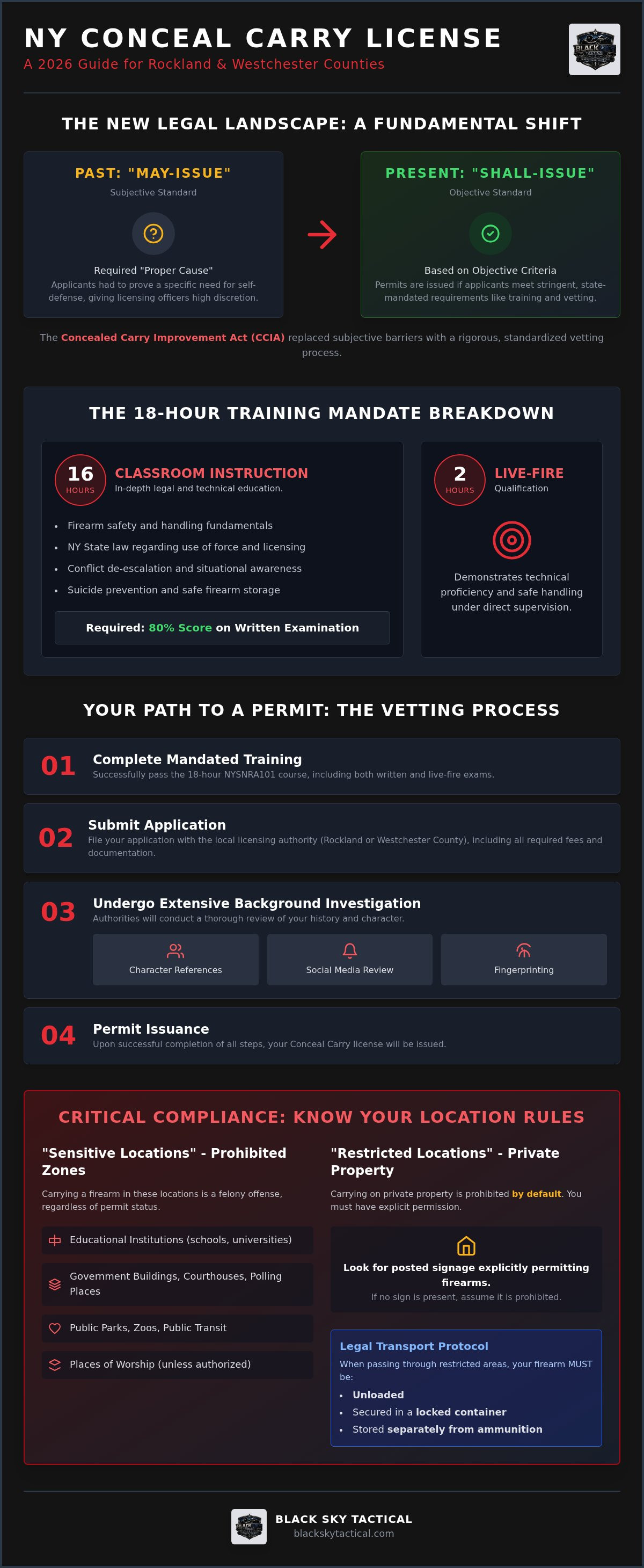
The regulatory framework governing NY Conceal Carry underwent a fundamental transformation following the Supreme Court's decision in NYSRPA v. Bruen. This ruling effectively transitioned New York from a "may-issue" jurisdiction, where applicants had to demonstrate a specific need for self-defense, to a "shall-issue" state. Under this current standard, licensing officers are required to issue a permit to any applicant who meets the objective criteria established by the state legislature. However, the subsequent enactment of the Concealed Carry Improvement Act (CCIA) introduced a series of rigorous administrative requirements designed to ensure that permit holders possess both the moral character and the technical proficiency necessary for public safety.
Compliance with these statutes is mandatory for both new applicants and existing permit holders seeking renewal. Failure to adhere to state and federal firearm statutes can result in immediate permit revocation and potential criminal prosecution. It's essential to recognize that while the "proper cause" barrier has been removed, the state has replaced it with an extensive vetting process that includes a review of social media accounts, character references, and the completion of a standardized 18-hour training course.
The Shift to Objective Licensing Standards
The removal of the "proper cause" requirement doesn't equate to a relaxation of standards. Instead, the state has shifted its focus toward an exhaustive background investigation and mandatory certification. Applicants must now navigate a landscape of New York gun laws that are recognized as some of the most stringent in the nation. This process ensures that individuals carrying a concealed weapon in public have undergone significant training and have been vetted through multiple layers of jurisdictional oversight. The emphasis is now placed on objective qualifications, such as the successful completion of a written exam and a live-fire proficiency test, rather than the subjective discretion of a licensing official.
Navigating Sensitive and Restricted Locations
A critical component of the CCIA involves the designation of "sensitive locations" where the possession of a firearm remains a felony offense, regardless of permit status. As of 2026, these areas include, but aren't limited to, the following:
- Educational institutions, including pre-schools and universities.
- Government buildings, courthouses, and polling places.
- Public parks, zoos, and specialized transit hubs.
- Places of worship, unless specifically authorized by the institution.
Additionally, the "restricted locations" rule establishes that carrying a firearm on private property is prohibited by default unless the property owner has explicitly posted signage permitting it. For those traveling through these zones, legal transport requires that the firearm be unloaded and secured in a locked container, separate from ammunition, to remain in compliance with state mandates. Understanding these nuances is vital for any individual exercising their NY Conceal Carry rights within Rockland or Westchester counties.
The 18-Hour Training Mandate: NYSNRA101 Breakdown
The NYSNRA101: Combined NYS 18-Hour Conceal Carry + NRA Basic Pistol Class serves as the primary educational vehicle for residents seeking a NY Conceal Carry license. This curriculum is meticulously structured to exceed the minimum standards established by the state, integrating the NRA basic pistol shooting course to provide a foundation of technical excellence. By combining these two programs, students receive both the administrative certification required for their permit and a globally recognized standard of firearm safety instruction. Accessing official NYS gun safety information confirms that this 18-hour training mandate is a non-negotiable prerequisite for all new applicants within the state.
The course is divided into 16 hours of classroom instruction and a mandatory 2-hour live-fire range qualification. This split ensures that applicants don't just understand the mechanics of a handgun, but also the gravity of the legal responsibilities that accompany its carry in public spaces. The training functions as a professional briefing, preparing individuals for the high-stakes reality of civilian firearm possession.
Classroom Instruction: Beyond the Basics
The 16-hour classroom component is designed to move beyond simple firearm operation, focusing heavily on the legal and ethical responsibilities of carrying a concealed weapon. A central focus of this instruction is a comprehensive analysis of NYS Penal Law Article 35, which dictates the specific circumstances under which the use of physical and deadly physical force is legally justifiable. We also explore the psychological complexities of self-defense, including the physiological responses during a high-stress incident and the legal aftermath that follows. Additional modules cover safe storage requirements to prevent unauthorized access, conflict de-escalation strategies to avoid the necessity of force, and urban situational awareness to identify potential threats before they escalate.
The Live-Fire Qualification Standard
The 2-hour live-fire portion of the training is a practical assessment of an applicant's ability to safely handle and accurately discharge a firearm. To satisfy the requirements for a NY Conceal Carry permit, students must demonstrate proficiency at various distances while maintaining a standardized accuracy threshold. This session isn't merely a practice round; it's a formal evaluation of safe drawing, holstering, and firing techniques under the supervision of certified instructors. For the convenience of our students, Black Sky Tactical provides the necessary firearms and ammunition for this qualification, ensuring that those who haven't yet purchased a handgun can still complete their certification. If you're ready to begin this professional certification process, you can view our upcoming course schedule to find a session that fits your timeline.
Step-by-Step Application Process for NY Residents
The application for a NY Conceal Carry license is an administrative procedure governed by the specific protocols of your county of residence. Although the NYSRPA v. Bruen Supreme Court decision fundamentally altered the legal landscape by establishing objective licensing standards, the actual submission process remains decentralized. Applicants must first identify their jurisdictional authority, which typically involves the County Clerk’s office or the local Sheriff’s Department, depending on the specific administrative structure of the region. This multi-stage process requires meticulous attention to detail, beginning with the compilation of a comprehensive application packet and culminating in a formal background investigation and personal interview.
County-Specific Nuances: Rockland, Orange, and Westchester
In Westchester County, the process is centralized through the Department of Public Safety’s Pistol License Unit. Applicants are required to pay a $175 processing fee along with a $120 background investigation fee, and they must schedule an appointment for both fingerprinting and a formal interview. Conversely, Rockland County residents must download a fillable PDF application and submit a $150 fee to the County Clerk’s Office before being fingerprinted by the Sheriff’s Department. Orange County applicants often experience varying processing times, necessitating a proactive approach to follow-up protocols once the 18-hour training certificate from the NYSNRA101 course is submitted. It's vital to ensure that every form is notarized where required, as minor administrative errors are the most common cause of application deferral or denial.
Managing Character References and Social Media
A significant component of the modern vetting process involves the demonstration of "good moral character" through both personal references and digital history. Applicants must provide four character references who aren't related to them by blood or marriage and who can attest to their stability and responsibility. Additionally, the Concealed Carry Improvement Act mandates the disclosure of social media accounts from the past three years. Licensing authorities review these platforms to identify any behavior or statements that might suggest a risk to public safety. Organizing this information in a transparent, linear fashion is essential for a successful review. During the mandatory in-person interview, a licensing officer will verify the details of your application and discuss your training experiences, making it imperative that you maintain a detailed record of your background documents to secure your NY Conceal Carry permit.
Developing Tactical Proficiency and Situational Awareness
Securing a NY Conceal Carry license represents the baseline of legal compliance, yet it shouldn't be viewed as the terminal point of an individual's education. True safety in the varied environments of Westchester and Rockland counties requires a transition from being a mere permit holder to becoming a tactically proficient citizen. This evolution involves a deep commitment to situational awareness, which serves as the primary layer of defense in both urban centers and suburban neighborhoods. By identifying potential conflicts before they escalate, a prepared individual can utilize de-escalation techniques to avoid the use of physical force entirely. For those seeking to accelerate this development, engaging a private firearms instructor NY provides the personalized attention necessary to refine holster draws and target acquisition under professional supervision.
The OODA Loop: Decision Making Under Stress
The OODA Loop (Observe, Orient, Decide, Act) provides a structured framework for processing information during high-stakes encounters. In public spaces, this means observing environmental anomalies and orienting yourself to recognize pre-attack indicators, which often precede a physical confrontation. These indicators may include:
- Target glancing or scanning for witnesses and exits.
- Unnatural gait or weight shifting that suggests a concealed weapon or aggressive intent.
- Conspicuous movements designed to "check" or adjust a hidden object.
Understanding these cues allows for a decisive response before a crisis reaches its peak. It's equally vital to manage the physiological effects of adrenaline, such as tunnel vision and auditory exclusion, which can impair judgment if not anticipated. Mastery of these psychological principles ensures that your reaction remains within the strict bounds of legal justification and professional responsibility.
Advanced Training Options Post-Permit
Once the initial 18-hour mandate is completed, ongoing education is essential to maintain proficiency and adapt to changing jurisdictional standards. Advanced programs such as Violent Incident Command training offer civilian responders a higher level of tactical knowledge, focusing on incident management and post-conflict protocols. For those who are new to the platform, private firearm training for beginners NY allows for the customization of drills to suit specific carry setups and hardware choices. These sessions are particularly beneficial for preparing for the NYS CCW renewal training cycle, ensuring that your skills don't atrophy over time. Regular proficiency check-ups should be treated as a professional obligation rather than an optional activity. If you want to elevate your defensive capabilities beyond the classroom, schedule a private training session with our expert instructors today.
Why Choose Black Sky Tactical for Your NY Conceal Carry Training?
Selecting a training provider for your NY Conceal Carry certification is a decision that carries significant legal and professional weight. Black Sky Tactical functions as a disciplined educational institution, prioritizing meticulous adherence to state mandates and the development of high-level tactical proficiency. Our instructors possess extensive backgrounds in safety education and tactical disciplines, ensuring that students receive a formal briefing on their responsibilities rather than a simple orientation. By maintaining accessible training facilities that serve Rockland, Orange, and Westchester counties, we provide a reliable bridge between the local citizen and the complex requirements of the state licensing authorities. We approach every course with a sense of duty, emphasizing that permit ownership is a serious commitment to public safety and personal integrity.
The NYSNRA101 Advantage
The NYSNRA101: Combined NYS 18-Hour Conceal Carry + NRA Basic Pistol Class represents our commitment to providing a superior educational experience that exceeds basic compliance. This flagship course is specifically engineered to fulfill all requirements of the NY 18-hour concealed carry course while simultaneously awarding students a nationally recognized NRA certificate. This dual-certification model ensures that your training is respected both within New York and across other jurisdictions that recognize NRA standards. We deliberately limit our class sizes to facilitate a steady, methodical pace of instruction, which allows our professional staff to provide individualized attention during the critical live-fire qualification. Our team also offers instructional support throughout the administrative process, helping you organize your application to meet the specific documentation standards required by your county clerk or sheriff's department.
Serving the Local Community
Our educational offerings are tailored to the unique demographic and legal needs of the Hudson Valley region. We recognize the importance of early safety education and provide specific guidance regarding Firearm laws for young adults NY, ensuring that families understand the regulatory pathway toward legal eligibility. For residents whose professional or personal lives require them to cross state lines, we also provide comprehensive NJ concealed carry permit training to ensure total compliance with New Jersey’s Permit to Carry (PTC) standards. This holistic approach to training ensures that your knowledge remains current and your skills remain sharp, regardless of which side of the state border you find yourself on. We don't view ourselves as a lifestyle brand, but as a professional resource for those who value safety, education, and strict legal compliance.
Register for the NYSNRA101 Combined Course at Black Sky Tactical to begin your transition from an applicant to a certified, proficient permit holder.
Securing Your Professional Certification for 2026
Navigating the administrative and technical requirements of the current licensing cycle requires a disciplined approach to both legal compliance and skill development. We've examined how the transition to objective standards has increased the necessity for formal certification through the NYSNRA101 course. It's clear that obtaining a NY Conceal Carry permit is just the first step in a commitment to responsible firearm ownership and situational awareness. By integrating the NRA Basic Pistol curriculum with state-mandated training, you ensure that your foundational knowledge meets the highest professional standards while satisfying local jurisdictional mandates in Rockland, Orange, and Westchester.
Black Sky Tactical provides the expert guidance needed to move through the background investigation and live-fire qualification with confidence. Our certified NRA instructors deliver a NYS CCW compliant curriculum designed to prepare you for the realities of public carry. You don't have to face the complexity of county-specific application processes alone. We provide a structured environment where safety and administrative precision remain the highest priorities.
Enroll in the NYSNRA101: Combined NYS 18-Hour Conceal Carry + NRA Basic Pistol Class to finalize your training requirements and join a community of proficient, safety-conscious citizens. We look forward to supporting your journey toward legal and tactical readiness.
Frequently Asked Questions
Is the 18-hour training course mandatory for all NY Conceal Carry applicants?
The 18-hour training course is mandatory for all new applicants seeking a NY Conceal Carry license under the Concealed Carry Improvement Act. This requirement consists of 16 hours of in-person classroom instruction and a 2-hour live-fire range component. Completion of this mandate is a prerequisite for the background investigation phase. Applicants must submit a certificate of completion from a certified instructor, such as those leading the NYSNRA101 course, to their licensing authority.
Can I use my NY Conceal Carry permit in New York City?
A standard county-issued permit is generally not valid within the five boroughs of New York City unless it is specifically endorsed for NYC carry. Applicants residing outside the city must typically apply for a Special Carry license through the NYPD Licensing Division to legally possess a firearm within city limits. It's essential to consult the specific administrative codes of the NYPD, as city regulations remain distinct from the broader state-level jurisdictional authorities.
What is the live-fire qualification requirement for the NY CCW permit?
The live-fire qualification requires applicants to demonstrate technical proficiency and safe firearm handling under the supervision of a certified instructor. To meet the NY Conceal Carry standard, students must achieve a minimum proficiency score on a written exam and pass a range assessment involving specific distances and accuracy thresholds. This 2-hour session ensures that every permit holder can safely draw, fire, and holster their weapon while adhering to strict safety protocols established by the state.
Do I need to list all my social media accounts on the NY permit application?
Applicants are required to provide a list of their social media accounts from the past three years as part of the "good moral character" assessment. Licensing officers review these digital records to identify any history of behavior that might indicate a risk to public safety. While this requirement has been subject to legal challenges, it remains a procedural mandate in 2026. Ensuring your digital presence aligns with the responsibilities of firearm ownership is a critical part of the vetting process.
How often does a NY Concealed Carry license need to be renewed in 2026?
In 2026, a NY Concealed Carry license must be renewed every three years. This represents a shift from previous five-year cycles, reflecting the state's intent for more frequent oversight of permit holders. The renewal process involves submitting an updated application and potentially completing supplemental training modules. It's the responsibility of the permit holder to monitor their expiration date and initiate the recertification process with their county licensing authority to avoid the legal consequences of an expired permit.
What happens if my character references are not accepted by the licensing officer?
If a licensing officer determines that your character references don't meet the legal criteria or fail to provide sufficient testimony of your moral character, your application may be deferred or denied. You must provide four references who aren't related to you by blood or marriage. If a reference is disqualified, the licensing authority typically requests a replacement. A complete failure to provide credible references will result in a formal denial of the permit based on administrative non-compliance.
Does NY honor concealed carry permits from other states like NJ or CT?
New York State does not recognize concealed carry permits issued by any other state, including neighboring New Jersey or Connecticut. Individuals who hold valid out-of-state permits must still complete the full New York application process, including the 18-hour training mandate, to legally carry within the state. This lack of reciprocity necessitates that multi-state travelers obtain specific certifications, such as the NJSNRA101 for New Jersey compliance, to ensure they remain legally protected across state lines.
Can military veterans waive the 18-hour training requirement in NY?
Military veterans are generally not exempt from the 18-hour training requirement for a NY Conceal Carry license. While prior service provides a strong foundation in firearm safety, the state mandate specifically requires instruction on NYS Penal Law Article 35 and local sensitive location regulations. Most licensing authorities, including those in Rockland and Westchester, require all civilians to complete the standardized curriculum to ensure every applicant is briefed on the specific legal landscape of New York State.


