
Possessing a firearm for personal protection in the NY/NJ tri-state area is no longer merely a matter of marksmanship, but is now primarily a challenge of administrative and legal endurance. You likely recognize that recent legislative shifts have transformed the application process into a complex series of mandates that can feel overwhelming to even the most disciplined applicants. Managing these requirements demands a meticulous approach to ensure that your Concealed Carry permit application is not only successful but also legally defensible in a highly regulated environment.
This guide provides the necessary clarity to master the legal requirements and rigorous training standards required to obtain and maintain your credentials in Rockland and Orange County. We will examine the specific components of the 18-hour New York State mandate, the necessary certifications for the New Jersey Permit to Carry, and the procedural steps involved in securing professional instruction. By understanding the integration of state mandates with established safety standards through courses such as NYSNRA101 and NJSNRA101, you can transition from an applicant to a proficient, legally compliant permit holder with confidence in your training and your standing with jurisdictional authorities.
Key Takeaways
- Understand the administrative distinction between constitutional carry and the rigorous permit-based systems enforced throughout the NY/NJ tri-state area.
- Identify the core components of the mandatory 18-hour training syllabus, which includes specialized instruction in holster skills and conflict de-escalation.
- Navigate the multi-step application journey for a Concealed Carry permit by identifying the specific roles of the State Police and County Clerk's offices.
- Evaluate firearm and holster combinations based on their suitability for both safe retention and the technical requirements of state-mandated qualification courses.
- Discover how combined training programs like NYSNRA101 and NJSNRA101 offer an efficient path to compliance by merging state requirements with NRA certifications.
Understanding Concealed Carry: Legal Mandates and Personal Responsibility
Concealed carry refers to the legal practice of carrying a handgun in public spaces in a manner that ensures the firearm remains hidden from the view of others. In the Northeast, specifically within the jurisdictions of New York and New Jersey, this practice is strictly regulated through a permitting system. Unlike "constitutional carry" states where no permit is required for law-abiding citizens, residents in Rockland and Orange counties must adhere to rigorous statutory requirements before they can legally carry a firearm. This decision carries immense legal and moral weight; a permit holder isn't just a firearm owner, but a citizen who has accepted a heightened level of accountability under the law.
The foundation of firearm regulation in New York is Penal Law 400.00. This statute serves as the exclusive authority for the issuance of licenses to possess or carry pistols and revolvers. It establishes the eligibility criteria, the application process, and the specific conditions under which a license may be revoked. Understanding this law is essential because any deviation from its mandates can result in criminal prosecution and the permanent loss of firearm privileges. Legal compliance is the only path to maintaining your status as a lawful permit holder.
The Evolution of Concealed Carry Laws in 2026
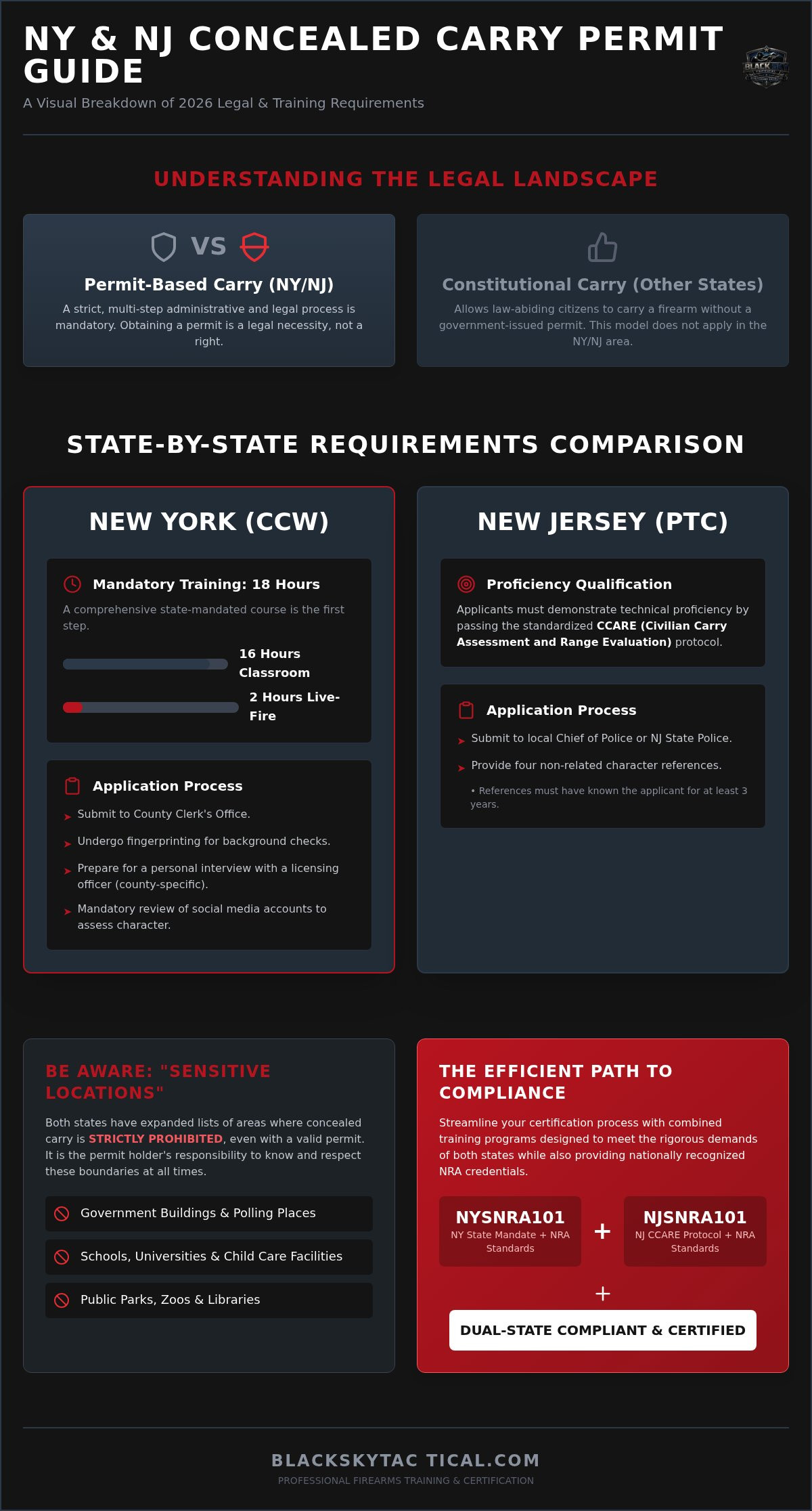
The legal landscape surrounding firearm permits has undergone significant transformation following the Supreme Court's decision in NYSRPA v. Bruen. While the ruling shifted the region from a "may-issue" to a "shall-issue" framework, it also prompted state legislatures to implement more stringent training hurdles. As of 2026, applicants must complete a comprehensive 18-hour training course to demonstrate proficiency. Additionally, the "Sensitive Locations" doctrine has expanded, creating a complex map of areas where Concealed Carry is prohibited. These locations include government buildings, schools, and public parks, making it the permit holder's responsibility to know the boundaries of the law at all times.
Concealed Carry vs. Open Carry: Jurisdictional Differences
In the tri-state area, open carry is effectively non-existent and legally precarious. Carrying a firearm openly in public is not recognized as a lawful activity under current NY or NJ administrative codes. Consequently, the only viable path for public carry is through a concealed carry permit (CCW in New York or PTC in New Jersey). If a firearm becomes visible, even inadvertently, it can lead to administrative action or charges of menacing. The legal consequences of carrying a firearm without a valid, state-recognized permit are severe, often involving felony charges that carry mandatory prison sentences. Maintaining a valid permit and ensuring the firearm remains concealed is a strict administrative necessity for legal compliance.
Step-by-Step: Obtaining Your NYS Concealed Carry Permit
The process begins with the mandatory 18-hour safety course, which is strictly divided into 16 hours of classroom instruction and 2 hours of live-fire training. In Rockland and Westchester counties, applicants must also prepare for a personal interview with a licensing officer. Beyond the standard fingerprinting, New York requires a review of the applicant's social media accounts to assess character. To ensure you meet these rigorous standards, you can enroll in a NYSNRA101 combined course to streamline your certification.
The NJ Permit to Carry (PTC) Requirements for 2026
New Jersey has standardized its shooting qualifications under the CCARE protocol, requiring technical proficiency through a specific course of fire. For Bergen County residents, the application is submitted to the local Chief of Police or the State Police. The administrative burden includes providing four non-related references who've known the applicant for at least three years. The State Police maintain oversight for applicants in areas without municipal coverage, ensuring that every permit issued meets the same high standard of scrutiny. Utilizing the NJSNRA101 course is a strategic choice for those seeking a Concealed Carry permit, as it ensures the training meets both state and NRA standards.
Mandatory Training: The 18-Hour NYS CCW Course Requirement
The 18-hour training requirement mandated by New York State represents a significant departure from the brief safety orientations of the past. Applicants seeking a Concealed Carry permit must now complete 16 hours of classroom instruction followed by a 2-hour live-fire range session. This expanded syllabus ensures that permit holders possess a foundational understanding of the legal, ethical, and practical responsibilities associated with public carry. A standard four-hour safety certificate no longer satisfies the administrative requirements set forth by the Division of Criminal Justice Services (DCJS) and the State Police. It's a rigorous process designed to verify both your knowledge of the law and your physical proficiency with a firearm.
NYSNRA101: Why Combined Training is the Standard
The NYSNRA101 course integrates the NRA Basic Pistol syllabus directly into the 18-hour state-mandated curriculum. This approach is highly efficient for students because it allows them to meet two major requirements within a single training block. By choosing this combined format, you receive both the certification required for your New York permit and a nationally recognized NRA certificate. This dual certification is particularly valuable for those who may seek non-resident permits in other jurisdictions, as the NRA Basic Pistol course is often the baseline standard for training recognition across the country. It's a professional solution that respects the student's time while maintaining a high standard of education.
Curriculum Highlights: From Law to Live Fire
The classroom portion of the course focuses heavily on New York Penal Law Article 35, which outlines the defense of justification. This section provides a detailed analysis of when the use of physical force, including deadly physical force, is legally permitted. Students also study safe storage requirements, including the legal obligations for securing firearms at home and within vehicles as mandated by recent legislative updates. These laws are technical and carry significant penalties for non-compliance, making this instruction a critical component of your legal protection.
The 2-hour live-fire component requires students to demonstrate proficiency through a standardized course of fire. This isn't merely a practice session; it's a formal evaluation of your ability to handle a firearm safely and achieve consistent hits on a target. Instructors assess your holster skills, trigger control, and adherence to safety protocols during every stage of the qualification. Successfully completing this portion is the final administrative hurdle before your training certificate can be issued. This certificate serves as documented proof that you've met the state's professional training standards.
Essential Gear and Proficiency for Concealed Carry
Selecting equipment for Concealed Carry requires a disciplined evaluation of both technical performance and administrative compliance. Your choice of firearm and support gear isn't merely a matter of personal preference; it's a critical component of your ability to meet state-mandated qualification standards. A firearm that's too small may be easy to conceal but difficult to manage during the live-fire proficiency test, while a larger frame might lead to inadvertent "printing," which can carry legal risks in the tri-state area. Balancing these practical needs ensures you remain both effective and compliant with local regulations.
Choosing Your EDC (Everyday Carry) Setup
A functional EDC setup starts with a firearm that allows for consistent accuracy and safe handling. While sub-compact pistols are popular for their concealability, they often require advanced recoil management skills that a new permit holder may still be developing. It's essential to balance these factors to ensure success during the 2-hour live-fire evaluation. Supporting this firearm requires a purpose-built gun belt. Standard leather belts often lack the structural rigidity to keep a holstered firearm secure and accessible, leading to sagging and poor retention that can compromise safety.
Holster selection is equally critical. A compliant holster must provide full coverage of the trigger guard and positive retention to prevent the firearm from becoming dislodged. Ammunition selection also follows a dual-track approach. You'll use target loads for high-volume practice and the mandatory qualification, but you must transition to high-quality defensive rounds for actual carry. These rounds are engineered for specific terminal performance and reliability, which are necessary for personal protection. If you need assistance in refining your equipment selection, seeking private firearm instruction NY can provide a tailored assessment of your setup.
Maintaining Proficiency Beyond the Permit
Obtaining a permit is the beginning of a lifelong commitment to technical skill and legal knowledge. It's best to view the CCW permit as a "license to learn" rather than a final certification of mastery. The initial 18-hour course provides the baseline, but the fundamentals of marksmanship and safe handling degrade without regular reinforcement. Many successful applicants find that returning to the NRA basic pistol shooting course helps solidify the core skills necessary for responsible firearm ownership.
Regular range practice isn't just a recommendation; it's a moral and legal obligation. In the event of a defensive encounter, your actions will be scrutinized against the standard of a "reasonable person" with proper training. Consistent practice ensures that your response is both effective and legally defensible. To advance your skills beyond the mandatory requirements, you should consider scheduling Private Firearm Training to address specific areas for improvement and maintain your proficiency.
Choosing Black Sky Tactical for Your NY/NJ Certification
Black Sky Tactical functions as a disciplined intermediary between the individual citizen and the complex administrative mandates of the tri-state area. We prioritize a grounded, professional methodology that focuses on strict legal compliance and the development of practical proficiency. By choosing our institution, you're engaging with instructors who view firearm education as a serious responsibility rather than a casual hobby. Our primary objective is to ensure that every student leaves with a complete understanding of their obligations under the law and the technical skills necessary to meet state-mandated qualification standards. We provide a bridge to compliance that respects the gravity of the subject matter.
Our Approach to the 18-Hour NYS Course
Our NYSNRA101 course is structured to adhere precisely to the 16-hour classroom and 2-hour live-fire syllabus required by New York State. We maintain small class sizes to ensure that each student receives individualized attention during the holster skills and marksmanship portions of the training. This instructional environment allows our staff to identify and correct technical errors before the final qualification, increasing the likelihood of a successful outcome for your Concealed Carry application. Beyond the technical training, we provide essential guidance on the administrative nuances of the application process, helping you navigate the specific documentation requirements and character reference protocols that often cause delays for unguided applicants.
Serving Rockland, Orange, Westchester, and Bergen Counties
The licensing process in the Northeast is notoriously localized, with different counties often maintaining unique procedural expectations for their applicants. Our deep familiarity with the specific requirements in Rockland, Orange, Westchester, and Bergen counties allows us to prepare students for the specific scrutiny they'll face from local licensing officers. Whether you're pursuing the NYSNRA101 for a New York permit or the NJSNRA101 for a New Jersey Permit to Carry, our scheduling is designed to be methodical and efficient, allowing you to complete your requirements in a structured timeframe. We're committed to your long-term safety and tactical proficiency, positioning our courses as the foundation for a lifetime of responsible, legally compliant firearm ownership. This local expertise ensures that you're not just meeting a state mandate, but are also prepared for the specific administrative landscape of your home jurisdiction.
Securing Your Credentials Through Professional Certification
Obtaining a permit in the tri-state area is a rigorous administrative process that requires both technical proficiency and a thorough understanding of current regulatory mandates. You've learned that success depends on mastering the 18-hour NYS syllabus and navigating the specific procedural expectations of licensing officers in Rockland and Orange counties. By prioritizing legal compliance and certified instruction, you ensure that your status as a permit holder is built on a foundation of professional responsibility and documented skill.
Black Sky Tactical provides the necessary expertise to guide you through these requirements with meticulous attention to detail. Our local knowledge of NY and NJ regulations, combined with our certified training syllabus, ensures that your Concealed Carry application meets the highest standards of jurisdictional authority. We invite you to Enroll in the NYSNRA101: Combined NYS 18-Hour Conceal Carry + NRA Basic Pistol Class to secure your combined NRA Basic Pistol certification and state-mandated credentials in one efficient program. We look forward to supporting your commitment to safe and lawful firearm ownership.
Frequently Asked Questions
How many hours of training are required for a NY concealed carry permit in 2026?
New York State mandates a minimum of 18 hours of training for all applicants seeking a Concealed Carry license as of 2026. This requirement is strictly partitioned into 16 hours of classroom instruction covering topics like conflict de-escalation and penal law, alongside 2 hours of live-fire range training. Applicants must attend the full duration to receive the certificate of completion necessary for their specific county-level application process.
Does the NYSNRA101 course include the live-fire qualification?
The NYSNRA101 course is a comprehensive program that fully incorporates the mandatory 2-hour live-fire qualification required by the state. During this session, students must demonstrate safe firearm handling and achieve a passing score on the standardized course of fire under the supervision of a certified instructor. This integrated approach ensures that all technical and administrative proficiency standards are met within the single 18-hour training block.
Can NJ residents use the same training for their NY permit?
NJ residents may use training completed through the NYSNRA101 course for their New York non-resident permit application, provided the curriculum meets the specific 18-hour New York State mandate. While New Jersey has its own distinct CCARE qualification standards for a Permit to Carry, New York licensing officers will only accept certificates that explicitly document the 16+2 hour syllabus required by NY Penal Law 400.00.
What happens if I fail the live-fire portion of the CCW course?
If an applicant does not meet the proficiency standards during the live-fire portion of the course, they'll be required to undergo additional instruction before attempting the qualification again. Failure to pass the live-fire component prevents the issuance of the training certificate. In such cases, pursuing private firearm instruction is often the most effective way to address specific technical deficiencies and ensure future compliance with state standards.
Are social media accounts still reviewed for NY CCW permits?
Review of social media accounts remains a standard component of the background investigation process for a Concealed Carry permit in New York. Licensing officers utilize this information to evaluate the applicant's character and conduct as part of the "good moral character" requirement. Applicants are typically required to provide a list of their current and former social media accounts from the past three years during the submission phase.
How often do I need to renew my concealed carry training in NY and NJ?
In New York, permit holders must generally recertify or renew their license every three years, though specific requirements can vary by county jurisdiction. New Jersey requires a Permit to Carry (PTC) to be renewed every two years, which includes a fresh background check and proof of continued shooting proficiency. It's the permit holder's responsibility to track these expiration dates to avoid administrative lapses and potential legal non-compliance.
Is the NRA Basic Pistol certificate required for a CCW permit?
While the NRA Basic Pistol certificate is not a standalone legal requirement for a carry permit, it's the foundational standard for many combined training programs. The state mandates its own specific 18-hour curriculum, but the inclusion of the NRA syllabus provides a nationally recognized credential. This integration ensures that the training meets both the rigorous administrative demands of the state and established national safety standards.


