
Could a single oversight in your understanding of New York's 18-hour training mandate lead to unintended legal consequences or a compromise in household security? For residents in Rockland and Bergen counties, the decision to own a weapon is inseparable from a commitment to rigorous firearm safety and strict adherence to evolving state laws. You likely recognize that the high-stakes nature of this responsibility requires more than just good intentions; it demands a precise, methodical approach to both mechanical handling and administrative compliance.
This guide is designed to bridge the gap between your current concerns and the level of expert proficiency required by modern regulatory standards. By reading further, you'll master the fundamental pillars of safe operation, gain a thorough understanding of current NY and NJ legal mandates, and learn how professional certification serves as the essential foundation for lawful possession. We'll examine the specific requirements of the New York State 18-hour concealed carry course, the New Jersey CCARE protocol, and the practical steps you must take to secure a permit with total confidence in your skills.
Key Takeaways
- Learn the four universal rules of firearm safety that form the non-negotiable foundation for every responsible owner in the Rockland and Bergen regions.
- Discover how to implement the "Three-Point" storage protocol to ensure your home remains secure while maintaining rapid access through modern safe technologies.
- Understand the specific administrative requirements of the mandatory 18-hour training courses necessary to obtain a concealed carry permit in New York and New Jersey.
- Explore advanced methods for moving beyond static target practice toward dynamic defensive proficiency and heightened situational awareness.
- Identify the critical criteria for selecting certified instructors to ensure your training documentation serves as a valid legal shield and professional credential.
The Four Universal Rules of Firearm Safety
The four universal rules of firearm safety constitute a foundational doctrine that every owner must internalize before handling a weapon. These protocols are not merely suggestions; they function as a redundant system of protection where the strict application of one rule prevents a catastrophe even if another is momentarily breached. In the high-stakes environment of Rockland and Bergen counties, where residential density is high, the margin for error is non-existent. Adherence to these standards is the primary requirement for any individual seeking to exercise their rights responsibly.
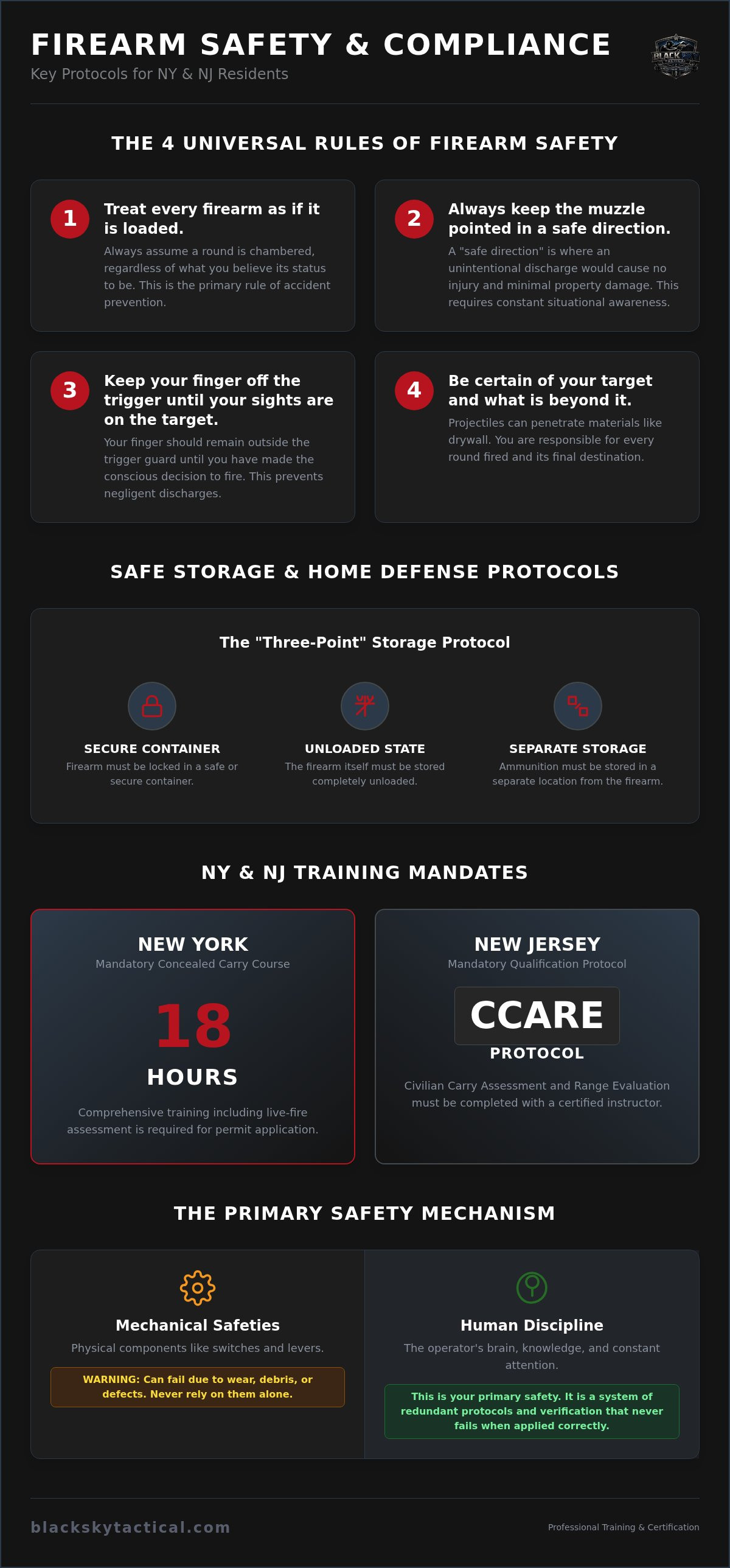
- Treat every firearm as if it is loaded: You must act with the assumption that a round is chambered, regardless of what you believe the status to be or who last handled the device.
- Always keep the muzzle pointed in a safe direction: A safe direction is one where an unintentional discharge would result in no human injury and minimal property damage.
- Keep your finger off the trigger until your sights are on the target: The trigger guard is a physical boundary that your finger must never cross until you have made a conscious, legal decision to fire.
- Be certain of your target and what is behind and around it: Projectiles can penetrate common building materials, such as drywall and plywood, and travel significant distances beyond the intended point of impact.
Mechanical Safety vs. Human Discipline
Mechanical safeties are physical components that can, and occasionally do, fail due to wear, debris, or manufacturing defects. Relying solely on a switch or a lever to prevent a discharge is a dangerous abdication of responsibility. The operator's brain is the primary safety mechanism. Discipline involves a methodical "clearing" process, which is a multi-step visual and physical verification. You must visually inspect the chamber and magazine well, then physically insert a finger to confirm the absence of ammunition. This level of meticulous attention is a core component of the NYSNRA101 and NJSNRA101 curriculum, ensuring that "clearing" a weapon is never a hurried or superficial act.
Muzzle Discipline in Public and Private Spaces
Defining a "safe direction" requires constant situational analysis. In a wooded area, the ground may be appropriate, but in a Bergen County apartment complex, a safe direction must account for the presence of neighbors in adjacent rooms or floors. Beginners are encouraged to use the "laser beam" visualization technique. You must imagine a continuous, destructive beam of light emitting from the muzzle at all times. This visualization forces the operator to maintain constant awareness of where the muzzle is "cutting" as they move or perform administrative handling. Whether you are cleaning your firearm at home or practicing at a range, muzzle awareness is the most critical factor in maintaining firearm safety and preventing injury.
Safe Storage and Home Defense Protocols
Transitioning from active handling to static storage is a critical phase in maintaining firearm safety within a residential environment. In both New York and New Jersey, the legal framework regarding secure storage is rigorous, specifically designed to prevent unauthorized access by minors or prohibited individuals. New York state law requires firearms to be secured if a person under sixteen years of age resides in the home or is likely to gain access. Responsible ownership requires the implementation of the "Three-Point" storage protocol, which dictates that a firearm must be locked in a secure container, kept in an unloaded state, and stored in a location physically separate from its ammunition. This redundancy ensures that even if one layer of security is compromised, the weapon remains non-functional for an unauthorized user.
Homeowners in Rockland and Bergen counties must evaluate safe options based on their specific defensive needs and household composition. While traditional dial locks provide high reliability, they often lack the speed required during a critical incident. Modern alternatives include:
- Biometric Safes: These utilize fingerprint recognition to provide near-instant access for authorized users while maintaining a high level of security.
- Electronic Keypads: These offer a balance of speed and reliability, allowing for rapid entry via a programmed code.
- Rapid-Access Long Gun Safes: Designed for larger platforms, these are often mounted to wall studs to prevent theft of the entire unit.
Balancing Accessibility with Security
Navigating the nuances of "staged" versus "stored" firearms is essential for effective home defense. A staged firearm is one that is secured yet remains accessible enough for immediate use. You must ensure that your choice of staging does not violate jurisdictional mandates, which often require firearms to be locked if children are present in the home. It's necessary to conduct regular audits of your storage protocols. As children age or family dynamics change, a system that was sufficient last year may require administrative updates to maintain compliance and safety. For those seeking to optimize their home setup, private firearm training can provide a tailored assessment of your specific environment.
Youth Firearm Safety and Education
Education is the most effective deterrent against curiosity-driven risks. You should initiate age-appropriate conversations with children to demystify firearms and establish clear boundaries. The "Stop, Don't Touch, Leave the Area, Tell an Adult" protocol is the industry standard for younger children who may encounter a weapon in an unsecured setting. For older children and teenagers, a formal Youth Safety Course provides a structured, professional environment to learn the gravity of firearm handling. This education transforms a potential hazard into a subject of respect and disciplined understanding, significantly reducing the likelihood of accidental discharges within the home.
Regulatory Safety: Meeting NY and NJ Training Mandates
In the jurisdictional landscape of Rockland and Bergen counties, firearm safety is codified through rigorous state-mandated training requirements that serve as a prerequisite for legal carry. New York and New Jersey have established specific administrative hurdles to ensure that every permit holder possesses a standardized level of proficiency. These mandates are not merely bureaucratic obstacles; they are designed to verify that an individual can navigate the complex intersection of mechanical operation and legal use of force. Understanding the distinct requirements of each state is the first step toward achieving a compliant status as a responsible owner.
The foundation for this training often begins with the NRA Basic Pistol course, which provides the universal safety principles required for more advanced state-specific certifications. While Rockland County and Bergen County share a border, their administrative paths to a permit differ significantly. New York focuses on a comprehensive classroom-heavy syllabus, while New Jersey emphasizes holster-based proficiency and use-of-force legalities. Both states, however, share the common goal of ensuring that no individual carries a weapon without first demonstrating a disciplined understanding of their legal and moral obligations.
The NYS 18-Hour CCW Course Syllabus
The New York State training standard is defined by an 18-hour curriculum, which is divided into 16 hours of classroom instruction and 2 hours of live-fire training. During the classroom portion, students examine state and federal laws, safe storage requirements, and conflict de-escalation strategies. You must achieve a minimum score of 80% on the written examination to proceed to the range qualification. The 2-hour live-fire segment is a critical assessment where you must demonstrate safe handling and marksmanship proficiency under the supervision of a certified instructor. Adhering to the NYS CCW 18 hour course requirements is an absolute necessity for any Rockland County resident seeking a concealed carry pistol license.
NJ PTC (Permit to Carry) Compliance Standards
New Jersey’s Permit to Carry (PTC) standards follow a standardized qualification known as the CCARE protocol. This protocol requires applicants to demonstrate proficiency by firing 50 rounds at FBI "Q" targets from distances of 15, 10, 7, 5, and 3 yards. Unlike general range practice, this qualification must be performed by drawing from a holster, reinforcing the practical application of firearm safety in a defensive context. A central pillar of NJ concealed carry permit training is the Use of Force component, which outlines the narrow legal parameters under which a firearm may be discharged. This training ensures that Bergen County residents are not only technically proficient but also administratively prepared for the legal scrutiny that follows any defensive encounter.
Developing Defensive Proficiency and Situational Awareness
Static target practice represents only the mechanical baseline of firearm operation. To achieve true defensive proficiency, a permit holder in Rockland or Bergen must integrate psychological preparedness with physical skills. This evolution involves understanding the Cooper Color Code, a system of situational awareness that categorizes mental states from Condition White (completely unaware) to Condition Red (lethal encounter). Maintaining Condition Yellow, a state of relaxed alertness, is the standard for responsible citizens. This state allows for the early detection of potential threats before they escalate into a crisis, ensuring that firearm safety remains a proactive rather than reactive discipline.
Mastery of the OODA Loop, which stands for Observe, Orient, Decide, and Act, is essential for making high-stakes decisions under duress. This cognitive cycle ensures that an individual can process environmental data and select a legal, safe response more rapidly than an adversary. During a violent incident, the psychological impact can lead to physiological changes such as auditory exclusion or tunnel vision. Developing "Command" principles through specialized training helps an operator maintain clarity and follow-through. This discipline ensures that safety protocols remain intact even during the intense physiological surge of a life-threatening event.
Situational Awareness in Everyday Life
Recognizing pre-attack indicators, such as scanning behavior, target glancing, or unnatural movements in public environments, provides a critical window for de-escalation or egress. For concealed carriers, situational awareness involves tactical positioning, such as facing the entrance in public spaces and identifying secondary exit strategies. Proper situational awareness training often results in the avoidance of conflict altogether. This fulfills the ultimate goal of defensive education: surviving an encounter without ever needing to discharge a weapon.
The Value of Private Instruction
One-on-one coaching offers a significant advantage over group sessions by allowing an instructor to identify and correct minute errors in grip, stance, or draw stroke that might otherwise go unnoticed. Customizing drills to reflect your specific home layout or daily commute ensures that your training is practical rather than theoretical. If you are starting your journey, private firearm training for beginners NY provides the personalized attention necessary to build a foundation of accuracy and legal confidence. To begin your professional development, contact Black Sky Tactical to schedule a session tailored to your jurisdictional needs and current skill level.
Formal Certification: The Path to Responsible Ownership
Certification serves as objective evidence of a citizen's commitment to firearm safety and legal compliance. In the event of a legal inquiry or administrative review, your training records and certificates of completion act as a critical shield, documenting that you've met or exceeded state-mandated standards. You should evaluate potential instructors with scrutiny, ensuring they hold active NRA certifications and are recognized by the relevant state agencies in New York or New Jersey. A qualified instructor provides more than just a signature; they offer a professional syllabus that bridges the gap between mechanical skill and jurisdictional accountability.
The combined NYSNRA101 and NJSNRA101 courses offer a distinct advantage for residents in the Rockland and Bergen regions. These programs integrate the comprehensive safety fundamentals of the NRA with the specific 18-hour mandates required by state law. This integrated approach ensures that your education isn't fragmented but builds logically from basic handling to complex legal scenarios. Beyond the initial permit, becoming part of the broader community through NRA membership provides access to ongoing education and updates on legislative shifts that affect your rights and responsibilities. Ongoing training ensures that your skills don't atrophy and that you remain informed about the evolving legal landscape.
Why Black Sky Tactical? The Local Advantage
Our instructors possess deep expertise in the specific regulatory environments of Rockland, Orange, Westchester, and Bergen counties. We don't view training as a mere transaction; it's a professional responsibility to ensure every student is prepared for the high-stakes reality of firearm ownership. Our NRA basic pistol shooting course establishes the foundational habits that prevent accidents and ensure long-term proficiency. We prioritize a sober, methodical environment where accuracy and safety are the only acceptable outcomes, providing a level of local expertise that generic national programs cannot match.
Next Steps for Permit Applicants
Once you complete your classroom hours, the next phase involves gathering your administrative documentation and scheduling your live-fire qualification with a certified professional. You'll need to ensure all signatures are on the correct jurisdictional forms and that your fingerprints are processed according to local law enforcement protocols. It's essential to remember that firearm safety education is a recurring obligation rather than a one-time event. You should plan for periodic renewal courses and skills maintenance to ensure your proficiency remains sharp and your permit remains in good standing with the state authorities.
Securing Your Path to Lawful and Disciplined Ownership
Responsible ownership in the Rockland and Bergen regions is defined by a continuous commitment to education and administrative compliance. By mastering the mechanical rules of firearm safety and establishing secure storage protocols, you create a foundation of protection for your household. The transition from a permit seeker to a certified carrier requires a methodical understanding of state-specific mandates, ensuring that every action you take is supported by thorough legal knowledge and disciplined handling skills.
Obtaining a formal certification provides the necessary verification of your proficiency and serves as a vital legal shield in high-stakes environments. Our NRA Certified Instructors offer training that is fully compliant with 2026 NYS and NJS mandates, specifically serving the needs of Rockland, Orange, Westchester, and Bergen county residents. We provide the professional oversight required to navigate complex jurisdictional requirements with total confidence and precision.
Enroll in the NYS/NJS 18-Hour Combined Safety & CCW Course to begin your journey toward responsible and legal firearm possession. We are prepared to help you achieve the gold standard in safety and certification as you take this important step for your family and community.
Frequently Asked Questions
What is the 18-hour concealed carry course requirement in NY?
The 18-hour requirement consists of 16 hours of classroom-based instruction and 2 hours of live-fire training as mandated by current New York State law. This curriculum is a prerequisite for any individual applying for a concealed carry pistol license in Rockland County and surrounding areas. The program covers essential topics including state and federal law, conflict de-escalation, and mechanical proficiency. You must pass a written exam with a minimum score of 80% to demonstrate compliance.
How do I safely store a firearm if I have children in the house?
You must store the firearm in a secure, locked container that is physically inaccessible to unauthorized minors and separate from its ammunition. New York law specifically mandates that firearms be secured if a person under sixteen years of age resides in the home or is likely to gain access. Implementing the "Three-Point" rule, which involves keeping the weapon unloaded and locked, provides the highest level of household security while maintaining strict compliance with jurisdictional regulations.
Can I take an NRA Basic Pistol course to fulfill NYS permit requirements?
A standalone NRA Basic Pistol course does not meet the current New York State 18-hour training requirement for a concealed carry permit application. However, the NYSNRA101 course integrates the foundational NRA curriculum with the specific state-mandated classroom and live-fire hours. This combined approach ensures that you receive the technical benefits of NRA training while simultaneously fulfilling the administrative mandates required by New York law for permit seekers in Rockland and Orange counties.
What are the specific shooting standards for the NJ Carry Permit qualification?
The New Jersey Permit to Carry qualification follows the CCARE Protocol, which requires an applicant to fire 50 rounds at an FBI "Q" target. You must demonstrate proficiency from distances of 15, 10, 7, 5, and 3 yards, with 10 rounds fired at each interval. This qualification specifically requires the operator to draw from a holster, reinforcing the practical application of firearm safety and marksmanship under standardized administrative oversight for Bergen County residents.
Is situational awareness training included in standard safety classes?
Situational awareness is a core component of both the mandatory 18-hour course in New York and the Permit to Carry training in New Jersey. These modules teach permit seekers to recognize pre-attack indicators and utilize the OODA loop to process environmental threats effectively. Understanding these psychological principles is as critical as mechanical skill, as it allows an owner to identify and avoid potential conflicts before they require a physical or lethal response.
How often should I practice live-fire drills to maintain safety proficiency?
You should schedule live-fire practice sessions at least once every quarter to prevent the atrophy of critical handling and marksmanship skills. While state mandates establish the baseline for permit issuance, maintaining high levels of firearm safety requires consistent and deliberate repetition. Monthly sessions are recommended for those who wish to maintain advanced defensive proficiency and ensure that their mechanical responses remain instinctive, accurate, and safe under the pressure of a crisis.
What should I do if I find an unattended firearm in a public place?
You should immediately maintain a safe distance from the weapon and alert local law enforcement without touching or attempting to secure the device yourself. It's essential to keep the area clear of other bystanders until authorities arrive to take possession of the firearm safely. Intervening personally can lead to unintended discharges or legal complications, so professional law enforcement intervention is the only responsible course of action in public spaces.
Does Black Sky Tactical offer private safety training for families?
Black Sky Tactical provides Private Firearm Training and specialized Youth Safety Courses tailored to the specific needs of families in Rockland and Bergen counties. These sessions allow for a customized assessment of your home defense plan and provide a controlled environment for children to learn the gravity of weapon safety. Our instructors focus on building a cohesive household protocol that prioritizes transparency, discipline, and strict adherence to all jurisdictional laws and safety standards.


