
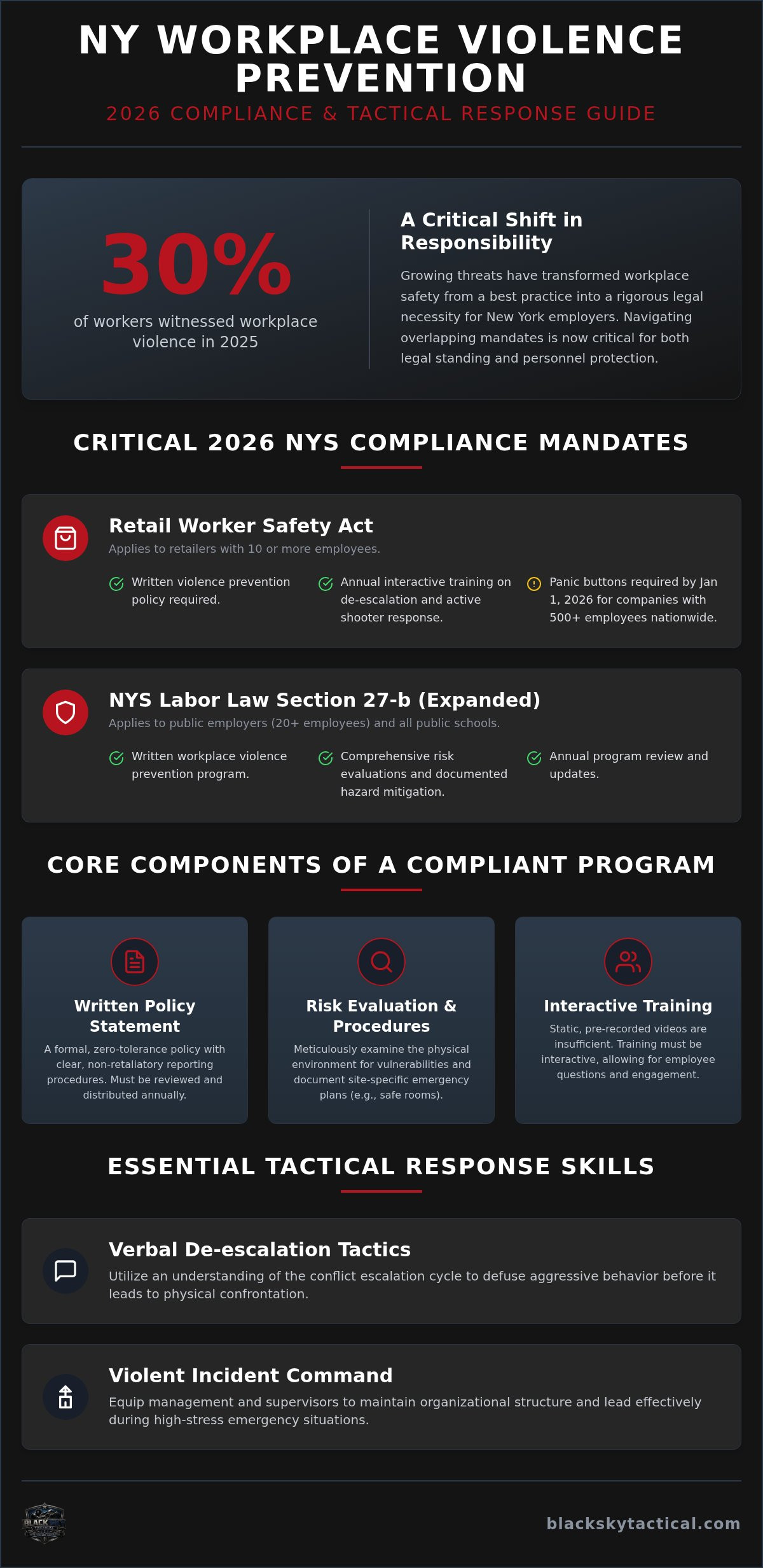
In 2025, 30% of workers reported witnessing workplace violence, a figure that highlights a growing gap between corporate policy and the physical reality of the modern work environment. For employers in New York, securing comprehensive workplace violence prevention training NY is no longer a matter of simple best practice; it's a rigorous legal necessity. With the 2026 implementation of Senate Bill 5294 for healthcare facilities and the specific requirements of the Retail Worker Safety Act, the administrative burden on management has reached a critical threshold of complexity.
You likely feel the weight of these overlapping mandates and the legitimate fear that a generic approach will fail your staff during a genuine crisis. We recognize that regulatory compliance serves as the floor rather than the ceiling for professional responsibility. This guide provides a definitive roadmap to achieving full NYS Department of Labor compliance while equipping your leadership with actionable de-escalation skills. We will examine the specific 2026 mandates, the expansion of legal definitions to include abusive conduct, and the implementation of a professional-grade Violent Incident Command system to protect your organization's legal standing and its personnel.
Key Takeaways
- Identify the specific regulatory obligations under the Retail Worker Safety Act and Section 27-b to ensure your organization meets the updated 2026 New York State compliance standards.
- Establish a comprehensive workplace violence prevention training NY program that satisfies Department of Labor mandates while providing staff with practical, life-saving skills.
- Develop a formal written policy statement and conduct a meticulous workplace risk evaluation to document and mitigate potential hazards within your facility.
- Utilize professional verbal de-escalation tactics and an understanding of the conflict escalation cycle to defuse aggressive behavior before it leads to physical confrontation.
- Equip management and supervisors with the Violent Incident Command Training necessary to maintain organizational structure and lead effectively during high-stress emergency situations.
NY Workplace Violence Prevention Laws: 2026 Compliance Standards
The New York Department of Labor defines workplace violence as any physical assault or threatening behavior that occurs at a work site. This encompasses a broad spectrum of Workplace aggression, ranging from verbal abuse to physical harm. As we approach the 2026 compliance cycle, the administrative requirements for employers have shifted from voluntary guidelines to strict, enforceable mandates. Specifically, the necessity for workplace violence prevention training NY has become a cornerstone of legal standing for both public and private entities operating within the state's jurisdiction.
Section 27-b and Public Education Coverage
New York State Labor Law Section 27-b historically governed public employers, but a significant 2023 amendment expanded this scope to include all public schools. By the 2026 cycle, these educational institutions must have completed their comprehensive risk evaluations and established formal policy statements. Public employers with 20 or more full-time permanent employees are required to develop and implement a written workplace violence prevention program. This program must be reviewed annually and updated whenever a significant incident occurs or a change in operations introduces new risk factors that could compromise staff safety.
The Retail Worker Safety Act Mandates
The Retail Worker Safety Act introduces some of the most stringent requirements for the private sector to date. For retailers with 10 or more employees, the law mandates the implementation of a written workplace violence prevention policy and the provision of annual interactive training. This training must cover de-escalation tactics and active shooter response procedures to ensure staff readiness. For larger organizations, specifically those with 500 or more employees nationwide, the act requires the installation of panic buttons in all New York work locations by January 1, 2026. These devices must be linked to local law enforcement or emergency dispatch to ensure immediate notification during a violent incident.
Compliance thresholds vary based on the specific statute and the size of the workforce. Under the Retail Worker Safety Act, the 10-employee mark triggers the requirement for a formal policy and annual workplace violence prevention training NY. Public employers under Section 27-b must establish a full written program if they employ at least 20 permanent, full-time staff members. Regardless of the specific headcount, the Department of Labor expects all covered entities to conduct a thorough risk evaluation. This process involves identifying factors that might place employees at risk, such as the exchange of money with the public, and documenting the specific measures taken to mitigate those identified vulnerabilities.
Core Components of a Compliant Prevention Program
Developing a robust prevention program requires moving beyond generic templates to site-specific documentation. A written Workplace Violence Prevention Policy Statement serves as the authoritative foundation for your organization's safety strategy. It must clearly outline a zero-tolerance stance while defining the specific, non-retaliatory procedures for reporting incidents. This document isn't a static asset; it requires annual review and distribution to all staff members to maintain its legal validity under state oversight.
Risk Evaluation and Site-Specific Procedures
A comprehensive risk evaluation is the most critical procedural step for any New York business. Employers must examine their physical environment for vulnerabilities such as inadequate lighting in parking areas, unsecured cash handling stations, or instances where employees work in isolation. You need to establish worksite-specific emergency procedures, including designated safe rooms and post-incident meeting places. These details must be documented according to NY Workplace Violence Prevention Laws to prove that the employer exercised due diligence in identifying foreseeable hazards within their unique operational context.
Interactive Training Requirements
Static training methods, such as requiring staff to watch a pre-recorded video without any engagement, no longer satisfy state standards. The mandate for workplace violence prevention training NY specifically requires an interactive component. This means the session must allow for a feedback loop where employees can ask questions and receive immediate clarification from a qualified instructor. Effective training incorporates site-specific hazard reviews, ensuring that staff members understand the unique risks associated with their specific work location rather than just broad, theoretical concepts.
To mitigate identified hazards, the state utilizes a hierarchy of controls. Engineering controls, such as physical barriers or electronic access systems, take precedence over administrative controls like scheduling changes. Meticulous record-keeping is the final pillar of compliance. You're required to maintain detailed logs of all violent incidents and accurate training attendance records for a minimum of three years. If you're looking to elevate your staff's readiness beyond basic documentation, exploring specialized safety programs can help bridge the gap between administrative compliance and actual tactical preparedness.
Tactical Response: De-escalation and Active Shooter Preparedness
While the administrative framework of a safety program provides the necessary legal protection, the physical safety of employees depends on their ability to recognize and respond to immediate threats. Effective workplace violence prevention training NY must bridge the gap between policy and practice by addressing the psychology of conflict. Understanding the escalation cycle allows staff to identify pre-attack indicators, such as scanning, target glancing, or repetitive movements, before a situation transitions into physical violence. Situational awareness isn't merely a passive observation; it's a disciplined methodology for assessing the environment and identifying anomalies that suggest an impending breach of safety. This proactive mindset is a core requirement for any comprehensive workplace violence prevention training NY program.
Verbal De-escalation and Conflict Resolution
In high-stress retail or public-facing environments, communication serves as the primary tool for mitigating aggression. Maintaining a professional distance of at least five to seven feet provides a necessary reactionary gap while signaling respect for the individual's personal space. Non-threatening body language, characterized by open palms and a relaxed but alert stance, can prevent the further escalation of a volatile encounter. Staff should utilize active listening techniques to validate the individual's concerns without necessarily agreeing with their position, a strategy that often lowers the emotional intensity of the interaction. Clear, concise directives are essential when a subject's cognitive processing is impaired by stress or anger.
Active Shooter and Emergency Procedures
The Run, Hide, Fight protocol remains the standard for active shooter response in 2026, yet its implementation requires site-specific adaptation. Employees must be trained to identify multiple exit routes that lead away from the threat rather than congregating in high-traffic areas. If evacuation is impossible, securing 'hide' locations involves more than just locking a door; it requires barricading entry points and silencing all electronic devices to minimize detection. During a tactical response by law enforcement, individuals must keep their hands visible and empty, following all commands without hesitation to avoid being misidentified as a threat. Organizations seeking to institutionalize these skills should consider Violent Incident Command Training to ensure their leadership can manage these high-stakes scenarios with professional precision.
Black Sky Tactical: Violent Incident Command for NY Professionals
Compliance with state mandates represents the minimum legal requirement for an organization, but it doesn't necessarily equate to operational readiness during a violent encounter. The Violent Incident Command Training philosophy focuses on bridging the gap between administrative checklists and the tactical reality of crisis management. By training supervisors and managers to assume immediate command during emergency situations, businesses can ensure a structured response that prioritizes life safety and minimizes organizational paralysis. This high-level instruction moves beyond the theoretical, providing leaders with the psychological and procedural tools needed to maintain order when seconds are critical.
Professional Instruction vs. Model Training
Relying on generic model training or passive video presentations can inadvertently increase an employer's liability by failing to address the specific environmental risks present at their unique facility. Expert-led instruction reduces this risk by providing nuanced, site-specific guidance that increases employee confidence and competence. The value of tactical experience in safety education cannot be overstated; instructors with real-world backgrounds in high-stakes environments offer insights that generic programs simply cannot replicate. For individuals who wish to extend their personal proficiency beyond the workplace, we recommend reviewing our Comprehensive Guide to the NY 18-Hour Concealed Carry Course (2026) to understand the requirements for legal firearm carry in New York.
Our customized workplace violence prevention training NY programs are specifically designed for professionals in Rockland, Orange, and Westchester County. We recognize that a retail environment in Yonkers faces different logistical challenges than a public school in New City. By integrating situational awareness into daily operational protocols, we help staff members develop a baseline of normal activity, making it easier to identify the anomalies that precede a violent incident. This habitual awareness transforms safety from an annual training requirement into a continuous, proactive component of the business's culture.
Implementing a Culture of Safety
A truly resilient organization establishes clear communication channels that allow employees to report hazards or suspicious behavior without fear of retaliation. This transparency is essential for identifying internal or external threats before they escalate. Regular drills and procedural reviews ensure that emergency responses become a matter of muscle memory rather than panicked improvisation. To ensure your organization meets both the legal standards and the practical needs of your staff, the next step is to schedule a professional consultation. We provide the specialized workplace violence prevention training NY necessary to secure your facility and protect your personnel against the evolving threats of the 2026 landscape.
Securing Your Organizational Future Through Professional Readiness
The 2026 regulatory shift in New York requires a transition from passive administrative compliance to a proactive, disciplined safety culture. By establishing a robust policy statement and conducting meticulous site-specific risk evaluations, your organization fulfills its legal obligations under the Retail Worker Safety Act and Section 27-b. The true measure of your program's efficacy lies in the tactical proficiency of your staff when faced with an immediate threat. Professional workplace violence prevention training NY serves as the necessary bridge between state mandates and the practical reality of de-escalation and emergency response.
Our experienced tactical instructors bring real-world proficiency to every session, ensuring that your team develops the situational awareness and command-and-control skills required for high-stakes environments. We provide specialized expertise in NY and NJ regulatory compliance through our professional Violent Incident Command Training, which is designed to empower management with the authority to lead during a crisis. Protecting your personnel and your legal standing requires more than a generic template; it demands a structured, institution-led approach to safety. Schedule your professional Violent Incident Command Training today to ensure your facility remains a secure environment for all employees.
Frequently Asked Questions
Is workplace violence prevention training mandatory for all NY employers?
Workplace violence prevention training NY is mandatory for all public employers under Section 27-b and for retail employers with 10 or more staff members under the Retail Worker Safety Act. While private employers in non-retail sectors aren't always subject to these specific statutes, they remain responsible for maintaining a safe environment under general duty clauses. Adhering to these training standards is a prudent measure to mitigate legal liability and ensure personnel safety.
What qualifies as 'interactive training' under the Retail Worker Safety Act?
Interactive training's defined as a program that allows for active engagement between the instructor and the participants. Passive methods, such as watching a pre-recorded video without an opportunity for feedback, are insufficient to meet the legal standard. To comply, the session must permit employees to ask questions and receive immediate clarification. Effective workplace violence prevention training NY also incorporates site-specific hazard reviews to address the unique vulnerabilities of the local work environment.
How often must NY public school employees receive violence prevention training?
Public school employees in New York must receive violence prevention training on an annual basis. This requirement follows the 2023 legislative amendment that officially categorized all public school districts as covered employers under Section 27-b of the Labor Law. Schools are now obligated to conduct yearly risk evaluations and provide comprehensive training sessions. It's essential to ensure all staff members are prepared to respond to potential threats within the educational facility.
Does the 2026 law require businesses to install panic buttons?
The requirement for panic buttons applies specifically to retail employers who employ 500 or more workers nationwide. Under the Retail Worker Safety Act, these large organizations must install panic buttons in every New York location by January 1, 2026. These devices must be positioned to allow for immediate notification of local law enforcement or emergency dispatch services. Smaller retailers aren't currently mandated to install this hardware but must still provide interactive training.
What are the penalties for non-compliance with NYS Labor Law Section 27-b?
Non-compliance with NYS Labor Law Section 27-b can result in formal citations and significant monetary penalties issued by the Commissioner of Labor. When an inspection reveals a violation, the Department of Labor issues a notice of violation with a specific timeframe for correction. If the employer fails to remedy the situation within the allotted period, the state may impose daily fines. It's vital to follow these procedures to avoid the financial consequences of non-compliance.


