
In New Jersey, a minor mechanical misstep or administrative oversight with a firearm isn't merely an embarrassing beginner error; under state statutes, it can quickly cross into severe criminal liability. If you're intimidated by complex FARS licensing procedures, strict transport mandates, and the prospect of manipulating live ammunition without formal coaching, your caution is warranted. Enrolling in a certified first time gun owner class NJ residents rely on is the most critical step you can take to bridge the gap between administrative red tape and competent firearm ownership.
It's completely understandable to feel overwhelmed by the state's rigorous regulatory climate and the confusion between basic handling instruction and formal Permit to Carry qualifications. Through structured, professional beginner training, you'll master essential New Jersey legal boundaries, develop autonomous weapon handling and safe storage discipline, and gain genuine live-fire confidence under direct supervision. This 2026 guide outlines the foundational training curricula, legal standards, and range protocols required to ensure your ownership journey begins with complete safety and statutory compliance.
Key Takeaways
- Understand foundational New Jersey statutes governing lawful firearm transport, mandatory storage protocols, and critical administrative purchasing pathways.
- Discover what structured mechanical instruction entails during a reputable first time gun owner class NJ instructors deliver to build safe handling habits.
- Distinguish between foundational civilian handling courses and formal state Permit to Carry qualifications to prevent premature range safety errors.
- Learn essential range preparation strategies, command line expectations, and personal protective equipment standards before your first live-fire discharge.
- Explore structured instructional pathways, including private firearm training and integrated curriculum courses designed to ensure strict state compliance.
Navigating New Jersey Firearm Ownership: Legal Baselines for Beginners
Operating a firearm within the Garden State requires an uncompromising commitment to statutory literacy. Understanding New Jersey's firearms laws isn't an optional academic exercise; it governs every aspect of how you acquire hardware, secure it at home, and move it across municipal borders. While state licensing evaluates your statutory eligibility on paper, completing a structured first time gun owner class NJ beginners rely on establishes the vital link between administrative permission and safe, functional execution.
Essential Documentation: FPIC and Purchase Permits
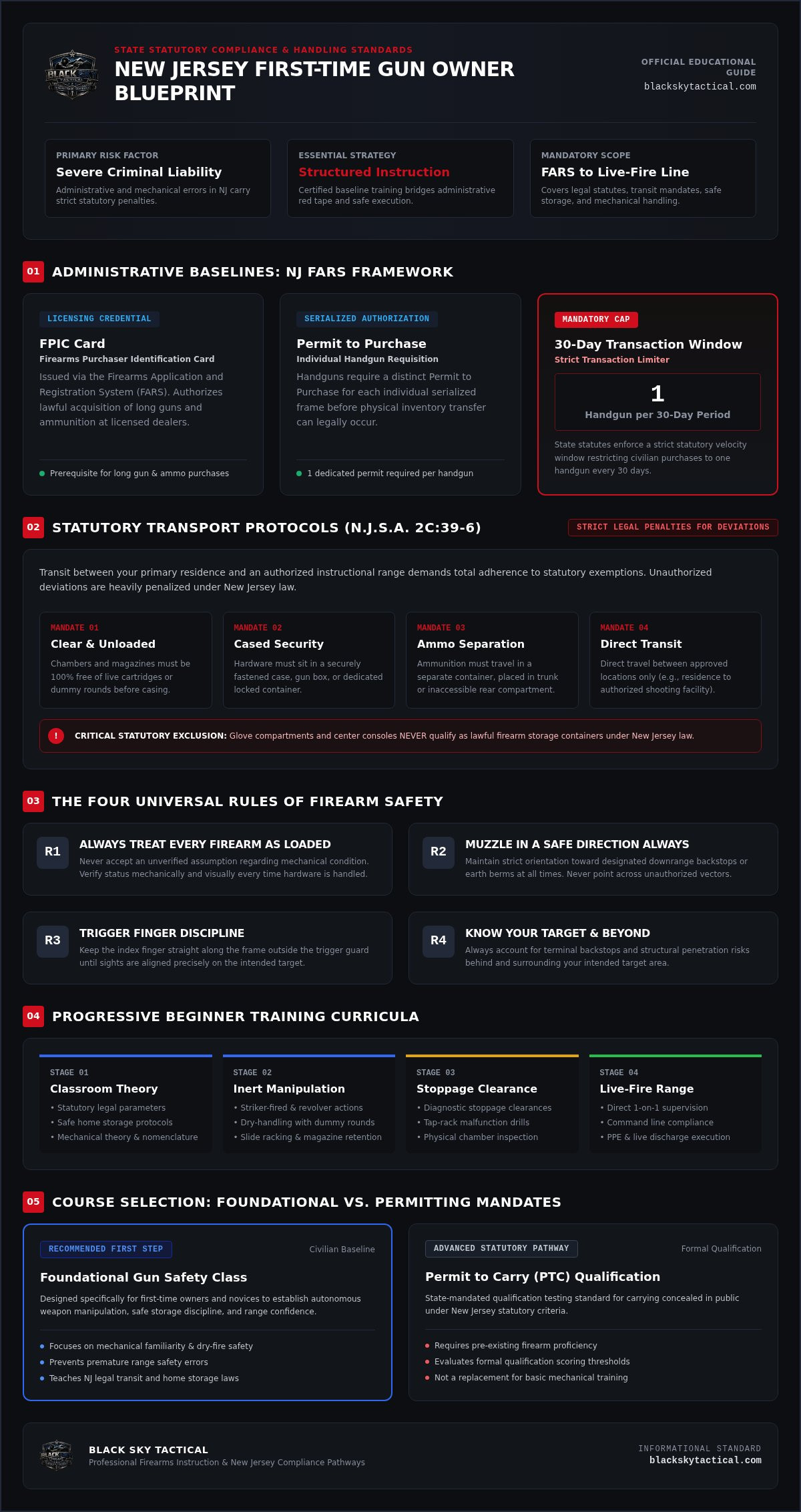
Prospective owners must secure credentialing through the Firearms Application and Registration System (FARS) before touching inventory at a licensed dealer. A Firearms Purchaser Identification Card (FPIC) authorizes the acquisition of long guns and ammunition, while handguns require an individual Permit to Purchase for each serialized frame. State statutes enforce a strict transaction window, restricting civilian acquisitions to one handgun per 30-day period. Although administrative approval does not explicitly require live-fire qualification simply to take possession of a home-defense firearm, skipping professional mechanical instruction creates an immediate safety liability inside your household.
Statutory Transport Protocols to Your Training Facility
Driving to an instructional facility requires absolute compliance with N.J.S.A. 2C:39-6 exemptions, which strictly penalize unauthorized deviations between approved locations. Moving your firearm between your residence and an authorized range demands specific packing discipline across Bergen County and adjacent travel corridors:
- Clear and Unloaded Status: Chambers and magazines must be completely free of live cartridges or dummy rounds before the case is closed.
- Cased Security: Hardware must sit in a securely fastened case, gun box, or dedicated locked container. Glove compartments and center consoles never qualify as lawful storage.
- Ammunition Separation: Ammunition must travel in a separate container, ideally positioned in the vehicle's trunk or an inaccessible rear compartment out of arm's reach.
A certified first time gun owner class NJ syllabus details these transit requirements early, ensuring that your travel to and from the firing line remains legally sound and procedurally compliant.
Core Curriculum: What to Expect in an Introductory Gun Safety Course
Professional firearm instruction dismantles anxiety through systematic, hands-on mechanical exposure. Rather than rushing novices onto an active firing line, an accredited syllabus builds competency across controlled stages. Much like the foundational safety modules emphasized in the state-administered NJ Hunter Education Program, formal beginner courses integrate structured classroom theory with dry-handling exercises before introducing live ammunition.
The Four Universal Rules of Firearm Safety
Every reputable syllabus begins with the four non-negotiable handling mandates. Instructors drill these rules until they become unconscious procedural safeguards:
- Always treat every firearm as if it were loaded: Never accept an unverified assumption regarding mechanical condition.
- Keep the muzzle pointed in a safe direction: Maintain orientation toward designated downrange backstops or earth berms at all times.
- Keep your finger off the trigger: Settle the index finger straight along the frame until sights align on target.
- Know your target and what lies beyond it: Account for terminal backstops and structural penetration risks.
Mechanical Operation and Stoppage Clearing
Before chambering a single live primer, students deconstruct modern semi-automatic striker-fired actions and double-action revolvers using inert dummy rounds. You'll practice slide racking, magazine retention, and physical chamber checks. Certified instructors guide you through diagnostic stoppage clearances, such as tap-rack malfunction remediation, ensuring you don't freeze if an operational stoppage occurs on the line. Building this baseline proficiency through Private Firearm Training allows novices to refine muscle memory in a dedicated, judgment-free environment.
Home Storage and Family Safety Protocols
Mechanical proficiency extends into household security discipline. A comprehensive first time gun owner class NJ curriculum addresses New Jersey's strict statutory child-access prevention laws. Training explores the functional trade-offs between rapid-access biometric lockboxes and heavy-gauge steel vaults, helping you stage defensive tools securely while maintaining complete legal compliance.
Mastering these operational modules in a dedicated first time gun owner class NJ environment ensures that defensive capability never compromises domestic safety or statutory standards.
Foundational Instruction vs. Permitting Mandates: Selecting the Right Class
Novice shooters often confuse introductory firearm education with state-mandated carry qualifications. That misunderstanding creates real risks on the line. A qualification course is an evaluation designed to test existing competence; it is not an educational environment built to teach mechanics from scratch. Enrolling in an advanced qualification without baseline skills invites frustration and serious safety infractions. Choosing an accredited first time gun owner class NJ guarantees that you develop steady handling, recoil management, and sight picture discipline before facing scored criteria.
NRA Basic Pistol Curriculum Standards
Standardized civilian curricula establish safe handling habits through methodical, step-by-step repetition. Completing an accredited NRA Basic Pistol Shooting Course grounds students in proper grip architecture, dominant-eye sighting, and deliberate trigger press control. This coursework provides verified training credentials recognized across multiple jurisdictions. Crucially, beginner modules eliminate dynamic movement, allowing you to focus entirely on static marksmanship and diagnostic evaluation under zero time pressure.
The New Jersey CCARE Protocol and Carry Permits
The Civilian Carry Assessment and Range Evaluation (CCARE) protocol dictates the mandatory live-fire benchmark for New Jersey Permit to Carry (PTC) applicants. Unlike beginner classes, CCARE demands rigorous, pre-established operational proficiency:
- Holster Presentation: Drawing safely from an approved concealed holster system without sweeping your own body or flagging the line.
- Timed Engagements: Delivering accurate fire within tight statutory windows at distances of three, five, seven, ten, and fifteen yards.
- Autonomous Manipulations: Executing reloads and clearing stoppages quickly while under evaluation.
Attempting these dynamic tasks before mastering core safety rules invites dangerous weapon-handling errors. Transitioning into NJ Concealed Carry Permit Training should happen only after completing a foundational first time gun owner class NJ, ensuring you possess the muscle memory required for demanding carry assessments.
Preparing for Your First Live-Fire Range Session
Stepping onto an active range marks the transition from mechanical theory to live kinetic execution. The sensory environment inside an indoor firing facility can feel overwhelming to a beginner. The concussive noise, mechanical cycling, and strict range oversight demand intense focus. Proper physical and mental preparation ensures you absorb instruction effectively rather than reacting to sensory overload during your first live-fire discharge.
Mandatory Equipment and Protective Gear
Showing up with adequate personal protective equipment protects against hearing degradation and errant hot brass. Indoor facilities produce amplified sound waves that reflect off concrete partitions, making gear selection critical:
- Ballistic Eye Protection: Wrap-around polycarbonate lenses shield your eyes from unburnt powder, vaporized lubricants, and ricochet fragments.
- Electronic Hearing Protection: Amplified earmuffs compress sharp concussive decibels while keeping instructor commands audible.
- Defensive Range Attire: Crew-neck shirts, closed-toe footwear, and brimmed baseball caps prevent ejected hot brass casings from contacting bare skin.
Always wash your hands and face with cold water and de-leading soap immediately after exiting the shooting bay to eliminate heavy-metal surface residue.
Standard Range Commands and Emergency Cease Fires
Every lane operates under structured verbal directives delivered by instructors and Range Safety Officers (RSOs). Internalizing these verbal triggers ensures seamless execution:
- "The Range Is Hot": Active shooting is permitted. Eye and ear protection must remain securely positioned. Firearms may only point directly downrange.
- "Cease Fire": Stop shooting instantly. Take your finger off the trigger, bench your firearm with the ejection port facing up, step back behind the lane perimeter, and await instructions. Anyone on the line can call a cease fire if an unsafe condition develops.
- "The Range Is Clear": All hardware must be unloaded, benched, and locked open with actions visibly cleared before anyone steps forward of the firing line.
Coaches observe your movements closely during a first time gun owner class NJ session to eliminate flinching, anticipatory push, and poor grip pressure. If you prefer tailored, one-on-one mechanical coaching before joining an open line, book Private Firearm Training to establish rock-solid live-fire confidence in an individualized environment.
Approaching your first live-fire training with disciplined preparation allows you to extract maximum skill value from your first time gun owner class NJ, transforming nervous initial discharges into calm, repeatable marksmanship habits.
Professional Instructional Pathways with Black Sky Tactical
Black Sky Tactical functions as an authoritative bridge between New Jersey's intricate statutory environment and real-world mechanical competence. Serving Bergen County and surrounding regional jurisdictions, our training methodology departs from crowded commercial range sessions that prioritize retail sales over detailed instruction. We emphasize disciplined pedagogy, legal compliance, and structured skill verification. Whether you seek an introductory foundation or an eventual carry permit, our programs deliver the formal certification required to handle firearms safely and legally.
Private Firearm Training: Tailored Novice Instruction
New shooters often experience apprehension in standard group classes. High lane density, rapid paces, and varied student backgrounds can easily detract from foundational mechanics. Private Firearm Training eliminates these distractions through one-on-one coaching customized to your specific comfort level and learning pace:
- Individualized Diagnostics: Instructors analyze your physical grip architecture, dominant-eye sighting, and trigger mechanics without line pressure.
- Platform Matching: You evaluate different frame profiles, action types, and calibers to identify the firearm that best fits your hand size and defensive goals.
- Dedicated Oversight: Direct instructor supervision ensures complete safety compliance during initial live-fire strings, building genuine confidence discharge by discharge.
This customized environment provides the ideal starting point for anyone seeking a low-stress first time gun owner class NJ alternative tailored specifically to personal skill development.
NJSNRA101: The Comprehensive Compliance Pathway
Graduating from baseline familiarity to legal carry capability demands a unified curriculum. The NJSNRA101 course provides this comprehensive bridge by merging the NRA Basic Pistol curriculum with state-mandated carry requirements. Instead of navigating disconnected classes across separate facilities, students undergo an integrated progression that covers safe gun handling, core marksmanship principles, legal statutes, and scored live-fire standards under certified professional direction.
Completing NJSNRA101 satisfies New Jersey's stringent training mandates while ensuring your administrative paperwork is backed by legitimate operational skill. Beginning your journey through a certified first time gun owner class NJ program establishes the safe habits, legal clarity, and shooting proficiency necessary to navigate New Jersey firearm ownership responsibly.
Take the First Step Toward Responsible Firearm Ownership in New Jersey
Responsible ownership in New Jersey requires balancing strict administrative mandates with instinctive mechanical discipline. From adhering to statutory transport protocols to mastering basic stoppage remediation before attempting carry evaluations, your long-term safety depends on a structured foundation. Completing a certified first time gun owner class NJ residents trust eliminates procedural guesswork, replacing handling apprehension with autonomous, repeatable safety habits.
Black Sky Tactical delivers authoritative instruction across Bergen County and surrounding regional jurisdictions, providing clear pathways from baseline safety drills to formal qualification. Whether you begin with individualized Private Firearm Training or enroll in the combined NJSNRA101 course curriculum fulfilling certified NRA and New Jersey standards, professional coaching ensures strict compliance at every phase. You don't have to navigate these demanding state standards alone. Build genuine confidence on the firing line and register for certified firearm training with Black Sky Tactical today.
Frequently Asked Questions
Do I need to own a firearm before taking a first time gun owner class in New Jersey?
No, you don't need to own a firearm before enrolling in an introductory class. Attending training prior to purchasing hardware allows you to test various platform configurations, frame dimensions, and grip styles under instructor supervision. Enrolling in a certified first time gun owner class NJ instructors offer helps you make an educated, legally compliant purchase while ensuring you handle platforms safely before buying your own.
Is formal training legally required to obtain a New Jersey Firearms Purchaser Identification Card?
New Jersey statutory law doesn't mandate live-fire classroom qualification simply to receive an initial Firearms Purchaser Identification Card (FPIC) or handgun purchase permit. However, administrative acquisition and mechanical competency are entirely separate matters. Bypassing structured instruction leaves novice buyers vulnerable to handling errors, municipal transport infractions, and storage violations inside their homes, making professional safety training an essential self-imposed benchmark.
What is the difference between an NRA Basic Pistol course and the NJ CCARE protocol?
An NRA Basic Pistol course teaches fundamental mechanics, grip stabilization, and stationary marksmanship without scoring pressure or rapid manipulation. Conversely, the Civilian Carry Assessment and Range Evaluation (CCARE) protocol is a standardized qualification assessment for Permit to Carry applicants. CCARE evaluates pre-existing proficiency through timed strings, draw-from-concealment mechanics, and scored target engagement at varying distances. Beginners should master baseline courses before attempting CCARE.
How should I legally transport my new firearm to a training session in New Jersey?
Under N.J.S.A. 2C:39-6 exemptions, you must transport your firearm unloaded inside a locked case or securely fastened box. Ammunition must travel in a separate container, kept entirely isolated from the cased firearm. When driving through Bergen County to your training range, store both containers in your vehicle's trunk or an inaccessible rear compartment out of arm's reach, avoiding unnecessary intermediate stops along your route.
Can family members or teenagers attend introductory firearm safety classes together?
Yes, families often train together to establish consistent safety baselines and secure household storage disciplines. While adult curricula focus on mechanical mastery and state compliance, younger participants can enroll in dedicated programs like a Youth Safety Course or tailored Private Firearm Training. Learning universal safety rules collectively eliminates curiosity, demystifies defensive tools, and ensures every household member understands vital accident-prevention protocols.
What happens if I experience a firearm malfunction or stoppage on the firing line?
If your firearm fails to cycle or fire, keep the muzzle oriented downrange and leave your finger off the trigger. Never turn around or step off the line with a malfunctioning weapon. During a professional first time gun owner class NJ coaches supervise your lane, diagnose whether you've encountered a failure to feed, extract, or eject, and guide you through standard clearance protocols safely.
How often should a beginner practice live-fire shooting after completing an initial safety class?
Novice shooters should aim for structured live-fire practice at least once or twice per month following an initial class. Consistent repetitions maintain perishable motor skills, reinforce recoil management, and prevent flinch anticipation from taking root. Integrating dry-fire manipulation exercises at home alongside deliberate live range drills preserves your foundational handling discipline and keeps your operational fundamentals sharp over the long term.


