
With active hostile events typically concluding within three to eight minutes, often before formal law enforcement arrives on the scene, the burden of survival rests almost entirely on immediate civilian action and on-site command. It's understandable that professionals across Rockland, Orange, Westchester, and Bergen counties feel a profound sense of anxiety regarding workplace violence and the conflicting response models currently circulating in the industry. You aren't alone if you find the transition from "Run, Hide, Fight" to dynamic models like ALICE or "Avoid, Deny, Defend" to be legally and procedurally confusing.
This guide provides the technical clarity you require to master active threat response training, ensuring your organization moves beyond mere awareness into a state of documented, regulatory-compliant preparedness. By following this framework, you'll gain the skills to lead others during a crisis while maintaining strict adherence to local safety recommendations and the 2024 NFPA 3000 standards. We will examine the essential pillars of prevention, explore the legal nuances of employer liability in NY and NJ, and outline a methodical emergency plan that bridges the gap between civilian response and professional tactical intervention.
Key Takeaways
- Analyze the 2026 threat landscape to identify specific risks within commercial and public environments that extend beyond traditional active shooter definitions.
- Implement a professional active threat response training framework that prioritizes situational awareness and rapid decision-making during the critical initial minutes of an encounter.
- Distinguish between civilian self-preservation and professional tactical command to maintain personal safety and facilitate effective communication with arriving law enforcement.
- Construct a regulatory-compliant Emergency Action Plan (EAP) using site-specific vulnerability assessments and established trigger points for evacuation or lockdown procedures.
- Evaluate how specialized Violent Incident Command training serves as a necessary advancement for concealed carry permit holders and safety coordinators throughout the NY and NJ region.
Defining the 2026 Active Threat Landscape
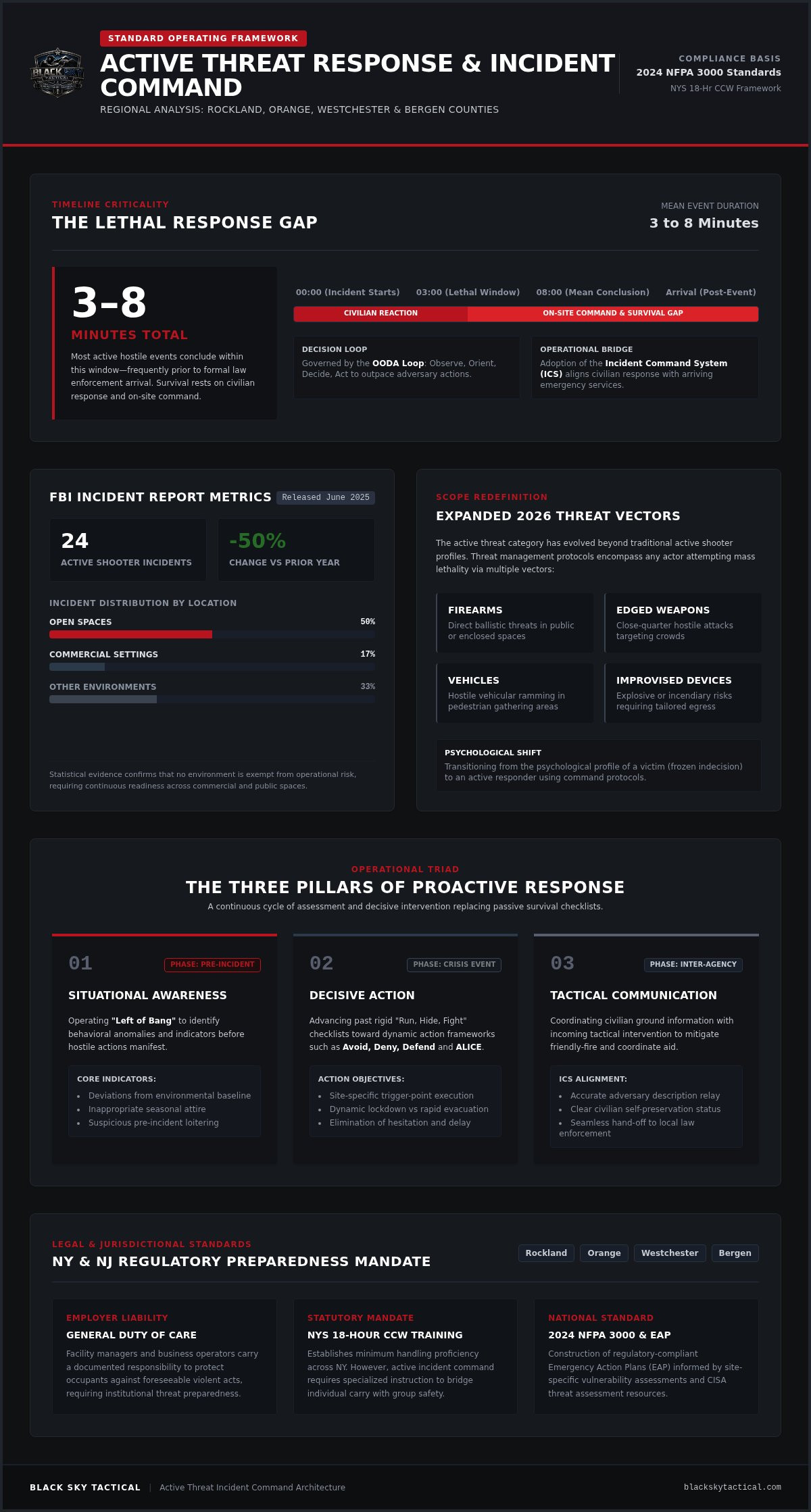
The term active threat encompasses a broader range of hazards than the traditional active shooter designation. While the FBI's 2024 report, released in June 2025, documented 24 active shooter incidents, a 50% decrease from the previous year, the definition of a threat in 2026 includes any individual actively engaged in attempting to kill people in a populated area using firearms, edged weapons, vehicles, or improvised devices. Effective active threat response training requires a shift from reactive posturing to a command-based mindset. Statistics from 2024 indicate that 17% of these incidents occurred in commercial settings and 50% in open spaces, illustrating that no environment is exempt from risk. Understanding this landscape is the first step in moving from the psychological state of a victim, characterized by frozen indecision, to that of a responder who uses structured protocols to mitigate harm.
The Evolution of Incident Dynamics
Modern violent critical incidents (VCIs) are characterized by their extreme brevity and high lethality. Most events conclude within three to eight minutes, creating a lethal gap where on-site personnel must act before professional law enforcement arrives. During these seconds, the ability to process information is governed by the OODA loop. The OODA loop is a four-stage decision-making cycle consisting of observation, orientation, decision, and action that allows a responder to process environmental cues and react more efficiently than an adversary. To manage this chaos, organizations are increasingly adopting the Incident Command System framework to coordinate civilian actions with arriving emergency services.
Legal and Regulatory Expectations in NY and NJ
Business owners and facility managers in Rockland, Orange, Westchester, and Bergen counties face rigorous legal and regulatory expectations regarding occupant safety. Under the general duty of care, there is a professional responsibility to provide a secure environment, which now includes documented preparedness for violent encounters. The implementation of the NYS 18-hour concealed carry training requirement has significantly influenced public safety expectations across the region. This mandate ensures that permit holders possess a baseline of firearm proficiency, yet it also highlights the necessity for specialized active threat response training to bridge the gap between individual gun safety and collective incident command. Professional instruction ensures that safety plans are not merely theoretical but are grounded in the specific jurisdictional requirements of New York and New Jersey law.
The Three Pillars of Proactive Response
Effective active threat response training is built upon a tripartite framework that ensures a continuous cycle of assessment and action. These pillars, situational awareness, decisive action, and tactical communication, function as the operational standard for individuals seeking more than a passive survival strategy. This methodology aligns with the heightened proficiency standards established in the NY 18 hour concealed carry course, which emphasizes that legal authorization to carry must be paired with a command-based tactical mindset. By integrating these components, responders can maintain cognitive control during high-stress encounters in environments ranging from corporate offices in Westchester to public spaces in Bergen County.
Situational Awareness and Environmental Scanning
The pre-incident phase, often referred to as "left of bang," focuses on identifying behavioral indicators and environmental anomalies before a threat fully manifests. This proactive scanning involves recognizing deviations from a baseline, such as inappropriate attire for the season or suspicious loitering, which serves as the earliest warning system for a violent critical incident. Developing this habit of mind is a core component of private firearm training for beginners NY, where students learn that situational awareness is the most critical tool for avoiding conflict altogether. Utilizing CISA active shooter preparedness resources can further assist organizations in establishing formal threat assessment teams to identify these red flags at an institutional level.
Decisive Action: Beyond Run, Hide, Fight
Linear checklists like "Run, Hide, Fight" often fail in non-linear, high-stress environments because they don't account for the rapid evolution of incident dynamics. Decisive action requires an "Enhanced Lockdown" approach, which moves beyond passive hiding to include active door barricading, the selection of improvised defensive tools, and the identification of secondary egress points. It's a transition from being a target to becoming a hard target. When evacuation is compromised, the responder must be prepared to transition immediately to a defensive posture. This level of readiness is precisely what's taught in professional Violent Incident Command training, where the focus shifts from individual survival to the management of the entire crisis space. Finally, tactical communication ensures that actionable intelligence is relayed to 911 dispatchers and arriving law enforcement, preventing misidentification and ensuring a unified response.
Civilian vs. Professional Response Frameworks
The objectives of a civilian responder differ fundamentally from those of law enforcement officers. While a police officer's duty is to locate and neutralize the threat, a civilian's priority is the preservation of life through evacuation or the defense of a specific, immediate area. Engaging in "hero syndrome," where an untrained individual attempts to clear a building or hunt an assailant, often leads to catastrophic results, including blue-on-blue misidentification. Comprehensive active threat response training emphasizes that your role is to manage the crisis within your immediate vicinity until professionals arrive. Establishing a foundation through the NRA basic pistol shooting course provides the necessary safety protocols, but civilian response requires additional layers of incident command knowledge to ensure survival and legal compliance.
The Civilian Responder Mindset
A disciplined mindset is essential for navigating the legal and physiological complexities of a violent encounter. In New York and New Jersey, the legal boundaries of self-defense are strict, often requiring a duty to retreat if it can be done with complete safety. Understanding these jurisdictional nuances is as vital as the physical response itself. During an incident, the body's sympathetic nervous system triggers physiological changes such as tunnel vision and auditory exclusion. Training helps you recognize these effects, allowing you to maintain better situational control despite the adrenaline surge. This cognitive preparation ensures you don't overextend your authority or compromise your legal standing in Rockland or Orange County.
Tactical Incident Management for Non-LEOs
Effective management for civilians involves clear, administrative communication and a structured "link-up" procedure with arriving authorities. When law enforcement makes entry into a scene in Westchester or Bergen County, they treat everyone as a potential threat until proven otherwise. You must ensure your hands are visible, empty, and that you follow all verbal commands without hesitation. Utilizing CISA active shooter preparedness resources can help you draft a communication plan for 911 dispatch that includes your physical description and exact location. Tactical Proficiency in civilian defense is defined as the ability to apply fundamental safety skills and command strategies to secure a localized environment while facilitating the safe entry of first responders. Once a threat has moved or been neutralized, your focus should remain on securing the immediate scene and providing actionable intelligence to the police.
Developing Your Local Emergency Action Plan (EAP)
Developing a robust Emergency Action Plan (EAP) is an administrative necessity that ensures organizational resilience during a violent critical incident. Under OSHA standard 29 CFR § 1910.38, employers are required to establish written procedures for reporting emergencies and evacuations, yet generic templates often fail to address the specific tactical needs of a facility. Effective active threat response training begins with a comprehensive vulnerability assessment of your site to identify blind spots, unsecured entry points, and structural weaknesses. Once these risks are documented, you must establish clear "Trigger Points" that dictate when staff should transition from standard operations to lockdown or evacuation. These plans require an annual review to remain compliant with evolving regional mandates, such as the 2026 requirements for NJ concealed carry permit training and permit to carry (PTC) standards.
Communication protocols must extend beyond the instruction to "call 911." Staff should be trained to provide dispatchers with actionable intelligence, including the specific location of the threat, a description of the assailant, and the number of individuals in secured areas. Realistic drills, conducted at least twice annually, should account for the unique layout of your building in Rockland or Orange County, testing exit points and the efficacy of barricading techniques under simulated stress. If you haven't yet codified these procedures, you should enroll in Violent Incident Command Training to ensure your leadership is prepared for high-stakes decision-making.
Small Business and Office Security Protocols
Small businesses and open-plan offices in Westchester face unique challenges, as these environments often lack internal ballistic protection or defined barriers. To mitigate these risks, organizations should designate a "Command Lead" among the staff who is responsible for initiating the EAP and coordinating with emergency services. Low-cost physical enhancements, such as the installation of high-quality security film on glass partitions and the placement of heavy furniture in designated "hard corners," can provide critical seconds of delay during an intrusion. These procedural steps transform a vulnerable retail or office space into a structured environment where every employee understands their specific role in the safety hierarchy.
Family and Residential Preparedness
Adapting incident command strategies for the home requires a focus on staging and family communication. Residential preparedness involves identifying a primary "safe room" equipped with secondary communications and defensive tools that can be secured against forced entry. When discussing these concepts with minors, it's effective to use a structured firearm laws for young adults NY approach, focusing on the gravity of safety and the importance of following parental instructions without delay. This ensures that every family member, including young adults, understands the legal and practical boundaries of home defense in the New York and New Jersey region.
Mastering Violent Incident Command with Black Sky Tactical
The Violent Incident Command program at Black Sky Tactical represents the culmination of professional preparedness, moving beyond basic firearm handling into the complex management of a critical event. While many programs offer standardized certifications, our approach integrates established NRA standards with high-stakes tactical response protocols designed for the unique environments of New York and New Jersey. Achieving situational mastery requires more than just knowing how to operate a handgun; it demands an understanding of how to command a space, coordinate with others, and interface safely with law enforcement. This advanced active threat response training is specifically structured for those who carry a professional responsibility to protect themselves, their families, or their organizations in high-pressure scenarios.
Beyond the 18-Hour Requirement
The NYS and NJS 18-hour mandatory concealed carry courses serve as the regulatory floor for legal compliance, yet they are merely the beginning of true tactical proficiency. Relying solely on a one-time certification to navigate a violent critical incident is a significant risk that often fails to account for the rapid degradation of fine motor skills under stress. A professional private firearms instructor in NY provides the personalized, one-on-one tactical focus necessary to bridge the gap between permit possession and operational readiness. For residents in Rockland, Orange, and Westchester counties, this means customizing drills to reflect the specific architectural and legal realities of the local region, ensuring that your training is as relevant as it is rigorous.
Next Steps: Enrollment and Certification
Identifying the correct course for your current skill level is a methodical process that begins with an honest assessment of your existing capabilities. Regular refresher training is essential to maintain the muscle memory required for effective active threat response training, as skills related to weapon retention and situational command diminish without consistent practice. Professional certification through Black Sky Tactical serves as documented proof of your commitment to safety and regulatory compliance. Organizations seeking a higher standard of readiness can contact us to schedule a professional organizational assessment. This ensures that your local emergency action plan is supported by the highest level of tactical instruction available in the NY and NJ area, providing a disciplined path from basic permit compliance to advanced situational mastery.
Achieving Situational Mastery and Legal Compliance
Transitioning from passive survival models to a proactive command structure represents the professional standard for safety in 2026. This guide has outlined how active threat response training functions as a critical bridge between basic permit compliance and the situational mastery required to navigate high-stakes environments. Effective preparation demands a site-specific Emergency Action Plan that accounts for the unique legal and architectural realities of Rockland, Orange, Westchester, and Bergen counties. By integrating situational awareness with disciplined incident command, you ensure that your response is both tactically effective and legally defensible.
As a certified NYS and NJS 18-hour training provider, Black Sky Tactical delivers expert tactical instruction alongside comprehensive youth and private safety programs. It's essential to recognize that proficiency isn't a destination but a continuous process of refinement and administrative oversight. You can take the next step in your professional development by visiting our portal to Enroll in Violent Incident Command Training with Black Sky Tactical. True readiness is a disciplined, ongoing commitment to safety and regulatory excellence that provides lasting security for your organization or family.
Frequently Asked Questions
What is the difference between active shooter and active threat response training?
Active shooter training focuses specifically on firearm-related incidents, while active threat response training encompasses a wider spectrum of hazards, including edged weapons, vehicles, and improvised devices. This broader approach ensures that organizations in Rockland and Westchester are prepared for any individual actively engaged in attempting to kill people in a populated area. By expanding the scope beyond firearms, responders develop more versatile situational awareness and defensive strategies that apply to diverse violent critical incidents.
Is active threat response training mandatory for businesses in New York?
While there isn't a universal state mandate requiring every private business to conduct active threat response training, federal OSHA standards and the General Duty Clause effectively require employers to provide a safe workplace. In New York, civil liability and the duty of care for occupants make documented preparedness an administrative necessity. Organizations that fail to implement safety protocols may face significant legal exposure if an incident occurs without a verified emergency action plan in place.
How often should my organization conduct active threat drills?
Organizations should conduct active threat drills at least twice annually to ensure that employees maintain the muscle memory required for a high-stress encounter. Regular practice allows staff in Orange and Bergen counties to test the efficacy of their specific evacuation routes and barricading techniques. Since incident dynamics and facility layouts often change, an annual review of the Emergency Action Plan ensures that all communication protocols and trigger points remain accurate and regulatory-compliant.
Can civilians legally use force during an active threat in NJ?
New Jersey law allows civilians to use force for self-protection only when it's immediately necessary to defend against the use of unlawful force by another person. However, the state maintains a strict duty to retreat if the individual can reach complete safety before resorting to force. Navigating these legal boundaries requires professional instruction to ensure that any defensive action taken during a crisis is proportional and justifiable under current NJ jurisdictional standards.
Does the NY 18-hour CCW course cover active threat response?
The NYS 18-hour concealed carry course provides the mandatory foundation for handgun safety and basic proficiency, but it doesn't fully encompass advanced active threat response training. The state syllabus focuses on permit compliance and fundamental firearm handling. To master the command strategies and tactical coordination needed during a violent critical incident, permit holders should pursue specialized training that bridges the gap between individual gun safety and collective incident management.
What should I do if I am caught in an active threat situation without a firearm?
If you are caught in an active threat situation without a firearm, you should immediately transition to an "Enhanced Lockdown" or "Avoid, Deny, Defend" strategy. Focus on creating physical barriers between yourself and the threat by barricading doors and identifying secondary exit points. You must also prioritize communication by relaying actionable intelligence to 911 dispatchers, ensuring that arriving law enforcement in Westchester or Rockland has accurate descriptions of the assailant's location and appearance.
How do I choose between ALICE training and other response models?
Choosing between ALICE, "Run, Hide, Fight," or "Avoid, Deny, Defend" depends on your organization's specific vulnerability assessment and the complexity of your facility's layout. You should prioritize models that move beyond passive hiding and offer clear protocols for proactive defense and incident command. It's often beneficial to consult with tactical experts who understand the local law enforcement response patterns in the NY and NJ region to ensure your chosen model is fully integrated.
What is Violent Incident Command and who is it for?
Violent Incident Command is a specialized training program designed for safety coordinators, business leaders, and concealed carry permit holders who need to manage a crisis space. Unlike basic survival courses, this program focuses on directing evacuations, securing localized environments, and facilitating a safe handoff to arriving police. It's the logical next step for individuals in Rockland and Orange County who want to move from individual preparedness to advanced situational leadership.


