
In New Jersey, the path to lawful firearm ownership is defined less by the equipment you choose and more by your ability to navigate a rigorous landscape of administrative mandates and safety certifications. You likely recognize that the transition from a curious beginner to a permitted owner is fraught with complex regulatory hurdles, especially with the implementation of updated shooting standards and the CCARE protocol. It's natural to feel concerned about misinterpreting the 2026 legal requirements or feeling out of place in a high-intensity training environment. Finding the right beginner handgun course NJ is the essential first step to overcoming these obstacles while building a foundation of professional responsibility.
This guide clarifies the specific steps required to secure your credentials, ensuring you find training that prioritizes legal compliance and fundamental safety over tactical bravado. We'll examine the distinction between basic safety training and the Permit to Carry (PTC) process, the mandatory 2026 shooting standards, and how structured courses like the NJSNRA101 provide the necessary certification for your applications. By the end of this article, you'll have a clear, methodical roadmap to navigate the state's stringent requirements with confidence and precision.
Key Takeaways
- Understand why formal instruction is now a mandatory administrative requirement for New Jersey residents seeking to navigate the state's rigorous firearm permit application process.
- Identify the core curriculum of a beginner handgun course NJ, focusing on the NRA Basic Pistol modules that establish a standardized, professional foundation for safe firearm handling and mechanics.
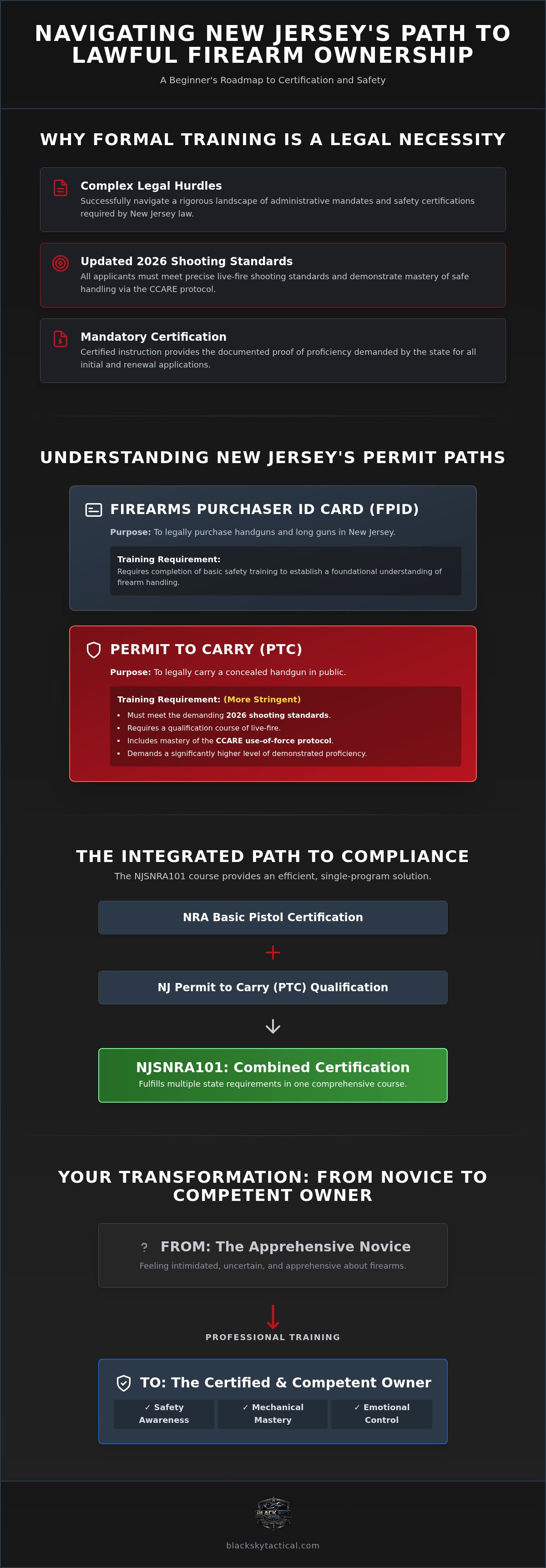
- Distinguish between the training obligations for a Firearms Purchaser Identification Card (FPID) and the more stringent 2026 shooting standards required for a Permit to Carry (PTC).
- Discover how the NJSNRA101: Combined NJS Conceal Carry + NRA Basic Pistol Class provides an efficient, integrated syllabus that fulfills multiple jurisdictional certifications in a single program.
- Gain a methodical preview of the transition from classroom theory to live-fire range qualification, ensuring you are prepared for the professional standards expected of a lawful owner.
The Essential Role of Beginner Handgun Training in New Jersey
A beginner handgun course NJ serves as the primary gateway for residents seeking to enter the highly regulated environment of firearm ownership. These programs are not casual recreational activities; they are structured, administrative syllabi designed to instill a disciplined understanding of firearm mechanics, universal safety protocols, and the specific legal obligations inherent to the jurisdiction. Ownership represents a serious, lifelong commitment that requires a sober assessment of one's responsibilities. It's a disciplined practice where the margin for error is nonexistent, making formal education the only responsible starting point.
There is a critical distinction between recreational shooting and the certified training required for permit applications. While anyone might discharge a firearm at a commercial range under supervision, certified training provides the documented proof of proficiency that the state demands. This structured education ensures that every participant understands the mechanical functions of their specific firearm, the physics of ammunition, and the ethical gravity of carrying a weapon in public spaces.
Why New Jersey Firearm Laws Mandate Professional Training
The administrative framework for obtaining a permit has undergone significant changes. Following recent judicial rulings, the state shifted toward a more rigorous, training-based qualification system to replace older, subjective standards. By 2026, all applicants must meet precise shooting standards and demonstrate a mastery of safe handling procedures to satisfy state police requirements. Understanding the broader context of New Jersey Gun Laws is essential for any applicant, as the statutes dictate everything from how a firearm is transported to where it may be legally possessed.
Engaging with a certified instructor is a legal necessity because these professionals provide the formal validation required for the Permit to Carry (PTC) and other credentials. A documented training record serves as a vital layer of legal protection, proving that the owner has been briefed on the current statutes and has demonstrated the required level of mechanical competence. This documentation is often the deciding factor in the success of an initial application or a biennial renewal.
The Emotional Shift: From Intimidation to Competence
It's common for beginners to feel a sense of anxiety or intimidation when considering their first visit to a professional training environment. Many fear they'll be the only novice in a room of experienced shooters or that the atmosphere will be overly aggressive. Professional instruction is designed to mitigate these concerns by replacing uncertainty with methodical, step by step skill building. Competence is defined as the ability to handle, load, and discharge a firearm safely without the need for constant external supervision.
- Safety Awareness: Learning to treat every firearm as if it's loaded, regardless of its perceived status.
- Mechanical Mastery: Understanding how to clear malfunctions and perform routine maintenance.
- Emotional Control: Developing the calm, steady focus required for accurate and safe operation under pressure.
By focusing on these core pillars, a structured beginner handgun course NJ replaces fear with a profound respect for the tool. Participants move from a state of apprehension to one of calm assurance, knowing they possess the skills to manage a firearm according to professional standards. This transition is essential for anyone intending to integrate a firearm into their personal safety plan responsibly.
NRA Basic Pistol Shooting Course: The Foundation of Handgun Safety
The NRA Basic Pistol Shooting Course represents the definitive benchmark for introductory firearm education within the United States. Unlike informal range orientations, this curriculum is a standardized, rigorous syllabus that emphasizes the "Proper Positive Attitude" necessary for safe and responsible ownership. This attitude is a formal requirement of the program; it reflects a student's disciplined willingness to adhere to strict safety protocols and legal mandates without exception. For many residents, this certification is the essential first step toward completing a comprehensive NRA basic pistol shooting course as part of a broader permitting strategy.
Core Curriculum: What You Will Learn
The instructional phase is divided into several critical modules that move from theoretical safety to mechanical application. Central to this instruction are the three fundamental NRA safety rules: always keep the gun pointed in a safe direction, always keep your finger off the trigger until ready to shoot, and always keep the gun unloaded until ready to use. Students receive detailed briefings on the distinct mechanical operations of revolvers and semi-automatic pistols, ensuring they can safely clear, load, and operate both platforms with professional precision.
Marksmanship instruction focuses on the physical fundamentals required for both accuracy and safety. This includes a methodical breakdown of the following elements:
- Grip and Stance: Establishing a stable physical platform to manage recoil and maintain consistent control of the firearm.
- Sight Alignment and Picture: The technical process of orienting the firearm's sighting system toward the target accurately.
- Trigger Control: The disciplined physical action required to discharge the firearm without disturbing the established aim.
The Value of an NRA Basic Pistol Certificate
Securing this credential is about more than personal skill development; it's about administrative compliance and jurisdictional recognition. Because firearm safety for beginners NJ is heavily regulated, possessing a nationally recognized certificate provides a verifiable record of training that is respected by law enforcement and licensing authorities. This certificate often facilitates permit applications in multiple jurisdictions, providing portable proof of competence that is recognized beyond state lines.
Enrolling in a structured beginner handgun course NJ ensures that your training meets these national standards while addressing the specific local requirements of the state. It's a methodical investment in your own legal and physical safety, providing the documentation necessary to advance through the permitting process. For those seeking to combine this foundational knowledge with specific state mandates, exploring the NJSNRA101: Combined NJS Conceal Carry + NRA Basic Pistol Class offers a streamlined path toward full certification and professional proficiency.
Navigating NJ Firearm Laws: Training Requirements for Permits
New Jersey distinguishes clearly between the credentials required for purchase and those required for public carry. While the Firearms Purchaser Identification Card (FPID) allows for the lawful acquisition and possession of a handgun, the Permit to Carry (PTC) involves a significantly more rigorous administrative process. A foundational beginner handgun course NJ provides the necessary groundwork for both, but the PTC specifically demands the Civilian Carry Assessment and Range Evaluation (CCARE) protocol. This evaluation isn't a mere participation event; it's a formal assessment of your ability to engage targets accurately and handle a firearm under the scrutiny of a certified instructor.
The NJ Permit to Carry (PTC) Pathway
The 2026 standards for the PTC include a mandatory 50-round live-fire qualification. Applicants must discharge rounds at an FBI Q target from various distances, achieving a minimum passing score of 80 percent. Beyond marksmanship, the law requires a comprehensive "Safe Handling" demonstration. This process ensures the applicant can safely holster, draw, and manage malfunctions without compromising safety protocols. Understanding these nuances is vital for liability, and readers can find a detailed breakdown in our nj concealed carry permit training guide, which explores the legal specifics of PTC compliance.
Jurisdictional Overlap: NJ and NY Reciprocity Training
For residents in Bergen County and surrounding northern New Jersey areas, legal compliance often extends beyond state lines. Many individuals commute into New York or own property across the border, necessitating a dual-jurisdictional approach to training. Because New Jersey doesn't recognize carry permits from any other state, and New York maintains its own 18-hour training mandate, residents often face a redundant path to legal carry. Achieving cross-border compliance requires a deep understanding of the "Use of Force" statutes in both regions, as the legal threshold for self-defense varies significantly between Trenton and Albany.
To address this, professional programs focus on jurisdictional overlap. By enrolling in a syllabus that satisfies both the New York Concealed Carry Improvement Act (CCIA) and the New Jersey PTC requirements, students can meet the standards for both states efficiently. Utilizing the NJSNRA101: Combined NJS Conceal Carry + NRA Basic Pistol Class allows residents to fulfill these requirements in a single, disciplined environment. This approach ensures total adherence to the law while establishing a documented record of training that stands up to professional and judicial scrutiny.
What to Expect in Your First Handgun Safety Class
Entering a beginner handgun course NJ requires a disciplined mindset and a commitment to methodical instruction. Whether you're enrolled in a standard 8-hour session or a comprehensive 18-hour course like the NJSNRA101, the schedule is structured to move logically from theoretical safety to mechanical application. This linear progression ensures that no student is introduced to live-fire exercises until they've demonstrated a complete understanding of safety protocols and administrative requirements. Black Sky Tactical maintains a sober and professional environment, prioritizing safety and legal compliance over the tactical stereotypes often associated with firearm training.
Classroom Instruction: The Legal and Mechanical Briefing
The initial phase of the course focuses on administrative paperwork and rigorous safety briefings. Instructors provide a thorough review of New Jersey statutes regarding the lawful transport and storage of firearms, which is essential for avoiding inadvertent legal violations during your commute to a range. Before any live ammunition is introduced, students engage in hands-on dry fire practice. This involves using inert training aids to master the mechanics of loading, unloading, and clearing malfunctions. This phase allows beginners to build muscle memory in a controlled, risk-free setting, ensuring they're prepared for the transition to the range environment.
The Range Experience: Your First Live Fire
Once the classroom requirements are met, the instruction moves to the range. This environment is strictly governed by Range Safety Officer (RSO) protocols, where every movement is monitored to ensure absolute safety. For beginners, the focus remains entirely on procedure and safety rather than speed or bullseye accuracy. Instructors provide one-on-one guidance during your first shots, assisting with grip, stance, and sight alignment. This personalized attention helps replace initial anxiety with a calm, focused respect for the firearm as a tool. You'll learn to manage recoil and maintain situational awareness, establishing the foundational skills required for eventual qualification.
Proper preparation includes arriving with the correct equipment to maintain the professional standards of the course. Students should wear suitable attire, such as closed-toe shoes and high-necked shirts, and bring high-quality eye and ear protection. These items are mandatory for participation and ensure a focused learning experience. If you're ready to begin your journey toward lawful ownership, you can view our upcoming certification schedule to ensure you meet all state and safety benchmarks in a disciplined environment.
NJSNRA101: Streamlining Your Path to Firearm Proficiency
The administrative complexity of New Jersey's firearm requirements often leads to a fragmented training experience, where students must navigate multiple courses to satisfy different legal standards. To address this, the NJSNRA101: Combined NJS Conceal Carry + NRA Basic Pistol Class integrates foundational safety with the specific mandates of the state’s carry permit process into a single, cohesive syllabus. This program serves as a critical bridge between the user and the state's rigorous mandates, ensuring that students don't simply fulfill a requirement but develop a deep, lasting proficiency. While the curriculum is delivered in a group setting, it maintains the meticulous, detail-oriented attention characteristic of private firearm training for beginners NY, allowing each participant to address their specific mechanical or conceptual challenges under expert supervision.
Why a Combined Course is the Intelligent Choice
Efficiency is the primary driver behind the development of a combined syllabus. Selecting a beginner handgun course NJ that accounts for both national standards and local mandates is the most effective way to ensure long-term compliance. By merging the NRA Basic Pistol curriculum with the NJ PTC requirements, students avoid the redundancy of attending multiple introductory sessions. This approach is significantly more cost-effective than booking separate certifications and ensures a consistent training philosophy throughout the entire instructional period. Rather than learning disparate techniques from different sources, students build their skills on a unified foundation that moves logically from basic mechanics to the legal complexities of concealed carry.
Booking Your Training in Bergen County
Black Sky Tactical facilitates these sessions within Bergen County, providing a central location for residents across northern New Jersey and neighboring New York counties. For students traveling from Rockland or Westchester, it's recommended to review the specific transport laws discussed in the administrative briefings to ensure compliance during transit. All registrations are handled through a structured portal to maintain strict class size limits, ensuring a professional instructor-to-student ratio that prioritizes safety and individual feedback.
Preparation for your session should include a review of the required equipment and a sober assessment of the legal responsibilities involved in firearm ownership. This training is a serious commitment to public safety and personal accountability. To begin your journey with a focus on legal compliance and disciplined skill building, you may Register for the NJSNRA101 course to begin your journey responsibly. This final step transforms the administrative burden into a structured path toward competent, lawful handgun ownership.
Establishing Your Foundation for Lawful Ownership
Securing a firearm permit in New Jersey is a deliberate process that requires more than just mechanical skill; it demands a comprehensive understanding of the state's administrative and legal framework. By selecting a structured beginner handgun course NJ, you ensure that your training record meets the rigorous standards set by state authorities for 2026. This foundational education replaces uncertainty with a disciplined respect for firearm safety and jurisdictional compliance, particularly for those navigating the complex overlap between New Jersey and New York statutes.
Black Sky Tactical serves as a professional bridge to these mandates. Our NRA Certified Instructors provide a comprehensive 18-hour NJ/NY curriculum with a specialized Bergen County focus, ensuring every student is prepared for the procedural reality of modern ownership. You don't have to navigate these regulatory hurdles alone. Taking the first step toward certification is a significant commitment to your personal responsibility and public safety. We're here to ensure that your transition into lawful ownership is methodical, transparent, and fully compliant with current law.
Enroll in the NJSNRA101: Combined NJS Conceal Carry + NRA Basic Pistol Class to begin your training with the precision and sobriety the subject matter requires. We look forward to guiding you through this essential certification process.
Frequently Asked Questions
Do I need to own a handgun before taking a beginner course in NJ?
You aren't required to own a firearm before enrolling in a beginner handgun course NJ. Professional training environments often provide the necessary equipment, including the handgun and safety gear, to ensure students can learn fundamental mechanics before making a purchase. This approach allows you to demonstrate safe handling and mechanical proficiency under supervision, which is an essential administrative step before applying for a Firearms Purchaser Identification Card or specific purchase permits.
How long does the NJ Permit to Carry (PTC) training take to complete?
The training required for the New Jersey Permit to Carry is comprehensive and typically spans 18 hours when completed through the NJSNRA101: Combined NJS Conceal Carry + NRA Basic Pistol Class. This duration is mandated to ensure that all administrative briefings, legal instruction, and live-fire qualifications are conducted with the necessary depth. The process involves a methodical transition from classroom theory to practical range application, ensuring each student meets the rigorous 2026 state standards for public carry.
Is the NRA Basic Pistol certificate required for an NJ gun permit?
While the state of New Jersey doesn't explicitly name the NRA certificate as the sole requirement for a basic permit, it's widely recognized as the foundational standard for demonstrating "substantially equivalent" training. Most residents find that completing a beginner handgun course NJ through the NRA curriculum provides the documented proof of proficiency required by local police departments. This certification serves as a professional record of your commitment to safety and is often a prerequisite for advanced carry qualifications.
Can I take a beginner handgun course if I live in NY but work in NJ?
Residents of New York who work or travel within New Jersey are eligible to enroll in these courses to ensure cross-border legal compliance. Because New Jersey doesn't recognize out-of-state permits, individuals seeking to carry or possess firearms in both jurisdictions must satisfy the specific training mandates of each state. Our programs in Bergen County are designed to address these jurisdictional overlaps, providing the necessary certifications for both New York and New Jersey administrative processes.
What is the minimum age for a handgun safety course in New Jersey?
To apply for a permit to purchase or carry a handgun in New Jersey, an individual must be at least 21 years of age. However, students younger than 21 may participate in safety-focused instruction, such as a Youth Safety Course, provided they are under the direct supervision of a certified instructor or a legal guardian. This early instruction focuses on establishing a disciplined mindset and fundamental safety protocols long before the administrative permitting process begins at the age of maturity.
What happens if I fail the live fire qualification portion of the course?
The CCARE protocol requires a passing score of 80 percent, which equates to 40 out of 50 rounds placed accurately on an FBI Q target. If a student doesn't meet this threshold during their initial attempt, they're typically required to undergo additional remedial instruction to address specific marksmanship or handling deficiencies. Professional instructors prioritize the mastery of safety and mechanics, ensuring that every student eventually reaches the state-mandated proficiency level through disciplined practice and technical adjustment.
Are there specific gear requirements for the NJSNRA101 course?
Participants in the NJSNRA101: Combined NJS Conceal Carry + NRA Basic Pistol Class must adhere to strict safety equipment standards. This includes high-quality wrap-around eye protection and electronic or high-decibel-rated ear protection to ensure clear communication during range commands. Additionally, students are required to wear suitable attire, such as closed-toe shoes and high-necked shirts, to mitigate the risks associated with hot shell casings. Arriving with the correct equipment is a mandatory component of the professional training environment.
How often do I need to renew my NJ handgun training certifications?
New Jersey Permit to Carry credentials must be renewed every two years to maintain legal status. This renewal process requires the applicant to demonstrate continued proficiency by completing the mandatory live-fire qualification and legal briefings again. Maintaining a current record of training is an ongoing administrative obligation for every permit holder, ensuring that your skills and knowledge of the evolving "Use of Force" statutes remain consistent with the latest state regulatory standards and police protocols.


