
The difference between a successful NY concealed carry application and a rejected one often comes down to procedural discipline rather than simple marksmanship. Obtaining a New York State license in 2026 is no longer a simple administrative formality; it's a rigorous 18-hour test of both your mental focus and your technical proficiency. You likely feel the weight of the 16+2 hour mandate, which can seem daunting when you're managing character references and local county background checks. It's natural to feel some anxiety about the live-fire qualification or the 80% passing score required on the written exam. Learning how to prepare for NY concealed carry class is the first step toward professional confidence.
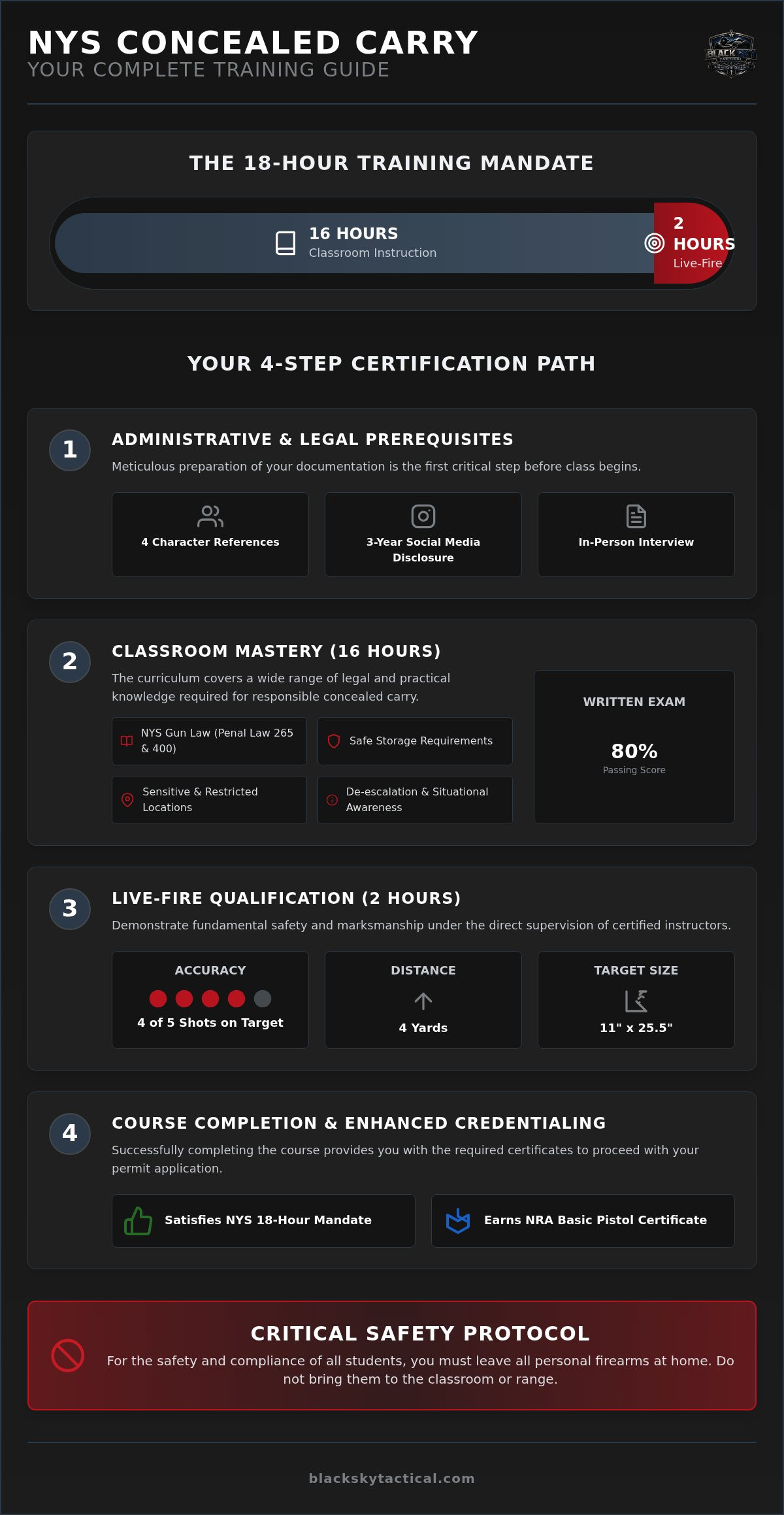
This guide provides a methodical breakdown of the administrative, physical, and mental requirements necessary to navigate the NYS 18-hour course successfully. You'll gain a clear understanding of the full syllabus, including the specific live-fire standards where you must hit an 11-inch by 25.5-inch target from four yards. We will outline what not to bring to the classroom to ensure you remain in strict compliance with safety protocols. By following this briefing, you can approach your certification process with the calm assurance of a prepared applicant.
Key Takeaways
- Understand the 16-hour classroom and 2-hour live-fire division required by the Concealed Carry Improvement Act to ensure your training adheres to current 2026 mandates.
- Gain a clear understanding of how to prepare for NY concealed carry class by organizing your character references and necessary documentation to meet the rigorous standards of the background investigation process.
- Prepare for the logistical demands of the 18-hour curriculum, including the necessity of leaving personal firearms at home and maintaining focus during extended instructional blocks.
- Familiarize yourself with the live-fire qualification metrics, which mandate hitting a specific target four out of five times from a distance of four yards to demonstrate technical proficiency.
- Leverage the efficiency of a combined course structure to satisfy the NYS 18-hour mandate while simultaneously earning an NRA Basic Pistol certificate for enhanced credentialing.
Understanding the NYS 18-Hour Training Mandate (16+2)
The regulatory environment for firearm ownership in New York transitioned significantly following the enactment of the Concealed Carry Improvement Act (CCIA). This legislation established a standardized 18-hour training curriculum that all new applicants must complete before their background investigation can proceed. It's a prerequisite. Understanding the specific breakdown of these hours is a vital part of learning how to prepare for NY concealed carry class, as it requires a disciplined commitment to both theoretical study and practical application. The state mandates this course to ensure that every permit holder possesses a baseline of legal knowledge and technical skill.
This shift in the law replaced the previous "proper cause" standard with a more objective, training-based framework. Your ability to follow these procedural steps is now just as critical as the quality of your character references. The 18-hour total is divided into two distinct phases to ensure a comprehensive education that covers both the legalities of carrying a weapon and the physical mechanics of using one.
The Core Classroom Curriculum
The 16-hour classroom portion serves as the foundation for responsible carry. It covers a broad spectrum of topics, including safe storage requirements and the interaction between state and federal regulations. A comprehensive review of New York State gun laws, specifically Penal Law Articles 265 and 400, is central to the curriculum. Students must demonstrate a clear understanding of these statutes to pass the mandatory written examination with a score of at least 80%. Instruction also encompasses the requirements for reporting stolen or lost firearms and the specific locations designated as "sensitive" or "restricted" under current law.
Beyond the letter of the law, the syllabus emphasizes the mental aspects of self-defense. This includes situational awareness training designed to help individuals avoid conflict before it escalates. Instructors provide detailed guidance on the physiological effects of substances on firearm safety and the legal "duty to retreat" that exists within the state. These modules are intended to foster a disciplined mindset that prioritizes de-escalation over the use of force.
The 2-Hour Live Fire Component
The final two hours of the mandate transition students from the classroom to the range for the live-fire component. This phase is not merely about shooting; it's an assessment of your ability to apply safety principles under direct supervision. You'll be evaluated on mandatory range safety rules and holster retention strategies to ensure you can manage a firearm securely in public spaces. Instructors look for consistent adherence to the four fundamental rules of gun safety while you perform drawing and holstering maneuvers. The Live Fire Qualification serves as the final proficiency hurdle for the NYS CCW permit.
Administrative and Legal Prerequisites for Students
The administrative process for obtaining a concealed carry license in New York is a multi-layered procedural commitment that begins long before you step onto the range. Understanding how to prepare for NY concealed carry class involves more than just physical readiness; it requires meticulous attention to the documentation requested by your licensing officer. Applicants must compile a list of four character references who can attest to their moral character and reliability. These individuals should be prepared for potential contact during the background investigation phase, which has become significantly more thorough under the Concealed Carry Improvement Act. Current legal standards also require the disclosure of social media accounts maintained over the past three years, a mandate that reflects the state's focus on identifying potential red flags before a permit is issued.
Consequently, the in-person interview has become a standard component of the 2026 application process, serving as a final verification of the information provided in your written submission. Accuracy in these early stages is paramount. Any discrepancy between your interview statements and your written application can lead to a presumption of dishonesty, which often results in an immediate denial of the permit.
Local County Compliance (Rockland, Orange, Westchester)
Licensing protocols in the Hudson Valley are not uniform; they are governed by the specific preferences and administrative schedules of each county clerk's office. For instance, Rockland County residents may find their processing timelines and fingerprinting schedules differ from those in Westchester or Orange counties. It's critical to ensure that your NY 18 hour concealed carry course certificate is specifically recognized by your local licensing officer. While the training standards are set at the state level, the local authority maintains the final word on the acceptability of your credentials. For the most current updates on county-specific forms and recertification links, applicants should regularly consult the NYS Police Firearms Information portal. Enrolling in a professional certification program that understands these regional nuances ensures your documentation meets these rigorous standards without unnecessary delays.
Background Checks and Disclosure
The background investigation now extends beyond the applicant to include the disclosure of household members and domestic partners. This requirement is designed to ensure that the environment where a firearm is stored is safe and that no prohibited persons have easy access to the weapon. One of the most common pitfalls that delays permit issuance is the failure to disclose minor legal encounters or sealed records from years past. The background check is exhaustive; it will uncover information that an applicant might assume is no longer relevant. Truthfulness in administrative filings is the only way to avoid permanent disqualification. A single omission, even if unintentional, can be interpreted as an attempt to deceive the licensing authority, effectively ending the application process before the training phase is even completed.
Logistical Readiness for the 18-Hour Session
The 'No Unauthorized Firearms' rule is the most critical logistical directive you must follow. Unless explicitly instructed by your trainer for the range portion, you must leave all personal weapons at home. Bringing a firearm into the classroom environment without prior authorization is often grounds for immediate dismissal and could jeopardize your permit application. This protocol ensures a controlled environment where safety remains the primary objective. Arriving without a weapon is not a sign of being unprepared; it is a demonstration of your ability to follow strict safety mandates.
Successfully finishing the course requires more than just showing up; it demands significant physical and mental endurance to manage two consecutive nine-hour days of intensive instruction. When considering how to prepare for NY concealed carry class, you should view the 18-hour requirement as a professional briefing rather than a casual seminar. Your ability to remain attentive throughout the legal and safety modules is vital for passing the final written exam. Arriving well-rested is a prerequisite for the high-focus environment you'll encounter.
The Classroom Environment
The classroom phase is a mental marathon. The NYS 18-Hour Training Mandate requires 16 hours of academic instruction, which often involves long-form lectures on complex penal codes. To maintain cognitive focus, planning your hydration and nutrition is essential. Many facilities have limited access to food, so bringing high-protein snacks and adequate water is a practical necessity. Effective note-taking is another priority. You'll need to reference specific legal definitions and safety protocols during the written test at the end of the 16-hour block. Wear comfortable, professional attire that allows you to sit for extended periods without distraction.
Range Day Logistics
Transitioning to the range requires a different set of logistical preparations. Safety is the absolute priority, which means adhering to strict dress codes. Open-toed shoes, such as sandals or flip-flops, are strictly prohibited because they don't protect against hot shell casings. You should wear sturdy, closed-toe footwear and a shirt with a high collar to prevent brass from entering your clothing. Ballistic-rated eye and ear protection are mandatory. While some students prefer their own equipment, firearms and ammunition for the qualification are typically provided by the instructor. This ensures that every applicant uses a reliable, well-maintained tool that meets state standards. Understanding how to prepare for NY concealed carry class means arriving with a valid photo ID and all required administrative documentation to ensure your range time is officially recorded.
Preparing for the 2-Hour Live Fire Qualification
The live-fire portion of the training mandate is not a casual target practice session; it is a formal proficiency assessment conducted under strict instructional oversight. To understand how to prepare for NY concealed carry class, you must recognize that the instructor is evaluating your procedural discipline as much as your marksmanship. The current state-mandated metrics require an applicant to fire five rounds from a distance of four yards at an 11-inch by 25.5-inch paper target. A successful qualification requires at least four out of those five rounds to hit the target. While these distances are relatively short, the pressure of a formal evaluation often induces range anxiety. Mental preparation should focus on the consistency of your process rather than the outcome of each shot. Establishing a technical foundation through the NRA basic pistol shooting course provides the muscle memory needed to perform these tasks with calm assurance.
Fundamentals of Marksmanship
Technical proficiency on the range begins with a stable stance and a consistent, high-grip on the frame of the firearm. These mechanical elements create the necessary platform for proper sight alignment and sight picture. During the two-hour session, you will be expected to demonstrate precise trigger control and disciplined breath management while operating under the direct supervision of a certified instructor. Every action, from drawing the weapon to recovering it, must be performed with deliberate intent. The shooting qualification serves as a test of both accuracy and safe firearm manipulation.
Safety Evaluations During the Test
Safety is the absolute priority throughout the live-fire component, and your adherence to range protocols is under constant scrutiny. Muzzle discipline remains the most critical factor; any instance of the muzzle pointing in an unsafe direction, even momentarily, is the primary reason for immediate failure and removal from the range. You must demonstrate a total understanding of range commands and the specific administrative procedures for loading and unloading the firearm. For individuals who have never handled a handgun, the 18-hour course shouldn't be the first time they experience live fire. Engaging in private firearm training for beginners NY can help bridge the gap between novice status and the technical competency required for state certification. This personalized instruction ensures that safety habits are ingrained before the high-stakes environment of the qualification test. You can enroll in a comprehensive training course to ensure your skills meet the rigorous 2026 certification standards.
Why the NYSNRA101 Combined Course is Essential
Selecting the right training provider is the final logistical hurdle in understanding how to prepare for NY concealed carry class. The NYSNRA101 program is designed for efficiency, allowing students to satisfy the state-mandated 18-hour requirement while simultaneously earning a nationally recognized NRA Basic Pistol certificate. This dual-track approach ensures that you aren't just checking a legal box; you're receiving a standardized education that meets both the high-stakes demands of the Concealed Carry Improvement Act and the rigorous safety benchmarks of the National Rifle Association. It's a comprehensive weekend commitment that consolidates your training into a single, professional briefing. By choosing a combined path, you ensure your credentials carry weight both within New York and across jurisdictions that respect NRA standards.
The Advantage of Dual Certification
The standard NRA curriculum provides a significantly deeper exploration of firearm mechanics and ballistics than what is required by the state's minimum standards. By incorporating these modules, the NYSNRA101 course helps you build a more robust training resume. This is particularly valuable for individuals seeking out-of-state permits, as many jurisdictions recognize NRA certification as a primary proof of competency even if they don't recognize specific New York permits. The presence of a private firearms instructor NY ensures that the instruction remains focused on tactical proficiency rather than just administrative compliance. This level of expertise bridges the gap between basic safety and the real-world responsibility of carrying a concealed weapon, offering a level of technical depth that standalone state courses often lack.
Completing Your Application Post-Class
Your responsibility doesn't end when the range session concludes. Once you receive your certificate of completion, you must organize it alongside your other application materials for the county licensing officer. A final checklist should include your four character references, your notarized application forms, and your training credentials. Ensure every document is legible and matches the specific requirements of your county clerk, whether you're in Rockland, Orange, or Westchester. It's also vital to remember that NY concealed carry licenses now operate on a three-year renewal cycle, a change from the previous five-year term. Staying current requires you to complete a two-hour live-fire range training course within six months of your renewal date. Understanding how to prepare for NY concealed carry class includes planning for this long-term maintenance of your legal and technical skills. Following this methodical path ensures that your application is processed without the delays caused by incomplete or unrecognized training documentation.
Securing Your Path to NYS Certification
Achieving a New York State concealed carry license in 2026 demands a commitment to both administrative precision and technical proficiency. Navigating the 18-hour mandate requires more than just attendance; it necessitates a disciplined approach to legal study and a focused mindset for the live-fire qualification. Mastering how to prepare for NY concealed carry class ensures that you arrive at the range with the logistical and mental readiness required to meet the state's rigorous safety standards. By organizing your character references early and adhering to local county protocols, you lay a professional foundation for your background investigation.
Black Sky Tactical provides the expert guidance necessary to navigate these complex requirements through our comprehensive 16+2 hour curriculum. Our certified NRA instructors serve as Rockland and Westchester county compliance experts, ensuring your training meets every jurisdictional standard. Register for the NYSNRA101: Combined NYS 18-Hour Concealed Carry Class today to begin your journey toward responsible firearm ownership. With the right preparation, you can approach the application process with calm assurance and professional integrity.
Frequently Asked Questions
Do I need to own a handgun before taking the NY 18-hour concealed carry class?
No, you don't need to own a handgun; in fact, New York State law prohibits the possession of a firearm without a valid permit. Since this 18-hour course is a prerequisite for that permit, instructors provide the necessary firearms and equipment for the training. This is a critical part of how to prepare for NY concealed carry class, as it ensures all students train on safe, well-maintained equipment while remaining in full legal compliance.
What happens if I fail the live-fire qualification portion of the course?
If a student fails to meet the proficiency standards during the live-fire qualification, they won't receive a certificate of completion. The state requires hitting the target four out of five times from a distance of four yards. In such instances, instructors typically offer remediation sessions or require the student to re-enroll in the range portion. The primary focus remains on ensuring that every certified individual can demonstrate safe firearm manipulation and technical accuracy before carrying in public.
Can I use my 18-hour NYS certificate to apply for a permit in NJ?
A New York State training certificate is not directly interchangeable with New Jersey's specific licensing requirements. While the NRA Basic Pistol portion of our combined course is nationally recognized, New Jersey mandates its own specific qualification standards and legal modules. Applicants seeking permits in both states should consider the NJSNRA101 course, which is tailored to the unique jurisdictional authority and administrative procedures of New Jersey, rather than relying on NYS-specific documentation.
How long is the NYS concealed carry training certificate valid for?
The training certificate issued upon completion of the 18-hour course is generally valid for one year for the purpose of your initial permit application. It's vital to submit your application to the county clerk or licensing officer within this timeframe to avoid the necessity of retraining. Once the permit is granted, remember that New York State now requires license renewal every three years, which involves additional live-fire training within six months of the expiration date.
Is ammunition provided for the 2-hour live-fire qualification?
Yes, ammunition is typically provided by the instructor for the 2-hour live-fire qualification to maintain a controlled and safe environment. This ensures that all participants are using factory-standard, reliable ammunition that functions correctly with the provided training firearms. By removing the need for students to source their own rounds, instructors can focus entirely on evaluating shooting fundamentals, muzzle discipline, and the administrative loading and unloading procedures required for state certification.
Are there any exemptions for the 18-hour training requirement for retired law enforcement?
Certain active and retired law enforcement officers are exempt from the 18-hour training mandate under New York State Penal Law 400.00. However, these individuals must provide official documentation verifying their status and successful completion of equivalent firearms training during their service. It's recommended that retired officers contact their local licensing authority in Rockland or Westchester to confirm exactly which forms are necessary to prove their exempt status before beginning the application process.
Can I take the 16 hours of classroom training online in 2026?
No, the 16 hours of classroom instruction cannot be completed online in 2026. The Concealed Carry Improvement Act specifically mandates in-person instruction to ensure that students engage directly with certified trainers on complex legal topics and safety protocols. This face-to-face requirement is a cornerstone of how to prepare for NY concealed carry class, as it allows for immediate clarification of New York State gun laws and ensures the integrity of the mandatory written examination.
What is the minimum age requirement to attend the NYSNRA101 course?
The minimum age requirement to attend the NYSNRA101 course is 21 years old, matching the legal age to apply for a concealed carry permit in New York. While younger individuals may be interested in firearm safety, this specific certification is designed for those eligible to undergo the full state background investigation. Applicants must present a valid photo ID at the start of the session to verify their age and identity before participating in the 18-hour curriculum.


