
With New York's gun laws ranked as the fourth strongest in the United States as of 2026, the path to lawful possession is a rigorous test of both patience and technical proficiency. It's understandable if you feel a sense of apprehension regarding the shifting landscape of requirements, particularly when faced with the 16-hour classroom mandate and the high-stakes nature of the mandatory live-fire qualification. The administrative complexity created by varying county-specific fees and strict oversight by the State Police can often make the application process feel unnecessarily opaque.
This guide provides a definitive roadmap for achieving legal firearm ownership NY, ensuring you meet every administrative, legal, and safety standard required by the state. We will detail the specific 18-hour training curriculum, clarify the distinct fee structures in Rockland, Orange, and Westchester counties, and examine the impact of recent legislation like the 2026 ban on convertible pistols. This instructional overview is designed to move you through the necessary procedural steps with clarity and professional confidence, replacing confusion with a structured path toward certification and legal peace of mind.
Key Takeaways
- Distinguish between the legal definitions of possession and carry permits under the NY SAFE Act to maintain strict adherence to 2026 state mandates and avoid regulatory violations.
- Review the comprehensive eligibility requirements, including social media disclosures and character references, that are essential for securing legal firearm ownership NY.
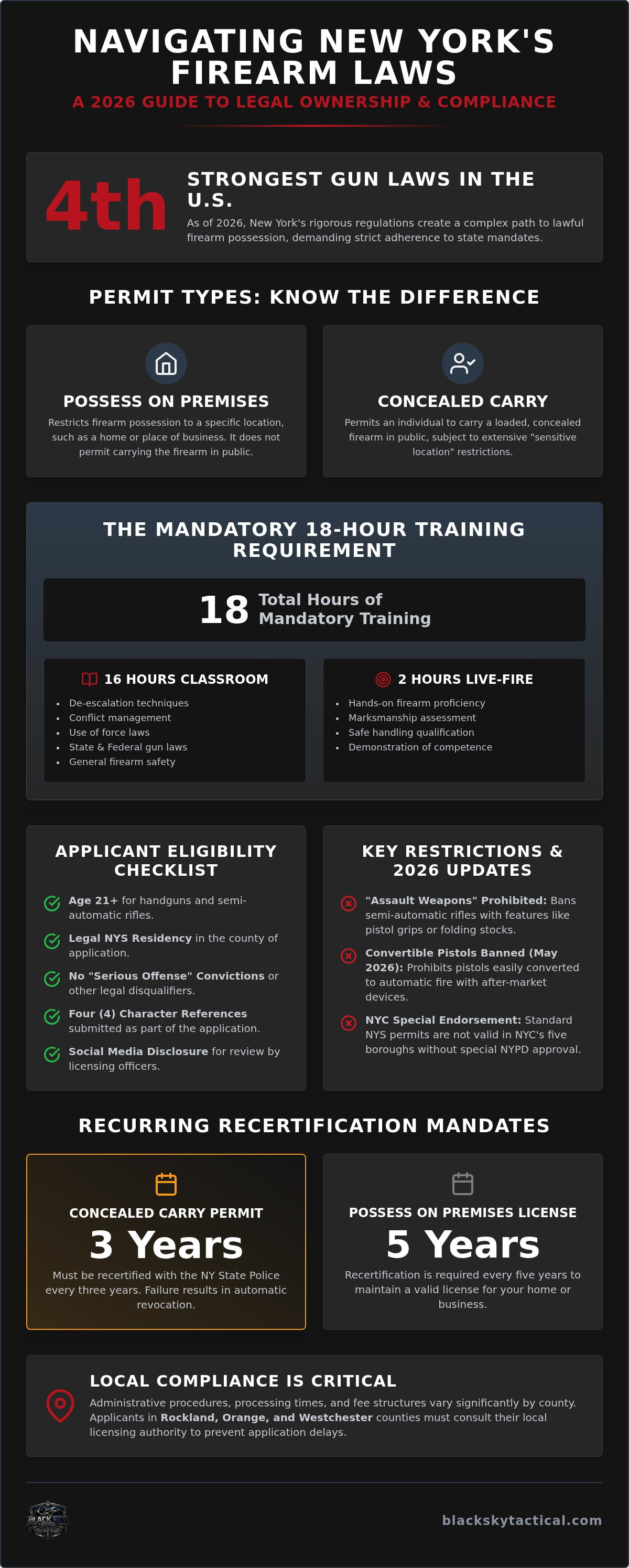
- Prepare for the mandatory 18-hour training requirement, which requires 16 hours of classroom education on de-escalation and law before completing a 2-hour live-fire assessment.
- Identify the specific administrative procedures and fee structures unique to Rockland, Orange, and Westchester counties to prevent application delays within your local jurisdiction.
- Explore how the NYSNRA101 combined course integrates NRA safety fundamentals with New York's state-specific certification mandates for a more thorough educational experience.
Overview of New York State Firearm Laws in 2026
The administrative framework governing legal firearm ownership NY requires a thorough understanding of state-level mandates that have significantly evolved following the Concealed Carry Improvement Act (CCIA). All handguns and semi-automatic rifles require specific permits issued by the licensing officer of the applicant's county of residence. This regulatory environment is detailed further in this Overview of New York Gun Laws, which outlines the state's position as one of the most strictly regulated jurisdictions in the country. Central to these regulations is the New York State National Instant Background Check System (NICS), which provides a centralized verification process for all firearm and ammunition transfers, ensuring that the standards for legal firearm ownership NY are consistently upheld across all jurisdictions.
The distinction between "possession" and "carry" remains a critical legal boundary. A "Possess on Premises" license restricts the firearm to a specific dwelling or place of business, whereas a "Concealed Carry" license permits the individual to carry a loaded firearm in public, subject to extensive "sensitive location" restrictions. Additionally, the NY SAFE Act continues to define the legality of firearm features; it prohibits the possession of "assault weapons" characterized by specific military-style features, such as folding stocks or pistol grips on semi-automatic rifles with detachable magazines. In May 2026, these restrictions were expanded to include a ban on pistols that are easily convertible to automatic fire, specifically targeting the proliferation of after-market conversion devices.
NYC vs. NY State: Understanding Jurisdictional Differences
New York exhibits a fragmented jurisdictional landscape where a standard New York State permit is generally not recognized within the five boroughs of New York City. Residents of Westchester and Rockland Counties must be particularly aware that while their permits are valid throughout the rest of the state, entry into NYC requires a specific "Special Carry" endorsement issued by the NYPD. Most counties have moved away from "Administrative" or restricted permits, such as those limited to hunting and target use, toward the standardized Concealed Carry format mandated by recent judicial rulings and state legislative updates.
The 2026 Recertification and Renewal Mandates
Recertification is no longer a one-time event but a recurring administrative obligation. Under current 2026 guidelines, concealed carry permit holders must recertify their licenses with the New York State Police every three years. This timeline is shorter than the five-year window established for "Possess on Premises" licenses. It's a strict requirement; failure to complete this process within the state-mandated window results in the automatic revocation of the permit, rendering possession of the firearm illegal. The CCIA also requires that any individual seeking to renew or upgrade their permit must demonstrate completion of the mandatory 18-hour safety course, ensuring that even long-term owners meet modern proficiency standards.
Licensing Requirements for Handguns and Semi-Automatic Rifles
The administrative procedure for securing legal firearm ownership NY involves a multi-tiered vetting process that evaluates an applicant’s legal eligibility, residency, and personal history. To qualify for a pistol or semi-automatic rifle license, individuals must generally be at least 21 years of age, maintain legal residency within the state, and possess a criminal record free of "serious offense" convictions. The application begins with a formal submission to the local licensing officer, which is followed by a mandatory fingerprinting session to facilitate a comprehensive background check. While the state provides Official NYS Gun Safety Information to assist with general inquiries, the burden of demonstrating "good moral character" remains with the applicant. Completing the NRA basic pistol shooting course is a recommended step for building the technical proficiency and safety awareness that licensing officers look for during the evaluation phase.
The Character Reference and Social Media Review
Current state mandates require applicants to submit four character references who can attest to their stability and integrity. These individuals must typically reside within the same county as the applicant and cannot be related by blood or marriage. Furthermore, the background investigation process includes a mandatory review of the applicant’s social media history from the preceding three years. Licensing officers examine these digital records for any evidence of behavior or statements that might suggest a risk to public safety. Applicants must provide a comprehensive list of all current and former social media accounts to ensure full transparency and administrative compliance during the investigation.
Semi-Automatic Rifle Permits: What You Need to Know
Since September 2022, New York has required a specific license for the purchase or transfer of semi-automatic rifles. While individuals may continue to possess rifles acquired prior to this date without a permit, any new acquisition requires a formal license endorsement. For existing pistol permit holders, adding a semi-automatic rifle endorsement is generally an administrative amendment process that involves a nominal fee. There are also specific legal provisions and restrictions concerning young adults in NY who seek to understand their rights regarding long gun ownership. If you require assistance with these specific licensing steps, Black Sky Tactical provides the professional training necessary to meet these state standards.
The Mandatory 18-Hour NYS Concealed Carry Training
The Concealed Carry Improvement Act (CCIA) established a uniform training standard that serves as the administrative cornerstone for legal firearm ownership NY. This mandate requires applicants to complete a minimum of 18 hours of instruction, consisting of 16 hours of classroom-based theory and 2 hours of supervised live-fire training. As outlined by NYS Police Firearm Licensing, this certification is a prerequisite for both new applicants and those seeking to renew or upgrade specific permit types. The NY 18 hour concealed carry course is designed to ensure that every permit holder possesses a standardized level of legal knowledge and technical skill before carrying a firearm in public spaces.
Classroom Curriculum: Legal and Tactical Fundamentals
The 16-hour classroom phase is an intensive review of the legal and ethical obligations of a permit holder. A significant portion of this time is dedicated to New York Penal Law Article 35, which defines the specific legal parameters for the use of physical and deadly physical force. Understanding these statutes is critical, as they dictate the legal consequences of defensive actions and the standard for "reasonable belief" in a self-defense scenario. Beyond legal theory, the curriculum covers several vital safety and administrative topics:
- Conflict De-escalation: Techniques and situational awareness strategies designed to avoid confrontations and minimize the need for force.
- Safe Storage Protocols: Mandatory practices to prevent unauthorized access by minors or prohibited persons, including the use of locking devices and safes.
- Firearm Maintenance: Detailed instruction on the mechanics of safe handling, cleaning, and ensuring the long-term reliability of the firearm.
- Mental Health and Situational Awareness: Resources for identifying potential risks and the ethical responsibilities inherent in firearm possession.
Live-Fire Qualification: Meeting the Shooting Standard
The 2-hour range component requires students to demonstrate safe firearm handling and a baseline level of marksmanship under the supervision of a certified instructor. The qualification involves a specific course of fire where the applicant must discharge a minimum number of rounds at a designated target from various distances, typically ranging from three to fifteen yards. Accuracy is strictly monitored, and any safety violations during the qualification phase result in an immediate failure of the course. For those who haven't previously handled a handgun, pursuing private firearm training for beginners in NY can be a prudent step to ensure they meet these proficiency standards during the official assessment. This practical evaluation ensures that legal firearm ownership NY is backed by demonstrated competence and the ability to operate a firearm safely in a controlled environment.
Local Compliance: Rockland, Orange, and Westchester Counties
The administrative journey toward legal firearm ownership NY is heavily influenced by the specific protocols of the county where you reside. While the 18-hour training requirement is a state mandate, the logistical execution of permit submissions and fingerprinting varies significantly between Rockland, Orange, and Westchester counties. Each jurisdiction manages its own scheduling and fee structures, which can impact the total duration of the application process. Engaging a private firearms instructor in NY who is familiar with these local nuances is often the most efficient way to ensure your documentation meets the exact standards of your local licensing officer. This local expertise is particularly valuable when navigating the specific range rules that govern the mandatory live-fire qualification phase.
County-Specific Application Nuances
In Rockland County, the application process is centered at the County Clerk’s Office, where a $150 application fee is required. Applicants must coordinate specific fingerprinting schedules and prepare for an interview process that forms a core part of the background investigation. Westchester County maintains a higher fee structure; initial applications and recertifications cost $175, while an amendment to upgrade an existing permit to a CCW license costs $125. For residents of Orange County, the initial fee for fingerprinting and processing is $111.50. Administrative expectations in 2026 suggest that wait times fluctuate based on application volume, so it's vital to submit completed 18-hour training certificates promptly to avoid unnecessary delays. Adding a semi-automatic rifle endorsement to an existing permit in Orange or Rockland generally involves a $5 amendment fee.
Local Training Availability and Range Access
Securing a slot for the mandatory live-fire qualification depends heavily on local range access in the Lower Hudson Valley. Certified instructors must often coordinate with private clubs or public ranges, which can affect the timing of your certification. For those living near the state line, there are significant benefits to training with a provider who understands the requirements for both New York and NJ residents, especially given the legal complexities of carrying across state borders. Orange County applicants should anticipate a methodical review process; current 2026 data indicates that administrative processing times are closely tied to the accuracy of the character reference disclosures. If you're managing multiple firearms, remember that each new purchase requires a formal amendment to your license before you can legally take possession. To ensure you meet all local and state mandates with professional guidance, you can view upcoming NYS CCW class schedules to begin your certification process.
Fulfilling NY Requirements with Black Sky Tactical
Black Sky Tactical functions as a professional training institution for residents in Rockland, Orange, and Westchester Counties, prioritizing strict adherence to the latest state mandates. The primary offering is the NYSNRA101: Combined NYS 18-Hour Conceal Carry + NRA Basic Pistol Class. This course is specifically structured to provide the necessary certification for legal firearm ownership NY while ensuring students receive instruction from NRA-certified instructors. By selecting this combined program, applicants ensure their training is both legally compliant and technically thorough, which is a critical factor for successful licensure under current 2026 standards.
The Advantage of Combined Certification
Integrating the NRA Basic Pistol curriculum with the mandatory New York State 18-hour course allows students to achieve a higher level of foundational knowledge without the need for separate, redundant training sessions. This approach saves time and ensures that the training certificate is recognized by local licensing officers during the permit review process. The integration of NRA fundamentals provides a national standard of training that often exceeds the basic state requirements, offering a more robust educational foundation for those navigating the permit process. For individuals who maintain interests in multiple jurisdictions, the provider also offers the NJSNRA101, which is a combined NJS Conceal Carry and NRA Basic Pistol Class designed to meet New Jersey’s specific PTC compliance standards.
Beyond the Permit: Advanced Tactical Training
Maintaining legal firearm ownership NY involves more than just the initial permit acquisition; it requires a commitment to ongoing skill development. Black Sky Tactical provides specialized programs such as Violent Incident Command and Violent Incident Command Training, which focus on advanced tactical responses and command structures. These courses are designed for permit holders who recognize that the duty of carry involves a continuous commitment to tactical proficiency and legal understanding. Additionally, the institution offers the following services to support long-term safety and compliance:
- Private Firearm Training: Customized lessons for individuals who require personalized instruction to refine their marksmanship or safe handling techniques.
- Youth Safety Course: An essential introduction to firearm safety for younger family members, fostering a culture of professional responsibility within the household.
- NRA Membership Assistance: Guidance on joining the national organization to stay informed about broader industry standards and safety advocacy.
This comprehensive approach ensures that the transition to lawful possession is handled with the gravity and meticulous attention to detail that the state's regulatory environment requires. By focusing on both the administrative mandates and the practical skills of defensive shooting, the training prepares you for the realities of responsible ownership. This methodical path ensures that every student leaves the course feeling informed and prepared to uphold their legal obligations.
Securing Your Certification and Legal Compliance
Achieving legal firearm ownership NY in 2026 requires a disciplined approach to both administrative documentation and mandatory safety training. You've now reviewed the specific jurisdictional requirements for Rockland, Orange, and Westchester counties, as well as the rigorous 18-hour curriculum mandated by the Concealed Carry Improvement Act. It's clear that successful licensure depends on meticulous attention to detail during the application phase and the successful completion of a certified live-fire qualification. Understanding these state-level mandates is the first step toward responsible possession.
To meet these standards with professional guidance, you can register for the NYS 18-Hour Concealed Carry + NRA Basic Pistol Class. Our NRA-certified instructors provide combined NY and NJ compliance training, ensuring you receive a high standard of education while fulfilling all local mandates. We're dedicated to assisting residents throughout Rockland, Westchester, and Orange counties in navigating these complex procedural requirements. With the right preparation and expert instruction, you'll be well-positioned to complete the licensing process and maintain your standing as a law-abiding firearm owner.
Frequently Asked Questions
Do I need a permit to buy a shotgun or bolt-action rifle in New York?
A specific permit is not required for the purchase of shotguns or bolt-action rifles in New York State, provided the transaction occurs outside the five boroughs of New York City. However, you must possess a license to purchase or take transfer of any semi-automatic rifle. All firearm purchases still require a background check through the National Instant Background Check System (NICS) to ensure the buyer is not legally prohibited from possession.
How long does the New York pistol permit application process take in 2026?
The duration of the application process varies significantly by jurisdiction, though state law generally mandates a decision within six months of submission. In practice, residents of Rockland, Orange, and Westchester counties often experience timelines ranging from several months to over a year due to the volume of background investigations and fingerprinting schedules. Ensuring your 18-hour training certificate is included with your initial submission can prevent administrative delays during the review phase.
Can a non-resident legally own a firearm in New York State?
Legal firearm ownership NY is generally restricted to residents or individuals with a principal place of business within the state. New York does not maintain reciprocity with other states, meaning out-of-state concealed carry permits are not recognized. Non-residents traveling through the state must adhere to federal "Safe Passage" laws, which require firearms to be unloaded and locked in a container inaccessible to the driver or passengers during transit across state lines.
What happens if I fail the NYS concealed carry live-fire qualification?
If an applicant fails to meet the proficiency standards during the live-fire component, they will not receive the mandatory 18-hour training certificate required for licensure. Instructors are obligated to ensure safety and accuracy before issuing certification. In such instances, individuals are typically encouraged to seek private firearm training to refine their handling and marksmanship skills before attempting the qualification again to ensure they meet the rigorous state-mandated safety criteria for public carry.
How often do I need to renew my NYS Concealed Carry permit training?
Under the current 2026 regulatory framework, concealed carry permit holders must recertify their licenses with the New York State Police every three years. While the initial 18-hour course is a prerequisite for the original permit, the state may require updated training or proof of continued proficiency during the recertification window. It's essential to monitor specific directives from the State Police to ensure your authorization remains valid and avoids the automatic revocation of your carry privileges.
Is the NY 18-hour course valid for a New Jersey permit as well?
The NYS 18-hour curriculum is designed specifically to meet New York's administrative standards and does not automatically fulfill the training requirements for a New Jersey Permit to Carry (PTC). New Jersey maintains its own distinct use-of-force statutes and qualification courses. Black Sky Tactical offers the NJSNRA101: Combined NJS Conceal Carry + NRA Basic Pistol Class to specifically address the unique legal and tactical mandates required for compliance for those living in or near Bergen County.
What are the safe storage requirements for firearms in a NY home with children?
New York law mandates that firearms be stored in a secure, locked container or rendered inoperable with a safety locking device if a person under sixteen years of age resides in the home. Failure to comply with these safe storage requirements can result in criminal charges if a minor gains unauthorized access. These protocols are a central component of professional safety instruction and are designed to prevent accidental discharge or unauthorized use within the household.
Are there specific social media platforms the state investigates during the permit process?
The licensing authority is authorized to review all social media platforms used by the applicant within the last three years to assess legal firearm ownership NY eligibility. This includes major networks such as Facebook, X, and Instagram, as well as smaller or niche forums. Applicants must provide a comprehensive list of their accounts so that investigators can evaluate the individual's character. Transparency is required, as any attempt to withhold account information can be grounds for denial.


