
Achieving baseline regulatory compliance does not guarantee that your personnel can successfully navigate the chaotic operational stress of an active threat. While satisfying state mandates is critical, establishing effective violent incident response training NJ programs requires moving far beyond superficial lectures and into structured, command-driven protocols. You are likely facing the pressure of aligning your organization with complex state-level safety mandates, such as the rigorous requirements outlined in Attorney General Law Enforcement Directive 2025-2, while fearing that your current emergency plans might fail under real-world conditions. It's completely understandable to question the gap between legal box-checking and actual operational readiness.
This guide helps you discover the critical regulatory frameworks, tactical command strategies, and professional training protocols required to mitigate active threats in New Jersey institutions. We will examine how to build a legally defensible, OSHA-compliant framework by implementing disciplined tactical command structures that protect your personnel, maintain jurisdictional compliance, and secure your organization against liability.
Key Takeaways
- Understand the specific employer obligations under the federal OSHA General Duty Clause regarding the mitigation of foreseeable workplace violence.
- Implement a definitive command architecture designed to eliminate decision-making paralysis and maintain control during high-stress critical incidents.
- Learn how professional violent incident response training NJ utilizes stress inoculation to address the physiological effects of sensory deprivation and auditory exclusion.
- Identify architectural vulnerabilities and fatal funnels within your facility to align egress routes and lockdown procedures with New Jersey jurisdictional standards.
- Establish a legally defensible safety program by securing certified, professional instruction that prioritizes operational reality over passive compliance lectures.
Establishing the Mandate for Violent Incident Response Training in New Jersey
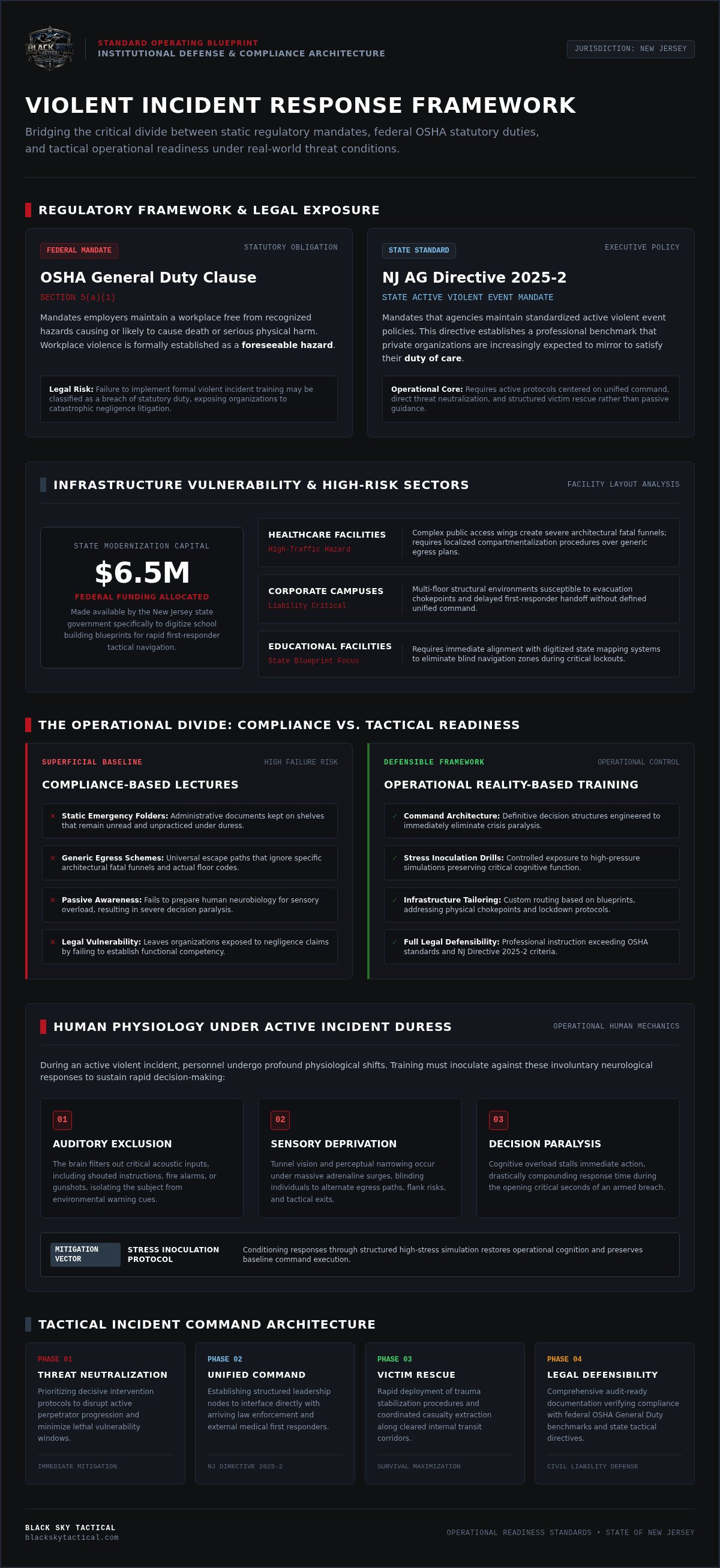
Violent incident response training NJ constitutes a structured educational and operational framework specifically engineered to mitigate active threats within a professional environment. It's not merely a series of recommendations but a vital component of institutional safety. Under the federal OSHA General Duty Clause, Section 5(a)(1), employers maintain a legal obligation to provide a workplace free from recognized hazards that are likely to cause death or serious physical harm. Workplace violence is now categorized as a foreseeable risk in many sectors, meaning a failure to implement formal training protocols may be interpreted as a breach of this statutory duty.
Static emergency folders, often left to gather dust on administrative shelves, consistently fail to protect personnel during dynamic, high-stress security breaches. A plan that hasn't been operationalized through tactical command strategies is effectively non-existent when an actual threat emerges. The intersection of New Jersey state workplace safety standards and corporate civil liability protocols creates a landscape where professional preparation is the only viable defense against catastrophic negligence litigation.
Regulatory Obligations and the OSHA General Duty Clause
Federal safety oversight mandates define a recognized hazard as any danger that is known to the employer or generally recognized within the industry. Because active threats are a documented reality, Active shooter response training has become a benchmark for corporate responsibility. Documenting this training mitigates exposure to liability by demonstrating that the organization took reasonable steps to prepare its workforce. The regulatory landscape is shifting, with New Jersey authorities increasingly emphasizing standardized response protocols. For instance, Attorney General Law Enforcement Directive 2025-2 now mandates that agencies maintain active violent event policies, setting a professional standard that private institutions are increasingly expected to mirror to maintain their duty of care.
High-Risk Sectors Requiring Immediate Preparedness Protocols
Certain environments in New Jersey face unique vulnerabilities that demand specialized attention. Healthcare facilities, corporate campuses, and educational institutions are high-traffic areas where infrastructure layouts often create architectural fatal funnels. In these settings, generic emergency egress planning is insufficient. Administrative leadership must establish a culture of proactive tactical preparedness by tailoring response protocols to their specific building codes and floor plans. The New Jersey government recently made available 6.5 million dollars in federal funding to digitize school building blueprints for first responders, highlighting the state's focus on integrated security. Proactive command training ensures that personnel can execute these plans under the immense physiological pressure of a real-world incident.
Core Components of an Effective Tactical Incident Management Framework
A resilient safety strategy relies on more than just high-level policies; it requires an operational framework capable of functioning under extreme duress. Implementing professional violent incident response training NJ ensures that an organization transitions from passive awareness to active command. This framework must align with the New Jersey active violent event policy, which emphasizes the necessity of threat neutralization and victim rescue through a unified command structure. Without a definitive command architecture, personnel often experience decision-making paralysis, which significantly increases response times during the critical initial moments of a breach.
Effective training addresses the psychological mechanics of stress inoculation. During a violent encounter, the human body undergoes profound physiological changes, including sensory deprivation and auditory exclusion. Professional instruction prepares individuals to manage these responses by simulating high-stress environments, allowing them to maintain cognitive function when it matters most. Organizations seeking to bridge the gap between theory and application can benefit from specialized Violent Incident Command programs that focus on these high-stakes realities.
Establishing a Clear Incident Command Hierarchy
A functional hierarchy defines exactly who assumes command before municipal law enforcement arrives on the scene. It's not enough to have a single designated leader. Organizations must establish redundant leadership tiers to account for potential communication disruptions or the unavailability of primary staff. These protocols structure delegation, ensuring that one group manages orderly evacuation while another coordinates defensive positioning. This tiered approach prevents a total collapse of order if the primary command node is compromised.
Critical Communication Protocols During Active Threats
Communication during a crisis must be explicit and unambiguous. Traditional coded alerts often lead to confusion and delayed reactions. Instead, personnel should use plain-language announcements over public address systems to provide clear instructions. Real-time intelligence gathering is equally vital. Staff must be trained to relay accurate details to emergency dispatchers, such as the specific location of the threat and the geometry of the environment, including architectural fatal funnels. Managing internal channels effectively prevents the propagation of misinformation, which is essential for effective violent incident response training NJ implementation.
Compliance-Based Lectures vs. Operational Reality-Based Training
Passive video presentations and slideshows frequently fail to alter human behavior during acute survival scenarios because they don't account for the physiological reality of the fight-or-flight response. When an active threat emerges, individuals often experience profound sensory distortions, such as tunnel vision and auditory exclusion, which are autonomic reactions that intellectual understanding alone doesn't overcome. Effective violent incident response training NJ must move beyond these static methods to ensure that personnel can maintain cognitive processing under duress. A failure to address these physiological factors leaves an organization vulnerable, as staff may intellectually know the protocol but remain physically unable to execute it when the sympathetic nervous system takes control.
The Limitations of Passive Video-Based Instruction
Standard corporate safety lectures typically result in low information retention rates because they lack the experiential component necessary for behavioral modification. This creates a dangerous environment of false security where employees believe they possess a physical capability that has never been tested. Administrators often prioritize this type of administrative box-checking to satisfy basic insurance requirements, yet these methods offer little protection during an actual security breach. A truly robust safety program requires a transition to the Incident Command System framework, which provides a scalable, standardized approach to managing emergencies. Relying on passive instruction is an abdication of the professional responsibility to provide personnel with the tools they need for actual survival.
Why Stress Inoculation and Scenario Drills Dictate Survival Outcomes
Survival outcomes are dictated by the neurological process of converting deliberate cognitive actions into immediate, conditioned tactical responses. Reality-based scenario drills facilitate this by building functional muscle memory and cognitive processing pathways, which are essential for bypassing the cognitive freezing that occurs during high-stress encounters. By providing controlled exposure to simulated stress, professional instructors help personnel develop the resilience needed to execute defensive positioning or evacuation protocols. These drills must be followed by structured post-drill debriefings to identify systemic vulnerabilities in the institutional response plan. This methodical approach ensures the training environment remains professional and safe while maximizing the operational readiness of the staff.
Designing a Localized Response Protocol for New Jersey Infrastructure
Designing a localized protocol requires a transition from abstract strategy to the concrete realities of New Jersey infrastructure. A comprehensive physical security audit identifies architectural vulnerabilities, specifically fatal funnels, which are confined spaces where movement is restricted and threat exposure is highest. Tailoring egress routes and lockdown procedures must account for specific regional building codes to ensure that safety measures don't inadvertently violate fire safety or accessibility mandates. Maintaining operational compliance involves scheduled bi-annual training iterations and rigorous documentation updates to reflect changes in staff or facility layout. This continuous cycle ensures that your violent incident response training NJ program remains relevant to your specific environment.
Coordinating Emergency Drills with NJ Law Enforcement Jurisdictions
Understanding the operational expectations of local police departments is essential, as New Jersey law enforcement agencies now operate under standardized mandates like Directive 2025-2. Organizations should structure facility maps and access protocols to facilitate rapid deployment by tactical units, ensuring that arriving officers have the intelligence required to neutralize threats immediately. Integrating your internal command structure into the municipal Incident Command System (ICS) minimizes friction during the handoff of authority. This coordination ensures that your violent incident response training NJ program aligns with the real-world methods of first responders who will be arriving on the scene.
Conducting Comprehensive Physical Security and Vulnerability Assessments
A thorough assessment evaluates access control systems, reinforcement points, and the viability of designated safe rooms. It's critical to identify and mitigate structural choke points, such as narrow corridors or single-point exits, that impede rapid and orderly personnel evacuation. This security architecture should be contextualized alongside broader defensive measures, including professional NJ concealed carry permit training for qualified personnel who may serve as a final layer of defense. By addressing both the physical environment and the human element, organizations create a layered security posture that prioritizes life safety. For institutions seeking to validate their current protocols against these standards, you can schedule a comprehensive tactical command consultation to ensure your facility meets all jurisdictional requirements.
Securing Certified Violent Incident Command Instruction with Black Sky Tactical
Implementing an effective security posture requires partnering with an institution that understands both tactical realities and legal frameworks. Black Sky Tactical delivers specialized tactical incident management through its Violent Incident Command Training program, servicing northern New Jersey, including Bergen County, and southern New York. Utilizing professional, vetted instructors is critical to maintaining the legal defensibility of an organization's safety program, as it demonstrates a strict commitment to industry-standard risk mitigation. This specialized curriculum is customized to match the specific operational constraints of your workplace, ensuring that safety protocols don't disrupt essential business operations while still providing robust protection during an active threat.
Tailored Emergency Management for Corporate and Institutional Clients
The instructional methodologies utilized by Black Sky Tactical ensure strict alignment with formal administrative, regulatory, and jurisdictional standards. Instructors adapt complex tactical command concepts to non-permissive corporate environments, translating law enforcement frameworks into actionable steps for civilian managers and administrative leadership. Establishing an ongoing educational partnership provides long-term benefits, ensuring that your organization receives the necessary annual compliance certifications as state mandates evolve. This continuous training model inoculates personnel against critical stress, maintaining a high state of operational readiness year after year.
Enrollment and On-Site Certification Logistics for New Jersey Organizations
Hosting on-site tactical command programs requires structured coordination regarding scheduling, onboarding, and physical facility requirements. Black Sky Tactical manages these logistics methodically, conducting initial facility walk-throughs to ensure the training environment is safely controlled yet operationally realistic. To fulfill corporate record-keeping and compliance mandates, the program provides comprehensive documentation of training completion, which serves as verifiable proof of an organization's proactive safety measures. Initiating a formal consultation and security assessment in 2026 allows your leadership team to secure certified violent incident response training NJ protocols tailored precisely to your facility's unique architectural layout. Taking this definitive step ensures that your workforce is guided by expert, sober, and highly disciplined instruction designed to mitigate corporate liability and protect human life.
Securing Your Institutional Safety Framework for 2026 and Beyond
Transitioning from theoretical safety brochures to operational reality requires a disciplined commitment to tactical command. As previously discussed, meeting the minimum standards of the federal OSHA General Duty Clause is a baseline necessity, but true protection involves stress inoculation and clear command hierarchies that function under duress. By prioritizing specialized violent incident response training NJ, organizations in Bergen County and the surrounding region ensure their personnel are prepared for the physiological realities of an active threat. This approach moves beyond administrative box-checking to establish a culture of genuine preparedness.
Black Sky Tactical provides the specialized Violent Incident Command Training curriculum needed to bridge the gap between regulatory mandates and real-world survival. Our instructors focus on strict compliance and legal defensibility, ensuring that every protocol is tailored to your specific infrastructure and jurisdictional requirements. Establishing this high-stakes safety foundation is a professional responsibility that protects both your personnel and your organization's legal standing. You may Schedule a Professional Violent Incident Command Consultation with Black Sky Tactical to begin your comprehensive security assessment. We look forward to assisting you in building a more resilient and compliant workplace.
Frequently Asked Questions
What is the primary objective of violent incident response training NJ?
The primary objective of violent incident response training NJ is to establish an operational and educational framework that mitigates active threats through structured tactical command. This training focuses on reducing organizational liability by aligning with state mandates while providing personnel with the skills to manage critical stress. It aims to ensure that response protocols are not just theoretical but functional under real-world pressure, prioritizing life safety and effective threat neutralization in institutional environments.
Does watching an active shooter safety video satisfy OSHA compliance mandates?
Watching a passive safety video does not satisfy the requirements of the OSHA General Duty Clause for recognized hazards like workplace violence. While informational media provides a baseline of awareness, it fails to build the functional muscle memory or cognitive pathways necessary for survival. OSHA mandates that employers provide a workplace free from recognized hazards, which necessitates active, documented instruction that demonstrates a proactive approach to mitigating foreseeable risks through operational readiness.
How often should New Jersey corporations conduct violent incident response drills?
Professional standards suggest that New Jersey organizations should conduct violent incident response training NJ drills at least bi-annually to maintain operational proficiency. Regular iterations are necessary to account for staff turnover, infrastructure changes, and the natural degradation of tactical skills over time. Scheduled training ensures that documentation remains current for compliance purposes and that personnel are consistently inoculated against the physiological stressors associated with high-stakes security breaches in the workplace.
What is the difference between standard safety training and Violent Incident Command training?
Standard safety training typically focuses on generalized hazard awareness and basic evacuation procedures, often utilizing passive instructional methods. In contrast, Violent Incident Command training establishes a definitive command architecture designed to eliminate decision-making paralysis during a crisis. It utilizes reality-based scenario drills and stress inoculation to prepare individuals for the physiological distortions of a life-threat encounter, ensuring that leadership can maintain control and coordinate with first responders effectively.
Can violent incident response protocols be customized for healthcare facilities in NJ?
Response protocols are frequently customized for healthcare facilities to address unique challenges such as non-ambulatory patients and complex architectural fatal funnels. These customized programs align with New Jersey regional building codes while identifying specific reinforcement points and designated safe rooms. By tailoring egress routes and lockdown procedures to the facility's layout, healthcare institutions can maintain regulatory compliance while ensuring that safety measures are practically applicable to their specific clinical and administrative environments.
How do internal response teams coordinate with New Jersey law enforcement during an active threat?
Internal teams coordinate with New Jersey law enforcement by integrating their command structure into the municipal Incident Command System. This process involves providing arriving tactical units with structured facility maps and real-time intelligence relayed through unambiguous, plain-language communication channels. By aligning internal protocols with the operational expectations of local police departments, organizations facilitate rapid threat neutralization and victim rescue, ensuring a seamless handoff of authority when official first responders arrive on the scene.
What geographical regions does Black Sky Tactical serve for corporate safety training?
Black Sky Tactical provides specialized institutional instruction across northern New Jersey and southern New York, with a specific focus on Bergen County. Our service coverage extends to Rockland County, Orange County, and Westchester County, allowing us to deliver on-site training that meets the jurisdictional standards of both states. This regional proximity ensures that our instructors can conduct thorough physical security audits and provide localized training iterations that reflect the specific regulatory requirements of these areas.


