
What should employees be prepared to do during a violent incident, and how can a business train for it without making a civilian workplace feel like a tactical exercise? Choosing active shooter training for businesses NJ organizations can use starts with identifying practical employee needs, not simply selecting the most intensive-sounding course.
It’s reasonable to ask whether staff can participate, whether visitors and building procedures are accounted for, and how employees would communicate with emergency responders. A useful plan reflects the workplace, clarifies responsibilities, and makes the training’s scope and limitations clear.
This 2026 guide explains how to evaluate preparedness training, coordinate staff and site procedures for Bergen County operations, and compare programs for fit. It also distinguishes workplace preparedness from individual concealed-carry or pistol courses. For organizations considering Black Sky Tactical’s Violent Incident Command training, the article outlines what to verify about the audience, learning objectives, format, and limitations before deciding whether it suits their needs.
Key Takeaways
- Assess training as part of a broader emergency plan that includes prevention, response coordination, and recovery, rather than as a stand-alone exercise.
- When evaluating active shooter training for businesses NJ organizations are considering, confirm the learning objectives, provider qualifications, and how instruction can reflect workplace policies and staff roles.
- Coordinate planning by assigning responsibilities across leadership, HR, facilities, and relevant building-management contacts.
- Before selecting a course, review organizational needs and existing procedures, consult stakeholders, and decide how you’ll evaluate whether the training meets its purpose.
- Black Sky Tactical offers Violent Incident Command training. Ask the provider directly about its audience, scope, format, and suitability for your organization.
Why Active Shooter Training for Businesses in NJ Requires a Workplace Plan
Active shooter preparedness training helps employees understand potential warning signs, communicate during an emergency, and follow workplace procedures. It is one part of a broader emergency-management plan, not a replacement for one. For businesses evaluating active shooter training for businesses NJ, the key question is how the training fits the organization’s responsibilities, site, and existing procedures.
Response instruction alone cannot determine who is authorized to issue an internal alert, how visitors receive information, or how building access and evacuation procedures work. Employees may have different responsibilities and needs, while building management and emergency responders have their own roles. A written plan clarifies how those elements connect. Training can then help employees understand the procedures relevant to them, without suggesting that a course can prevent every incident or guarantee a particular response.
What businesses should expect from preparedness training
Instruction may address awareness, communication, and how to follow established emergency procedures. The scope should suit the workplace: an office with controlled entry, a customer-facing location, and a multi-tenant building may have different notification processes and coordination needs. Ask the provider to explain the learning objectives and how the content relates to employee roles and the organization’s current emergency plan.
Preparedness education is different from firearms training, law-enforcement tactics, and security services. A course that includes tactical or weapons-focused content may not suit a civilian workforce or match the organization’s objectives. For background on different approaches to active shooter training, readers can review the topic overview, then assess whether a proposed program aligns with their needs.
How New Jersey business context affects planning
For Bergen County operations, review the specific site and how work is conducted there. Consider entrances, shared spaces, visitor check-in, work shifts, staff who may work alone, and how employees would receive an alert. In a multi-tenant building, determine which procedures belong to the business and which need to be coordinated with building management. These details help identify questions to resolve before selecting a training format or provider.
Check current preparedness guidance from CISA and relevant local agencies, and confirm that workplace procedures are consistent with instructions from appropriate authorities. Requirements may depend on an organization’s circumstances, so don’t treat general training information as a legal determination. This article is for general informational purposes, not legal advice or a compliance assessment.
What Active Shooter Training for NJ Businesses Can Cover
Training may address several parts of workplace preparedness, but curricula vary by provider and program. Before booking, request the course outline and confirm which topics are included, how they relate to your organization’s emergency plan, and what employees are expected to learn. For businesses comparing active shooter training for businesses NJ, clear, plain-language procedures are more useful than material that doesn’t fit employees’ roles or workplace policies.
Prevention, reporting, and preparedness
Prevention-oriented instruction can help employees understand how to raise concerns through established workplace channels. Guidance should focus on reporting specific, relevant behavior or information, not profiling people or encouraging speculation about someone’s intentions. Preparedness topics may include where employees can find the organization’s procedures, how official instructions will be communicated, and whom to contact with questions before an emergency.
Ask whether the instruction can account for your site’s arrangements, including visitor processes, shared spaces, and coordination with building management. Where appropriate, clarify how workplace procedures relate to communication with emergency services. CISA’s Active Shooter Preparedness resources can provide an official reference point for organizations reviewing preparedness materials and planning questions.
Response coordination and recovery
A program may address how employees receive and follow authorized instructions, how the organization coordinates responsibilities, and how it accounts for staff and visitors after an incident. Planning can also consider reunification arrangements and access to post-incident support. These subjects should complement the organization’s procedures, not replace instructions from qualified authorities or current official guidance.
Before selecting a course, ask the provider to specify its learning objectives and explain how discussions or exercises account for accessibility, employee roles, and organizational policy. Confirm whether the content is general awareness, incident-response coordination, or another form of instruction. These categories are not interchangeable. Ask for clarification about any tactical or firearms-related material, particularly if the intended audience is a civilian workforce.
Black Sky Tactical offers Violent Incident Command training, but organizations should verify its intended audience, format, objectives, and scope directly rather than assume it covers every preparedness topic listed here. If structured incident-response education may fit your needs, you can ask about Black Sky Tactical training and confirm those details before deciding whether to proceed.
How to Compare Active Shooter Training Providers in New Jersey
Compare programs by their stated learning objectives, qualifications you can independently verify, and experience relevant to organizational settings. A provider should be able to explain who the course is designed for, what participants are expected to learn, and where the instruction’s scope ends. For active shooter training for businesses NJ organizations are evaluating, a clear course description is more useful than broad assurances or unsupported claims.
Use the questions below to compare providers consistently. These are evaluation criteria, not a list of mandatory credentials or accreditation requirements.
Who is the course designed for, and what should participants understand or be able to do afterward?
Is the program educational, scenario-based, firearms-focused, or a combination? What activities and participant expectations should the organization anticipate?
How can instruction account for staff roles, site conditions, accessibility needs, and organizational policies?
What topics or services are excluded? Are written materials or other follow-up resources included, and can the provider confirm the course scope in writing?
What qualifications and relevant organizational experience does the provider have, and how can these be verified? If compliance is mentioned, what specific requirement is the course claimed to address?
Questions to ask before selecting a course
Request written information about the course description, intended audience, learning objectives, prerequisites, and any compliance-related claims. Confirm whether exercises are included and what participation involves rather than assuming the program’s title describes its format. CISA’s active shooter preparedness guidance can serve as a government reference while you assess whether a provider’s proposed scope is relevant to your organization.
Why firearms qualifications are not workplace preparedness plans
Organizational response education addresses shared procedures, communication, and coordination among employees. Individual firearms instruction serves a different purpose and does not, by itself, establish workplace roles, visitor procedures, or organizational communications. Employees researching NJ concealed carry permit training can treat it as a separate individual training topic. Likewise, private firearm training for beginners in NY concerns individual instruction, not a workplace plan.
How NJ Businesses Can Prepare Employees and Coordinate a Training Plan
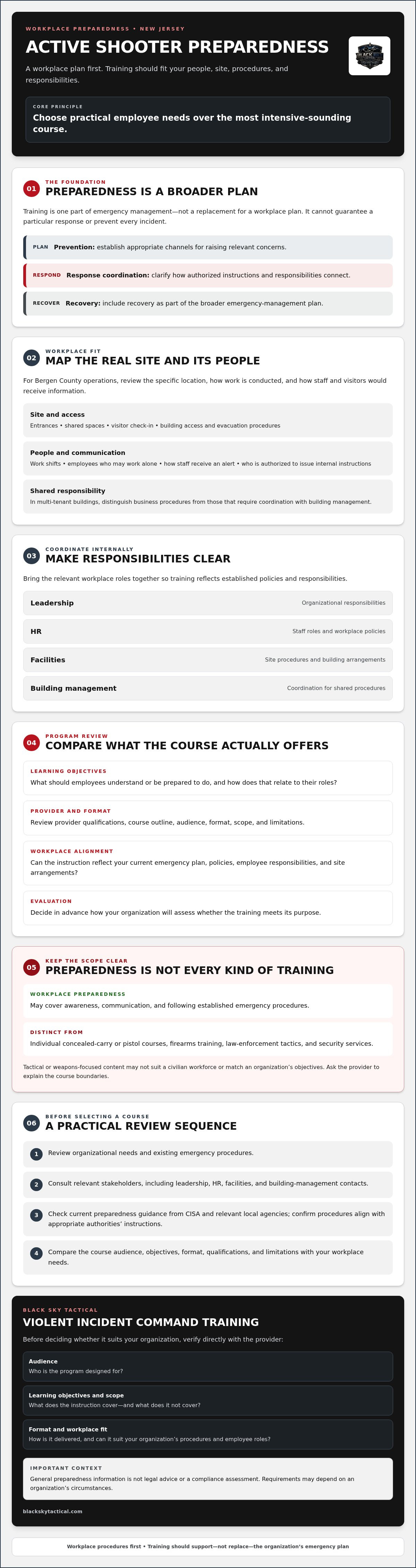
A practical training plan starts with workplace needs, not a course calendar. Assess employee groups and site arrangements, review existing procedures, consult relevant stakeholders, select instruction that fits the identified needs, and evaluate what should be clarified or updated afterward. This sequence gives an organization a structured way to plan active shooter training for businesses NJ without implying that training can guarantee safety or a particular outcome.
Assess the workplace before arranging training
Identify who works at the site, when they work, how visitors enter, and which accessibility needs should inform communications or exercises. Review emergency notification methods, relevant building procedures, and where the organization coordinates with property management or emergency services. Keep sensitive security details within appropriate channels rather than including them in broadly distributed training materials.
Assign planning responsibilities early. Leadership can authorize the process, HR can help identify workforce considerations, and facilities staff can review relevant site procedures. Include building-management contacts when responsibilities or communications cross organizational boundaries. Consult qualified safety professionals and confirm current official guidance relevant to the organization before finalizing procedures or training content.
Turn training into a maintained preparedness process
Exercises should be proportionate to the workplace, communicated in advance, and aligned with applicable procedures. Before scheduling one, confirm its purpose, participant expectations, accessibility arrangements, and how it will be coordinated with normal operations. Staff should understand what is being practiced and where to direct questions. Avoid exercises that conflict with established workplace procedures or create unnecessary confusion.
Preparedness requires review over time. Revisit plans when staffing, facilities, building arrangements, or communication procedures change. After training, gather participant feedback and identify unclear responsibilities or communication gaps. Document follow-up actions, assign appropriate internal owners, and coordinate external questions with relevant building contacts or local authorities where appropriate.
- Assess: Identify workforce, visitor, accessibility, and site considerations.
- Review: Check existing plans, communications, and coordination points.
- Consult: Involve leadership, HR, facilities, and relevant building contacts.
- Select: Choose training that matches the organization’s needs and procedures.
- Evaluate: Collect feedback, document actions, and review plans as circumstances change.
Organizations considering structured incident-response education can ask about Black Sky Tactical Violent Incident Command training, confirming its intended audience, objectives, format, and scope before determining whether it fits their plan.
Explore Black Sky Tactical Violent Incident Command Training
Black Sky Tactical offers Violent Incident Command training, which organizations may consider when exploring structured incident-response education. The course name alone does not establish its audience, learning objectives, format, or suitability for a particular workplace. Businesses evaluating active shooter training for businesses NJ should confirm those details directly and compare them with existing emergency plans before deciding whether the offering meets their needs.
Determine whether the program fits your organization
When contacting the provider, describe the workplace need and who would participate, such as employees with planning responsibilities or a broader staff group. Ask for the current course outline and written details about delivery, prerequisites, participant expectations, and stated learning outcomes. Clarify what is included and excluded, then consider whether the scope fits the organization’s policies and the procedures employees are expected to follow.
Be specific about the questions that affect your selection. For example, if your organization needs employees to understand established communication procedures, ask whether that objective is covered rather than assuming it from the course title. If you’re assessing whether instruction is appropriate for a civilian workplace, ask directly about the intended audience and nature of the material. Don’t treat a training offering as a substitute for reviewing internal plans or obtaining current guidance from relevant authorities.
Plan a responsible next step in Bergen County
Black Sky Tactical serves Bergen County, New Jersey, as well as Rockland, Orange, and Westchester counties in New York. This local service-area information can help organizations in those counties decide whether to inquire, but it doesn’t confirm availability for every location or establish specific scheduling, delivery, or site arrangements. Confirm service availability and logistics with the provider before making commitments or inviting employees to participate.
Coordinate internally first. Identify who will handle the inquiry, which stakeholders need to review the course information, and whether proposed training aligns with workplace procedures. Keep official organizational plans and current authority guidance central to the decision. Training should be evaluated as one part of a broader preparedness process, not as a replacement for it.
If the program appears relevant, contact Black Sky Tactical about training to ask about its current scope, audience, objectives, format, and suitability for your organization. An initial inquiry can help establish whether the offering merits further review without presuming a fit or a particular outcome.
Build a Preparedness Plan That Fits Your Workplace
Effective preparedness begins with a workplace-specific plan, clear employee roles, and communication procedures staff can understand. Training should support those procedures, not replace them. Before an organization commits, providers should be able to explain their qualifications, course objectives, format, and limitations.
For active shooter training for businesses NJ, evaluate programs against your workforce, site arrangements, accessibility needs, and existing emergency plans. Keep individual firearms instruction distinct from workplace preparedness, and review plans when staffing, facilities, or procedures change.
Black Sky Tactical offers Violent Incident Command training and serves Bergen County, New Jersey, as well as Rockland, Orange, and Westchester counties in New York. Organizations considering the program should confirm its current scope, intended audience, format, and learning objectives directly with the provider, then determine whether it fits their needs and procedures. To make an informed inquiry, ask Black Sky Tactical about Violent Incident Command training.
A measured, coordinated approach can help your organization make thoughtful preparedness decisions and give employees clearer guidance about their roles.
Frequently Asked Questions
What does active shooter training for businesses typically cover?
Workplace preparedness training may cover prevention and reporting, awareness of established emergency procedures, communication, response coordination, and post-incident considerations. Topics depend on the provider and course, so request a current outline before booking. Ask how instruction relates to employee roles and your organization’s procedures, and whether it includes exercises or follow-up materials. Don’t assume training will prevent every incident or guarantee a particular response.
Is active shooter training required for businesses in New Jersey?
New Jersey does not have an overarching state law requiring every private business to provide active shooter training. Specific requirements may apply to certain workplaces, including licensed health care facilities, and employers should assess their circumstances with qualified legal or safety professionals. Federal OSHA has no specific standard mandating active shooter training, though its General Duty Clause addresses recognized workplace hazards. This is general information, not legal advice or a compliance determination.
How do businesses choose an active shooter training provider in NJ?
Compare providers based on qualifications you can verify, clearly stated learning objectives, and experience relevant to organizational settings. Ask who the course is designed for, what participants should learn, whether content is educational, scenario-based, firearms-focused, or a combination, and how it can account for workplace policies and staff roles. Request written details about prerequisites, exclusions, accessibility, and any compliance claims. Businesses seeking active shooter training for businesses NJ should assess fit, not just course titles.
Can active shooter preparedness training be tailored to a workplace?
Training may be adapted to an organization’s roles, site procedures, workforce needs, and existing emergency plan, but the extent of adaptation depends on the provider and program. Describe relevant considerations, such as visitor procedures, shifts, accessibility needs, or a multi-tenant building, then ask what can be addressed. Confirm the learning objectives and any limits in writing. Tailoring should support official workplace procedures, not replace them or imply guaranteed results.
What is the difference between workplace response training and firearms training?
Workplace response training addresses organizational procedures, employee communication, and coordination during an emergency. Firearms training focuses on individual firearm knowledge or skills and serves a separate purpose. A firearms or concealed-carry course does not, by itself, establish staff responsibilities, visitor communications, or building procedures. Organizations should select instruction based on their objectives and avoid assuming one type of course substitutes for the other.
How often should a business review its active shooter preparedness plan?
Review the plan periodically and whenever relevant circumstances change, such as staffing, facilities, building arrangements, or emergency communication procedures. There isn’t a single review interval that applies to every business. Gather employee feedback after training or exercises, document unclear responsibilities and communication gaps, and assign follow-up actions. Check applicable official guidance and consult qualified professionals to determine whether additional reviews are appropriate for your organization.
Does Black Sky Tactical offer active shooter training for businesses in Bergen County?
Black Sky Tactical offers Violent Incident Command training and serves Bergen County, New Jersey, but the offering should not be assumed to cover every active shooter preparedness topic. Ask the provider about the current course scope, intended audience, objectives, format, and organizational suitability, and confirm availability and logistics directly. Its stated service area also includes Rockland, Orange, and Westchester counties in New York. Verify service availability for other locations with the provider.


