
An emergency plan can exist on paper and still leave staff uncertain about who leads, who communicates, and how to coordinate with responding agencies. Active shooter incident command training NY organizations consider should focus on more than individual reactions. It should help establish clear, role-based coordination that fits the organization’s plans and local emergency procedures.
Organizations need to prepare staff without creating confusion about the role of law enforcement or other responders. Incident command education addresses organizational roles, information flow, and coordination. It is not the same as tactical or firearms instruction, does not grant law-enforcement authority, and cannot guarantee a particular outcome.
This guide explains how incident command can support a coordinated response, which roles and communication needs to review, and what questions to ask when evaluating training in New York. It also outlines how to assess a course’s intended audience and scope, then confirm whether its content aligns with your organization’s plans and applicable local procedures.
Key Takeaways
- Distinguish incident command education, which addresses coordination and organizational decisions, from tactical or firearms instruction.
- Review how assigned roles, decision ownership, and information flow fit your organization’s emergency plan.
- When comparing active shooter incident command training NY options, check course objectives, intended participants, format, and organizational fit.
- Prepare by documenting existing procedures, identifying relevant participants and decision-makers, and noting accessibility needs.
- Black Sky Tactical offers Violent Incident Command Training. Confirm its current scope and alignment with your organization’s plans before proceeding.
What active shooter incident command training in NY is designed to address
During a fast-moving emergency, an organization may need to coordinate staff, share reliable information, and make decisions in line with established procedures. Incident command training prepares designated people to manage those organizational responsibilities. Its focus is coordination: assigned roles, how information moves between people, and the decision pathways the organization has established.
The Incident Command System (ICS) provides background on a standardized approach to command and coordination in emergency response. However, organizations should confirm which framework, if any, a particular course covers. Do not assume that every incident command course uses the same model.
Incident command training versus active shooter response training
Course labels can describe different learning goals. Command-side education may address role assignments, communication protocols, decision ownership, and coordination with responding authorities. General awareness instruction may focus on recognizing an emergency and understanding organizational procedures. Tactical or firearms courses address different subject matter. Incident command training should not be treated as a substitute for a site-specific plan or direction from responding authorities.
Before enrolling, compare the course description with your preparedness objectives. For example, if designated personnel need to understand how reports are routed and who communicates on the organization’s behalf, confirm that those subjects are within the course scope. Do not infer curriculum, certification, or legal compliance from a course title alone.
Who in a New York organization may need command training?
Potential participants include administrators, designated safety leads, facility managers, and other employees assigned coordination responsibilities in the organization’s existing plan. The right group depends on the setting, organizational size, and how responsibilities are assigned. A school, workplace, facility, or community organization may have different decision-makers and communication needs, so select participants based on the plan rather than a generic roster.
Start by identifying who is expected to receive information, make organizational decisions, communicate with staff, and coordinate with external responders. Then check whether those people understand their responsibilities and where handoffs may occur. This helps determine whether command education addresses an actual planning need, without suggesting that trained participants take over authority from public responders.
Black Sky Tactical lists Violent Incident Command Training and serves customers in Rockland, Orange, and Westchester counties in New York, as well as Bergen County, New Jersey. Organizations in these areas considering active shooter incident command training NY can ask about the course’s intended audience, objectives, format, and scope, then compare those details with their procedures and local response arrangements.
How incident command supports coordinated decisions during an emergency
Incident command gives an organization a pre-agreed structure for handling information and internal decisions when normal operations are disrupted. It is an organizational method for coordinating assigned people, information, and decisions. It does not confer operational authority over public responders. Staff can carry out responsibilities in the organization’s plan while following the direction of emergency services and other authorities.
The Incident Command System (ICS) describes a standardized approach to incident management, while the National Incident Management System (NIMS) provides a broader framework for coordinating incident management across organizations and jurisdictions. Confirm the relevance of either framework to a particular organization, course, or New York setting against current guidance from the appropriate agencies. FEMA’s Basic Incident Command System training is one reference for understanding ICS concepts. It should not be assumed to establish local procedures or satisfy an organization’s specific obligations.
Roles, reporting lines, and decision responsibilities
Before an incident, an organization can document who receives reports, who is responsible for internal decisions, and who serves as an alternate if a designated person is unavailable. Clear assignments can help prevent duplicate requests, conflicting internal messages, and uncertainty about who should pass information to the next responsible person. Role labels and reporting lines should match the organization’s adopted plan, not be copied from a generic course or another institution.
These assignments support internal coordination only. They do not place organizational personnel in command of police, fire, emergency medical services, or other responding agencies. Participants in active shooter incident command training NY should understand this boundary and know that public responders direct their own operations.
Communications and coordination with responding agencies
An emergency plan should specify how designated staff share accurate information internally and communicate with responders, consistent with procedures established by the relevant authorities. A practical planning review can identify who is authorized to communicate, what information the organization needs to convey, and how staff should avoid circulating unverified reports. Do not treat a course as the source of local agency protocols.
Review communication arrangements with the appropriate local agencies, and update organizational procedures when those agencies advise that changes are needed. During an incident, staff should follow instructions from emergency services and applicable authorities. Black Sky Tactical lists Violent Incident Command Training. Prospective participants can ask how the course scope relates to their existing plans and coordination needs.
How to evaluate active shooter incident command training in New York
Choose training by comparing its stated scope with the decisions and responsibilities your organization needs participants to understand. A useful course description should identify learning objectives and intended audience, and explain whether instruction includes discussion, exercises, or another format. Use the framework below to assess active shooter incident command training NY options without assuming a course title alone establishes suitability.
| Evaluation area | Questions to ask | What to compare with your organization |
|---|---|---|
| Course objectives | Which command, communication, and coordination concepts are covered? | Whether the objectives address documented preparedness needs. |
| Intended participants | Who is the course designed for, and which roles does it address? | Whether relevant decision-makers and assigned coordinators are included. |
| Format | Is instruction classroom-based, scenario-based, or delivered another way? | Whether the format is appropriate for the participants and learning goals. |
| Organizational fit | Can course content be considered alongside existing plans and policies? | Whether it supports, rather than conflicts with or replaces, site procedures. |
Questions to ask before choosing a course
Ask the provider to state the learning objectives, intended participant roles, delivery format, and limits of the course. If exercises are included, confirm that they are appropriate for the audience and relate to coordination objectives. A scenario-based format is not automatically suitable for every organization. Explain which plans or policies participants use, then ask how course concepts can be considered alongside them.
What training can and cannot establish
Training can provide preparedness education, but it does not by itself establish official credentials, regulatory approval, legal advice, or compliance. Verify any certification or compliance claims directly with the provider and the relevant authority before enrollment. No course guarantees safety or replaces decisions and instructions from responding authorities.
A course also cannot replace a site-specific plan. Organizations differ in layout, staffing, communication systems, and assigned responsibilities. A general course cannot verify that local procedures account for those details. Treat training as one input to preparedness, and review resulting questions through the organization’s established planning process.
New York readers should verify current local procedures and agency guidance with the relevant authorities rather than assume that one statewide rule or course applies to every setting. The state’s Initial Response to Active Shooters (IRAS) course is described for law enforcement, including first-arriving officers’ incident-command responsibilities. That scope provides context, but should not be confused with organizational command training for non-law-enforcement participants.
How New York organizations can prepare for incident command training
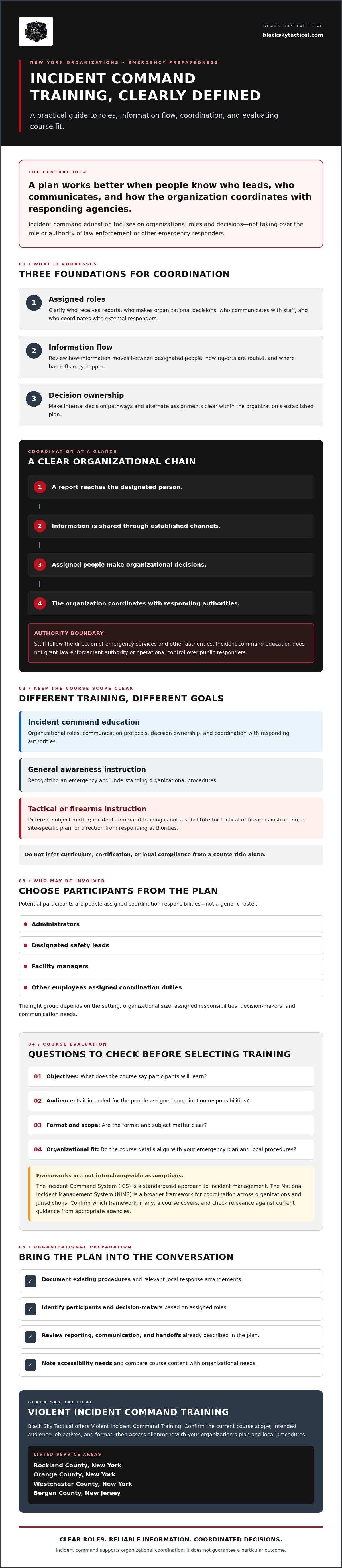
Preparation helps ensure a course addresses actual organizational needs rather than hypothetical responsibilities. Select a course after reviewing the organization’s goals, existing procedures, and identified coordination gaps. Use these steps to organize that review before choosing active shooter incident command training NY.
Before training: review plans and identify gaps
- Set the learning goal. Decide what participants should better understand, such as internal reporting responsibilities, decision pathways, or communication roles.
- Review existing procedures. Check the emergency plan, communication pathways, and assigned responsibilities. Note unclear or overlapping roles without circulating sensitive site-security details beyond those who need them.
- Identify participants and decision-makers. Select representatives whose roles relate to the learning goal, and identify alternates where the plan assigns them. Consider accessibility needs so participants can engage with the instruction and materials.
- Document questions for relevant authorities. List uncertainties about local procedures, agency coordination, or current guidance, then direct those questions to the appropriate local emergency services or New York authorities. Do not assume a training provider can establish local protocols.
- Confirm course fit. Ask the provider about objectives, intended audience, format, and how the content relates to organizational plans. Confirm that the scope matches the responsibilities participants are expected to perform.
After training: reinforce learning responsibly
Training is a starting point for review, not a substitute for organizational planning. Afterward, designated leaders can identify relevant lessons, determine whether approved procedures need review, and refer proposed changes through the organization’s established authorization process. Do not change emergency instructions informally or treat course content as a replacement for direction from public authorities.
Assign follow-up responsibilities, such as recording unresolved questions, identifying who will review the plan, and setting a time to revisit procedures with appropriate leadership and local emergency-management contacts. Keep a record of decisions and outstanding items so the organization can distinguish completed actions from matters still requiring confirmation. Training alone does not complete preparedness.
Organizations considering Black Sky Tactical’s Violent Incident Command Training can ask about Violent Incident Command Training and confirm the current course scope, audience, format, and learning objectives before deciding whether it fits their preparation needs.
What to expect from Black Sky Tactical's violent incident command training
Black Sky Tactical lists Violent Incident Command Training among its offerings. For organizations considering active shooter incident command training NY, that offering is a starting point for a conversation, not a basis for assuming particular course content, credentials, or outcomes. Prospective participants should obtain current details directly and compare them with the roles and procedures their organization has established.
Before registering, clarify what the training is designed to address and whether its scope suits your organization’s preparedness objectives. Incident command education may be relevant to organizations seeking structured coordination, but appropriate participants and learning goals depend on the organization’s own plan. Firearms or permit training should not be assumed to be required for this organizational purpose.
Confirm whether the course fits your organization
Ask Black Sky Tactical who the course is intended to serve, what participants should be able to understand afterward, and what the current delivery format involves. Request clarification on learning objectives and course limits, including whether the content addresses the roles represented by your proposed participants. These details help you assess suitability without presuming that the course covers a particular framework or fulfills a regulatory requirement.
Describe your organization’s planning context at an appropriate level, then ask how the training relates to established procedures. Do not share sensitive site-security information unless there is a clear, authorized reason to do so. Confirm whether course content can be considered alongside your plans, while keeping responsibility for adopting or revising procedures within your organization and its established approval process.
Take the next step in Rockland, Orange, or Westchester County
Black Sky Tactical serves customers in Rockland, Orange, and Westchester counties in New York, as well as Bergen County, New Jersey. Organizations in these areas can use an initial inquiry to explain their intended audience, coordination goals, and questions about course scope. Service-area relevance does not confirm a particular training date, format, or availability, so verify those details directly before making plans.
A practical next step is to gather relevant organizational questions and ask the provider to clarify the current audience, objectives, and delivery details for Violent Incident Command Training. This gives decision-makers a basis for evaluating whether the offering aligns with their preparedness needs, without treating training as a substitute for site procedures, agency direction, or other planning responsibilities.
To discuss whether the offering may fit your organization, contact Black Sky Tactical about Violent Incident Command Training with your audience and course-scope questions.
Make Your Training Decision With Clear Priorities
Effective incident command preparation starts with defined organizational roles and communication responsibilities, then connects them to existing emergency procedures. The right course should match the people who need to coordinate and the learning objectives your organization has identified. It complements site-specific planning and does not replace instructions from responding authorities.
For organizations assessing active shooter incident command training NY, confirm the course’s current scope, intended audience, format, and objectives before registering. Black Sky Tactical lists Violent Incident Command Training and serves customers in Rockland, Orange, and Westchester counties in New York, as well as Bergen County, New Jersey.
If your organization is considering this training, contact Black Sky Tactical to discuss Violent Incident Command Training and ask how its current offering may fit your audience and preparedness needs. A considered next step can help your team make informed decisions about training and planning.
Frequently Asked Questions
What is active shooter incident command training?
Active shooter incident command training prepares designated people to coordinate organizational roles, information, and decisions during an emergency. It can help participants understand who communicates internally, how information reaches decision-makers, and how the organization’s procedures relate to response activity. It is distinct from firearms or tactical instruction and does not grant authority over public responders. Confirm course objectives and limits with the provider before enrollment.
Who should take incident command training in a New York organization?
Select participants according to the organization’s emergency plan and assigned responsibilities. Administrators, safety leads, facility managers, and other designated coordinators may be appropriate if they have roles in internal communication or organizational decisions. Consider the setting, staffing, alternate role assignments, and accessibility needs. A school, workplace, facility, or community organization may need a different participant group, so avoid relying on a generic roster.
Is active shooter incident command training required by New York State?
There is no blanket requirement established here for every New York organization to take an incident command course. Separate requirements may apply to particular sectors. For example, amendments to the New York Retail Worker Safety Act effective June 2, 2025 require covered retail employers with 10 or more employees to adopt a workplace violence prevention policy and provide interactive training. Frequency varies by workforce size, and required topics include active shooter procedures. Verify current applicability with official sources.
What is the difference between incident command and active shooter response training?
Incident command training focuses on coordination, including assigned organizational roles, reporting pathways, decision responsibilities, and communication. Active shooter response training is a broader label that may refer to general awareness, organizational procedures, or other course content. Tactical and firearms instruction covers different subject matter. Because course titles are not standardized descriptions of curriculum, review the stated objectives, intended audience, format, and limits before deciding whether a course fits your needs.
Can incident command training replace an organization's emergency plan?
No. Training can help participants understand coordination concepts, but it cannot account for every organization’s site, staff roles, communication systems, or approved procedures. Review course content alongside the current emergency plan and route proposed changes through the organization’s established approval process. Training also does not replace instructions from emergency services or other applicable authorities, and it cannot guarantee a particular outcome during an emergency.
How do we choose an active shooter incident command training provider in NY?
Compare the provider’s current learning objectives, intended participants, delivery format, course limits, and instructor qualifications with your organization’s documented needs. Ask how the material relates to existing plans, and verify any claims about certification or compliance directly. Black Sky Tactical lists Violent Incident Command Training and serves Rockland, Orange, and Westchester counties in New York, as well as Bergen County, New Jersey. Confirm course details and availability directly before making arrangements.


