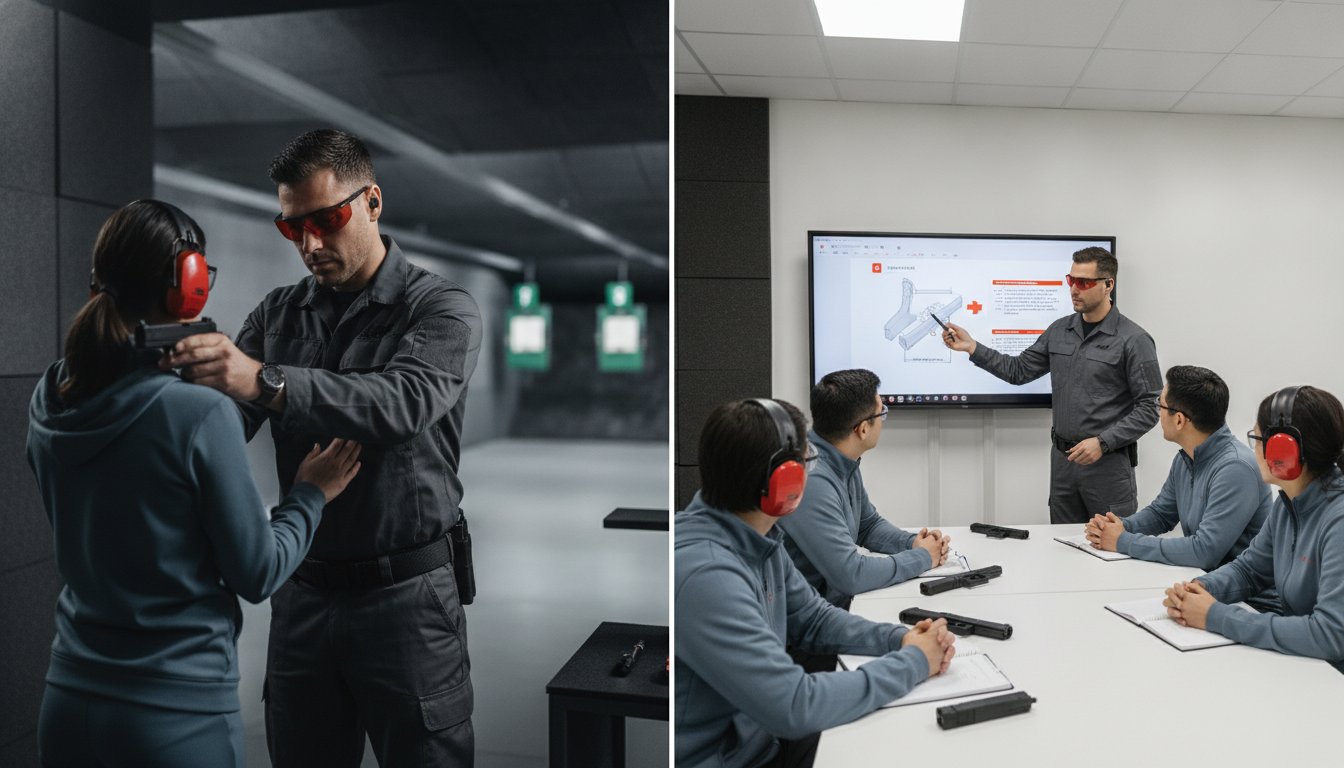
The fulfillment of New York’s 18-hour training mandate is often viewed as a mere administrative hurdle, yet the format you choose determines whether you emerge with a certificate or true tactical competence. Applicants frequently experience a high degree of apprehension regarding the mandated 16 hours of classroom instruction and two hours of live-fire training, particularly when faced with the prospect of large, impersonal group settings. When evaluating private vs group firearm training NY, it's essential to weigh the structured environment of a traditional classroom against the meticulous, one-on-one attention provided by private instruction.
You likely recognize that professional responsibility and public safety require more than just "passing the test" to satisfy local licensing authorities. This article provides a comprehensive comparison of both instructional paths to help you determine which format aligns with your personal safety objectives and the rigorous requirements of the NYSNRA101 course. We will examine the logistical advantages of group certification alongside the proficiency gains offered by individualized coaching to ensure you handle your firearm with absolute confidence in public spaces.
Key Takeaways
- Understand how to satisfy the New York State 18-hour training mandate through either format while ensuring complete adherence to established jurisdictional safety protocols.
- Explore the administrative benefits of group classes, where standardized instruction ensures the delivery of the required NRA basic pistol curriculum in a collaborative learning environment.
- Evaluate the proficiency advantages of private vs group firearm training NY to understand how one-on-one coaching addresses specific mechanical errors, such as grip and stance, in real-time.
- Assess your individual timeline for permit submission in Rockland, Orange, or Westchester County to select the instructional path that best facilitates both skill-building and timely compliance.
Comparing Private and Group Firearm Training in New York
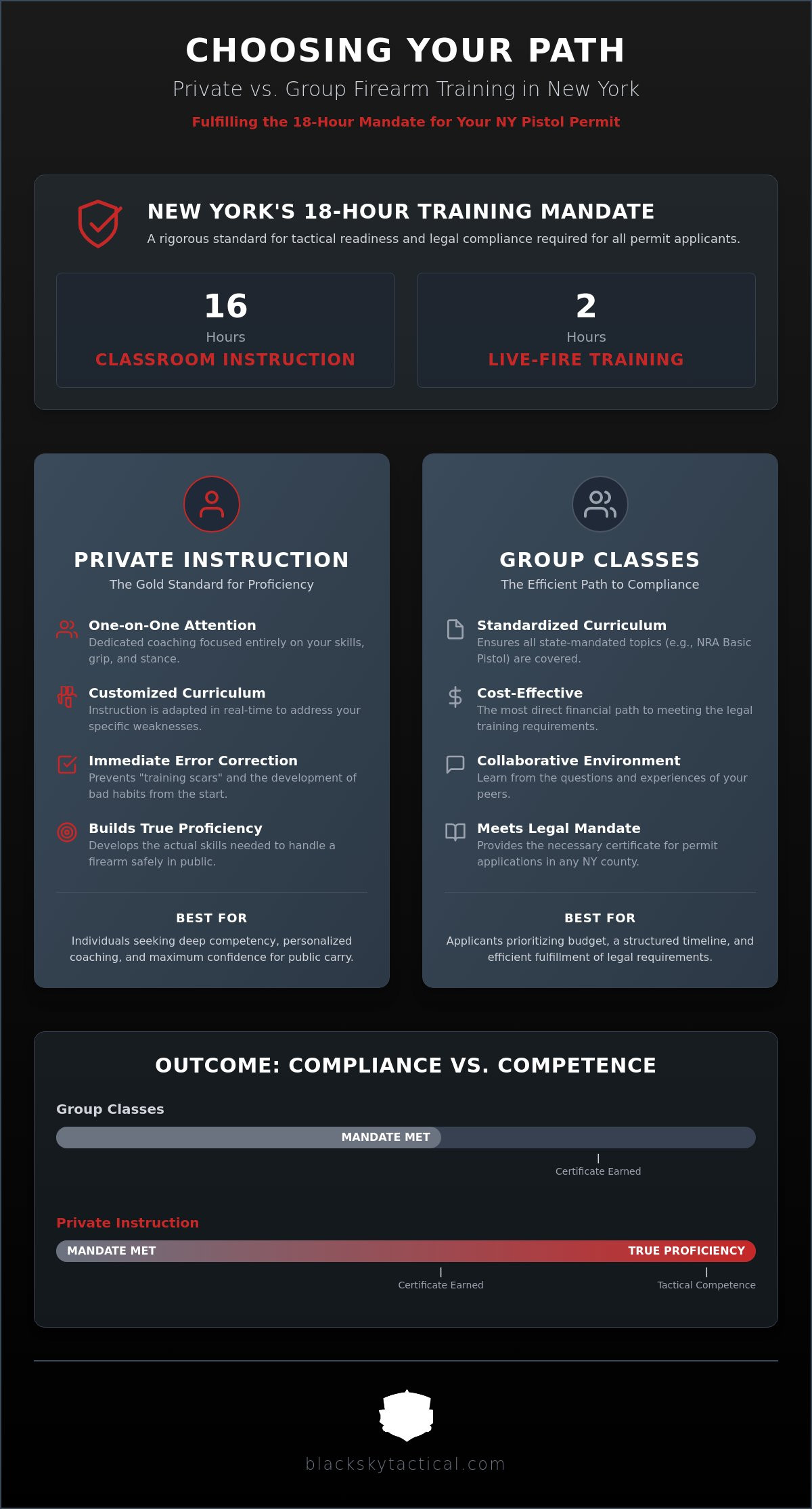
The regulatory environment in New York underwent a significant shift following the enactment of the Concealed Carry Improvement Act. This legislation replaced previous, shorter training standards with a rigorous 18-hour mandate, creating a definitive distinction between basic administrative compliance and actual tactical readiness. When considering private vs group firearm training NY, applicants must determine whether they prioritize the standardized environment of a large class or the intensive, safety-focused supervision of individualized instruction. The NY 18 hour concealed carry course serves as the foundational vehicle for this certification, encompassing 16 hours of classroom learning and 2 hours of live-fire exercises. While both formats satisfy legal requirements, the instructor-to-student ratio significantly impacts the depth of supervision and the reinforcement of fundamental firearm safety principles.
The Structural Differences in Curriculum Delivery
Group classes operate under a fixed, state-mandated syllabus designed to move a high volume of students through the curriculum efficiently. This structure ensures that every participant receives the same information regarding state laws and jurisdictional restrictions. Private instruction offers a flexible alternative where the curriculum is adapted to the student's specific mechanical weaknesses. If a student demonstrates difficulty with holster draws or sight alignment, a private instructor can dedicate the necessary time to correct these issues immediately, rather than adhering to a rigid group schedule.
Cost vs. Value: An Objective Assessment
Group certifications are generally the most direct financial path to meeting New York's legal mandates. The investment covers the essential hours required for permit eligibility. However, the long-term value of private sessions is found in the prevention of "training scars," which are improper techniques or bad habits developed when errors go uncorrected in a crowded setting. While a group class provides the necessary certificate for Rockland, Orange, or Westchester County applications, private sessions build the actual proficiency required to handle a firearm safely in high-stress public environments. For those who appreciate the value of expert coaching in high-adrenaline settings, you might also check out UK Skydiving to see how they prioritize safety and skill.
The Advantages and Limitations of Group Firearm Classes
Group instruction remains the primary method for satisfying the administrative requirements established by the Division of Criminal Justice Services. Safety remains the priority. One significant advantage is the standardization of the educational material. Most accredited providers utilize the NRA basic pistol shooting course, which ensures that every applicant receives the specific safety and mechanical instruction required for certification. Additionally, the social environment facilitates a broader understanding of potential legal scenarios as students hear questions from peers that they might not have considered independently.
When evaluating private vs group firearm training NY, cost-efficiency is a vital consideration for those completing the mandatory 18-hour training period. Efficiency is the goal. Since the law mandates 16 hours of in-person classroom instruction, the group format allows for the efficient delivery of information regarding New York State gun laws and jurisdictional restrictions. However, the primary limitation of this format occurs during the 2-hour live-fire qualification. In a large group, the instructor's attention is distributed across multiple shooters. This can result in less immediate correction of mechanical errors compared to one-on-one sessions. For many applicants, enrolling in a structured NYSNRA101 course provides the most efficient path to fulfilling these state requirements.
When Group Training is the Optimal Choice
Group classes are the preferred route for permit applicants who prioritize meeting state mandates within a structured, predictable timeframe. These sessions offer the unique benefit of observing various firearm platforms and malfunctions, providing a broader educational experience than practicing in isolation. This format is particularly effective for those who learn well through observation and collaborative discussion among fellow residents of Rockland or Orange County.
Navigating the Challenges of Large Class Sizes
Sustaining focus throughout 16 hours of classroom instruction is a professional necessity. Applicants should treat the curriculum as a formal briefing, ensuring they understand the legal consequences of firearm ownership. In a shared range environment, situational awareness and efficient gear organization become even more critical; to prepare your equipment for these sessions, you can discover Tak-tical and their range of precision utility bags. Students must remain vigilant and strictly follow all range safety officer protocols to ensure the safety of the entire group during the live-fire assessment.
Why Private Firearm Instruction is the Gold Standard for Proficiency
While group settings provide the necessary certification hours, private instruction facilitates a superior level of technical mastery through immediate feedback loops. When choosing between private vs group firearm training NY, the primary differentiator is the instructor's ability to correct minute mechanical errors in real-time. This includes precise adjustments to grip, stance, and trigger press that often go unnoticed in a crowded range environment. For many beginners, the presence of a "firing line" in large groups can induce significant performance anxiety. Private sessions mitigate this pressure, allowing the student to focus entirely on the New York State firearm training requirements without the distractions inherent in a public class.
Customized pacing is a critical component of professional development. It ensures that no student is forced to move to the next stage of instruction before they have demonstrated safety and mechanical competence. This tailored approach is particularly beneficial for those with specific goals, such as home defense strategies or specialized Private Firearm Training for family members. By focusing on the individual's aptitude, instructors can build a foundation of calm assurance that is difficult to replicate in a mass-enrollment setting.
Accelerated Skill Development
Expert observation suggests that one hour of dedicated, one-on-one instruction often yields results comparable to four hours of group range time. This efficiency stems from the instructor's capacity to focus exclusively on the specific firearm the student intends to carry for their New York permit. This eliminates the generalized instruction found in group courses and replaces it with a methodical briefing on the maintenance and operation of the student's personal equipment. This commitment to specialized, expert-led training is a universal standard for safety and skill; for a look at how this philosophy is applied in martial arts, you can check out JKA Shotokan Karate Club Dubai.
Addressing the NY Live-Fire Qualification
The 2-hour live-fire component of the state mandate is a high-stakes administrative requirement. Private coaching ensures that students don't just meet the minimum standards but exceed them by building reliable muscle memory. This disciplined preparation is essential for maintaining safety and accuracy during the formal qualification process required by licensing authorities in Rockland, Orange, and Westchester Counties. Similar to how one-on-one firearms instruction accelerates technical skill, many individuals find that they can explore 1-on-1 Personal Training to apply the same principles of dedicated coaching to their physical health and fitness goals.
Choosing the Right Path for Your NY Pistol Permit
Selecting an instructional format is a decision that carries significant legal and personal weight. When weighing private vs group firearm training NY, an applicant should follow a structured decision-making framework. It's necessary to first conduct a thorough self-assessment of existing mechanical proficiency and familiarity with administrative mandates. If physical stability is a concern for your shooting stance, The Orthopaedic & Sports Medicine Institute offers specialized care to help you meet the physical demands of training. If you're a novice, the standardized pace of a large group might not provide the granular feedback required for safe handling. Second, consider your submission timeline. Jurisdictional authorities in Rockland, Orange, and Westchester Counties maintain specific processing windows, making the timing of your training a critical factor in the application lifecycle.
A strategic, hybrid approach involves utilizing initial private sessions to master NRA Basic Pistol fundamentals before enrolling in the mandated 18-hour course. By building foundational muscle memory in a controlled, one-on-one environment, you ensure that your performance during the group live-fire qualification is both safe and accurate. To supplement your training with high-quality tactical gear and practice equipment, you can learn more about Catus-airsoft.eu. This proactive measure reduces the risk of administrative delays caused by a failure to meet proficiency standards during the state-mandated assessment. While group classes represent the most cost-effective method for meeting the 18-hour mandate, private instruction provides the tactical bridge necessary for those who prioritize genuine proficiency over mere certification.
The Black Sky Tactical Approach: Professional Responsibility
Our commitment to legal compliance and meticulous safety standards informs every aspect of our curriculum. The NYSNRA101 course is specifically engineered to integrate essential NRA fundamentals with the rigorous requirements of the New York State 18-hour mandate. We function as a disciplined expert source, ensuring that every student understands the gravity of their responsibilities as a permit holder while meeting all procedural steps necessary for certification.
Next Steps for Rockland and Westchester Residents
Preparing for your permit application requires careful attention to administrative detail. Once you've selected your training path, you should begin gathering the necessary documentation for your local licensing authority. Scheduling your training sessions early is vital, especially when aiming to align with specific county deadlines. Professional preparation is the most reliable way to navigate the complexities of New York's firearm regulations while building the skill set required for public safety; for those looking to understand global benchmarks in professional security education, Insight Security Training offers a perspective on accredited industry standards.
Securing Your Certification and Tactical Proficiency
The final determination between private vs group firearm training NY should be informed by your dedication to achieving both administrative certification and genuine tactical proficiency. While group sessions efficiently satisfy the state’s 18-hour mandate, private coaching provides the specialized attention necessary to eliminate mechanical errors and build lasting confidence. Our certified NRA instructors are committed to maintaining the highest safety standards while serving the specific needs of applicants in Rockland, Orange, and Westchester Counties. This structured approach ensures that you meet all jurisdictional requirements with meticulous attention to detail.
Successful permit acquisition is merely the first step in a lifelong commitment to professional responsibility and public safety. By integrating the rigorous NYS and NJS 18-hour course compliance with individualized skill-building, you ensure that you're prepared for the high-stakes nature of firearm ownership. We encourage you to view our upcoming NYS 18-Hour CCW and Private Training schedules to secure your place in a program that values accuracy and integrity. You have the capacity to meet these rigorous state standards through disciplined study and expert instruction.
Frequently Asked Questions
Is private firearm training required for a NY pistol permit?
No, private instruction is not a statutory requirement for obtaining a concealed carry permit in New York. The legal mandate, established by the Concealed Carry Improvement Act, requires the successful completion of a standardized 18-hour safety course consisting of 16 hours of classroom learning and 2 hours of live-fire training. While private sessions aren't mandated by law, many applicants utilize them to supplement their learning and ensure they possess the necessary mechanical proficiency before attempting the formal live-fire qualification.
How many students are typically in a Black Sky Tactical group CCW class?
Our group NYSNRA101 sessions are structured to maintain a professional learning environment that facilitates both administrative compliance and safety. We prioritize an instructor-to-student ratio that ensures every participant receives adequate supervision, particularly during the critical live-fire component of the course. This structured approach allows for the efficient delivery of the state-mandated curriculum while maintaining the strict safety standards required for residents in Rockland, Orange, and Westchester Counties.
Can I use my own firearm for private instruction in New York?
In New York State, the legal possession of a handgun generally requires a valid pistol permit issued by the appropriate jurisdictional authority. Consequently, applicants who don't yet possess a permit must utilize firearms provided by the instructor during their training sessions to remain in compliance with state law. For individuals who already hold a permit and are seeking recertification or advanced skill-building, using a personal firearm is permitted and encouraged to foster familiarity with their specific equipment.
What is the "live-fire qualification" in the NY 18-hour course?
The live-fire qualification is a mandatory two-hour component of the 18-hour training requirement where students must demonstrate safe handling and marksmanship. This assessment is conducted under the direct supervision of a certified instructor and requires the student to successfully complete a standardized shooting course of fire. It serves as the formal practical evaluation of a student’s ability to apply the safety principles and mechanical skills discussed during the 16 hours of classroom instruction.
Does private training count toward the mandatory 18-hour NYS requirement?
Private instruction can fulfill the 18-hour requirement provided the training adheres strictly to the state-mandated syllabus and is conducted by an authorized instructor. When evaluating private vs group firearm training NY, many students find that a private format allows for a more focused delivery of the 16 hours of classroom material and 2 hours of live-fire practice. This path ensures the training is tailored to the individual's proficiency level while remaining in full compliance with New York’s rigorous administrative standards.


